
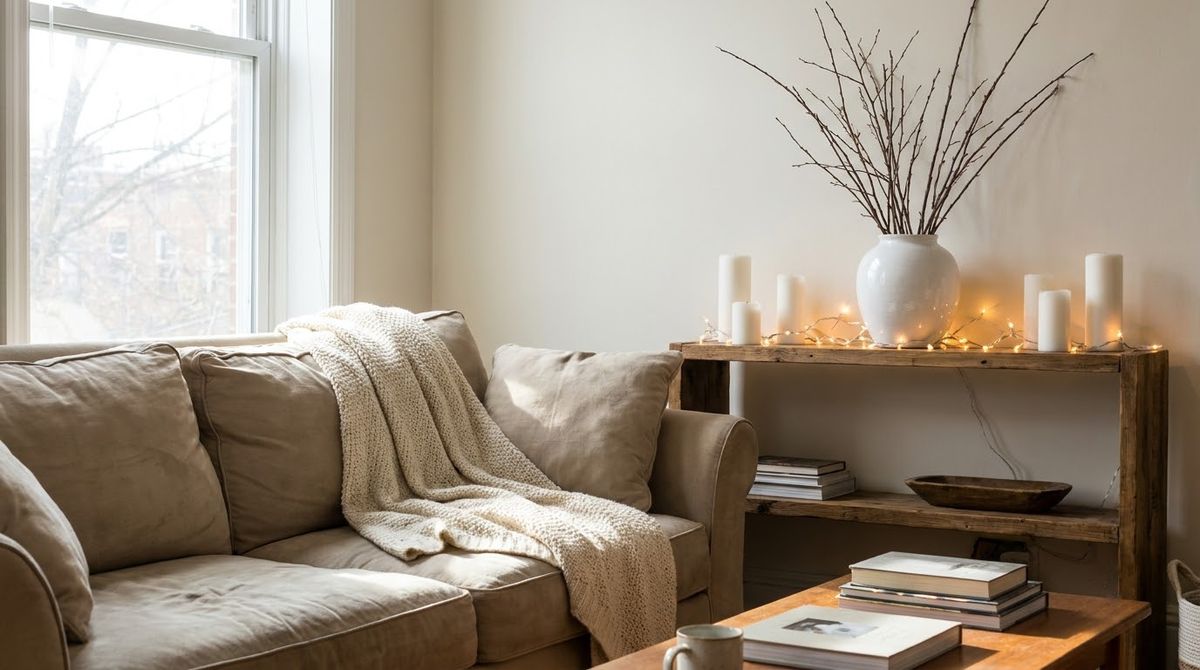
You can turn a home from Christmas to winter decor for about $46 to $294 by swapping red and green for white, wood and greenery, then adding warm light, heavy textiles and a draft fix. This guide covers the palettes, lighting, textures and three priced plans.
Key Takeaways
- Winter decor is the January to March look: neutral colors, evergreen and bare-branch shapes, warm light and heavy textiles, with nothing tied to Christmas.
- Warm white light, rated about 2700K to 3000K, does more for a winter room than any object.
- Closing curtains at night helps trap heat, and windows account for about 30% of a home’s heating energy loss, per the U.S. Department of Energy.
- Paperwhite bulbs take about 3 weeks to root and 3 to 4 more to bloom, so start them in early January for February flowers.
- Three Target-priced plans run about $46, $144 and $294.
What Counts as Winter Decor (And When to Switch)
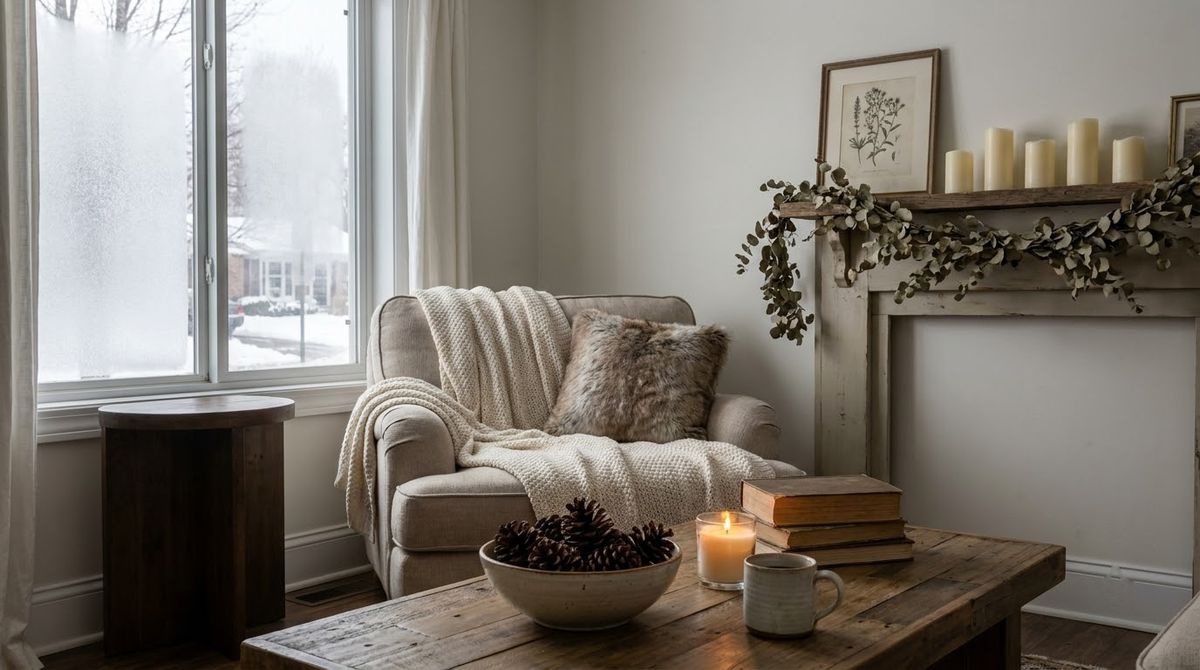
Winter decor is what stays after Christmas: neutral colors, evergreen and bare-branch shapes, warm light and heavy textiles. It leaves out red-and-green palettes, ornaments, stockings and anything that says December 25.
Most of what makes a room feel wintry is already in a home after the holidays. The job is to remove the Christmas signals and keep the cozy ones.
Here is a simple sort for the first week of January:
| Keep out | Swap or store | Why |
|---|---|---|
| Warm white string lights | Colored or blinking strands | Warm light is a winter staple |
| Plain pillar candles | Red and green candles | Neutral wax suits any month |
| Plain evergreen and cedar stems | Berry, ribbon or glitter picks | Greenery reads as nature, not holiday |
| Wool and knit throws | Plaid reds and Santa prints | Texture stays, motifs go |
| White ceramic and wood | Ornaments, stockings, tree skirt | Store the symbols |
Our cozy bedroom ideas guide shows how the same textiles carry into the bedroom once the holiday items are boxed.
Sorting first also tells you what to buy. Most homes need less than the budget plans below suggest.
A good order for a weekend takedown:
-
Tree and ornaments first. They are the largest and most obviously Christmas.
-
Wreaths and garlands with red, berries or bows. Strip the picks and keep the greenery if it is in good shape.
-
Stockings and tabletop figures. Wrap breakables in the textiles you are about to keep.
-
Seasonal pillows and throws. Swap them for neutral knits.
-
Last: the lights. Keep warm white strands up and unplug anything colored.
Do the rooms in the same order each year and the job takes hours, not days.
Winter Color Palettes That Are Not Red and Green
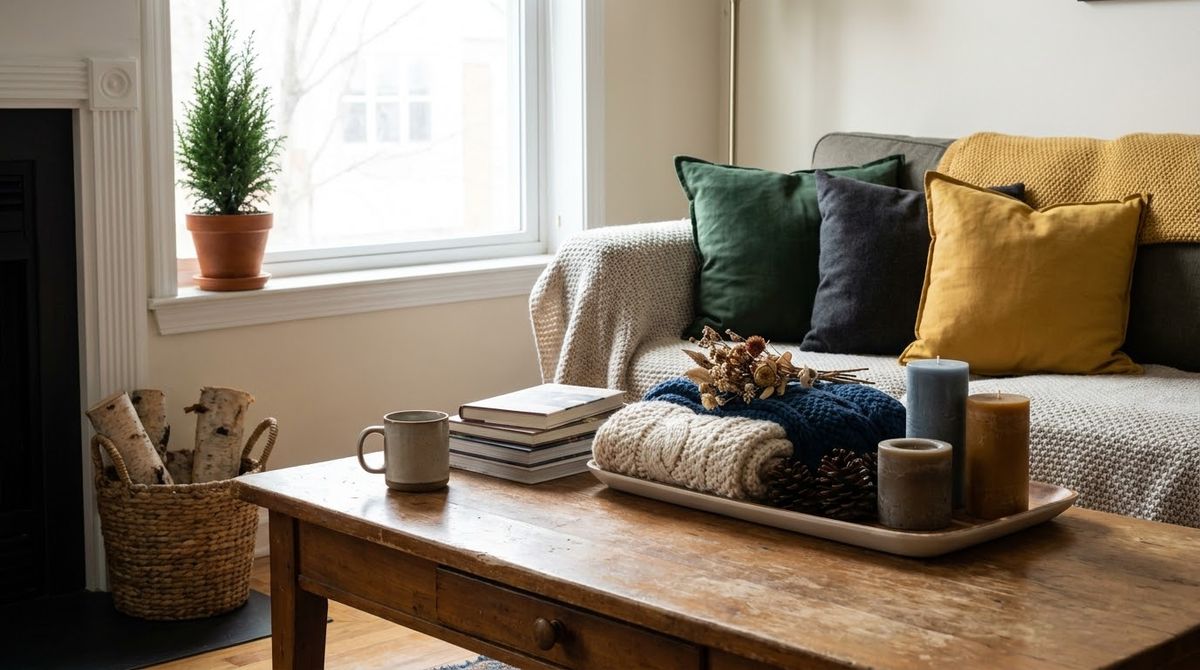
The easiest winter palettes are cool or neutral: snow and oak, evergreen and cream, or charcoal and brass. Each one uses two or three colors, which keeps the room calm when daylight is low.
Here are three palettes built from items on shelves at Target and IKEA in October 2026.
| Palette | Base | Accent | Sample pieces |
|---|---|---|---|
| Snow and oak | White and cream | Light wood | Textured white ceramic vase, 7.75 in, $20; 3 x 6 in LED pillar candle, $5; plush 50 x 70 in throw, $15 |
| Evergreen and cream | Cream | Deep green | 40 in magnolia leaf branch, $15; olive stems, $10; IKEA GURLI cushion cover in unbleached cotton, $4.99 |
| Charcoal and brass | Gray and black | Brass | Set of 3 gold taper holders, $25; 12-pack white tapers, $7; curved black metal floor basket, $35 |
Pick one palette and repeat it in three places: a textile, a surface object and a light source. A palette with three repeats looks planned. A palette with one repeat looks accidental.
Winter also suits slightly darker tones than summer does. Charcoal, olive and chocolate absorb light, so use them in the pieces you want to recede and keep white for what you want to notice.
A simple split keeps it tidy: roughly 60% of the room in the base neutral, 30% in a second color and 10% in the accent. A cream sofa, oak table and one green branch follow that split without effort.
Warm Lighting and Candles
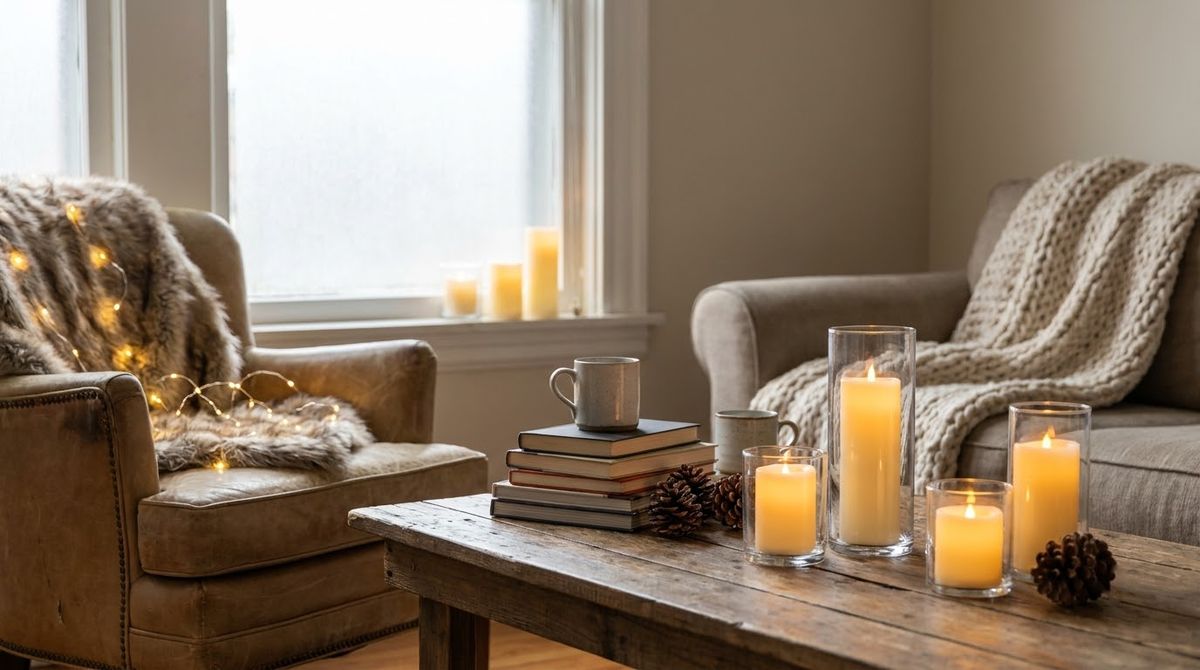
Warm white light is the single biggest upgrade for a winter room. Look for bulbs rated 2700K to 3000K, and add small low sources such as string lights and candles.
Bright overhead lighting flattens a room in the evening. Lamps at table height, lights at shelf level and candles on the coffee table spread several soft pools of light instead.
Think in three layers. Ambient light fills the room, so use a ceiling fixture on a dimmer or a pair of lamps. Task light sits where you read or cook. Accent light is the small stuff: string lights, candles and a picture light. Winter evenings need the third layer most.
Prices at Target are low for the small sources:
- 50-count warm white micro lights on batteries (Wondershop): $7
- 200 LED warm white lights, 66 ft, USB powered (Twinkle Star): $16.49
- 50 LED warm white fairy lights, 19 ft, with timer (Kurt Adler): $14.17
- LED pillar candle, 3 x 4 inch (Room Essentials): $3; 3 x 6 inch: $5
- 6-pack black flameless LED tapers with remote and timer: $23.99 (regular $65)
Use string lights in a clear jar, along a bookshelf or draped over a mirror. A timer turns them on at dusk so the room is already warm when you get home.
Candle safety
The NFPA’s candle safety page advises keeping candles at least 12 inches from anything that can burn. It also says over half of candle fires began when decor or furniture sat too close to the flame.
In winter, that means the throw on the arm of the sofa and the curtains by the window. Use flameless candles near textiles and keep wax candles on a tray in the middle of the table.
Throws, Pillows and Rugs: Layer Three Textures
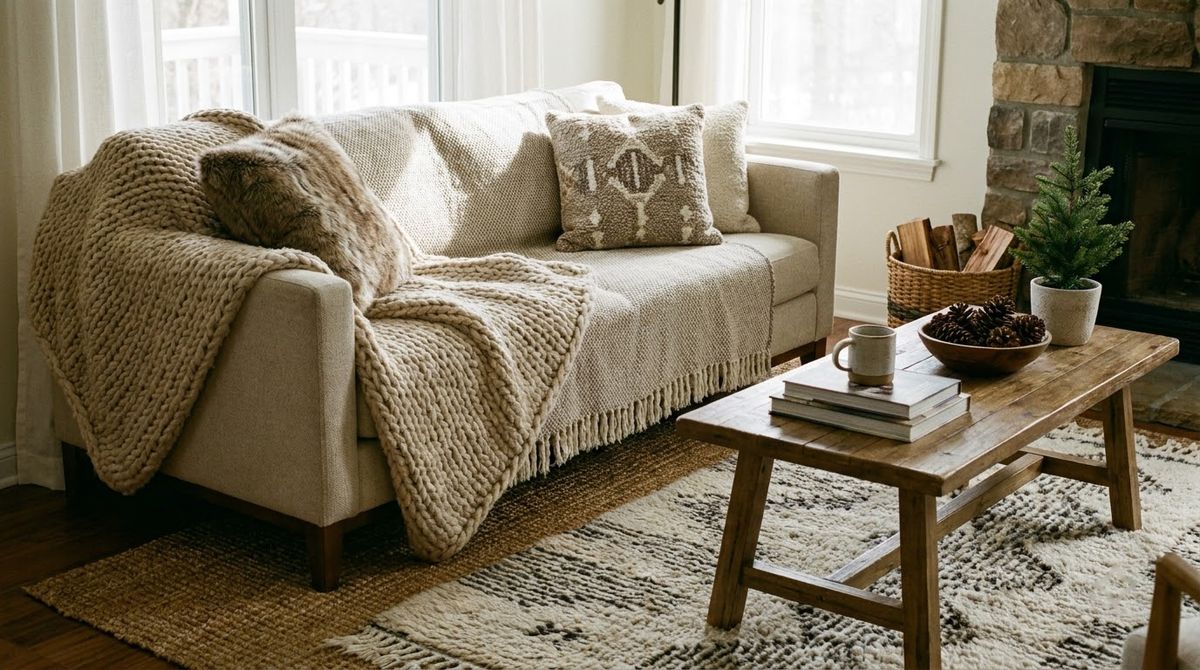
Layer a chunky knit throw, a velvet or bouclé pillow and a shaggy rug. Three different textures in one palette read as cozy because the eye finds variety without finding clutter.
Textiles are also where a small budget goes furthest. A $15 throw changes a sofa more than a $15 candle does.
| Item | Price | Notes |
|---|---|---|
| 50 x 70 in oversized Primalush throw (Threshold) | $15 | Plush, low cost |
| Chenille throw with faux shearling reverse (Threshold) | $20 | Two textures in one |
| 50 x 60 in cable knit throw (Hearth & Hand) | $44.99 | Heavier knit |
| 20 x 20 in cotton velvet pillow (Threshold) | $25 | Reads dark and rich |
| 18 x 18 in Fair Isle knit pillow, khaki (Threshold) | $25 | Pattern without red and green |
| GURLI cover, 20 x 20 in, unbleached cotton (IKEA) | $4.99 | Insert sold separately at $9 |
| 5 x 7 ft speckled shag rug (Threshold, clearance) | $42.50 | Regular price $50 |
| 3 ft round faux fur sheepskin rug (Home Mart Goods) | $29.99 | Layer over a flat rug |
IKEA’s GURLI cover is 100% cotton and fits a 20 x 20 inch insert, so a cover plus insert costs $13.99. Swap the cover by season and keep the insert.
For rug size and placement, our what size rug for living room guide has the exact numbers. For more on the textile layers, layering warmth in Scandinavian decor covers sheepskin, candles and wool.
Seal Drafts and Dress the Windows
Closing curtains at night helps trap heat in a room, and sealing air leaks keeps cold air out. These are the cheapest changes you can make to a winter room, and they also change how it looks.
The U.S. Department of Energy’s winter energy tips say closing curtains and drapes at night can help trap heat inside, and that about 30% of a home’s heating energy is lost through windows. It lists weatherstripping and caulking as low-cost ways to reduce air leaks.
Floor-length curtains in a heavy fabric are the best-looking fix. They are also the most expensive, so start with the leak points:
- Door draft stopper. Under-door stoppers at Target run from $11.99 on sale to $24 for a 36 inch fabric version.
- Foam seal tape. A 20 ft roll of self-stick foam insulation tape is $9.31 on sale.
- Window insulator film. A 3M kit covering five 3 x 5 foot windows was listed at $19.99 on Walmart in a search snippet. Check the label for the window count before you buy.
Window film and foam tape are common renter choices. Read the label before sticking anything to a painted frame.
If you run a space heater, keep it at least 3 feet from curtains, bedding and furniture, plug it directly into a wall outlet and turn it off when you leave the room or sleep.
Greenery and Branches Without the Holiday Look
Greenery reads as winter instead of Christmas when it has no berries, ribbon or glitter. Use eucalyptus, olive, magnolia leaf or plain cedar in a simple vase or on a shelf.
Bare branches are the second option. A few tall branches in a white ceramic vase give height and a graphic shape, and they cost less than most flowers.
Target prices for greenery in October 2026:
- 40 in magnolia leaf branch (Threshold): $15
- Olive branch (Threshold): $15; artificial olive stem leaf sprays: $10
- 36 in mixed greens stem (Hearth & Hand): $10.99
- 3-pack of 25 in banyan leaf stems (Hearth & Hand): $16.99
- Cedar branch (Hearth & Hand): $16.99
For vases, Target lists a 6 inch beaded ceramic bud vase in ivory at $15, a white textured bud vase at $10, and a 7.75 inch white textured round vase at $20.
Cluster in odd numbers. Three stems in one vase look fuller than three vases with one stem each. Keep stems about one and a half times the height of the vase for balance.
Plain pine or cedar stems with no red are the safest bridge from Christmas to winter. Take off any berry picks and tuck them away.
To keep faux stems looking fresh, bend each leaf or needle out from the stem so it fans, then trim wires with scissors to fit the vase. Mix two kinds of green with different leaf sizes, such as olive and magnolia, so the arrangement has contrast.
Paperwhites, Citrus and Winter Houseplants
Forced paperwhite bulbs give you living flowers in February and cost under $2 each. They take about 3 weeks to root and bloom 3 to 4 weeks after that, per the Almanac’s paperwhite guide.
To grow them, set the bulbs on pebbles or in potting mix with the top third exposed, and add water to just below the base of the bulbs. Start in a cool, dark spot of 50 to 60 degrees F until roots form, then move them to bright light.
Home Depot listed a 10-bulb pack of Ziva paperwhites at $17.74 in a search snippet, though stock varied by store. Start in early January for February blooms, or in mid-January for early March.
The Almanac also notes that low light makes plants leggy. Turning the pot every few days and staking tall stems keeps them upright.
Houseplants need less in winter. The University of Illinois Extension winter houseplant advice says to water less often and keep soil on the dry side, though plants should never wilt. It also says to skip fertilizer while plants are dormant.
To raise humidity around plants, group them together or set the pots on a tray of gravel. For plant picks that tolerate dim rooms, see our low-light indoor plants list.
Citrus is an easy accent. A bowl of oranges or clementines adds color and scent for the price of groceries.
Mantels, Shelves and the Entry in Winter Mode
Style a winter surface in groups of three: one tall item, one medium item and one low item. Leave empty space around the group so it can be seen, and vary the shapes: a round pot beside a tall stem beside a flat tray.
Here are three simple winter groups:
- Snow group. A white ceramic vase with bare branches, a white pillar candle and a small stack of books.
- Evergreen group. A 36 inch mixed greens stem in a tall vase, a hurricane glass with a pillar and a ceramic bowl.
- Brass group. Three gold tapers in holders of 12, 9 and 6 inches, with a tray underneath.
Target sells a clear glass cloche pillar holder 8.8 inches tall for $10 and a ribbed glass hurricane 11 inches tall for $20. A bronze fireside lantern, 8.5 inches tall, is $34.19.
On the entry table, add a tray for keys, a small lamp and a bowl for hats and gloves. Winter entries collect gear, so give it a home.
For the formulas on stacking and spacing, see our coffee table decor ideas. For hygge-style comfort throughout the home, 30 Scandinavian living room ideas shows how the pieces come together.
Bedroom and Cozy Corner Ideas for Winter
A winter bedroom needs warm bedding, a rug underfoot and a low lamp. A corner chair with a throw and a lamp turns any spare space into a reading nook.
Flannel sheets are the quickest change. Target lists Threshold ultra soft flannel sheet sets at $35 to $65 depending on bed size, and Intelligent Design printed cotton flannel sets at $21.49 to $47.99.
Add a rug beside the bed so your feet land on something soft. A 2 x 3 ft faux fur rug from Home Mart Goods is $14.99 in gray at Target.
For a corner chair, use a floor lamp with a warm bulb, a basket for blankets and a small side table. A curved black metal floor basket from Threshold is $35 and holds three or four throws.
Bedding layers work like living room textiles. Put a flannel or cotton sheet down first, then a duvet, then a throw folded across the foot of the bed. Two pillows in a velvet or knit cover add texture without extra cost, and the GURLI covers at $4.99 are an easy way to try a new color.
Keep the nightstand simple: a lamp with a warm bulb, a book and a glass of water. Flameless candles are the safer choice in a bedroom, where fabric is always within reach.
The aim is to make a room you want to stay in when it gets dark early Our Scandinavian decor guide and hygge vs lagom vs Nordic minimalism explain the comfort-first approach that suits this season.
Three Winter Refresh Plans: $46, $144 and $294
Three plans cover a quick refresh at about $46, a fuller living room at about $144, and a complete winter setup at about $294. All prices were seen on Target and IKEA pages in October 2026.
| Item | Plan 1: about $46 | Plan 2: about $144 | Plan 3: about $294 |
|---|---|---|---|
| Throw | 50 x 70 in Primalush, $15 | Plan 1 plus chenille shearling-reverse throw, $20 | Plus 50 x 60 in cable knit throw, $44.99 |
| Light | 2 LED pillars $10; 50-count warm lights $7 | Same as Plan 1 | Same as Plan 1 |
| Pillow | 1 GURLI cover, $4.99 | Same as Plan 1 | Plus 2 Fair Isle knit pillows, $50 |
| Greenery | None | 2 magnolia leaf branches, $30 | Same as Plan 2 |
| Vase and candle | None | White textured vase $20; cloche pillar holder $10 | Same as Plan 2 |
| Paperwhites | None | 10 bulbs, $17.74 | Same as Plan 2 |
| Draft fix | Foam seal tape, $9.31 | Same as Plan 1 | Plus door draft stopper, $11.99 |
| Rug | None | None | 5 x 7 ft speckled shag, $42.50 |
| Approx. total | $46 | $144 | $294 |
Plan 1 changes the feel of one room at the lowest cost. Plan 2 adds greenery and living flowers. Plan 3 adds a rug and heavier textiles.
The GURLI cover assumes you own a 20 x 20 inch insert. If you do not, add $9.
Frequently Asked Questions
What is the difference between winter decor and Christmas decor?
Winter decor is neutral, natural and lasts from January to March. It uses white, wood, greenery, warm light and knit textiles. Christmas decor uses red and green palettes, ornaments, stockings and holiday motifs. Anything you can leave out in February without it looking like leftover Christmas counts as winter decor.
When should I take down Christmas decorations and switch to winter decor?
Most people take Christmas down in the first week or two of January. Keep warm string lights, plain candles, white ceramics and plain evergreen stems, and store ornaments, stockings and red-and-green items. The switch takes an afternoon if you sort first.
How do I decorate for winter on a budget?
Start with warm light and textiles. A 50-count warm string light is $7, an LED pillar candle is $3 to $5 and a plush throw is $15 at Target. A budget refresh of about $46 changes a living room more than buying new objects.
What can I put out after Christmas that is not holiday decor?
Bare branches in a white vase, plain evergreen or eucalyptus stems, white pillar candles, forced paperwhite bulbs, a bowl of citrus, knit throws and a faux sheepskin rug. All of these read as winter and need no storage when spring arrives.
How do I make my home feel warmer in winter?
Use warm white bulbs rated about 2700K to 3000K, close heavy curtains at night, seal drafts with foam tape or a door stopper, and layer a throw, pillow and rug. The Department of Energy says windows account for about 30% of heating energy loss.
Winter Is Long, So Decorate for It
Winter runs from January to March, so a room that feels good in February is worth more than one that looks good for a week in December. Start with light and textiles, fix the draft, and add a plant that blooms.
Prices checked October 2026. Retailer prices change often, so confirm on the product page before you buy.