
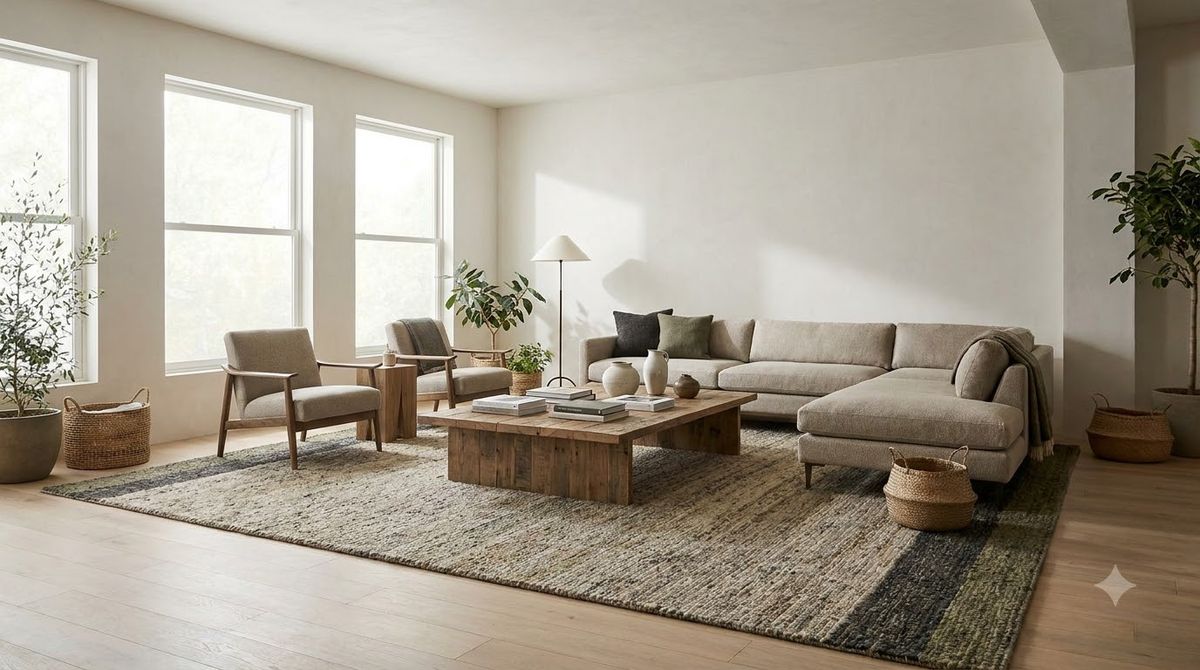
For most living rooms, an 8×10 rug is the right size, and it’s the single most common living room rug we recommend. The rule that fixes the biggest mistake, a rug that’s too small, is simple: get at least the front legs of every seat onto the rug, keep the rug 6 to 8 inches wider than your sofa, and leave 10 to 18 inches of bare floor between the rug edge and the walls. Below is every layout with the exact size, plus a full room-size reference table.
Check your own room: our free rug size calculator picks the right size for your sofa, bed or dining table.
Key Takeaways
- Most common living room size: an 8×10 rug fits the majority of standard rooms
- The leg rule: get at least the front legs of every seat onto the rug (all legs is best)
- Sofa overhang: the rug should be 6 to 8 inches wider than your sofa on each side
- Floor border: leave 10 to 18 inches of bare floor between the rug and the walls
- Small rooms under 10 feet wide: a 5×8 rug works only for the front-legs-on layout
- Large or open rooms: step up to a 9×12 so all four legs sit on the rug
What Is the Rule for Living Room Rug Size?
The core rule is that a living room rug should sit under at least the front legs of every piece of seating, with the rug running 6 to 8 inches wider than the sofa on each side. The most common mistake is a rug that is too small and floats like a bath mat in the middle. Bigger almost always reads better.
There are three accepted layouts, and the size you buy depends on which one you use.
The three rug layouts:
- All legs on: every leg of the sofa and chairs sits on the rug. The most luxurious look. Needs the largest rug.
- Front legs on: only the front legs of each seat touch the rug. The most common renter-friendly choice. Saves money and space.
- Floating (all legs off): nothing sits on the rug. Only works with a very large rug in an open room. Skip this in small spaces.
The second rule is the floor border. Leave 10 to 18 inches of bare floor showing between the rug’s edge and the walls, so the rug frames the room instead of wall-to-wall carpeting it. In a tight room, 8 inches is the minimum before it starts to look like broadloom.
Citation capsule: A living room rug should extend under at least the front legs of every seat and run 6 to 8 inches wider than the sofa, while leaving 10 to 18 inches of bare floor between the rug edge and the walls to frame the space.
What Size Rug Fits a Standard Living Room?
For a standard living room around 12 by 15 feet, an 8×10 rug is the right call, and it’s why 8×10 is the best-selling living room size at retailers like IKEA and Wayfair. That size clears room for a three-seat sofa, a coffee table, and two accent chairs with front legs on the rug, while still leaving a clean 12-to-18-inch border of floor.
Take a 12×15 rental living room as an example. A 5×8 leaves the sofa’s front legs barely touching and looks marooned. A 6×9 is better but tight. The 8×10 anchors everything and makes the room feel larger, not smaller, which surprises people who assume a big rug shrinks a space.
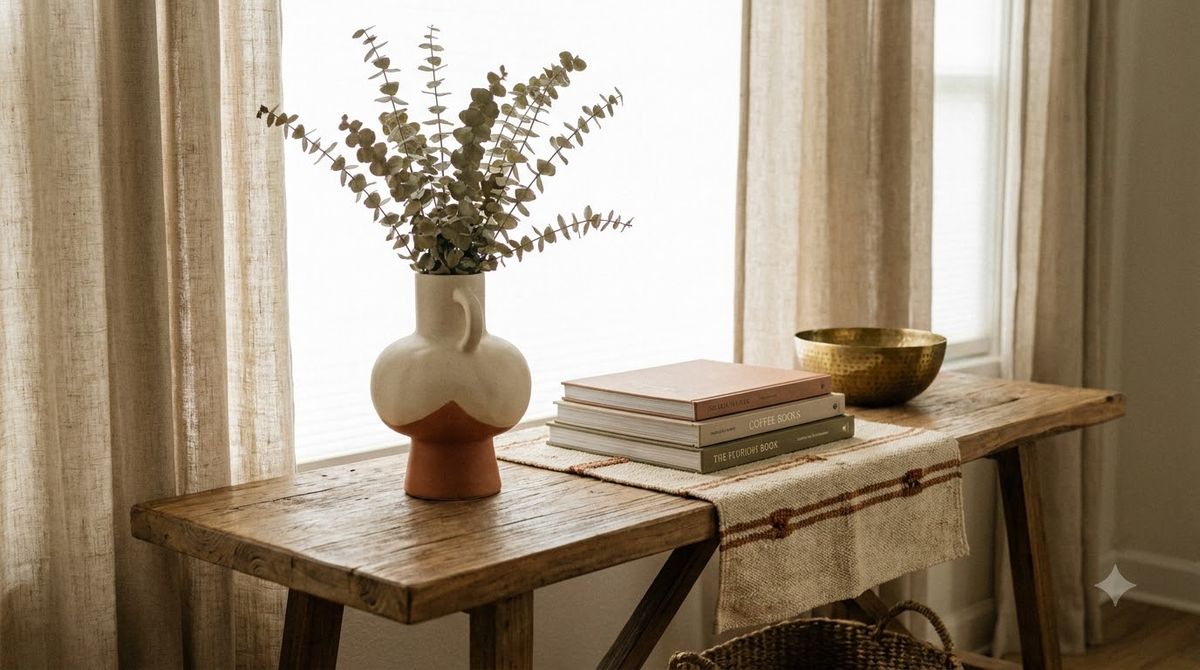
Here’s the quick sizing logic we use before buying anything:
-
Measure your seating zone, not the whole room. Include the sofa, chairs, and coffee table.
-
Add 6 to 8 inches past each side of the sofa for the width.
-
Add 8 to 12 inches past the front of the seating for the length.
-
Round up to the nearest standard size (5×8, 8×10, 9×12).
What Size Rug for a Small Living Room?
For a small living room, roughly under 10 feet wide, a 5×8 rug is usually the ceiling, and it only works with the front-legs-on layout. At this size the rug slips under the front legs of a loveseat or 72-inch sofa and stops there, defining the seating without eating the whole floor. A 5×8 from Ruggable or Amazon runs about $80 to $200.
The honest limit: a 5×8 is genuinely too small if you want all four sofa legs on it, or if you have a full three-seat sofa plus chairs. In apartments where the sofa is under 72 inches wide, though, a 5×8 looks intentional. We size these all the time for a first apartment checklist build-out, where budget and floor space are both tight. The same front-legs-on trick scales down for a bedroom seating nook in our cozy bedroom ideas guide.
If your small room is closer to 10 by 12 feet, jump to a 6×9. It’s the in-between size that saves a room too big for a 5×8 but too small for an 8×10.
What Size Rug for a Large or Open-Plan Living Room?
In a large or open-plan living room, go 9×12 or larger so you can pull all four legs of the sofa and chairs fully onto the rug. Open-concept spaces need the rug to do a second job: it visually carves the seating area out of the larger room, telling the eye where the living zone ends and the dining or walkway begins (Apartment Therapy, 2025).
For rooms wider than 15 feet, a 10×14 or 12×15 rug keeps proportions right. The mistake in big rooms is buying an 8×10 out of habit and watching it look like a postage stamp. A 9×12 wool-blend from Wayfair sits around $300 to $600, and it’s the size that makes a great room feel grounded instead of echoey.
Citation capsule: In open-plan living rooms, a 9×12 rug or larger lets all furniture legs rest fully on the rug, which visually defines the seating zone and separates it from adjacent dining or walkway areas in the same open space.
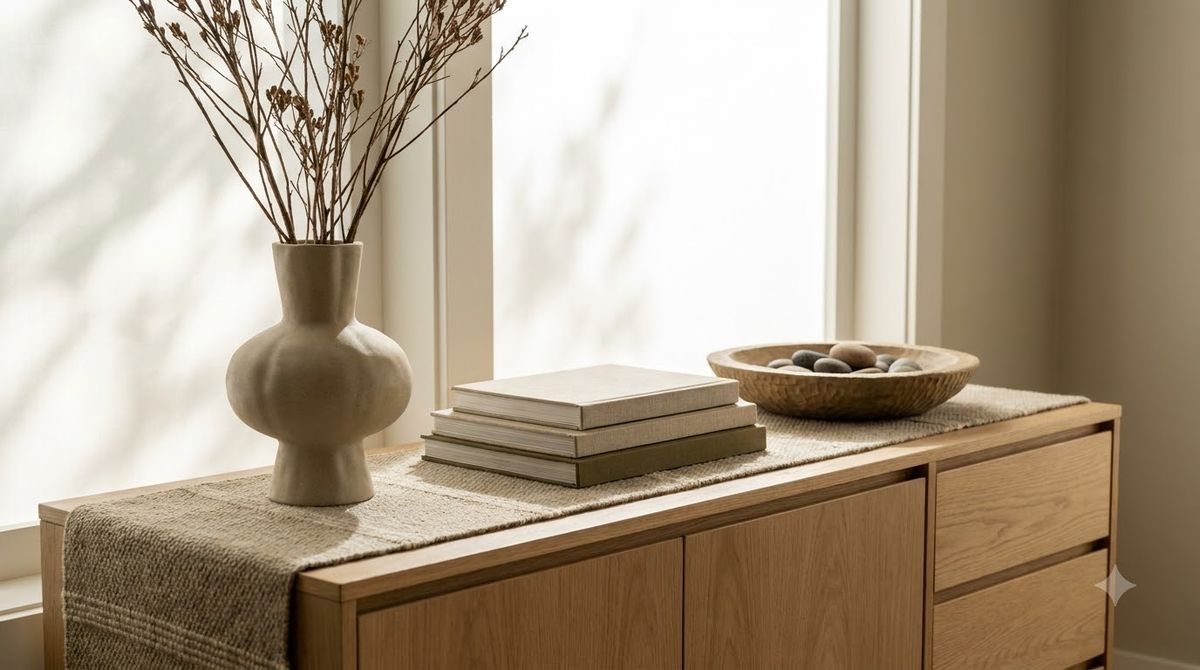
The Full Living Room Rug Size Reference Table
Every scenario condenses into one table you can shop by. Match your room dimensions and sofa to the recommended rug size, then confirm the layout it supports.
| Room size | Sofa width | Best rug size | Layout it supports |
|---|---|---|---|
| Under 10 ft wide | Loveseat / under 72″ | 5×8 | Front legs on only |
| 10 x 12 ft | 72-84″ | 6×9 | Front legs on, tight all-legs |
| 12 x 15 ft (standard) | 84-90″ | 8×10 | Front legs on; all legs for a smaller set |
| 13 x 18 ft | 90-96″ | 9×12 | All legs on |
| 15 x 20 ft+ (open plan) | Sectional / 96″+ | 10×14 or 12×15 | All legs on, defines the zone |
| Narrow / galley | Any | Runner + area combo | Zone-based layering |
A quick cross-check on any size: the rug should be 6 to 8 inches wider than the sofa per side, and leave 10 to 18 inches of floor to the walls. If your chosen size breaks either rule, size up.
What most guides miss: Going one size up rarely doubles the price. Moving from an 8×10 to a 9×12 usually adds only about 20 to 40 percent to the cost, yet a rug that’s too small is the one mistake you can’t fix without rebuying the whole thing. When you’re stuck between two sizes, buy the larger one.
Should You Layer Rugs or Use a Rug Pad?
If your rug is one size too small, layering it over a larger jute or sisal base is the cheap fix, and it’s why layered rugs stayed one of the most-saved living room looks on Pinterest through 2025 (Architectural Digest, 2025). Put a natural-fiber 8×10 down first, then center a smaller patterned or wool rug on top. The base does the sizing job; the top rug adds texture.
Always add a rug pad, whatever the size. A grippy pad stops slides on hardwood, adds cushion, and makes a thin rug feel far more expensive. We buy the felt-and-rubber kind cut about 1 inch smaller than the rug on every side, usually $20 to $40 for an 8×10. It’s the least glamorous thing on this list and the one we never skip.
What most guides miss: You can absolutely put an area rug over wall-to-wall carpet. It just has to be big enough to sit under your furniture legs and low-pile enough to lie flat. Use a rug-on-carpet gripper pad, the thin mesh kind rather than felt, so the top rug doesn’t creep, bunch, or curl at the corners over the plush carpet underneath.
Layering also lets a washable Ruggable top-rug ride over a plush base, which is how we keep a light rug alive in a room with pets. For more ground-level styling once the rug is down, see our coffee table decor ideas and how the palette ties into what colors go with sage green. A runner from the same collection can carry the look through to your entryway decor ideas or fill the blank space above with our empty wall ideas.
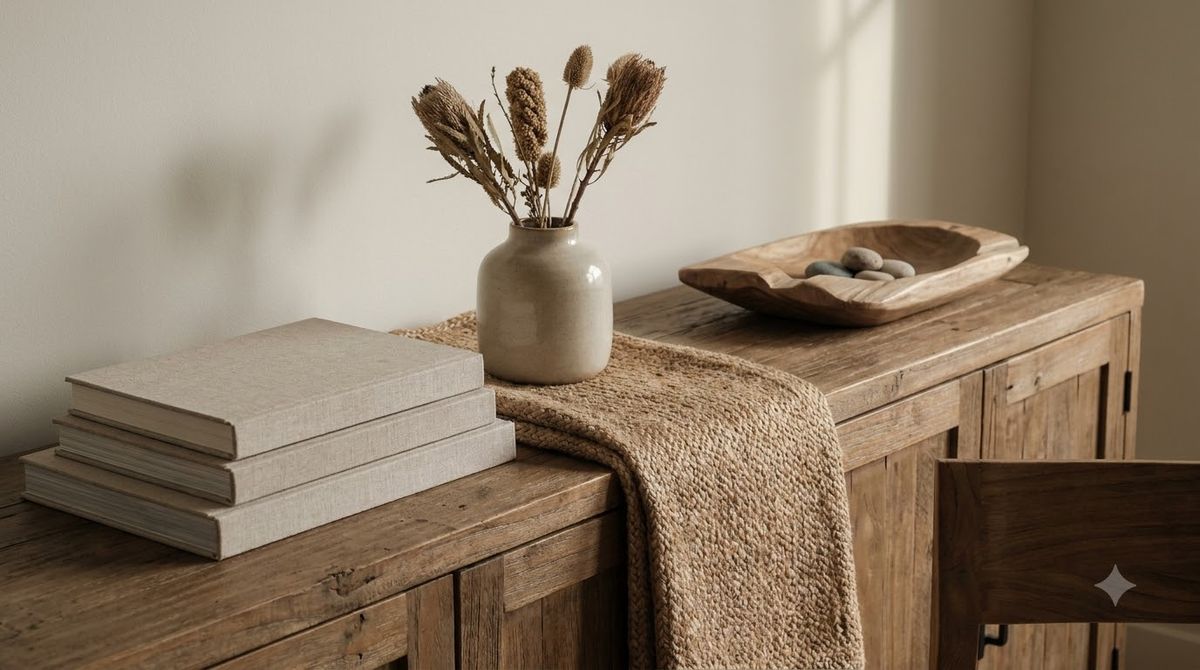
Frequently Asked Questions
What size rug for a living room?
An 8×10 rug fits most standard living rooms and is the single most common size we recommend. The rule: keep at least the front legs of every seat on the rug, size it 6 to 8 inches wider than your sofa per side, and leave 10 to 18 inches of bare floor to the walls. Small rooms use a 5×8; open rooms use a 9×12.
Should a rug go under the couch?
Yes, a rug should go under the couch, at minimum under the front legs. The best look pulls all four sofa legs onto the rug, but front-legs-on is the practical standard for most rooms and rug budgets. A rug that stops short of the couch entirely looks too small and disconnects the seating from the room.
How much floor should show around a rug?
Leave 10 to 18 inches of bare floor between the rug edge and the walls in a standard room. This border frames the space so the rug reads intentional, not like wall-to-wall carpet. In small living rooms, 8 inches is the absolute minimum before the rug starts to look like broadloom instead of an area rug.
Is a 5×8 rug too small for a living room?
A 5×8 is too small if you want all four sofa legs on it or you have a full three-seat sofa plus chairs. It works well for small rooms under 10 feet wide with a loveseat or a sofa under 72 inches, using the front-legs-on layout. For rooms around 12×15, an 8×10 is the safer size.
What size rug for a sectional?
For a sectional, size the rug so the front legs of the entire sectional sit on it, which usually means a 9×12 or larger. Measure the full footprint of the sectional, add 6 to 8 inches of overhang on the open sides, and leave a border to the walls. Most L-shaped sectionals need at least a 9×12; large U-shapes need a 10×14.
Can you put an area rug over carpet?
Yes. An area rug over wall-to-wall carpet works as long as it’s large enough to sit under your furniture legs and low-pile enough to lie flat. Add a mesh rug-on-carpet pad to stop shifting and wrinkling. This is a common rental fix for updating a room without touching the landlord’s builder-grade carpet.