
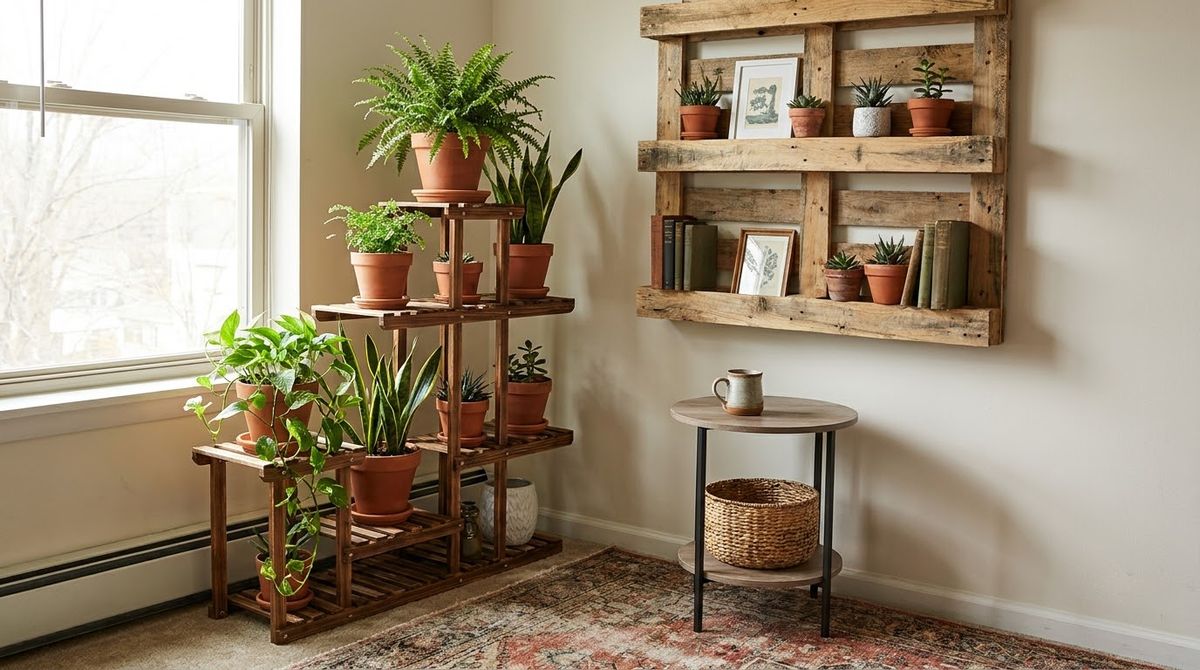
A plant corner looks designed when it has 3 heights: a tall floor plant, a mid-height shelf or stand, and a trailer up high. These 18 ideas use real shelves and stands with listed sizes, from a $9.99 IKEA rolling base to an $80 corner stand, and each has a weight limit to respect.
Key Takeaways
- Check the weight rating first: IKEA’s LACK shelf holds 22 lb and its MOSSLANDA ledge holds 16.53 lb, spread evenly.
- Fix shelves into a stud or a rated anchor; IKEA sells the screws for LACK and BERGSHULT separately.
- Use three heights (floor, mid, high) and put trailers on the top shelf so they can fall.
- Wall-mounted racks like IKEA’s SKUGGRÖNA take pots up to 3 1/2 inches wide, so they suit cuttings and small succulents only.
- A shelf of mixed plants works best when each shelf holds plants with the same watering needs.
Floating Shelf Ideas
Floating shelves cost the least and use no floor, so they are the first thing to try in a rental where the landlord allows screws.
1. One Long Shelf Beside the Window
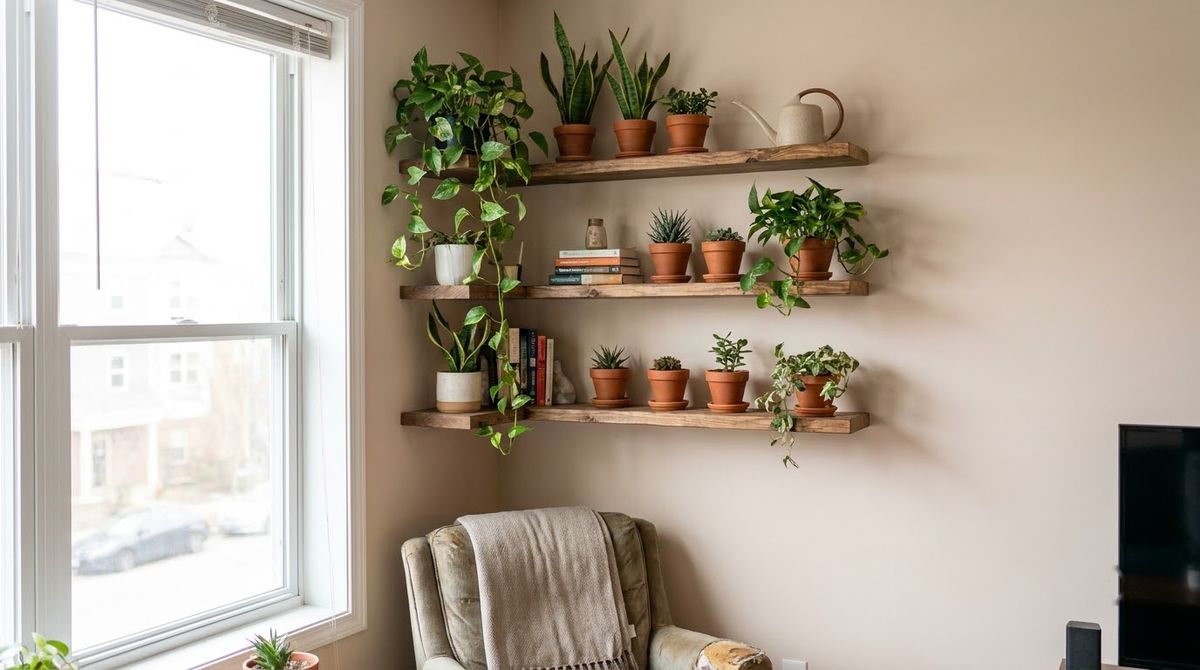
A single long shelf along a window wall holds three or four small pots in a row. IKEA’s LACK wall shelf measures 43 1/4 by 10 1/4 inches, is rated for 22 lb and was $29.99 on IKEA’s page. Its depth leaves room for 4 to 5 inch pots. Wall screws are sold separately and IKEA says the shelf must be anchored with fasteners suited to your wall, so buy those first.
2. A Deeper Shelf for 6-Inch Pots
A 6-inch pot needs more depth than a picture ledge gives. IKEA’s BERGSHULT shelf, 31 1/2 by 11 3/4 inches, was $20 on IKEA’s page, with a 22 lb maximum load. The brackets (RAMSHULT, $5) should sit at least 27 1/2 inches apart. Keep the heaviest pot over a bracket and put a saucer under every pot to protect the finish.
3. Picture Ledge for Cuttings and Small Pots
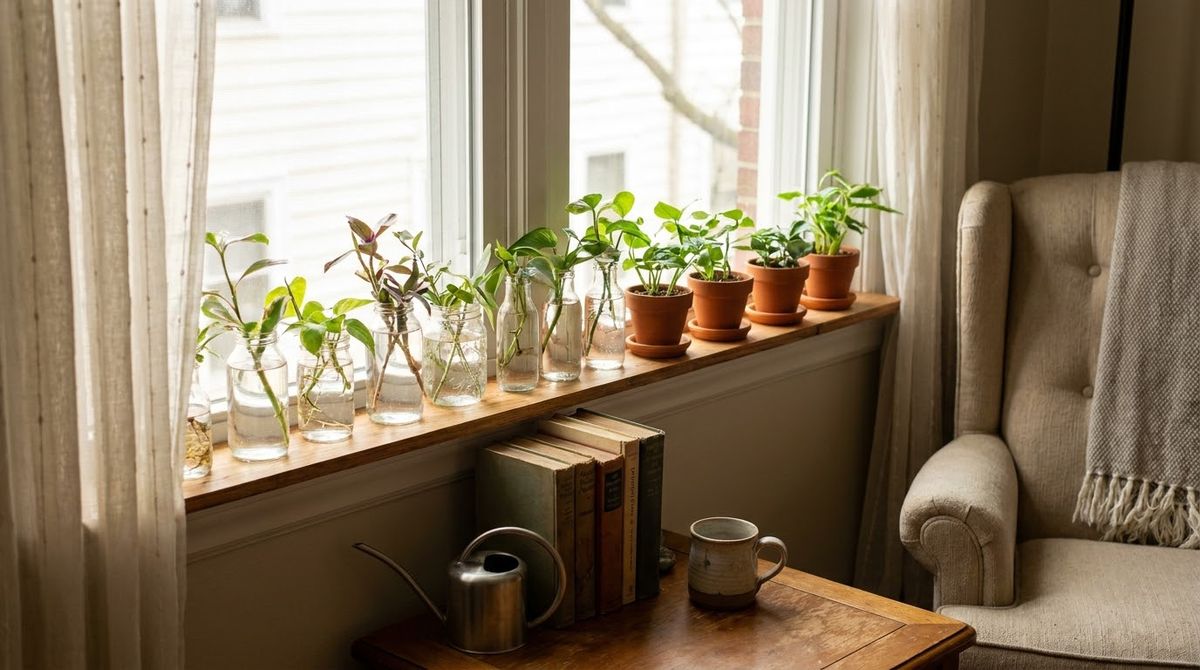
A narrow ledge is made for propagation jars and 3-inch pots. The IKEA MOSSLANDA ledge in the 45 1/4 inch length is 4 3/4 inches deep, holds 16.53 lb and cost $19.99 on IKEA’s page. Because the lip is shallow, use pots with flat bottoms and keep each one light. Put a trailing pothos cutting in a glass jar at the end to give the row a drop.
4. Staggered Pair at Two Heights
Two shelves at different heights make the wall look planned. Hang the lower one about 10 to 12 inches below the upper one and offset it to the side by half a shelf. Two IKEA BERGSHULT shelves at 31 1/2 by 11 3/4 inches come to about $40 before brackets and screws. Put sun lovers on the shelf nearer the glass and low-light plants on the one farther away.
5. Corner Pair That Meets at the Angle
Two shelves meeting at a corner create an L-shaped display and catch light from two walls. Use two 31 1/2 inch BERGSHULT shelves ($20 each) and set one flush to the corner, with the other butting against its end. Check that the first shelf’s bracket lands in a stud or a rated anchor, since the corner shelf carries load from both. Fill it with a mix of upright and trailing plants.
Ladder and Stand Ideas
Ladders and stands add height without drilling, so they suit rentals and rooms where the wall cannot take a screw.
6. Five-Tier Ladder Shelf
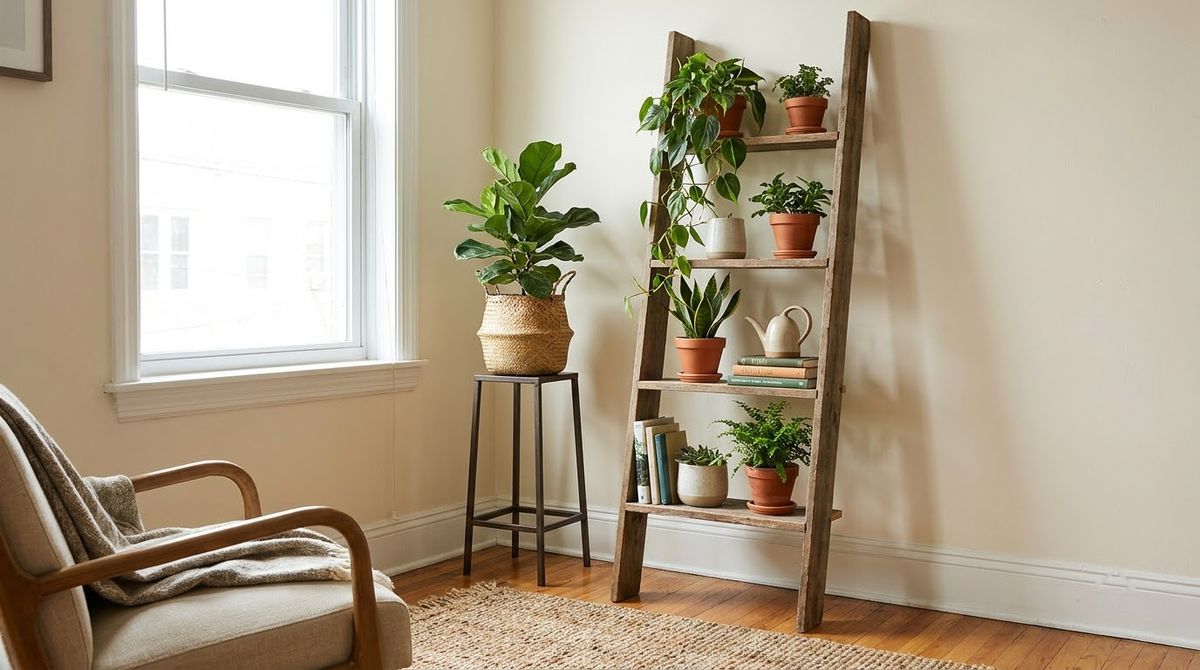
A leaning ladder shelf gives you five levels in a footprint about 16 inches wide. A Lavish Home 5-tier ladder shelf, listed at 16.25 by 11.5 by 50 inches, was $41.59 at Walmart (snippet). Check the weight rating on the listing, because the figures vary between versions. Put the biggest pots on the bottom rung and trailers on the top rung. It leans on the wall, so no hardware goes in.
7. Low Round Stand for a Big Floor Plant
A stand lifts a floor plant to counter height so the leaves show over the sofa arm. IKEA’s OLIVBLAD stand in black is 22 3/4 inches tall and 17 3/4 inches across, is rated for 55 lb and cost $29.99 on IKEA’s page. The steel tray holds a large nursery pot. Place a smaller version in the same finish next to it for a pair at two heights.
8. Tall Acacia Stand as a Room Divider
A tall stand makes the corner itself. IKEA’s ASKHOLMEN plant stand is 45 3/4 inches high, 17 3/4 inches wide and 12 1/2 inches deep in solid acacia, at $49.99 on IKEA’s page. The page does not list a maximum load, so keep it to a few medium pots. Put one large plant on the floor in front of it and smaller pots on the stand.
9. Wide Pine Stand With Room for Big Pots
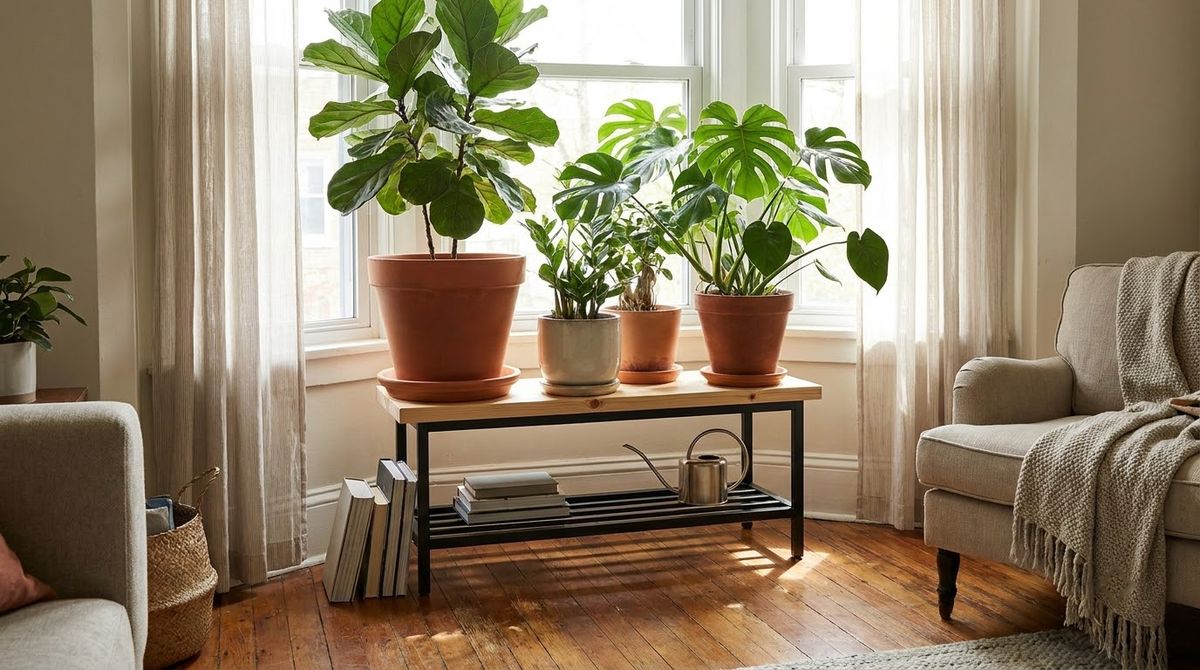
IKEA’s VANILJSTÅNG plant stand in pine and black is about 29 1/4 inches long, 10 3/4 inches wide and 26 1/2 inches high, with a 110 lb load and a $79.99 price (snippet). That is a much higher rating than the shelves above, so it can take a heavy ceramic pot or a trio of 8-inch plants. Use it in front of a window as a low plant bench.
10. Rolling Base for a Heavy Pot
A rolling base lets you move a large plant to the window and back, or rotate it. IKEA’s ÅKERBÄR plant stand on wheels is 12 1/4 inches across and 2 inches tall, is rated for 77 lb and costs $9.99 (snippet). It is the cheapest idea here. Use it under a floor plant in the corner, then pull the plant out to water it over a sink or tub.
Wall-Mounted and Window Ideas
When floor and shelf space is gone, small wall racks and hangers hold the cuttings and trailers.
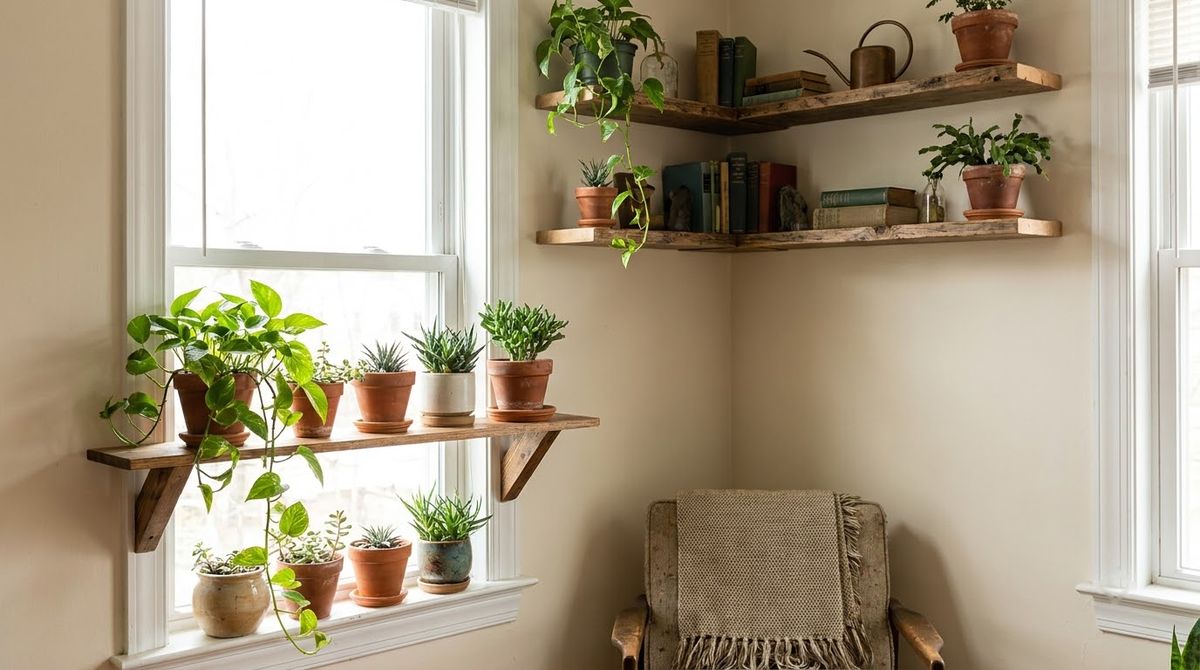
11. Wall-Mounted Rack for Small Pots
A narrow rack holds a row of small plants flat against the wall. IKEA’s SKUGGRÖNA wall-mounted plant stand is 21 1/4 inches high and 5 1/2 inches wide, was $19.99 on IKEA’s page, and holds about 7 lb per shelf. Pots must be 3 1/2 inches wide or less. It is for indoor use, and wall screws are not included. Use succulents, cuttings or small trailing plants.
12. Hanging Pot Above the Corner
A hanging planter fills the high spot over a corner and keeps the floor free. IKEA’s CHILISTRÅN hanging planter, 4 3/4 inches, was $12.99 on IKEA’s hanging planters page, and its KORKGRAN (10 3/4 inches) was $14.99. Pair it with a ceiling hook rated for the pot’s wet weight. See hanging plant ideas for indoors for hook ratings and trailing plants.
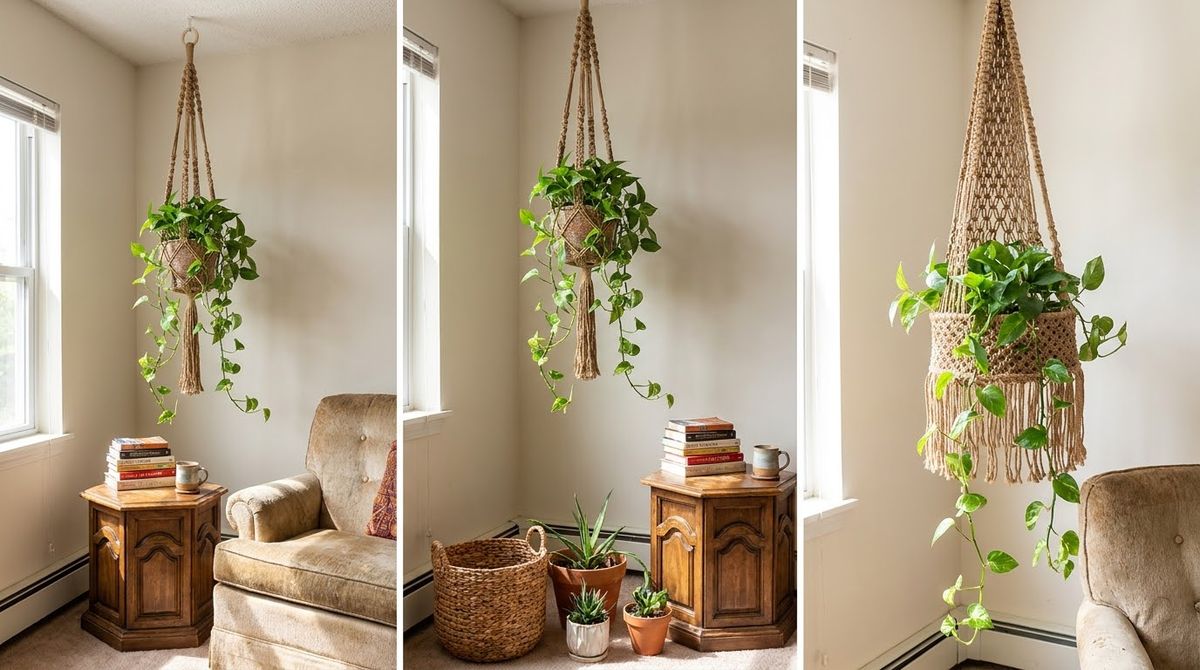
13. Riser for the Windowsill
A small riser lifts plants out of a deep sill and gives you two levels in the same window. IKEA’s DAKSJUS bamboo plant stand is 8 1/4 inches high with a 9-inch diameter and an 11 lb rating at $12.99 (snippet), and LÅNGNÄBB is $6.99 but only rated for 4 lb. Put a taller plant on the riser and a low one in front.
14. Plant Pot Hanger on a Rail
A plant pot hanger lifts one pot off every surface, so a corner with no room for another shelf still gets a layer. IKEA’s MÄVINN plant pot hanger in white, handmade, was $9.99 on IKEA’s hanging planters page. Hang it at mid-height between the shelf below and the ceiling, in a spot where the wall is plain and the vines have room to fall.
Corner Builds and Styling Formulas
These last four ideas are about how to arrange the pieces, not the pieces themselves.
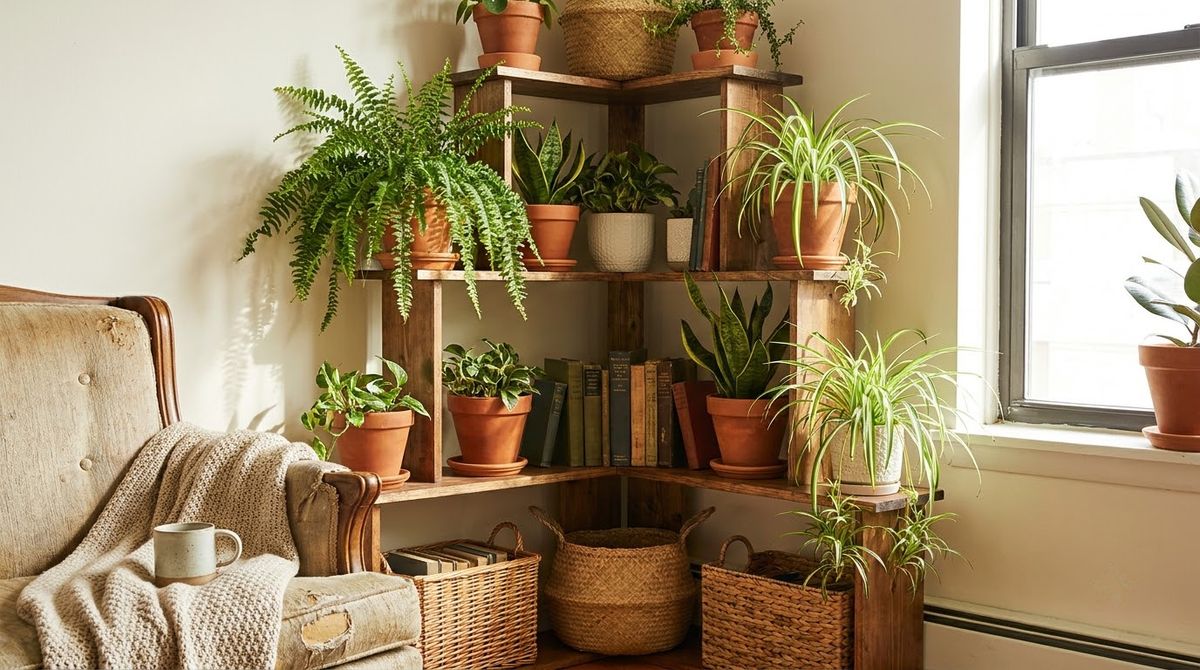
15. Three-Tier Corner Stand
A corner stand fits the angle exactly, so every tier is the same distance from both walls. The Sunnydaze 3-tier corner stand at Lowe’s is listed at 34 inches wide, 17 inches deep and 36 inches high, with a 20 lb limit per shelf (snippet). A pine 3-tier corner stand was $81.15 at Kohl’s (snippet). Put the heaviest pot on the bottom tier, which keeps the stand stable.
16. Three Heights in a Row
Use one tall plant on the floor, one plant at 20 to 30 inches on a stand, and one trailer at or above eye level. The eye then travels from the floor up to the ceiling with no gap. The cost can be as low as one stand ($29.99 for OLIVBLAD) plus plants you already own. Leave a few inches between pots so leaves can open.
17. Upright Plus Trailer Pairs
Put one stiff, upright plant next to a trailing plant in the same shelf group. Snake plant with pothos, or ZZ plant with string of hearts, gives you vertical lines and a soft drop. Let the trailer hang over the front edge of the shelf, and repeat the pairing on a second shelf so the corner feels consistent. See indoor plant styling ideas for more pairings that read as designed.
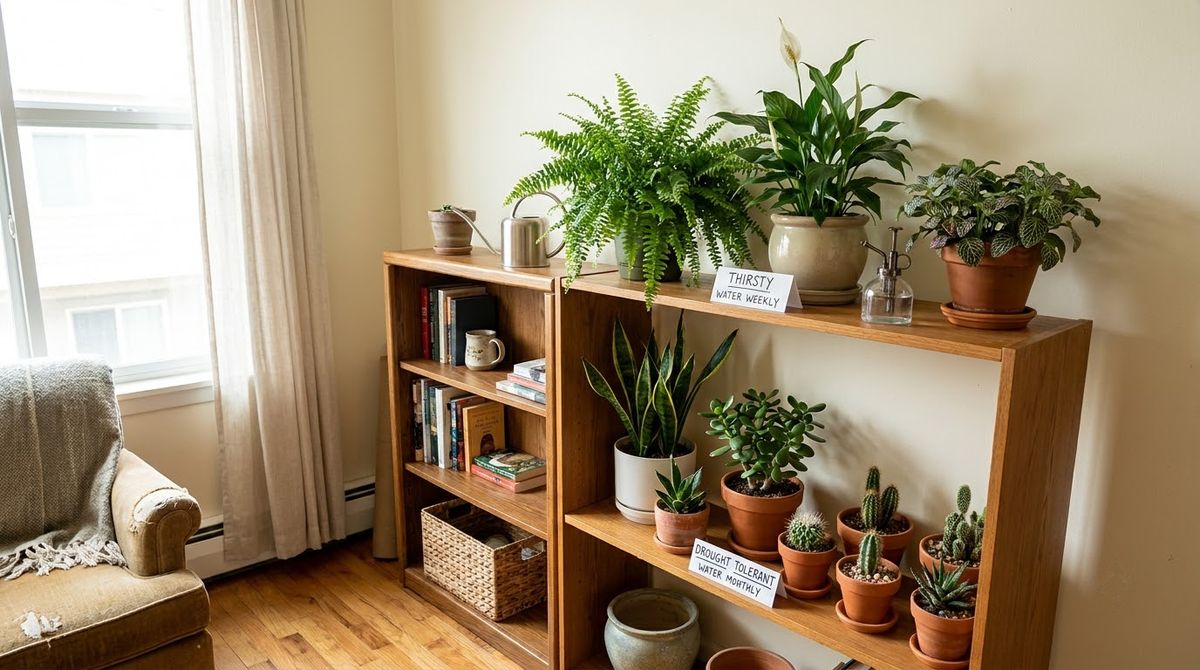
18. Group by Watering Needs
Put thirsty plants on one shelf and drought-tolerant plants on another, so you water each shelf on its own schedule. Set every pot on a saucer, because the weight of a full pot and the water that leaks from it can harm a shelf finish. For plants that survive dim corners, see low-light indoor plants, and for tough picks see best low-maintenance indoor plants.
Shelf and Stand Cost Table
| Piece | Size | Rated load | Price |
|---|---|---|---|
| IKEA MOSSLANDA ledge | 45 1/4″ x 4 3/4″ | 16.53 lb | $19.99 |
| IKEA BERGSHULT shelf | 31 1/2″ x 11 3/4″ | 22 lb | $20 |
| IKEA LACK shelf | 43 1/4″ x 10 1/4″ | 22 lb | $29.99 |
| IKEA OLIVBLAD stand | 22 3/4″ tall | 55 lb | $29.99 |
| IKEA ASKHOLMEN stand | 45 3/4″ tall | not listed | $49.99 |
| IKEA SKUGGRÖNA rack | 21 1/4″ tall | about 7 lb per shelf | $19.99 |
Frequently Asked Questions
How do you make a plant corner?
Use three heights: a tall plant on the floor, a stand or shelf in the middle, and a trailer up high. Group pots in odd numbers, repeat two or three pot colors, and match each plant to the light that spot gets. A corner works well because two walls bounce light onto the plants.
What plants go on shelves?
Trailing plants such as pothos and string of hearts belong on top shelves where they can fall. Upright plants such as ZZ and snake plant suit middle or back shelves. Put sun lovers such as aloe and pilea nearest the window. Match each plant to the light the shelf gets, not to its looks.
How do you display plants without much space?
Go vertical. Use a floating shelf, a ladder shelf, a wall rack or a hanging planter, and put small plants on a windowsill riser. IKEA’s SKUGGRÖNA wall rack is only 5 1/2 inches wide and a 5-tier ladder shelf is about 16 inches wide, so both fit in a narrow gap.
What shelf is best for plants?
It depends on the wall. A wall-mounted shelf such as IKEA’s BERGSHULT ($20) holds 22 lb but needs screws into a stud or rated anchor. A ladder shelf leans and needs no hardware, so it suits renters. For heavy pots, use a floor stand rated for 55 lb or more.
How many plants should be in a plant corner?
Three to seven plants usually reads as styled without looking cluttered. Start with one large anchor plant, add two or three mid-size plants, and finish with one or two trailers up high. Leave a few inches between pots so the leaves can open and the corner does not look crowded.
How much weight can a floating plant shelf hold?
Check the rating on the shelf. IKEA lists 22 lb for its LACK and BERGSHULT shelves and 16.53 lb for the 45 1/4 inch MOSSLANDA ledge, and the load must be spread evenly with the shelf anchored. A watered pot can weigh several pounds, so keep the total well below the rating.
Start With the Corner You Have
Pick the corner, measure its width and depth, and choose one stand or shelf that fits within those numbers. Add a second height and a trailer once the first piece is in. For tight spaces, see small apartment plants and floating shelf wall styling.
Prices checked October 2026.