
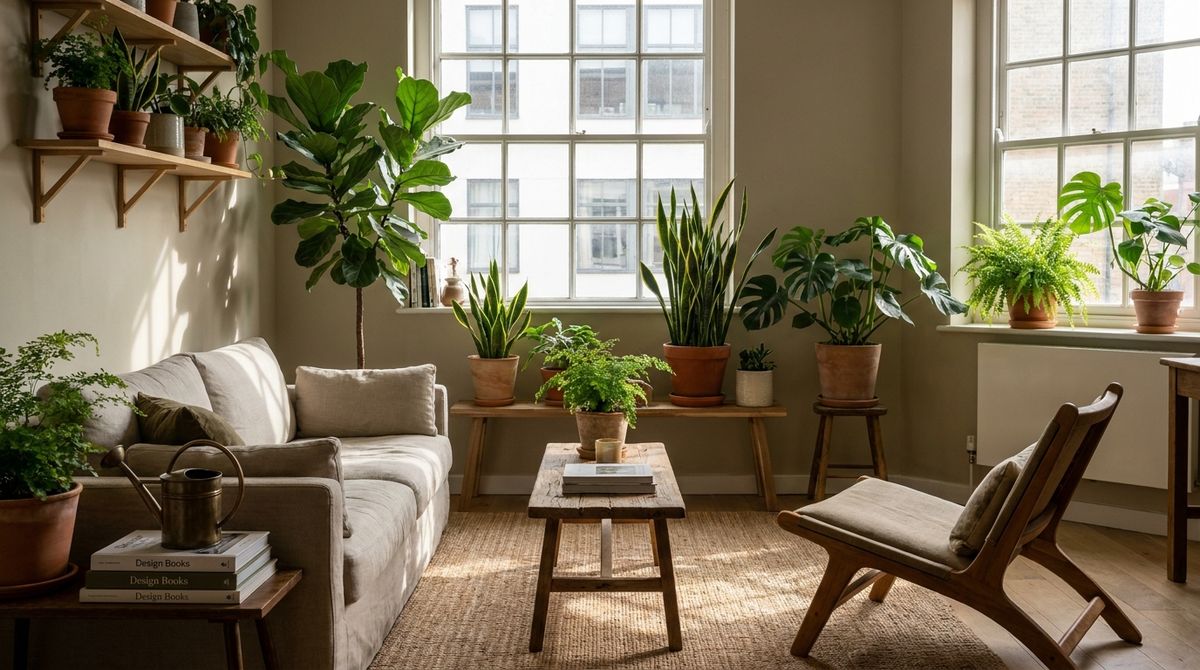
The core plant-styling rule is simple: group plants in odd numbers (3 or 5) at varied heights, and mix pot materials. A tall floor plant, a mid-height plant on a stool, and a small trailing plant on a shelf read as “designed,” while a straight row of matching pots reads as a garden center. Below are 22 ways to arrange plants so a room looks styled, not just green. After moving plants around dozens of rooms, these are the setups that actually work.
Key Takeaways
- Group in odd numbers at three heights: a trio of one tall, one medium, one small always looks more intentional than a matched pair
- Mix pot materials, keep the palette tight: terracotta + woven basket + one glazed ceramic in 2 to 3 colors max
- A room reads “styled” with 5 to 9 plants, spread across floor, shelf, and eye level, not lined up on a windowsill
- Corners are the highest-value spot: one floor plant in a $15 to $30 woven basket fills dead space instantly
- Odd-number grouping is a designer staple because the eye can’t split odd sets into pairs, so it keeps moving (The Spruce, 2024)
Why do plants look better in odd-numbered groups?
Odd-numbered groupings look more natural because the eye can’t neatly divide 3 or 5 objects into pairs, so it keeps traveling across the arrangement instead of stopping. Designers call it the “rule of three,” and it’s one of the most repeated principles in styling (Apartment Therapy, 2023). It works for plants, books, and vases alike.
Here’s the practical version. Buy plants in threes, not twos. A pair sits there like bookends, but a trio of one tall snake plant, one medium pothos, and one small succulent creates a little visual staircase. When we style a shelf or console, we default to 3 plants of clearly different heights, then stop. Five works for a big surface; two almost never does.
- Groups of 3: shelves, consoles, coffee tables, nightstands
- Groups of 5: large sideboards, wide windowsills, plant corners
- Single statement plant: floors, empty corners, beside a sofa
How do you vary plant heights when styling?
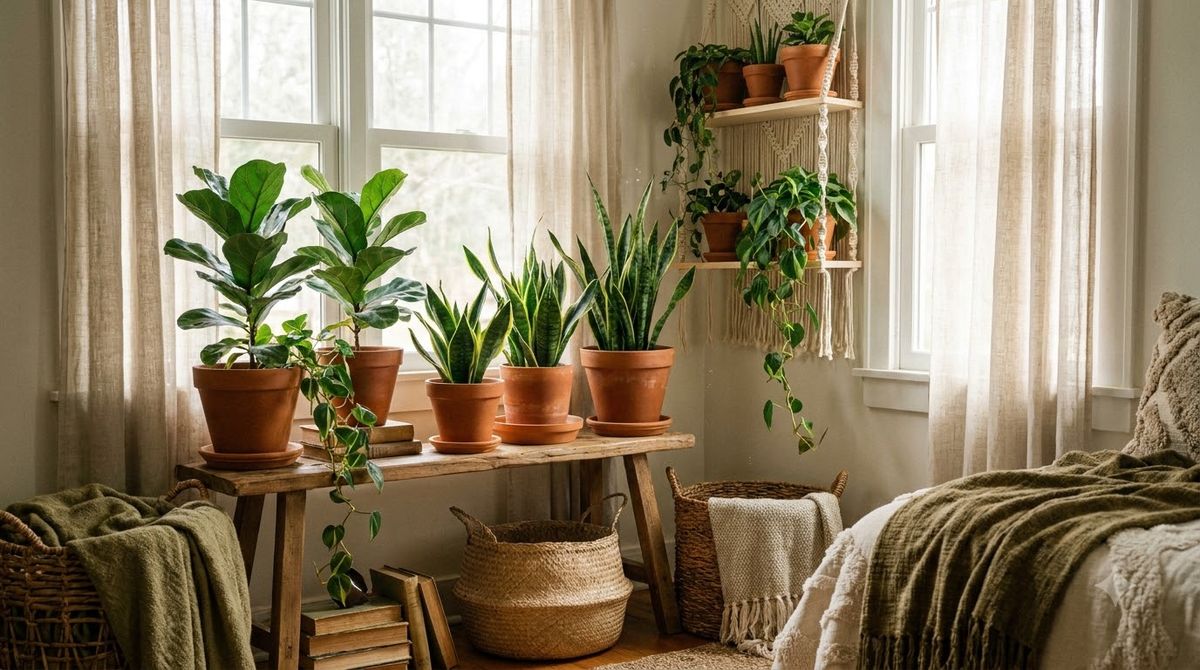
You vary height three ways: choose plants of different mature sizes, raise pots on stands or stacked books, and let trailing plants spill downward. A styled vignette needs a clear tall, medium, and low element, roughly a 3-to-2-to-1 height ratio, so the eye moves top to bottom instead of scanning a flat line.
The cheapest way to add height is a plant stand or a stool. IKEA plant stands run about $10 to $25, and a $20 wooden stool from Target does the same job while holding a mid-height plant off the floor. For trailing height, hang a pothos or ivy above a shelf so it drapes down and closes the gap between levels. We keep a stack of hardback books on hand purely to lift a small pot two or three inches when a grouping falls flat.
What most guides miss: the staggering ratio matters as much as the count. Aim for each level to be roughly 1.5 times the one below it, so a 24-inch plant pairs with a 16-inch mid and an 8-inch low, and offset them side to side so no two tops line up. Evenly spaced, equal-gap heights read like a bar chart; uneven steps read as designed.
- Add tall: floor plants (fiddle-leaf fig, bird of paradise), or a plant on a stand
- Add medium: plant on a stool, stacked books, or a plant stand
- Add low: succulents, small pots, or a trailing plant cascading down
What size plant goes where? (placement by size)
Plant size should match the surface: floor plants belong in corners and beside furniture, mid-size plants suit shelves and consoles, and small plants finish nightstands, desks, and bathroom counters. Matching scale to spot is the single fastest fix for a room that feels either cluttered or empty. Here’s the cheat sheet we use.
| Plant size | Where it works | Pot size (diameter) | Example |
|---|---|---|---|
| Floor / statement (2–6 ft) | Empty corner, beside sofa, entryway | 10–14 in | Fiddle-leaf fig, bird of paradise, rubber plant |
| Large tabletop (12–24 in) | Console, sideboard, plant stand | 8–10 in | Snake plant, ZZ plant, Chinese evergreen |
| Medium (8–14 in) | Open shelf, coffee table, mantel | 6–8 in | Pothos, philodendron, peace lily |
| Small (under 8 in) | Nightstand, desk, bathroom counter | 3–5 in | Succulents, pilea, small ferns |
| Trailing | Hung shelf, high cabinet, wall bracket | 4–6 in | Pothos, string of pearls, ivy |
A quick rule for pot size: pick a pot 1 to 2 inches wider than the plant’s current nursery pot, and no deeper. Too big a pot holds excess wet soil and rots the roots. For a full breakdown of forgiving plants by light level, see our guide to the best low-maintenance indoor plants.
What most guides miss: match the pot to the plant visually, not just by fit. As a rough proportion, the pot should read as about one third of the total height of the plant-and-pot together, so a 2-inch nursery pot on a 12-inch plant looks starved, while a huge planter swallows a small succulent. Size the pot to the plant and the plant to the surface, and the grouping settles on its own.
How should you mix pots and planters?
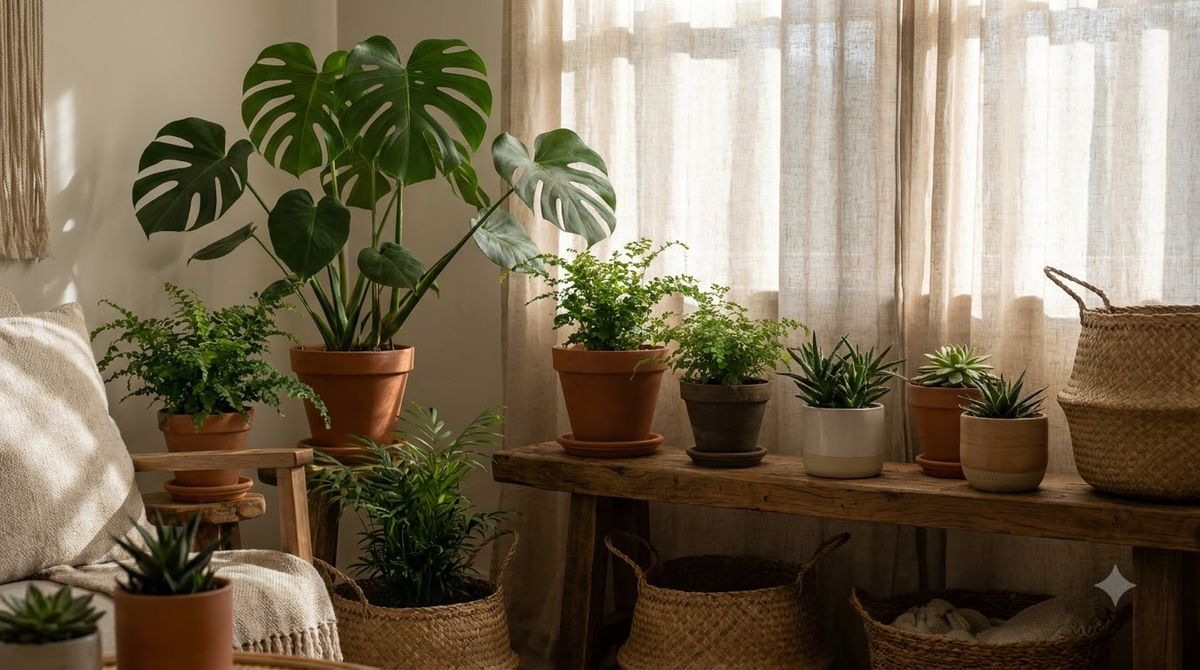
Mix materials but limit the color palette: combine terracotta, a woven basket, and one glazed ceramic, staying inside 2 to 3 tones so the grouping looks collected, not chaotic. Contrasting textures (rough terracotta against smooth ceramic against natural jute) add depth, while a tight palette keeps it cohesive. This is the difference between “curated” and “cluttered.”
Our go-to formula for a plant corner: one large woven basket for the floor plant ($15 to $30 at Target or IKEA), a neutral ceramic pot for the mid-height plant, and a small terracotta pot for the little one. All three sit in a warm, earthy range: cream, tan, rust. When every pot matches exactly, the display feels flat and store-bought. When they clash in five colors, it feels messy. Two or three related tones is the sweet spot.
- Cohesive but interesting: terracotta + jute basket + one cream ceramic
- Renter-friendly cover-up: drop the ugly nursery pot straight into a basket, no repotting
- Budget move: paint mismatched thrift pots one neutral color to unify them
What most guides miss: pot material changes how often you water, not just how it looks. Terracotta is porous, so it wicks moisture out through the walls and dries soil faster, which suits succulents, snake plants, and anything prone to root rot. Glazed ceramic and plastic seal moisture in, better for thirsty pothos and ferns. Whatever the material, choose pots with a drainage hole; a decorative cachepot with no hole traps water at the roots and quietly drowns the plant.
Where are the best places to put plants in a room?
The highest-impact spots are empty corners, open shelves, and the floor beside furniture, in that order. A single floor plant in a corner fills negative space that furniture can’t reach, which is why designers reach for corners first (The Spruce, 2024). Work through a room by targeting the spots that feel bare.
Plant corners and floor statements
An empty corner is the best return on a single plant. Set one tall plant (rubber plant, bird of paradise, or a tall snake plant) in a woven basket, and the corner instantly feels finished. We add a small stool or stacked books beside it with a trailing plant to build a two-level moment. For more corner-specific setups, see our plant shelf and corner ideas.
Shelves and bookcases
Style plants into a bookcase the way you’d style objects: odd numbers, varied heights, and negative space between them. Let one trailing pothos spill down from a top shelf to break the grid of straight book spines. Don’t fill every shelf; a plant on 2 or 3 shelves out of 5 looks more deliberate than one on each.
Hanging and wall-mounted
Hanging plants add height without using floor or shelf space, ideal for small rooms and rentals. A trailing pothos or spider plant in a macramé hanger draws the eye up and softens hard corners. We cover brackets, hooks, and the best trailers in hanging plant ideas indoor.
How many plants should you put in a room?
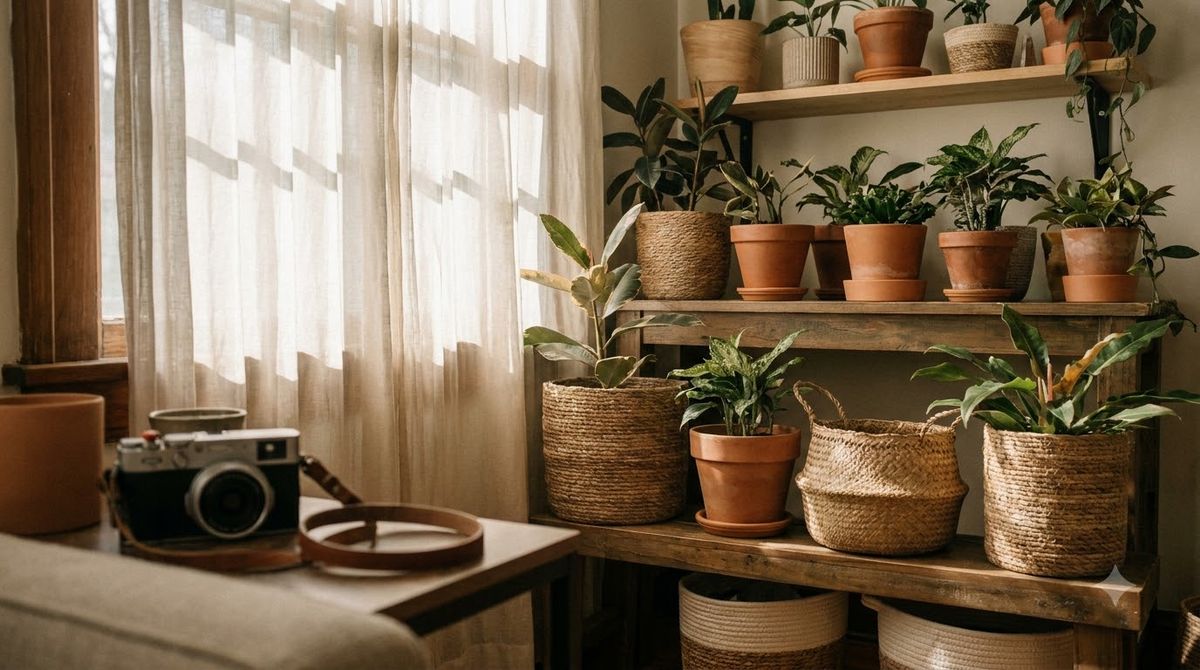
Most rooms look styled with 5 to 9 plants spread across three zones: floor, eye level, and above eye level. Fewer than 3 tends to look accidental; more than a dozen starts to read as a jungle unless that’s the intended look. The number matters less than the spread: plants at multiple heights beat a big cluster in one spot.
A living room hits a good balance at around 5 to 7 plants: one floor statement, two or three at shelf or table height, and one or two trailing or hanging. A bedroom or small apartment needs fewer, often just 3 well-placed plants. If you’re working with limited square footage, our small apartment plants guide covers picks that stay compact. And if a real plant won’t survive a dark corner, a good faux plant that looks real fills the gap without the upkeep.
- Small room / bedroom: 3 plants, at 3 different heights
- Living room: 5 to 7, spread floor-to-ceiling
- Big open space: 7 to 9, grouped in two or three vignettes, not evenly scattered
Quick styling rules to remember
These are the extractable rules we come back to on every project:
- Odd numbers: group in 3s and 5s, never even pairs
- Three heights: every grouping needs a tall, a medium, and a low
- Tight palette: 2 to 3 pot tones, mixed materials
- Corners first: one floor plant fills the most dead space
- Trailing to connect: let one plant spill to link shelf levels
- Don’t fill everything: leave negative space so each plant reads
- Match scale to surface: big plant, big surface; small plant, small surface
For low-light spots where most plants sulk, pair these styling rules with the right species from our low-light indoor plants list.
Frequently Asked Questions
How do you style indoor plants?
Group them in odd numbers (3 or 5) at varied heights, mix pot materials within a tight 2 to 3 color palette, and place them across three zones: floor, eye level, and above. Start with empty corners, add a trailing plant to connect shelf levels, and leave negative space so each plant stands out.
How many plants should you have in a room?
Most rooms look styled with 5 to 9 plants spread across floor, table, and hanging height. A small bedroom needs about 3; a living room looks best with 5 to 7; a large open space can carry 7 to 9. Spread across heights matters more than the exact count.
What size pot for a plant?
Choose a pot 1 to 2 inches wider in diameter than the plant’s current nursery pot, and no deeper. Small plants suit 3 to 5 inch pots, tabletop plants 6 to 10 inches, and floor plants 10 to 14 inches. An oversized pot holds too much wet soil and can rot the roots.
Should plant pots all match?
No. Matching pots exactly makes a display look flat and store-bought. Mix materials like terracotta, woven baskets, and glazed ceramic, but keep them within 2 to 3 related tones so the grouping still feels cohesive. Contrast in texture, cohesion in color.
Where should you put plants in a room?
Target empty corners first, then open shelves and the floor beside furniture. One floor plant in a woven basket fills a bare corner instantly. Use hanging plants to add height in small rooms, and set trailing plants up high so they spill down and soften hard edges.
Is terracotta or plastic better for indoor plants?
It depends on the plant. Terracotta is porous and dries soil faster, so it protects succulents, snake plants, and cacti from root rot. Plastic and glazed ceramic hold moisture longer, which suits thirsty pothos and ferns. Whichever you pick, make sure the pot has a drainage hole.