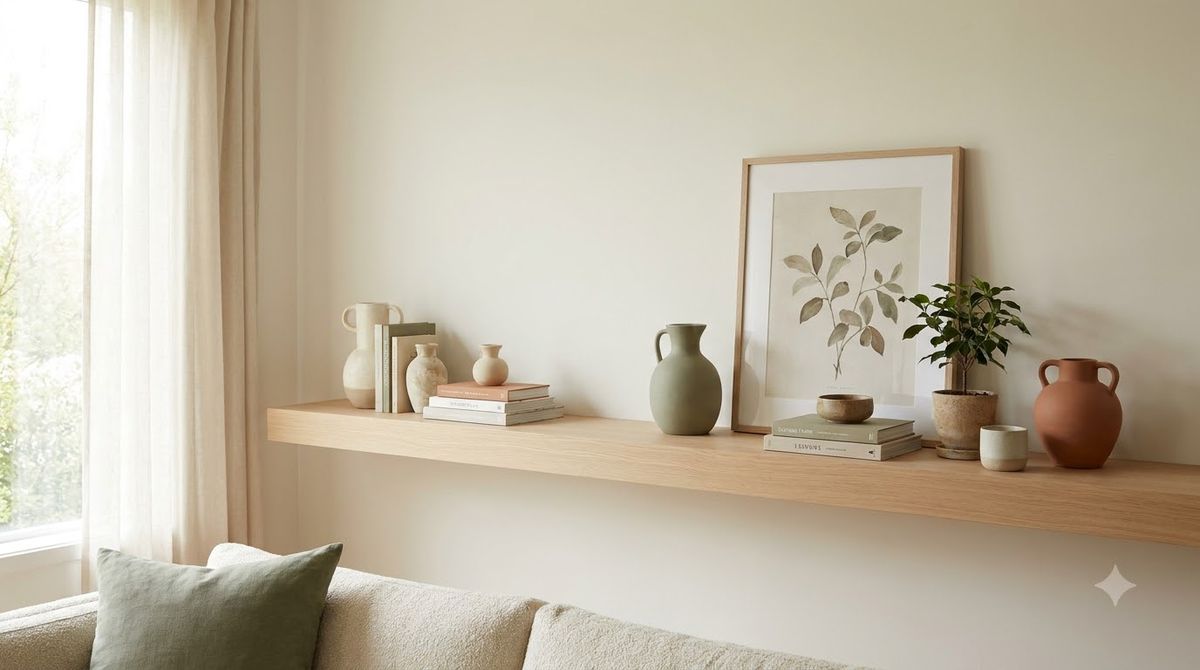
The formula that keeps floating shelves from looking cluttered is simple: lean one piece of art at the back, add objects in odd-numbered groups of three, vary the heights, and leave 40% of each shelf empty. That last number matters most. Style to roughly a 60/40 filled-to-empty ratio so the eye has room to rest. The empty space is what makes the full parts look intentional instead of crowded.
Key Takeaways
- The core formula per shelf: 1 leaning artwork at the back + 1 book stack + 1 plant or sculptural object, arranged in a loose triangle
- Fill about 60%, leave 40% empty — negative space is what reads as “styled,” not “cluttered”
- Group in odd numbers (3 or 5). Odd groupings look more natural to the eye than even, symmetrical pairs
- Space stacked shelves 10-12″ apart so a mid-size book or frame fits between them with breathing room
- Vary heights deliberately: tallest object about 1.5x the shortest, never all the same line
- A 24″ shelf holds 3-4 objects max; a 36″ shelf holds 5-6. More than that and it tips into clutter
How Do You Style Floating Shelves?
Style floating shelves with a three-part formula: lean art at the back, stack two or three books flat, then top them with one small object, and finish with a plant. Layered, staggered arrangements look more professionally styled than flat rows of items lined up like a store shelf. The trick is the triangle.
Here’s the repeatable move we use on every shelf:
-
Anchor the back with one leaning piece of art or a framed print (the tallest element)
-
Add a horizontal base – a stack of 2-3 books laid flat, which doubles as a riser
-
Top the stack with one small object: a candle, a small bowl, a ceramic figure
-
Add one organic element – a trailing plant or a single dried stem for softness
-
Step back and remove one thing. Nine times out of ten, our first pass has one item too many
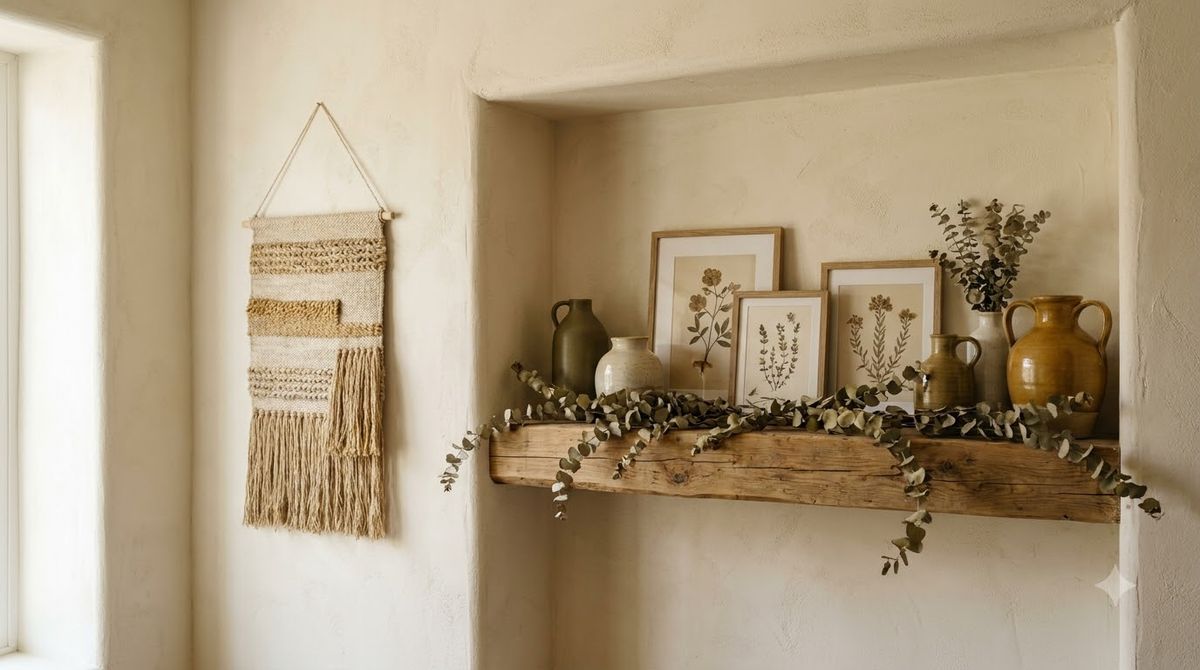
What most guides miss: the odd-number rule works because of how the eye tracks a group. Three or five objects force your gaze to move in a triangle or zigzag, so the arrangement feels collected. An even pair pulls the eye into a flat, symmetrical line that reads as staged. Within each group, keep the tallest object about 1.5x the shortest, and let one item overlap the edge of another so the trio reads as one composition, not three separate props.
Citation capsule: To style a floating shelf without clutter, use a triangle of three elements per shelf – leaning art at the back, a flat book stack in front, and one plant or object – while leaving about 40% of the shelf empty.
How Far Apart Should Floating Shelves Be?
Space stacked floating shelves 10 to 12 inches apart vertically. That gap fits a standard hardcover book (about 9 inches tall) or a small framed print with a little air above it. Apartment Therapy notes that shelves spaced closer than 10 inches feel cramped and limit what you can display, while gaps over 15 inches start to look disconnected from each other.
Quick spacing rules we follow:
- Vertical gap between shelves: 10-12″ (fits most books and mid-size frames)
- First shelf above a console or desk: 10-15″ above the surface, so objects on the desk don’t crowd the shelf
- Above a sofa or bed: start the lowest shelf 8-10″ above the furniture back
- Horizontal shelves side by side: keep 2-4″ between shelf ends if they’re on the same wall
- Leaning art depth: buy shelves at least 6″ deep so a framed piece leans back safely without sliding off
What most guides miss: shelf height is measured to your eye, not the ceiling. The lowest display shelf reads best with its top surface around 56-60 inches from the floor, the same center line galleries use for hanging art. Above seating, forget that rule and clear people’s heads instead: start the bottom shelf 8-10 inches above the sofa back. Stack upward from there in 10-12 inch steps, rather than centering the whole group on a tall blank wall where it floats too high.
Shelf length → how many objects (quick reference)
| Shelf length | Objects to display | Example combo |
|---|---|---|
| 18-24″ | 3-4 | 1 leaning frame + book stack + small plant |
| 30-36″ | 5-6 | 2 frames + book stack + plant + 1 object |
| 42-48″ | 6-8 | 2-3 frames + 2 book stacks + plant + 2 objects |
| 60″+ | 8-10, in clusters | Build 2-3 separate triangles with gaps between |
Citation capsule: Floating shelves should sit 10 to 12 inches apart vertically, enough to fit a standard 9-inch hardcover with breathing room. A 24-inch shelf holds 3-4 objects, a 36-inch shelf holds 5-6, and anything longer should be styled in separate odd-numbered clusters rather than one crowded row.
What Do You Put on Floating Shelves?
Put a mix of three categories on floating shelves: something to lean (art), something to stack (books), and something living (a plant). A 2026 Pinterest Predicts trends report flagged “shelfie” styling as a rising home search, and the saved images that perform best pair one plant with one book stack and one sculptural object per shelf. Balance the three and almost any shelf looks composed.
Our go-to object mix, by category:
- Lean: a framed print, a small canvas, or a decorative plate on a stand (IKEA sells frames from $3-15)
- Stack: 2-3 hardcovers laid flat as a base, or spine-out if the covers are pretty
- Living: a small pothos or trailing plant, or a single dried pampas stem for zero maintenance
- Sculptural: a ceramic vase, a small bowl, a candle, or a bookend (Target’s Threshold line runs $8-25)
- Warm metal or wood object: a brass figure or wood bead garland to add texture
Most shelf-styling advice says “add books and plants,” but the piece people skip is the riser. Laying books flat under a small object lifts it into the mid-height zone, which is exactly what creates the staggered triangle. Without risers, everything sits on one flat baseline and the shelf looks like inventory, not decor.
For a full walk-through on arranging books themselves, our bookshelf styling ideas guide covers spine-out versus stacked in depth.
How Do You Style Floating Shelves by Room?
Style floating shelves differently by room based on what the space needs: living rooms want a balance of decor and personality, while kitchens and bathrooms lean functional. Shelves stay tidy longest when they have a clear job – display in the living room, storage-plus-style in the kitchen – rather than a vague mix of both.
Living room floating shelves
Above a sofa or console, run 2-3 shelves and follow the triangle formula on each. Keep the palette to 2-3 colors so it reads calm from across the room. See our full living room wall decor ideas for pairing shelves with art, and above the couch wall decor for the exact heights above a sofa back.
Kitchen floating shelves
Kitchen shelves earn their keep. Mix everyday items (stacked plates, mugs) with one or two decorative pieces – a small plant, a wood cutting board leaned at the back. Group like items together so daily use doesn’t wreck the styling.
Bedroom and bathroom shelves
Keep bedroom shelves soft and low-contrast: a candle, a book, one plant. In bathrooms, use short shelves for rolled towels plus a single plant that tolerates humidity, like a pothos or fern.
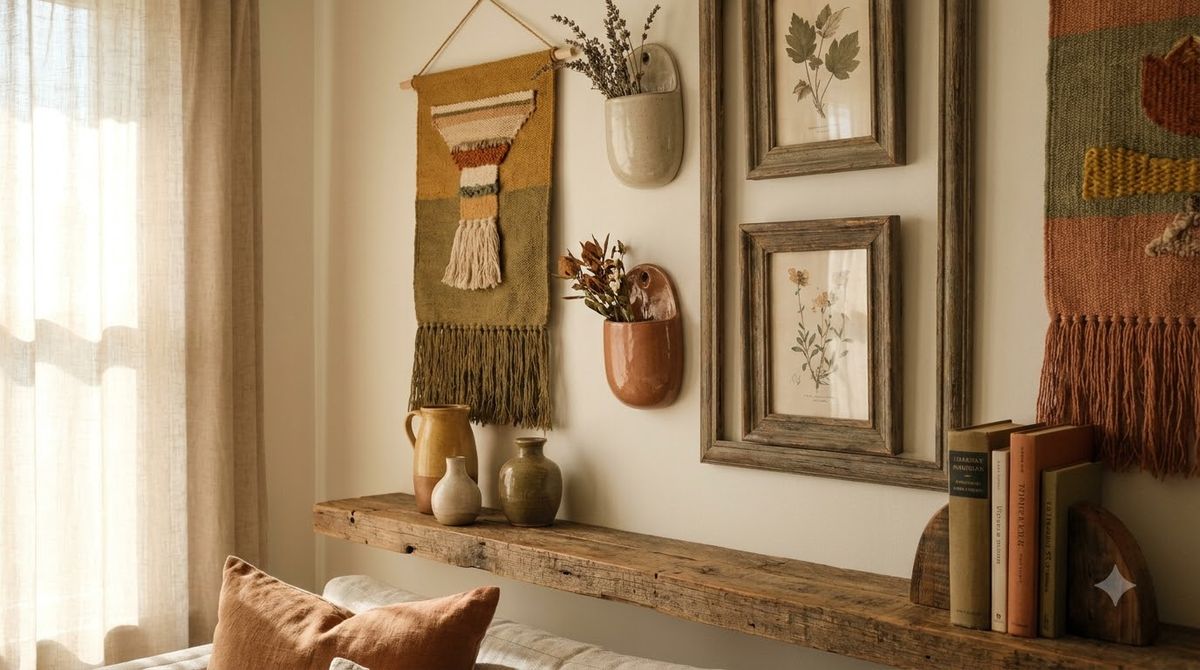
Citation capsule: Style floating shelves by room’s purpose: living-room shelves balance art, books, and plants in a triangle; kitchen shelves group everyday plates and mugs with one or two decorative pieces; bedroom and bathroom shelves stay soft with a candle, a book, and one humidity-tolerant plant like a pothos.
What Are the Most Common Floating Shelf Mistakes?
The most common floating shelf mistake is overfilling – packing every inch until there’s no negative space. On our first shelf styling attempt, we lined up eight objects in a neat row and it looked like a shop display. Removing three items and staggering the rest fixed it in about two minutes. The 60/40 fill ratio is the guardrail.
Mistakes we see (and made) most often:
- Everything the same height – creates a flat, boring line; vary heights so the tallest is about 1.5x the shortest
- Even, symmetrical pairs – odd numbers (3 or 5) look more natural and collected
- No leaning art at the back – the back layer adds depth; without it, shelves look thin
- Overfilling – if you can’t add one more thing comfortably, you already have one too many
- Ignoring weight limits – a standard IKEA LACK floating shelf holds about 22 lbs evenly distributed; heavy books plus ceramics add up fast
What most guides miss: the anchor matters more than the shelf itself. A screw driven into a wood stud holds 80-100+ lbs in shear, but that same screw in bare drywall pulls loose under about 20 lbs. Studs sit 16 inches on center in most homes, so find them with a magnet or stud finder first. Where no stud lands behind your bracket, use a rated toggle or molly bolt: a pair of #8 toggles holds roughly 50-60 lbs in half-inch drywall. Keep the heaviest books over the bracket, never out at the shelf end.
Getting the shelf mounted level and at the right height matters too. Our how to hang wall art guide covers the mounting heights that apply to shelves as well, and if your wall’s still bare, start with empty wall ideas or a full gallery wall for the surrounding space.
Frequently Asked Questions
How do you style floating shelves?
Use a three-part triangle per shelf: lean one piece of art at the back, stack 2-3 books flat in front, and top them with one small object, then add a plant. Fill about 60% of the shelf and leave 40% empty. Group items in odd numbers and vary their heights for a collected, uncluttered look.
How far apart should floating shelves be?
Space stacked floating shelves 10 to 12 inches apart vertically, which fits a standard 9-inch hardcover or a small frame with breathing room. Start the lowest shelf 8-10 inches above a sofa or bed, or 10-15 inches above a console or desk so surface objects don’t crowd it.
What do you put on floating shelves?
Mix three categories: something to lean (framed art or a canvas), something to stack (2-3 books laid flat), and something living (a small plant or dried stem). Add one sculptural object like a vase or candle. IKEA frames start at $3-15 and Target’s Threshold decor runs $8-25.
How many items should go on a floating shelf?
A short 18-24″ shelf holds 3-4 objects, a 30-36″ shelf holds 5-6, and a 42-48″ shelf holds 6-8. Anything over 60 inches looks best styled as two or three separate odd-numbered clusters with clear gaps between them, rather than one crowded row.
How much weight can a floating shelf hold?
A standard IKEA LACK floating shelf holds about 22 pounds when weight is spread evenly, and most 24-36 inch shelves anchored into studs hold 25-40 pounds. Books and ceramics add up quickly, so mount into studs or use rated anchors and avoid loading one end.
Do floating shelves need leaning art?
Leaning art isn’t required, but it’s the fastest way to add depth. A framed piece at the back creates a layered look that flat objects alone can’t. Buy shelves at least 6 inches deep so a frame leans back safely without sliding, and let books or objects overlap its lower edge slightly.
Can you hang floating shelves without a stud?
Yes, but match the anchor to the load. In half-inch drywall, a pair of toggle bolts holds roughly 50-60 pounds, plenty for a lightly styled 18-24 inch shelf. Keep heavy books near the bracket rather than the ends, and skip plastic expansion anchors for anything breakable or valuable.