
Quick answer: A complete minimalist room costs $850–$6,400 depending on quality tier. Budget builds run $850–$1,800, mid-range lands at $2,000–$3,500, and premium minimalist rooms reach $4,000–$6,400+. The single biggest line item is always seating (35–45% of total spend), followed by lighting and one statement piece.
Minimalism gets sold as the cheap aesthetic—fewer things, smaller bill. The reality is more nuanced. Because every piece in a minimalist room is visible and exposed, quality matters more, not less. You can’t hide a flimsy side table behind clutter. That changes how your minimalist decor cost breaks down compared to a maximalist room of equal square footage.
This guide walks through real category-by-category pricing for a 12×14 ft living space, three quality tiers, and the exact sequence we recommend for stretching your budget further.
Key Takeaways
- Total budget range: $850 (budget) to $6,400 (premium) for a complete 12×14 ft minimalist living room
- Largest expense: The sofa or primary seating, averaging 35–45% of total budget
- Hidden cost: Quality textiles (rug, throws, curtains) add $300–$1,200 most people forget to plan for
- Best ROI: Lighting upgrades—a $180 floor lamp transforms a room more than a $400 art piece
- Skip first, buy later: Coffee tables, accent chairs, and decorative objects (build the bones first)
How Minimalist Decor Cost Breaks Down by Category
A complete minimalist room has six functional categories. Here’s how budget typically distributes across them, based on the 60/25/15 rule we use for client projects:
The 60/25/15 minimalist budget rule:
-
60% — Anchor furniture (sofa, bed, dining table, or primary seating)
-
25% — Secondary pieces (rug, lighting, storage)
-
15% — Finishing layer (one statement piece, textiles, plants)
Applied to a $2,500 mid-range living room budget, that’s roughly $1,500 for the sofa, $625 for rug plus lamps plus a media console, and $375 for art, a throw, and a ceramic vessel or two.
The mistake most first-time minimalists make is inverting this ratio—buying the throw pillows, the candles, and the small accent table first, then running out of budget for the sofa. Build the bones first.
Actionable takeaway
Before buying anything, write your total budget at the top of a page, then multiply by 0.60, 0.25, and 0.15. Those are your three buckets. Don’t shop until each bucket has a name attached.
Free checklist
Spending $100 on a room? Spend it in this order.
The four phases we use, starting with the free one that changes more than any purchase.
Real Price Ranges by Quality Tier
Here’s what each category actually costs in 2026, sourced from current pricing at retailers including IKEA, West Elm, Article, CB2, Crate & Barrel, and Room & Board.
Anchor furniture (sofas, beds, dining tables)
- Budget tier: $400–$900 — IKEA Kivik, Article Ceni, secondhand Crate & Barrel
- Mid tier: $1,200–$2,400 — Article Sven, West Elm Andes, Burrow Nomad
- Premium tier: $2,800–$5,500 — Room & Board Jasper, EQ3, Design Within Reach
A well-built mid-tier sofa lasts 8–12 years. A budget tier sofa typically needs replacement at 3–5 years. Cost-per-year of ownership often favors mid-tier.
What most guides miss: The “buy less but better” math only works when you count cost-per-year, not sticker price. A $1,600 mid-tier sofa across a 10-year life runs about $160 a year. A $700 budget sofa replaced twice in the same decade costs roughly $210 a year, before you add two more rounds of delivery, disposal, and a weekend of assembly each time. Minimalism saves money only when the better piece genuinely lasts, so read the frame warranty before you fall for the price tag.
Rugs
- Budget tier: $120–$280 — Ruggable, IKEA, Boutique Rugs (8×10 ft synthetic)
- Mid tier: $400–$900 — Article, West Elm wool blends
- Premium tier: $1,200–$3,500+ — hand-knotted wool, natural fiber, designer collaborations
For minimalist rooms, a single oversized neutral rug delivers more visual weight than two smaller ones. Size up before you spec up materials.
Lighting
- Budget tier: $40–$120 per fixture — IKEA, Target Threshold
- Mid tier: $180–$450 — CB2, West Elm, Schoolhouse outlet
- Premium tier: $500–$1,800+ — Cedar & Moss, In Common With, Allied Maker
Plan for three light sources per room minimum: one overhead or ambient, one task, one accent.
Storage (media console, shelving, side tables)
- Budget tier: $100–$300
- Mid tier: $400–$1,100
- Premium tier: $1,400–$3,000+
Textiles (curtains, throws, pillows)
- Budget tier: $80–$200 total
- Mid tier: $250–$550 total
- Premium tier: $700–$1,500+ total
One statement piece (art, sculpture, vintage chair)
- Budget tier: $60–$200 — Society6, Etsy prints, vintage finds
- Mid tier: $300–$800 — Minted, Juniper Print Shop, local artists
- Premium tier: $1,200–$5,000+ — original works, gallery pieces
Actionable takeaway
Mix tiers strategically. The pattern that works: mid-tier sofa, mid-tier rug, budget-tier secondary pieces, premium-tier statement piece. This is the single highest-impact spend pattern for minimalist rooms.
What a Complete Minimalist Living Room Actually Costs
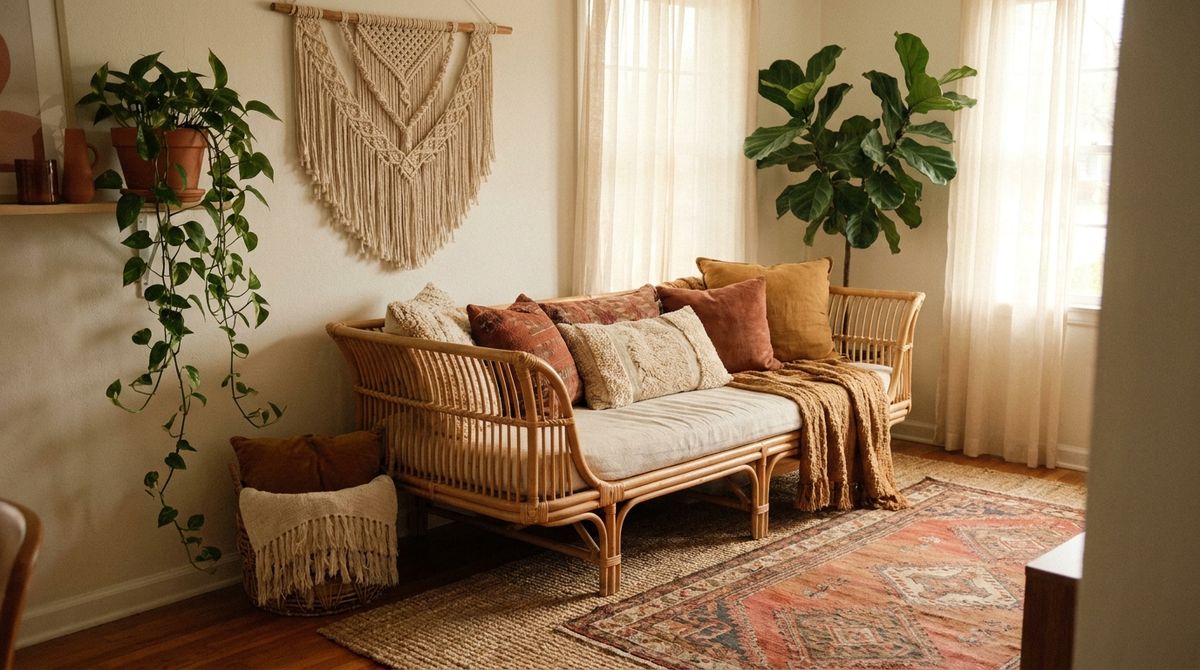
Here are three real budget builds for a 12×14 ft living room, every line item included.
Build #1: Budget minimalist living room — $1,420 total
-
Sofa (IKEA Kivik 3-seat, light beige): $799
-
8×10 ft jute-blend rug: $179
-
Arc floor lamp: $89
-
Small table lamp: $45
-
Media console (IKEA Besta): $160
-
Framed art print 24×36: $78
-
Linen curtains (one pair): $70
Build #2: Mid-range minimalist living room — $3,180 total
-
Sofa (Article Sven, 3-seat): $1,599
-
Wool rug, 9×12 ft, oatmeal: $649
-
Floor lamp, brushed brass: $229
-
Ceramic table lamp: $149
-
Walnut media console: $499
-
Original print or limited edition: $310
-
Textiles (curtains, one throw, two pillows): $220
Build #3: Premium minimalist living room — $6,180 total
-
Sofa (Room & Board or similar): $3,200
-
Hand-knotted wool rug, 9×12 ft: $1,400
-
Sculptural floor lamp: $580
-
Ceramic table lamp, designer: $295
-
Solid oak media console: $1,100
-
Original art piece: $890
-
Premium textiles: $465
Note what’s missing from all three builds: a coffee table, accent chair, and decorative objects. Those are phase-two purchases. A minimalist room functions beautifully without them, and adding them later lets you respond to how you actually use the space.
Actionable takeaway
Build to roughly 80% complete on day one. Live in it for 60 days. Only then decide what’s missing. Nine times out of ten, you’ll buy half of what you originally planned—and pick better pieces.
The 7-Step Minimalist Buying Sequence
Order matters as much as budget. Buy in this sequence to avoid the most common minimalist budget mistakes.
-
Measure first, shop second. Tape out furniture footprints on the floor before any purchase. Returns kill minimalist budgets faster than overspending.
-
Set the rug. The rug defines the room’s footprint and color palette. Buy it before the sofa—it constrains every other choice and saves you from buying a sofa that fights your rug.
-
Buy the sofa. The single most-used piece in the room. Spend here.
-
Add primary lighting. One overhead solution plus one floor lamp. The room becomes usable.
-
Add storage. Media console, shelving, or a sideboard—whichever the room needs for its function.
-
Layer textiles. Curtains last, after you’ve seen real light patterns in the room for two weeks.
-
Choose one statement piece. Art, sculpture, vintage chair, or vessel. Only one. This is what gives a minimalist room its identity.
Most over-budget minimalist projects skip steps 1 and 2 and start with step 7. The result is a beautiful object floating in an unfinished room. Resist.
For more on choosing that single statement piece, see our guide to minimalist statement pieces.
Actionable takeaway
Print the seven steps. Tape them to your fridge. Do not buy out of sequence. If you find an incredible deal on a step 6 textile before you’ve completed step 3, walk away.
Where to Save and Where to Spend on Minimalist Decor
Not every category rewards a premium spend equally. Here’s the strategic split we recommend:
Worth spending more on
- Sofa frame quality. Kiln-dried hardwood frame, eight-way hand-tied springs, and high-density foam differentiate a $1,800 sofa from a $700 one. You feel it daily.
- Rug quality. A wool rug ages beautifully; synthetic fibers flatten and pill within two years. Wool premium is worth it in high-traffic rooms.
- Lighting fixtures. A single sculptural floor lamp delivers disproportionate visual impact. A $300 lamp can do work a $700 sculpture cannot.
- One piece of art. If you only own one decorative object, make it count. Original work over mass-market prints.
Worth saving on
- Decorative objects. Ceramic vessels, candleholders, books-as-decor. Thrift stores, estate sales, and HomeGoods are minimalist-friendly because the look depends on form, not brand.
- Throw pillows and throws. These rotate seasonally and wear out. Buy mid-budget and replace, don’t invest.
- Side tables. Function is simple, form should be quiet. IKEA, Article entry-level, or vintage all work fine.
- Curtains. Hang them high and wide. Construction matters less than placement.
- Plants and planters. A $14 ZZ plant in a $22 ceramic pot reads as expensive when the room around it is well-edited.
Actionable takeaway
For every $100 you save on a side table or decorative object, redirect it to the sofa or lighting line. This single rule consistently produces rooms that read more expensive than their total spend.
Hidden Costs Most Minimalist Buyers Forget
The published price of furniture is rarely the final cost. Plan for these line items:
- Delivery and assembly. $100–$350 for a sofa from most direct-to-consumer brands. IKEA flat-pack is “free” but costs hours of your weekend.
- Window treatments hardware. Rods, brackets, rings: $40–$180 per window. Often forgotten.
- Wall anchors and hanging hardware. $30–$80 for proper drywall anchors, French cleats for heavy art, picture rails.
- Paint, if you’re refreshing walls. Two gallons of quality paint plus supplies: $120–$200.
- Light bulbs. A minimalist room with five fixtures needs five quality bulbs—Edison, smart, or warm-temperature LEDs at $8–$25 each.
- Returns. Many online furniture retailers charge $99–$250 return shipping. Budget 5% of your total spend as a contingency for one return.
These add roughly 8–15% to a stated furniture budget. Bake the buffer in from the start.
What most guides miss: Going minimalist has a demolition cost nobody budgets for. Clearing a fully furnished room means offloading pieces you already paid for, and getting rid of them isn’t free. Junk-removal pickup runs $75–$200 per load, many donation centers now decline large upholstered furniture, and selling secondhand recovers only 20–40% of original value at best. Set aside $100–$300 for offloading what the new room replaces, because a clean, empty room is the starting line, not a given.
For common pitfalls beyond budget, our minimalist decor mistakes guide covers the design errors that quietly inflate cost.
Actionable takeaway
Multiply your furniture budget by 1.12 to get your true project budget. If $2,500 is your ceiling, plan to spend $2,232 on furniture and reserve $268 for the line items above.
Stretching a Tight Minimalist Decor Budget
If your total budget is under $1,500, here’s how to make a real minimalist room work:
-
Buy one piece secondhand. Facebook Marketplace, Chairish, AptDeco, and estate sales routinely yield mid-tier sofas at 30–50% off retail. The sofa is the highest-leverage secondhand buy.
-
Skip the coffee table. A vintage stool, a stack of art books, or an oversized ottoman doubles as a coffee table. Save $200–$600.
-
Use what you own. A neutral piece you already own is worth more than a perfect new piece on credit. Minimalism does not require starting from zero.
-
Wait for late-season sales. January, July, and Labor Day are the strongest furniture sale windows. Major retailers discount 20–40% on floor models and previous-season pieces.
-
Buy unframed art and frame locally. A $40 print in a $35 custom frame reads as $200 art. Mat width matters more than frame brand.
For broader strategies and the full design philosophy behind these choices, see our minimalist decor overview and the modern minimalist decor guide.
Actionable takeaway
A $1,200 secondhand-anchored room can outperform a $3,000 all-new room. Pride of source isn’t a design principle—curation is.
Frequently Asked Questions
How much should I budget for a minimalist bedroom versus a living room?
Bedrooms typically run 15–25% less than living rooms of the same tier. Expect $700–$1,500 (budget), $1,800–$3,000 (mid), $3,500–$5,500 (premium) for a complete minimalist bedroom including bed frame, mattress excluded.
Is IKEA actually minimalist or just cheap?
IKEA’s design language is functionalist Scandinavian, which overlaps heavily with minimalism. Lines like Hauga, Malm, and Lack work well. The trade-off is durability—budget for replacement at 4–6 years.
Can I do a minimalist room for under $1,000?
Yes, if you buy one major piece secondhand and source 60% of remaining items from IKEA, Target Threshold, or Amazon Basics. Expect a 3–4 year horizon before pieces need replacement.
Does minimalist decor actually save money long-term?
Yes, in most cases. Fewer pieces means each can be higher quality, and minimalist rooms turn over decor less frequently than trend-driven styles. The Reddit r/Weddingsunder10k community consistently reports minimalist approaches reducing event decor budgets by 40–60%, and the same pattern holds for residential spaces.
What’s the single highest-ROI purchase in a minimalist room?
A quality floor lamp in the $180–$350 range. It improves the room’s evening usability, defines a reading or seating zone, and creates the warm, shadow-rich lighting that distinguishes intentional minimalism from sterile emptiness.
What does it cost to convert a fully furnished room to minimalist?
Beyond new pieces, budget $100–$300 to offload what you’re replacing. Junk-removal pickup runs $75–$200 per load, many donation centers now decline large upholstered furniture, and secondhand sales recover only 20–40% of original value. This offloading cost is the line item most minimalist conversions overlook.