
Apply minimalism room by function, not by one blanket rule: a bedroom is tuned for sensory calm, a living room for selective warmth, and a home office for zero distraction. One set of principles, three very different rooms. That’s the core tension anyone runs into when applying minimalism across a whole home. Minimalist bedroom decor demands near-total sensory quiet. Your living room needs enough personality to feel welcoming without going clinical. Your home office requires zero-distraction clarity to actually get work done.
The mistake most people make is treating minimalism as a single style rule — stripping every room to bare walls and calling it done. The smarter approach is function-led: each room has a primary job, and minimalism is the tool that removes everything blocking that job.
This guide breaks down exactly how to apply minimalist principles in all three spaces, with numbered steps, specific product categories, and real price ranges.
Key Takeaways
- Bedroom minimalism prioritizes sensory calm: no more than 5 furniture pieces and a 2–3 neutral-tone palette directly supports sleep quality (Sleep Foundation, 2025)
- Living rooms need purposeful display — one curated vignette per surface, not zero decor
- Home offices have the lowest visual-noise tolerance of any room; Princeton researchers found clutter competes directly with sustained focus
- Subtraction always comes before purchases — 90% of the result comes from what you remove
Why Minimalism Works Differently in Every Room
Visual clutter actively competes for your brain’s attention, and research backs this up. Neuroscientists at Princeton University demonstrated that unrelated objects in the visual field reduce the brain’s ability to concentrate on any single task by taxing its executive function resources (Princeton Neuroscience Institute, 2011). That finding applies in every room — but what “clutter” means, and how much of it matters, shifts dramatically depending on what the room is for.
A bedroom exists to support rest and sleep. A living room serves social connection and low-effort relaxation. A home office exists for concentrated output. Strip the wrong things from any of these rooms and you don’t get minimalism — you get a space that can’t fulfill its purpose.
What most guides miss: the same minimalist rule pulls in opposite directions depending on the room. A bedroom needs warmth added back through texture, linen, wood, wool, so it reads restful rather than clinical. A home office benefits from stripping those same soft, lingering cues that quietly invite you to relax instead of work. Copy a magazine bedroom into your office and focus slips; copy an office into your bedroom and sleep suffers.
Actionable takeaway: Before removing anything from a room, write down its single most important function in one sentence. Every object you keep must actively support that function or go.
How to Apply Minimalist Bedroom Decor: A 6-Step System
The bedroom is where minimalism delivers the fastest, most measurable result. According to a 2025 Sleep Foundation survey, adults who described their sleeping environment as “calm and visually uncluttered” reported meaningfully shorter sleep-onset times and higher overall sleep quality ratings than those in disorganized bedrooms (Sleep Foundation, 2025). The mechanism is simple: a clear room gives the brain less to process when it’s trying to wind down.
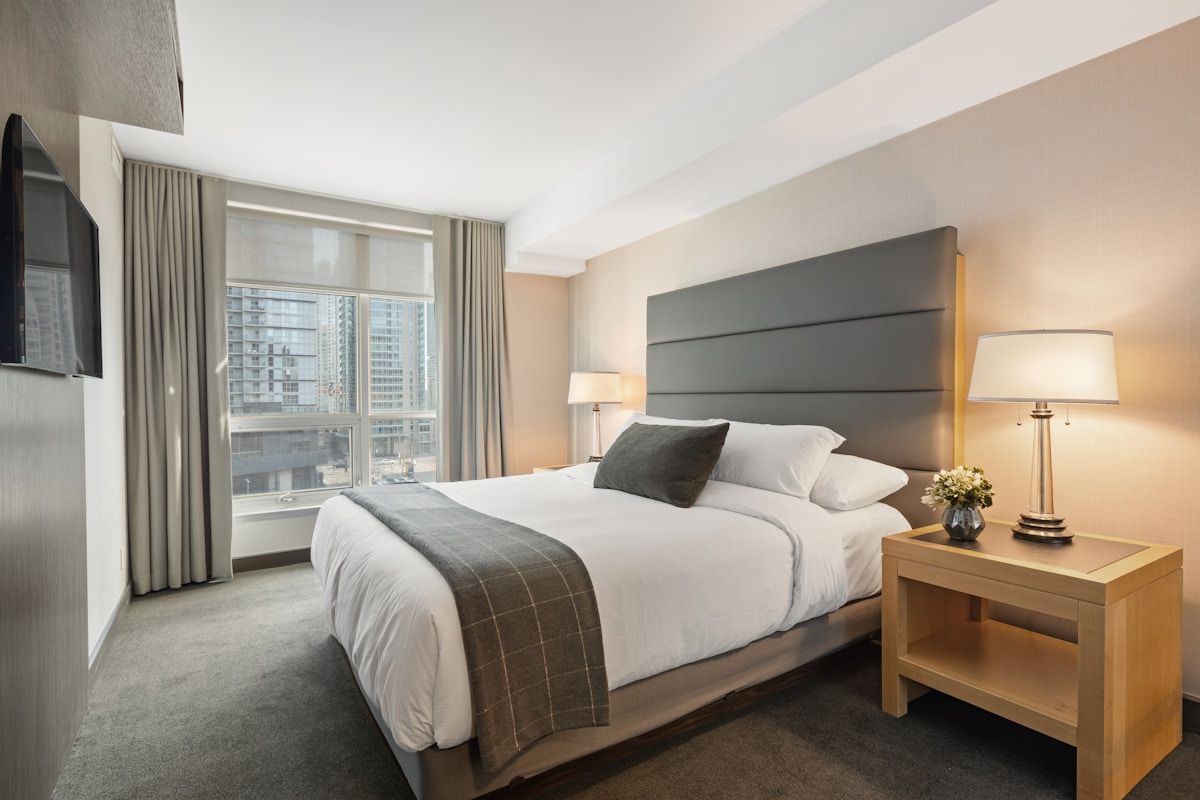
Clean surfaces and a restrained palette create the sensory quiet that supports sleep
Here’s a six-step system that produces a real transformation without a full room renovation:
Step 1: Do the 5-Furniture Audit
Count every piece of furniture in the room. Effective minimalist bedrooms rarely need more than five: bed frame, one or two nightstands, a dresser, and one chair or bench. If you have more, identify which pieces are genuinely earning their square footage.
Step 2: Clear Every Horizontal Surface Completely
Nightstands, dressers, and windowsills are clutter magnets. Clear them entirely. Then return only items used daily: lamp, phone charger, one book, a glass of water. Everything else needs a home in a drawer or a closet.
Step 3: Commit to the 2–3 Tone Rule
The most effective minimalist bedrooms use no more than three tones — a neutral base (warm white, soft beige, or warm gray), one muted accent (sage, dusty rose, or slate blue), and a natural texture (linen, wood, rattan). More than three tones create visual noise the resting brain works against rather than with.
Step 4: Handle Under-Bed Storage Intentionally
Under-bed storage is fine — visible chaos isn’t. Flat storage bins (IKEA SKUBB range, ~$15–$20) or bed frames with built-in drawers (~$300–$700) keep items out of the visual field without wasting otherwise dead space.
Step 5: Rebuild Your Lighting Layer
Harsh overhead lighting is the bedroom’s biggest enemy. Replace or supplement a single bright fixture with layered warm lighting: a bedside lamp ($30–$120), dimmable LED bulbs at 2,700K color temperature (~$12–$25 for a 4-pack), and an optional floor lamp for a reading zone.
Step 6: Enforce the One-In, One-Out Rule
Every new item that enters the bedroom requires one item to leave. This rule makes minimalism a habit rather than a one-time project.
Our finding: The most common stall point in bedroom transformations isn’t furniture — it’s the sentimental pile on top of dressers. Giving those items a designated off-display home (a lidded keepsake box in a closet) removes them from the visual field without requiring you to discard anything. That single move clears more surface area than any furniture swap.
Bedroom product categories + price ranges:
- Platform bed frames (clean lines, no footboard): $200–$800
- Linen or cotton duvet covers in neutral tones: $60–$180
- Minimalist ceramic or wood-base bedside lamps: $30–$120
- Flat under-bed storage bins: $15–$40
- Natural-fiber baskets for dresser storage: $20–$65
Free · 60 seconds
Not sure which style is actually yours?
Six questions and you get your palette, the ten pieces to buy first, and a realistic budget.
How to Apply Minimalism in the Living Room Without the Cold-Room Problem
Living rooms present a harder challenge than bedrooms. The IKEA Life at Home report consistently finds that people rank their living room as the space where they most want to feel both calm and welcoming — two goals that appear to conflict until you understand the principle of purposeful display (IKEA Life at Home, 2024).
The key distinction: living room minimalism is about selective presence, not absence. A single well-chosen art piece on an otherwise empty wall reads as intentional. No art and no objects reads as unfinished.
Step 1: Apply the One-Vignette-Per-Surface Rule
Walk your living room and identify every horizontal surface. Each surface earns a maximum of one vignette — a tray with 2–3 grouped objects, a single sculptural piece, or nothing. Trays are a minimalist’s best tool: they combine multiple small objects into a single visual unit, eliminating scattered clutter without removing the objects themselves.
Step 2: Edit the Sofa
Excess throw pillows are the most common living room clutter signal. Cap at four pillows on a full sofa, two or three on a loveseat. Use one pattern maximum; the rest should be solid textures.
Step 3: Run the Double-Duty Furniture Test
Every large piece should earn its spot twice over: an ottoman that opens for storage, a coffee table with a shelf below, a media console that handles both display and books. If a piece does only one job, it needs to justify itself on visual merit alone.
Step 4: Deal With the Technology Footprint
Cables, remotes, and charging stations are the biggest visual disruption in most living rooms. A cable management box ($20–$45), cord covers along baseboards ($10–$25), and a single charging caddy ($30–$80) eliminate the tech-clutter effect without hiding the devices you actually use.
Step 5: Commit to One Focal Point
Every successful minimalist living room has one — a fireplace, a large window, a statement art piece. Arrange furniture toward it and keep competing visual elements off that same wall. Two focal points split attention and make the room feel unsettled regardless of how little furniture it contains.
Living room product categories + price ranges:
- Minimalist coffee tables (wood slab or metal base, open underneath): $150–$600
- Solid-tone textured throw pillows (linen, boucle, cotton): $20–$60 each
- Cable management boxes: $20–$45
- Storage ottomans with clean lines: $80–$350
- Large-format low-contrast art prints: $40–$200 framed
How to Apply Minimalism in the Home Office for Measurable Focus Gains
Visual minimalism in the home office isn’t decorative — it’s functional. The Princeton research on visual clutter established that competing objects in the visual field actively deplete the executive-function resources you need for sustained, concentrated work (Princeton Neuroscience Institute, 2011). A Steelcase workplace research report found that employees in visually organized, low-stimulus environments consistently rated their focus and task concentration higher than peers in cluttered workspaces (Steelcase Research, 2023).
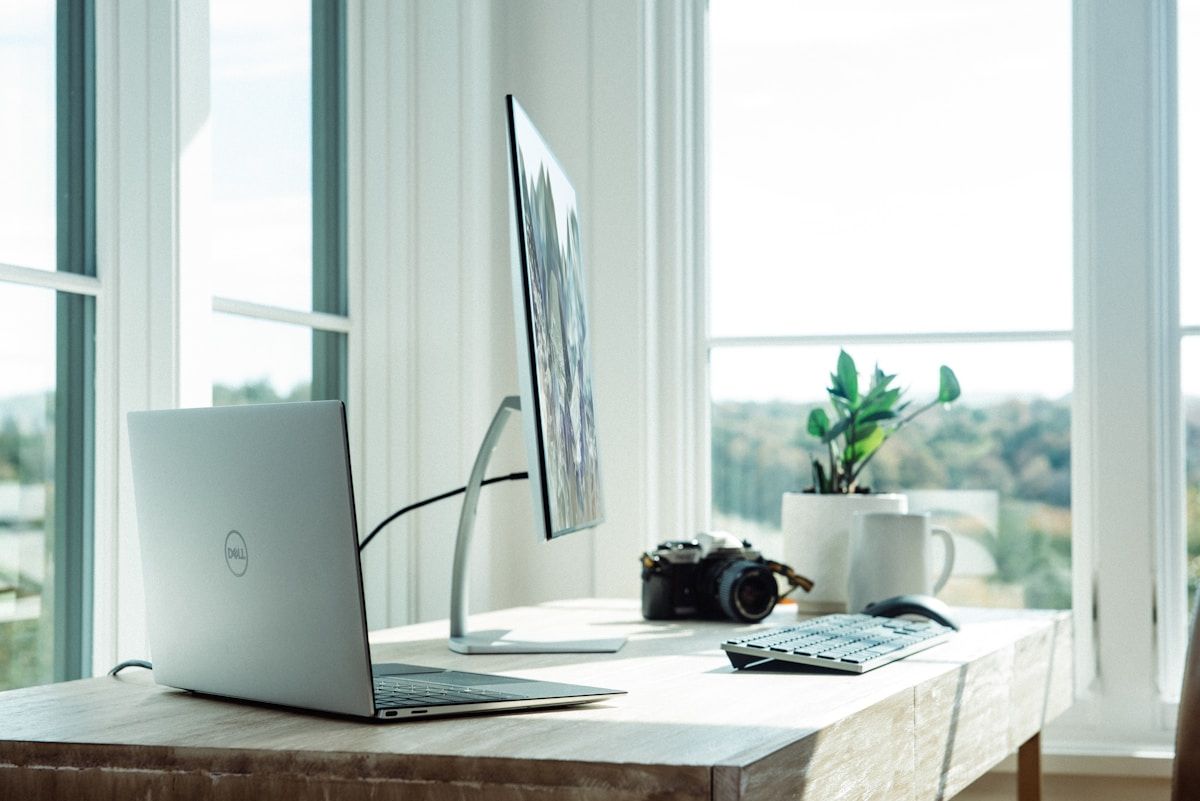
A cable-free desk surface with a single screen removes the low-grade distraction that degrades focus over hours
The home office has the lowest tolerance for visual noise of any room in the house.
Step 1: The One-Screen Default
Unless your work genuinely requires two monitors, one screen reduces decision fatigue and visual spread. If dual monitors are necessary, mount both on a single adjustable arm ($40–$120) to consolidate footprint and keep the desk surface clear beneath them.
Step 2: Cable Control Is Non-Negotiable
Under-desk cable trays ($15–$35), adhesive cable clips ($8–$15), and one power strip mounted out of sight do more to change the feel of a workspace than almost any other intervention.
Step 3: Prioritize Closed Storage
Open shelving in a workspace creates constant low-grade distraction — books not yet read, files not yet filed. Closed cabinets ($120–$400) or a credenza with doors ($200–$600) keep reference materials visually contained.
Step 4: Limit the Desk Surface to 5 Objects
Monitor or laptop. One pen cup. Notepad. Water bottle. One personal item. That’s the list. Everything else — stapler, tape, extra cables, secondary chargers — lives in a drawer.
Step 5: Treat Wall Space Like a Copy Editor
One art piece or a single magnetic glass whiteboard ($80–$200) keeps walls intentional. A covered cork board or layers of scattered reference pages make even a tidy desk feel chaotic by association.
Home office product categories + price ranges:
- Monitor arms, single or dual: $40–$120
- Under-desk cable management trays: $15–$35
- Closed-front file cabinets (wood veneer or matte steel): $120–$400
- Ergonomic desk chairs with clean silhouette: $180–$600
- Magnetic glass whiteboards: $80–$200
Room-by-Room Minimalism at a Glance
The differences across all three rooms become clearer when mapped side by side.
The bedroom’s “very low” decor tolerance isn’t a style preference — it’s a sleep hygiene principle. The living room’s “moderate” tolerance isn’t sloppiness; it’s what prevents social spaces from feeling sterile. And the office’s demand for closed storage reflects the direct relationship between visual noise and cognitive output.
How to Transition All Three Rooms Without Starting Over
The biggest fear people have with minimalism is cost. The truth is, you don’t need new furniture to achieve a minimalist feel in any of these rooms. The IKEA Life at Home Report finds that the perception of calm in a room correlates more strongly with surface clarity and organization than with furniture quality or price — meaning you can get most of the visual result before spending a cent (IKEA Life at Home, 2024).
A practical three-weekend transition plan that won’t burn you out:
Weekend 1 — Bedroom
- Saturday morning: Full declutter using four boxes (keep, donate, store, trash)
- Saturday afternoon: Clear all surfaces and apply the 5-furniture rule
- Sunday: Install a new lighting layer — one bedside lamp minimum; add a neutral linen duvet if budget allows ($60–$80 is enough)
Weekend 2 — Living Room
- Saturday morning: Edit soft furnishings to meet the 4-pillow, 1-pattern rule
- Saturday afternoon: Apply the one-vignette-per-surface rule; use trays to group remaining objects
- Sunday: Cable management for all visible tech
Weekend 3 — Home Office
- Saturday: Reorganize or install closed storage; consolidate open shelving
- Saturday afternoon: Apply the 5-object desk rule
- Sunday: Under-desk cable management and wall simplification
This phased approach keeps the project sustainable. Each finished room builds momentum for the next, which is the most important thing: most minimalism projects fail not from wrong technique but from starting too big and running out of energy before the first room is done.
What most guides miss: staying minimalist is a storage problem, not a decorating one. Rooms drift back to clutter because incoming items have nowhere to land, so they pile on the nearest flat surface. Give every category a closed home first: hidden bins under the bed, a lidded ottoman in the living room, closed cabinets at the desk. Once each thing has a place off-display, surfaces stay clear on their own and the aesthetic holds without daily effort.
Actionable takeaway: Don’t buy anything new until the room has been fully stripped and edited. Ninety percent of the minimalist aesthetic comes from subtraction. Purchases are refinements, not foundations.
Frequently Asked Questions
What’s the single most important rule of minimalist bedroom decor?
Surface clarity outranks every furniture or color choice. Cleared nightstands and dresser tops eliminate the visual processing load that keeps the brain in a wakeful state at night. Sleep Foundation research consistently identifies bedroom environment — especially clutter level and lighting — among the top factors affecting how quickly adults fall asleep (Sleep Foundation, 2025).
Can a minimalist living room still feel warm enough for guests?
Yes — warmth comes from texture and material, not from quantity of objects. One chunky-knit throw ($30–$60), two solid linen pillows, and a single wood or ceramic accent piece on a tray create a welcoming feeling without visual clutter. Natural materials — linen, cotton, rattan, ceramic — add the tactile interest that reads as inviting rather than cold.
Does a minimalist home office have to be all-white?
No. Color doesn’t create clutter — visual complexity does. A home office in deep navy with one white desk and zero cable mess is minimalist. A white room covered in open shelving and layered papers isn’t. Tonal restraint (two tones maximum) plus clutter elimination is the principle; the specific palette is up to you.
What’s the realistic budget to start minimalist bedroom decor?
Under $100 will take you far. A full declutter costs nothing. A neutral duvet cover runs $40–$70. Clearing surfaces is free. That combination alone creates a fundamentally different room. Furniture upgrades — a new bed frame, new nightstands — are optional refinements for later, not entry requirements.
Which room should I start with first?
Start with the bedroom. It’s the fastest room to transform (smaller square footage, clearer function), the results are immediately felt through better sleep, and the confidence from finishing it makes tackling the living room and office much easier.
What’s the most common minimalism mistake in each room?
Each room fails differently, so the fix has to match the room. Bedrooms stall on the sentimental pile that keeps reappearing on dressers. Living rooms tip into cold-and-empty when texture gets stripped out alongside the clutter. Home offices hold onto open shelving that drips low-grade distraction all day. Diagnose by room rather than applying one blanket rule everywhere.
How do you keep a minimalist room from getting cluttered again?
Storage decides it, not willpower. Give every category a closed home before anything new arrives: hidden under-bed bins, a lidded ottoman, closed office cabinets. Pair that with the one-in, one-out habit, where each new item means one leaves. Clear surfaces then hold themselves, since incoming things always have somewhere to land off-display.
Conclusion
Minimalism isn’t a single rule applied the same way everywhere. It’s a function-first framework where each room’s primary purpose — sleep, social connection, or focused work — determines exactly what stays and what doesn’t. Minimalist bedroom decor prioritizes sensory quiet above everything else. The living room tolerates selective warmth and purposeful display. The home office demands the strictest visual discipline of any room in the home.
The path forward is simpler than most people expect: start with subtraction, phase the rooms across three manageable weekends, and resist buying anything new until each space is fully edited. The results — better sleep, sharper focus, a home that actually supports how you live — are well worth the work.
Ready to go further? Our complete guide to modern minimalist decor covers color systems, material selection, and the full room-by-room philosophy from the ground up.
Sources:
- Sleep Foundation, “Sleep and Bedroom Environment,” retrieved 2026-06-03, https://www.sleepfoundation.org
- McMains, S. & Kastner, S., Princeton Neuroscience Institute, “Interactions of Top-Down and Bottom-Up Mechanisms in Human Visual Cortex,” Journal of Neuroscience, 2011, retrieved 2026-06-03, https://pni.princeton.edu
- IKEA Life at Home Report 2024, retrieved 2026-06-03, https://www.ikea.com/global/en/life-at-home/
- Steelcase Global Workplace Research, 2023, retrieved 2026-06-03, https://www.steelcase.com/research/
“`