
Key Takeaways
- Declutter before you decorate. Pulling everything from a category onto the floor (the KonMari method) forces honest decisions in a way shelf-by-shelf editing never will.
- The 90/90 rule is the fastest filter for beginners. If you haven’t used it in 90 days and won’t in the next 90, it leaves.
- Stick to a 60-30-10 neutral palette. Sixty percent dominant neutral, thirty percent secondary tone, ten percent accent — this single rule prevents 80% of beginner mistakes.
- Buy fewer, heavier pieces. One $400 solid-oak side table outperforms four $100 particleboard tables in both longevity and visual calm.
- Empty space is a design element, not a problem to solve. Aim for 40-50% negative space on walls and surfaces.
The six-step minimalist process runs in a fixed order: declutter by category, define a 60-30-10 palette, invest in fewer quality pieces, edit surfaces to three objects, layer texture over color, then protect the empty space. Minimalist decor isn’t about owning the fewest things possible — it’s about owning the right things and letting them breathe. If you’re a minimalist decor beginner staring at a cluttered living room and a Pinterest board full of impossibly serene spaces, the gap can feel huge. It isn’t. The transformation comes down to a repeatable six-step process that any beginner can run in a weekend (declutter) and refine over four to six weeks (decorate).
This guide walks you through every step with specific product categories, real 2026 price ranges, and the decision rules professional stylists actually use.
Step 1: Declutter by Category, Not by Room
The single biggest mistake beginners make is decluttering room by room. You move things around, get tired by hour three, and end up with the same volume of stuff in slightly different locations.
The fix: declutter by category, in this order — clothes, books, papers, miscellaneous (komono), then sentimental. Pull every item in a category from every room into one pile. Seeing all 84 mugs you own at once is what creates the decision.
The decision filter for beginners:
- The 90/90 rule: Have I used it in the last 90 days? Will I use it in the next 90? If both are “no,” it leaves.
- The duplicate rule: Keep the best one. Donate or recycle the rest.
- The “would I buy this today?” rule: If the answer is no, you’re holding it out of guilt, not utility.
What most guides miss: Decluttering fails less from bad rules and more from fatigue. Work in 20-minute zones with a timer, one drawer or shelf per block, then stop. Three or four 20-minute blocks across a day clear a whole category over a weekend, without the burnout that makes most people quit at hour three and quietly reverse their progress.
Actionable takeaway: Block out one full weekend. Start with clothes (fastest dopamine hit) and finish with papers (slowest, most tedious). Have three labeled bins ready: Donate, Recycle, Trash. A fourth bin — “Maybe” — should be sealed, dated 30 days out, and donated unopened if you haven’t reached into it.
Free checklist
Spending $100 on a room? Spend it in this order.
The four phases we use, starting with the free one that changes more than any purchase.
Step 2: Define Your Minimalist Color Palette
Before you buy a single decor item, lock in your palette. This is where most beginner minimalist rooms fail — not from too many objects, but from too many competing tones.
Use the 60-30-10 rule:
- 60% dominant neutral — walls, large rugs, sofa. Warm white, soft greige, or oat.
- 30% secondary tone — curtains, accent chair, bedding. Natural oak, soft charcoal, or warm taupe.
- 10% accent — throw pillows, art, ceramics. Black, terracotta, sage, or brushed brass.
Skip stark cool whites unless your room gets strong north light — they read clinical in most homes. Warm neutrals (Benjamin Moore White Dove, Farrow & Ball Slipper Satin, Sherwin-Williams Alabaster) flatter both natural materials and skin tones in photos.
For a deeper breakdown of which specific tones create calm without feeling sterile, see our minimalist color palette guide.
Actionable takeaway: Tape three large paint swatches to your wall and live with them for 48 hours. Check them in morning light, afternoon light, and lamp light. The swatch that still feels good at 9 p.m. is the one.
Step 3: Choose Quality Foundation Pieces
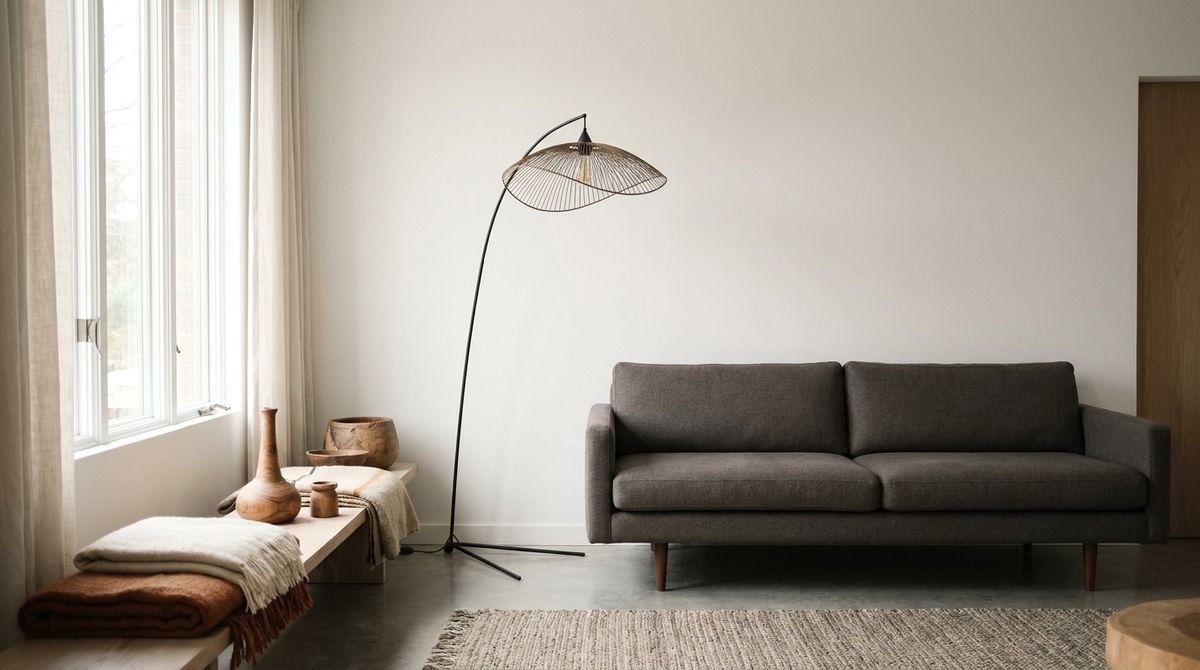
Minimalism magnifies quality. When a room contains five objects instead of fifty, every flaw is visible — the wobbly leg, the cheap veneer peeling at the corner, the polyester throw that pills after one wash.
This is where the beginner’s budget question gets real. You don’t need designer pieces, but you do need to stop buying disposable furniture. A useful rule: half as many pieces, twice the price per piece.
Realistic 2026 price ranges for foundation pieces:
| Piece | Beginner Budget | Mid-Range | Investment |
|---|---|---|---|
| Sofa (3-seater) | $700-$1,200 (Article, Castlery) | $1,500-$2,800 (West Elm, Burrow) | $3,500+ (DWR, Room & Board) |
| Solid wood dining table | $450-$800 (IKEA Mörbylånga, Wayfair) | $900-$1,800 (Crate & Barrel) | $2,000+ (heirloom-grade oak/walnut) |
| Bed frame (queen) | $300-$600 (Thuma alternatives) | $700-$1,200 (Thuma, Floyd) | $1,500+ (solid hardwood) |
| Linen curtains (pair) | $80-$150 (IKEA, H&M Home) | $180-$300 (Quince, Parachute) | $400+ (Restoration Hardware) |
| Wool area rug (8×10) | $300-$600 (Rugs USA, Revival) | $700-$1,400 (Lulu and Georgia) | $2,000+ (hand-knotted) |
Actionable takeaway: Audit your current furniture. List every piece that wobbles, sheds, or you don’t actively love. Don’t replace them all at once — replace one piece per quarter with something built to last 15+ years. The room transforms within a year without a single stress spike.
Step 4: Edit Surfaces to the “Rule of Three”
Every flat surface in your home — coffee table, console, nightstand, kitchen counter — should follow a simple rule:
No more than three objects per surface, varying in height.
This is the styling shortcut professional photographers use. Three objects create visual rhythm without competing for attention. Try a stack of two books, a low ceramic bowl, and a small sculpted object. Or a single tall vase with a branch, a low candle, and a coaster.
Categories that work on a minimalist surface:
- One organic element — branch, dried grass, single stem in a bud vase ($8-$25)
- One textural object — a small ceramic, wood bowl, or stoneware vessel ($20-$80)
- One book or stack — hardcover, with the spine you love facing out ($0, you already own them)
The rest goes into closed storage. This is the part beginners resist most: closed storage is the cheat code of minimalist decor. Open shelves require constant editing. A media console with doors lets your living room look styled at 11 p.m. on a Tuesday without effort.
Actionable takeaway: Walk through your home with a tray. Sweep every surface clean. Then place back only three intentional objects per surface. Everything else goes into a “decision box” — if you don’t retrieve it within two weeks, it leaves.
Step 5: Layer Texture, Not Color
Once color is restrained, beginners often worry their space will feel cold or boring. The answer isn’t more color — it’s more texture.
A minimalist room reads warm and lived-in when it stacks 4-6 distinct textures within a tight palette:
- Linen — curtains, throw pillows, bedding ($30-$120 per piece)
- Wool or jute — area rugs, throws ($80-$400)
- Solid wood — table tops, shelves, side tables — visible grain matters
- Matte ceramic — vases, planters, dinnerware ($15-$70)
- Woven natural fiber — rattan baskets, seagrass storage ($25-$80)
- Unpolished metal — brushed brass, blackened steel, raw iron ($20-$200)
Avoid mixing more than two metal finishes in the same room. Avoid glossy or lacquered finishes entirely unless you’re going for a high-contrast Japandi look — they fight against the soft, matte language that defines beginner-friendly minimalism.
Actionable takeaway: Photograph your room in black and white. If the photo still looks rich and varied, your texture layering is working. If it looks flat, you need more material contrast, not more objects.
Step 6: Protect the Empty Space
The final step is the hardest: stop filling the gaps. Minimalism’s defining feature isn’t what you put in a room — it’s what you leave out. Negative space is what makes a $200 IKEA chair look intentional and a $4,000 designer chair look loved.
Some rules that hold up:
- Walls: Aim for 40-50% of wall surface left empty. One large piece of art is almost always better than three small ones.
- Floors: Keep one clear walking path that’s at least 36 inches wide through every room.
- Corners: Leave at least one corner of every room completely empty. The eye needs a place to rest.
- Shopping pause: Wait 30 days between adding any new decor object. The urge to fill space passes; the calm of empty space deepens.
What most guides miss: Re-cluttering starts at the doorway, not the store. Give every kept object one fixed home, then set a single “landing zone”, one tray or drawer for keys, mail, and stray items, and empty it every Sunday. Homes stay minimalist because each thing has a place; anything that can’t find a home is the next item to leave.
This is also where you’ll feel the strongest pushback — from yourself, from family, from anyone visiting who expects “decorated” to mean “full.” Hold the line for 60 days. The shift is psychological: empty space stops reading as incomplete and starts reading as luxurious. That’s the moment minimalist decor clicks.
Actionable takeaway: Install a one-in, one-out rule for the next 12 months. Every new decor object requires one to leave. This single habit prevents 95% of clutter creep and is the secret behind every minimalist home that stays minimalist past month three.
Putting the 6 Steps Together
The order matters. Decluttering before decorating prevents you from styling around objects you don’t actually want. Locking your palette before buying foundation pieces prevents expensive returns. Editing surfaces before layering texture prevents visual chaos from creeping back in within weeks.
A realistic timeline for a minimalist decor beginner working one room at a time:
- Weekend 1: Steps 1-2 (declutter by category, define palette)
- Weeks 2-4: Step 3 (replace one foundation piece, live with it)
- Weekend 4: Steps 4-5 (edit surfaces, layer texture)
- Ongoing: Step 6 (protect empty space, one-in-one-out)
You don’t need a renovation budget, a designer, or a four-month sabbatical. You need a weekend, a 60-30-10 palette, and the discipline to leave a few surfaces empty.
For the broader strategy behind this approach — the design philosophy, the room-by-room application, and how minimalism intersects with current 2026 interior trends — start with our complete modern minimalist decor guide.
Frequently Asked Questions
How long does it take a beginner to fully transition to minimalist decor?
Most beginners reach a stable, minimalist baseline in 6-8 weeks: one weekend to declutter, four weeks to replace foundation pieces, and two weeks of styling refinement. Full visual mastery — knowing exactly what to leave out — takes about six months of living with the choices.
Do I have to throw away everything I own to be a minimalist?
No. Minimalism is about intentionality, not scarcity. If you own 200 books and read all of them, keep them all. If you own 12 throw pillows and use two, donate ten. The test is honest use, not arbitrary numbers.
Do you have to declutter the whole house in one weekend?
No. Work one category at a time in 20-minute zones. Most beginners clear clothes in a single weekend, then handle books and papers over the following two weeks. Spreading it out prevents the hour-three fatigue that makes people quit and slowly reverse their progress.
What’s the cheapest way to start minimalist decor on a tight budget?
Start with steps 1, 2, 4, and 6 — they cost nothing. Decluttering, choosing a palette, editing your surfaces to three objects, and protecting empty space transform a room without spending a dollar. Foundation pieces (Step 3) can be replaced gradually over 12-18 months.
How do you keep a minimalist home from getting cluttered again?
Give every kept item one fixed home and run a one-in, one-out rule. Add a single landing tray for daily stray objects and empty it weekly. Re-clutter almost always starts with homeless items piling on flat surfaces, so a designated spot for each thing is the real safeguard.
Why does my minimalist room still feel cold even though I followed the rules?
You’re probably under-textured. Add a chunky wool throw, a jute rug under your existing rug, and a single large dried branch in a floor vase. Warmth in minimalism comes from material variety within a restrained palette — not from adding color.
Can minimalist decor work in a small apartment or rental?
It works best in small spaces. Minimalism makes 600 square feet feel like 900. In rentals, focus on Steps 1, 2, 4, 5, and 6 — all renter-friendly. For Step 3, prioritize pieces you’ll take with you: a quality sofa, a solid wood dining table, and good lighting outlast any lease.