
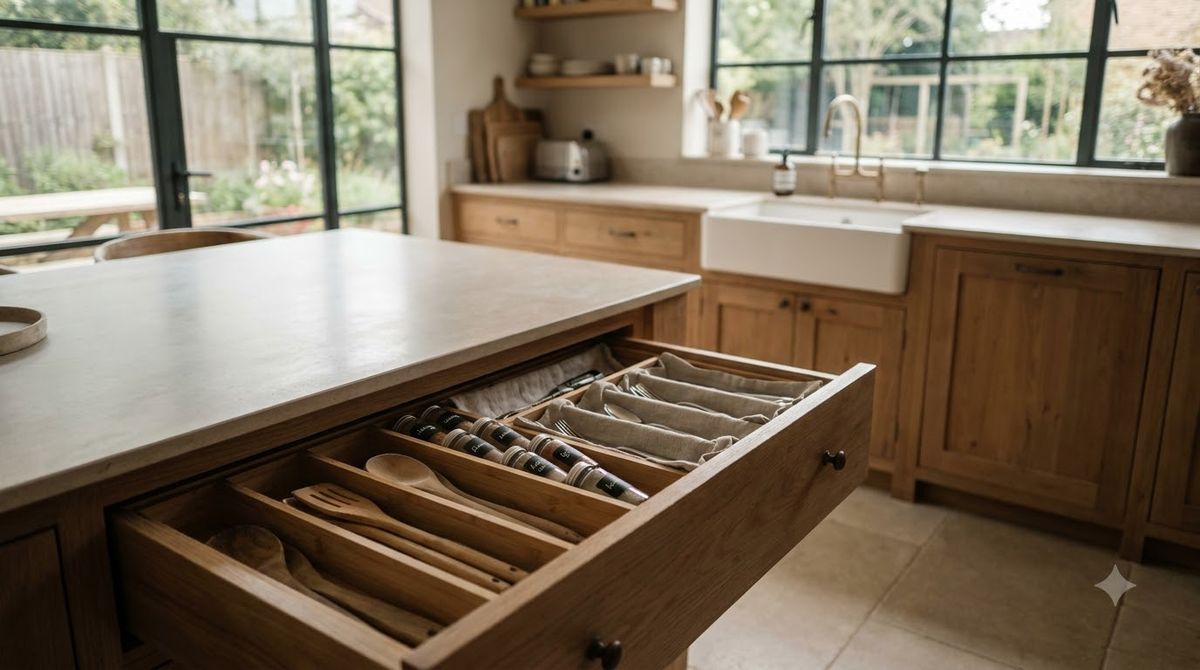
A messy kitchen drawer isn’t a storage problem. It’s a system problem. Most drawers become a single sliding pile because nothing has a defined lane, so every item drifts every time you open and close. The fix costs less than you’d guess: a good divider set runs $12-$20, and non-slip liner is about $8 a roll. After organizing dozens of apartment kitchens, here’s what actually works, seven steps in the order we’d tackle them, from the first empty-and-measure to a tested shopping shortlist.
Key Takeaways
- Empty and measure first: interior depth and width decide which organizers fit, and skipping this step is the top reason dividers get returned
- Utensils need lanes: an expandable divider or angled tray ends the tangle for $12-$20
- The junk drawer isn’t the enemy: one small-bin insert turns it into a tidy catch-all in ten minutes
- Deep drawers waste vertical air: peg systems and tiered inserts stop pots and lids from stacking into chaos
- Spices belong in a drawer, not a cabinet: an angled tiered insert makes every label readable at a glance
- Non-slip liner is the quiet MVP: it keeps dividers and contents from sliding on every open
1. Empty and Measure Your Drawers
Start by emptying the drawer completely, then measure three numbers: interior width, depth (front to back), and clearance height. This single step prevents the most common mistake we see, which is buying an organizer that’s an inch too wide to close the drawer. The Spruce recommends measuring before shopping for exactly this reason (The Spruce).
Pull everything out onto the counter and wipe the drawer clean. Sort as you go: keep, relocate, toss. Chipped tools, dried-out pens, and mystery gadgets don’t earn a spot. Write your three measurements on your phone before you shop.
What most guides miss: measure the interior at its narrowest point, since many drawer boxes taper or have runner rails that steal a quarter-inch on each side near the back. Height matters just as much: the countertop lip above the drawer sets your real clearance, so a tiered insert that fits the box can still jam on the way in. Standard kitchen drawers run roughly 3 inches deep (utensil) to 10-plus inches (pots), and widths of 12-30 inches, so write all three numbers down, not just width.
- Measure interior width and depth, not the outside of the drawer
- Note clearance height so trays and inserts still let the drawer shut
- Declutter first, so you buy fewer organizers than you’d expect
Free checklist
Spending $100 on a room? Spend it in this order.
The four phases we use, starting with the free one that changes more than any purchase.
2. Utensil Dividers and Trays
The utensil drawer is where most chaos lives, and dividers are the cure. An expandable bamboo divider set runs about $12-$18, while a molded utensil tray from OXO or mDesign runs $10-$20. An adjustable divider usually beats a fixed tray because you can reset the lanes as your tools change.
For a tight drawer, angled trays let you fit more without a tangle. Group by use: one lane for cooking tools, one for serving, one for gadgets.
What most guides miss: an expandable divider is sized by its compressed length, so buy one whose closed width is slightly under your interior measurement and let the spring-tension arms push out to fill the gap. A set that starts wider than the drawer won’t seat flat. The arms grip better over a strip of non-slip liner than on bare drawer bottoms, which stops the whole frame from creeping forward each time you yank the drawer open.
- Expandable bamboo dividers ($12-$18): adjustable lanes, best for odd sizes
- Molded utensil tray ($10-$20): drop-in and done, ideal for standard drawers
- Edge-grip dividers ($15): press-fit sides, no adhesive, renter-friendly
Deeper systems for the whole kitchen live in our kitchen cabinet organization guide.
3. The Junk Drawer Fix
Every kitchen has one, and that’s fine. The problem isn’t having a catch-all drawer, it’s letting it run without any structure. A modular small-bin insert set (IKEA and mDesign both sell them for $10-$15) turns the pile into defined zones in about ten minutes.
The trick: give each category its own bin so items stop migrating. Keep only what genuinely belongs in a kitchen catch-all.
- Batteries, tape, and twist ties in the smallest bins
- Pens, scissors, and a notepad in a medium lane
- Purge takeout menus and dead pens every season
4. Deep Drawer Solutions
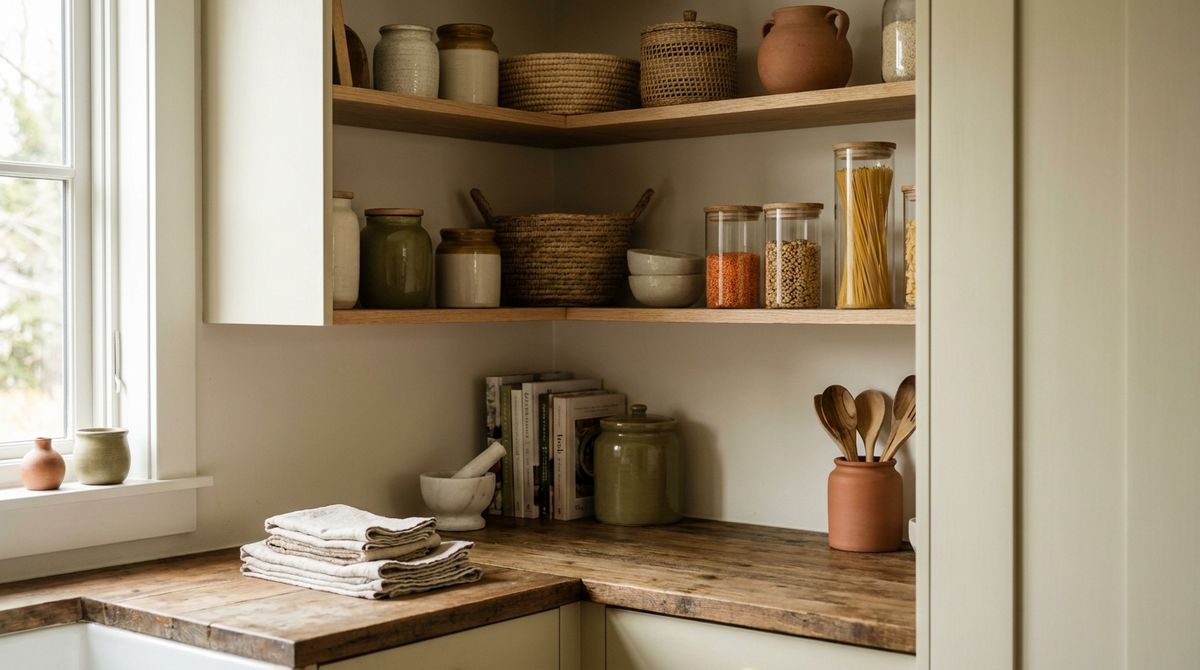
Deep drawers hide the most wasted space in the kitchen because everything stacks into an unstable pile. The fix is dividing vertically. Adjustable peg-board inserts ($25-$40) hold plates and lids upright, and tiered inserts let you see the back row without digging.
Store pots and pans on their sides, or stand lids in a peg system so they don’t slide loose. We keep a shallow catch-all tray on top of taller items so no vertical inch goes unused. For more clever space wins, browse our kitchen storage hacks.
- Peg-board insert ($25-$40): pegs move to grip pots, lids, and plates
- Tiered riser insert ($15-$25): back row sits higher and stays visible
- Vertical file rack ($12): stands lids and cutting boards on edge
5. Spice Drawer Setup
Spices belong in a drawer, not stacked three-deep in a cabinet where the back row expires unseen. An angled tiered drawer insert ($15-$30 from The Container Store or Amazon) tilts each jar so the label faces you the moment you open the drawer. It’s one of the highest-satisfaction fixes we install.
Decant into uniform jars only if you’ll keep it up, otherwise the original tins work fine on a tiered insert. Alphabetize or group by cuisine, whichever you actually reach for. The Container Store has a helpful drawer-spice overview (The Container Store).
Pantry and bulk food zoning is covered in pantry organization ideas.
6. Non-Slip Liners
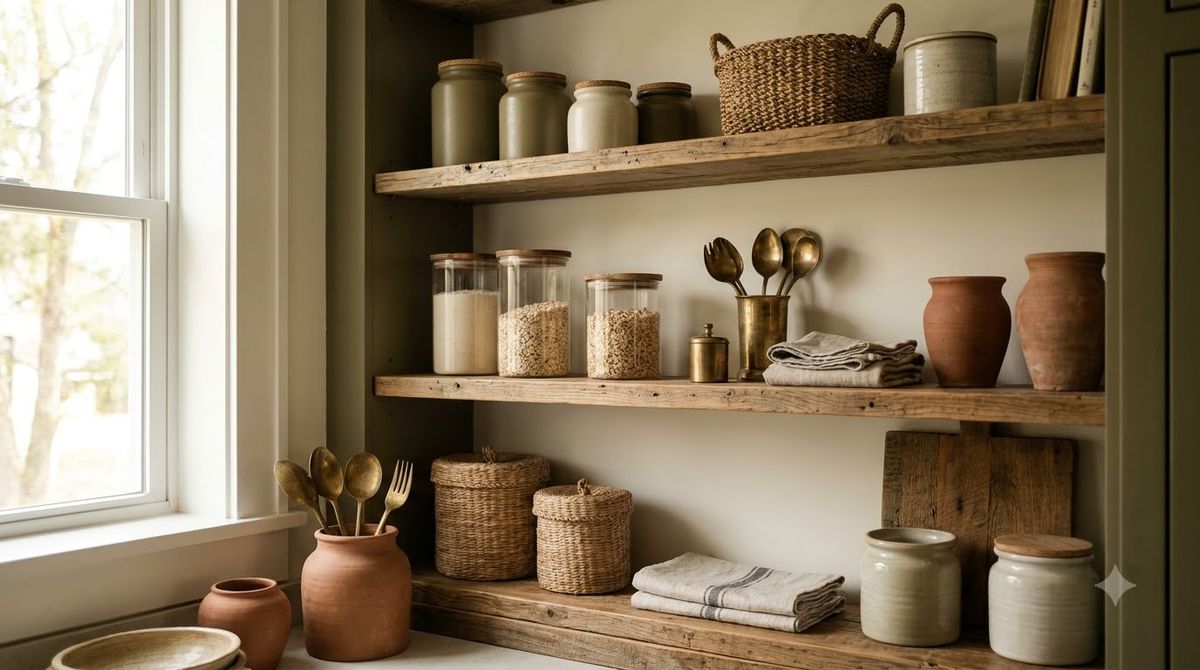
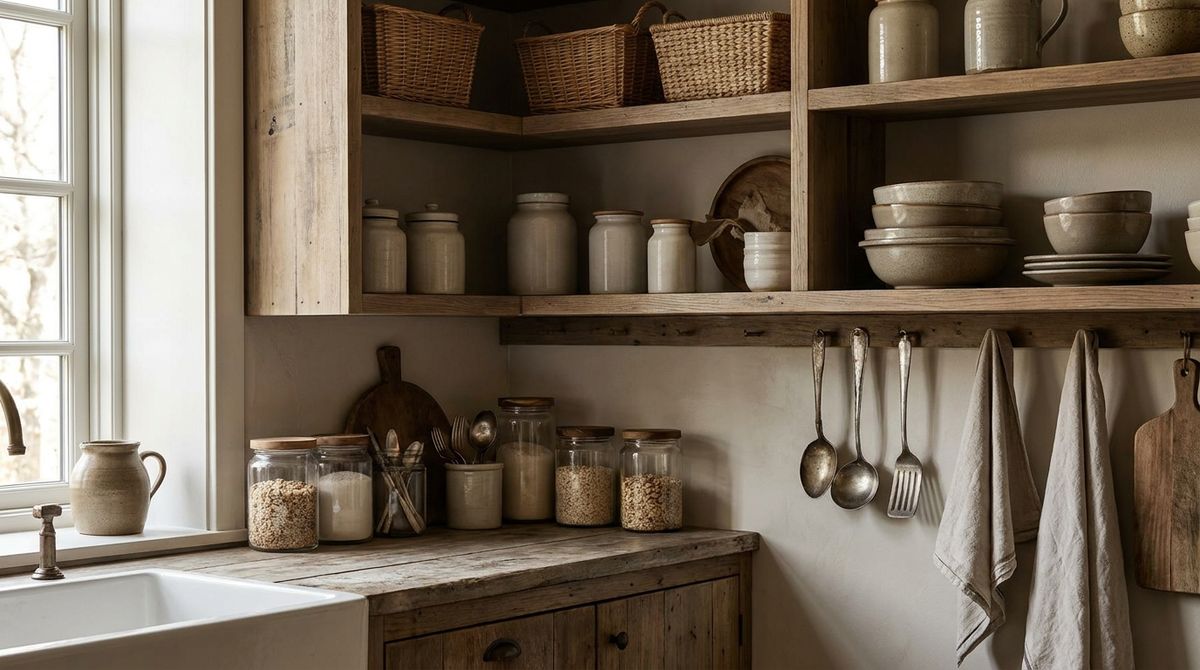
Liner is the quiet workhorse of a good drawer. A non-slip liner ($8-$12 a roll) stops trays, dividers, and loose items from sliding every time you open and close. It also protects the drawer bottom from scratches and crumbs, which matters most in a rental you want your deposit back on.
Cut it to size with scissors, no adhesive needed. The grippy foam kind wipes clean and lifts out for a rinse.
- Choose the ventilated foam style for easy cleaning
- Cut about a half-inch short of each edge so it lies flat
- Renters especially benefit, since it’s fully removable
Damage-free systems for the whole kitchen are in our no-drill renter kitchen guide.
7. Best Drawer Dividers
If you want a ready-to-buy shortlist, these are the drawer organizers that deliver the most order per dollar. Our full tested roundup with specific picks lives in best kitchen organizers 2026, and counter fixes are in kitchen countertop organization.
- Expandable bamboo dividers: adjustable lanes for any drawer
- Molded utensil tray: drop-in fix for standard drawers
- Modular small-bin set: tames the junk drawer
- Angled spice insert: every label readable at a glance
- Non-slip drawer liner: keeps everything from sliding
Frequently Asked Questions
How do I organize kitchen drawers on a budget?
Start with what you own by decluttering, then add one expandable divider set ($12-$18) and a roll of non-slip liner ($8). That covers most drawers under $30. Buy inserts only after measuring, so nothing gets returned for being too wide.
What’s the best way to organize a deep kitchen drawer?
Divide vertically. An adjustable peg-board insert ($25-$40) holds plates and lids upright, and a tiered riser keeps the back row visible. Store pots on their sides so the deep space works for you instead of becoming an unstable pile.
How do I keep a junk drawer from getting messy again?
Give every category its own bin so items stop migrating, and do a quick seasonal purge of dead pens and old menus. A modular small-bin set ($10-$15) is what turns a catch-all from chaos into a tidy, usable drawer.
Do I really need drawer liner?
It’s optional but genuinely useful. Non-slip liner stops dividers and contents from sliding on every open, protects the drawer bottom, and lifts out for cleaning. For renters wanting a deposit back, it’s a cheap layer of protection at $8-$12 a roll.
What are standard kitchen drawer dimensions?
Most base-cabinet drawers measure 12-30 inches wide, 20-24 inches deep, and 3-10 inches tall inside. Shallow utensil drawers are about 3 inches deep; pot drawers run 10 inches or more. Measure your own box, since runner rails and tapered sides can shave a quarter-inch off each edge.