
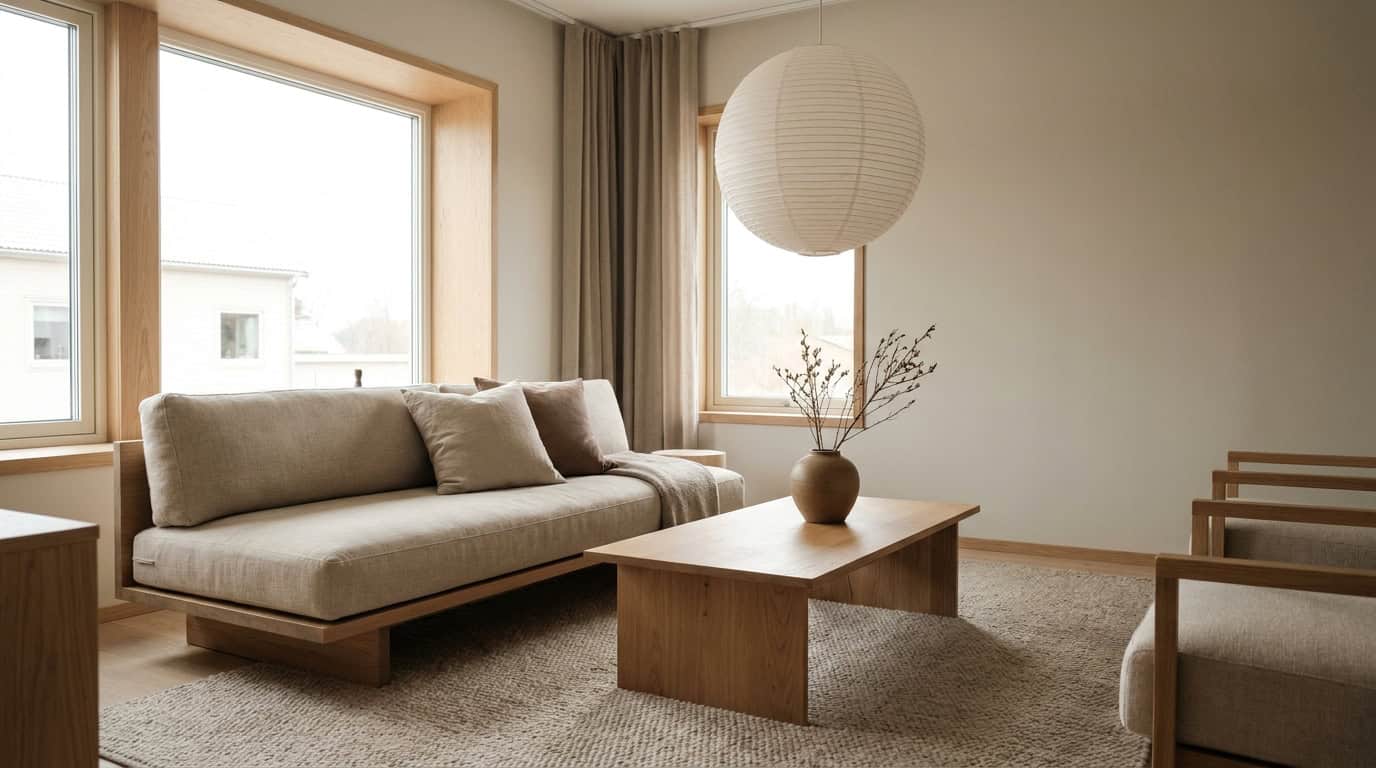
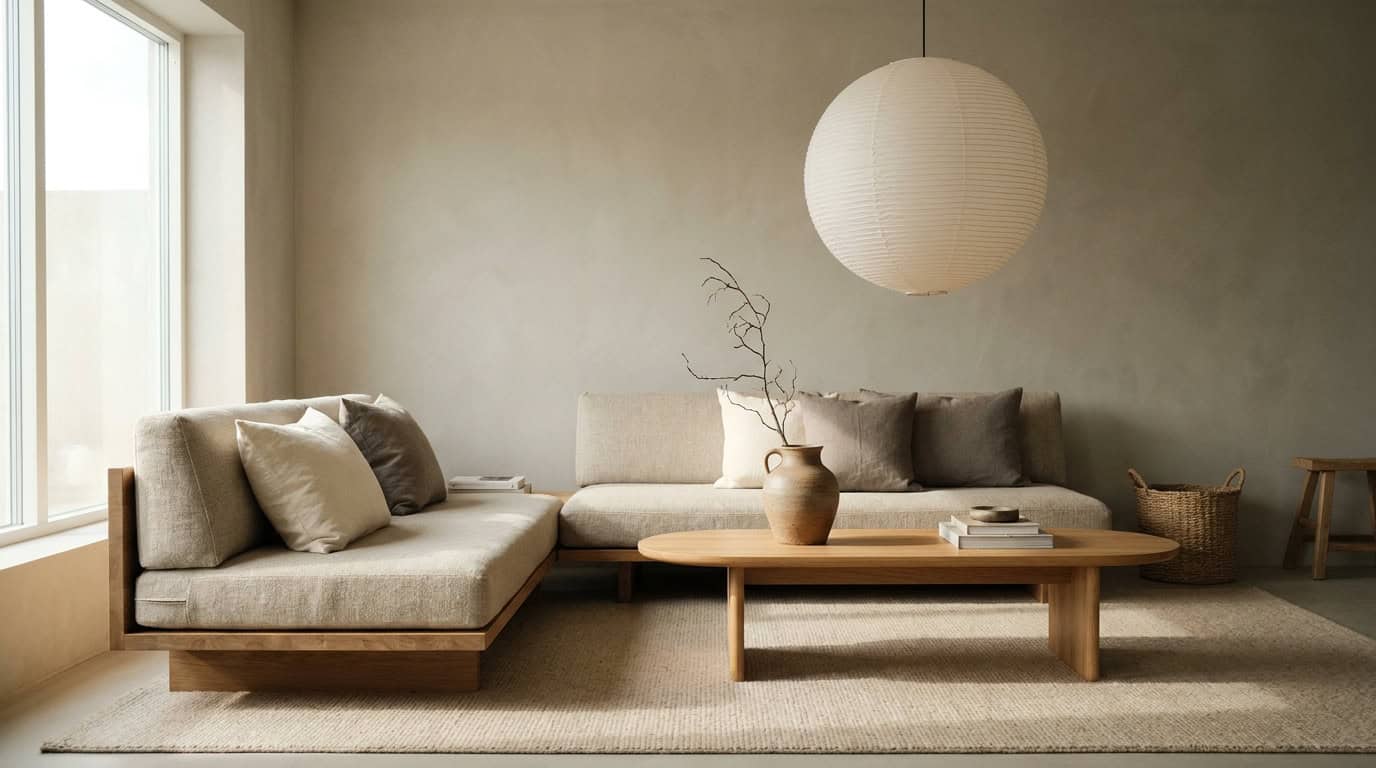
Scroll Pinterest long enough and the same room appears three times under three different labels: Japandi, Wabi-Sabi, Zen. Same warm neutrals. Same low platform bed. Same lone pampas grass stem in a ceramic vase. The aesthetic overlap is real — but the philosophies behind them are not the same thing, and treating them as interchangeable leads to real decorating mistakes.
Japandi emerged as a named design trend around 2018. Wabi-Sabi traces back to 16th-century Japan as an aesthetic philosophy. Zen is a school of Buddhist practice that arrived in Japan from China in the 13th century and informed everything from garden design to architecture to tea ceremony. Three distinct roots, three different sets of rules for what a room should do. Here is how they actually differ — and which one belongs in your home.
The one-line version: Japandi is a curated look, Wabi-Sabi is a philosophy of imperfection, and Zen is a discipline of empty space. Everything below is detail on those three sentences.
Key Takeaways
- Japandi = curated, styled, Pinterest-ready. Best for renters who want a polished look that photographs well.
- Wabi-Sabi = beauty in age and imperfection. Best if you already own handmade, heirloom, or visibly worn objects you love.
- Zen = radical emptiness. Best if your actual goal is calm, focus, or a true meditation-friendly space.
- All three use neutral palettes and natural materials — but their tolerance for ornament, color, and visible wear is completely different.
- Mixing Japandi and Wabi-Sabi carelessly produces rooms that feel neither polished nor intentionally imperfect — just unfinished.
The 3 Philosophies in One Sentence Each
Understanding the source philosophy matters because it dictates every downstream decision — how much you spend, what you keep, and what you remove.
Japandi is a portmanteau of Japanese and Scandinavian design, coined as a Western trend around 2018 that merges Japan’s wabi-influenced minimalism with Nordic functionalism: every object earns its place by being both useful and beautiful.
Wabi-Sabi is a Japanese aesthetic philosophy with roots in 16th-century tea ceremony culture — specifically in the teachings of tea master Sen no Rikyu — that finds beauty in impermanence, incompleteness, and the honest evidence of time passing on objects and materials.
Zen refers to design principles derived from the Rinzai and Soto schools of Zen Buddhism, which took hold in Japan from the 13th century onward, and which hold that unobstructed negative space — not objects — is the primary design element.
These three philosophies share a respect for natural materials and an aversion to mass-market visual noise, but that is roughly where the agreement ends.
Free · 60 seconds
Not sure which style is actually yours?
Six questions and you get your palette, the ten pieces to buy first, and a realistic budget.
Japandi — Defined for Western Homes
Origin: Trend-named around 2018 in Western design media, drawing on longstanding Japanese mingei (folk craft) traditions and Scandinavian functionalism (think: Danish Modern from the 1950s, rebooted).
Signature moves:
- Low-profile furniture with clean, deliberate lines — think walnut or oak platform beds, low-slung sofas
- A controlled palette: warm off-whites, warm greys, terracotta, sage, charcoal — never bright whites or primary colors
- Dark wood accents paired with light linen
- Handmade ceramics chosen for their form, not their age or visible wear
- Exactly the right number of objects: a curated grouping, not a cluttered shelf and not an empty one
Brands that do it well: Muji (Japan) for storage and textiles; HAY (Denmark) for furniture and accessories.
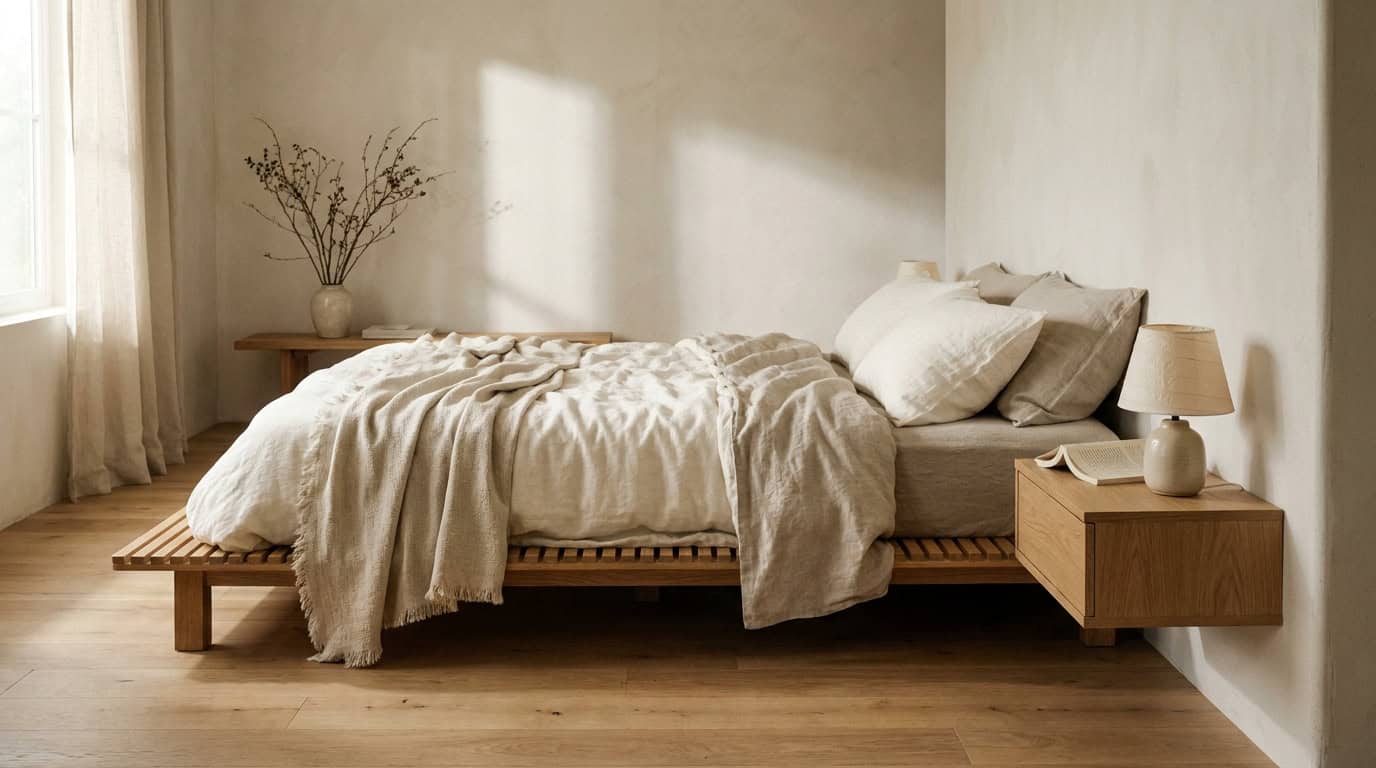
Defining feature: Japandi is curated balance. It is a styled look designed to be photographed, pinned, and reproduced. There is nothing spiritual about Japandi — it is design-forward minimalism for people who want a beautiful, liveable home without going full monastic. The “handmade” ceramics can come from a well-chosen studio or a carefully selected retail find. The goal is visual harmony, not philosophical purity.
What most guides miss: The Scandinavian half is what keeps Japandi liveable. Nordic design brings hygge warmth and lagom (just-enough) restraint, so a Japandi room welcomes a soft wool throw, layered lamp light, and a cushioned reading chair. That everyday comfort is exactly what a stricter Zen or temple-minimal room would strip out.
Common mistake: Buying “Japandi” labeled products that are simply beige. The actual quality of materiality matters — cheap linen-look polyester defeats the whole point.
For a full breakdown of the Japandi system, see our Ultimate Japandi Style Guide.
Wabi-Sabi — Defined
Origin: Emerges from 16th-century Japanese tea ceremony culture, where Sen no Rikyu deliberately chose rough, asymmetrical, unglazed vessels over the Chinese porcelain that was fashionable at the time. The philosophy was formalized through centuries of aesthetic writing and practice, and introduced to Western design audiences most influentially through Leonard Koren’s 1994 book Wabi-Sabi for Artists, Designers, Poets & Philosophers.
Signature moves:
- Visible age and wear on surfaces — patinated metal, worn wood, cracked plaster — treated as beautiful, not a flaw to fix
- Asymmetry and irregular form: a bowl that is not quite round, a plank with a live edge, a wall with texture variation
- Raw, undyed, or naturally aged textiles: linen, rough cotton, unbleached wool
- Kintsugi-style thinking — broken objects repaired visibly with gold, highlighting the break rather than hiding it
- A general comfort with dust, shadow, and things that are “not quite finished”
Sourcing notes: Real Wabi-Sabi objects are harder to fake than Japandi. A mass-market “distressed” ceramic from a big-box retailer reads as fake aging, not honest imperfection. Seek out actual artisan ceramics (Etsy studios, local pottery markets), genuinely vintage pieces, or objects with real provenance. The price per piece tends to be higher, but you need fewer of them.
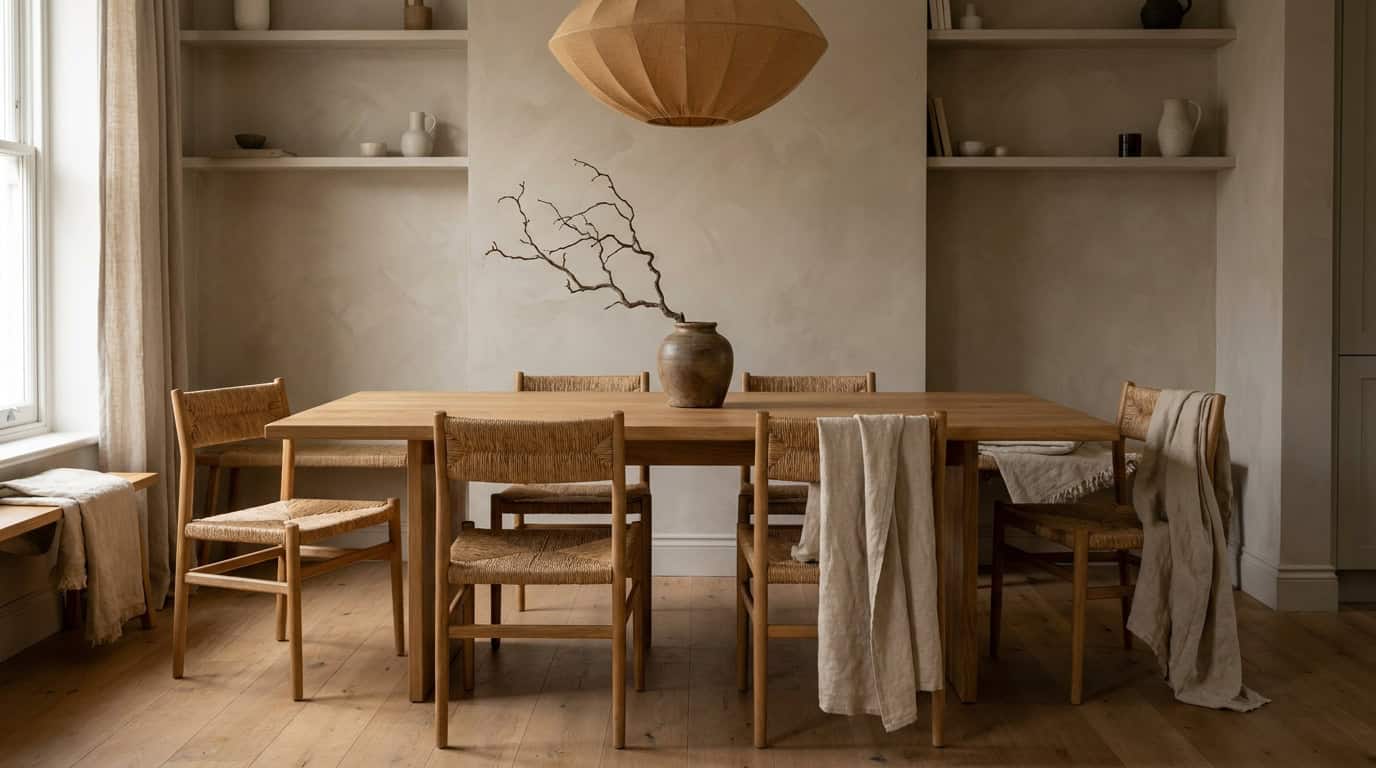
Defining feature: Intentional imperfection. Wabi-Sabi is a philosophical stance about what is worth valuing — not a surface aesthetic you apply. A room can be Wabi-Sabi only if the objects in it have real stories, real age, or real handwork behind them. Without that, it is just a beige room with rough textures.
For how Wabi-Sabi principles work within Japandi, see Wabi-Sabi in Japandi: Using Imperfection and Warmth.
Zen — Defined
Origin: Zen Buddhism arrived in Japan from China (Chan Buddhism) in the 12th and 13th centuries. Its design expressions developed most visibly in karesansui (dry stone gardens), Zen temple architecture, and the tea ceremony tradition that Sen no Rikyu would later shape into Wabi-Sabi. In the context of residential interiors, Zen design principles prioritize the psychological effect of space itself over the psychological effect of objects within it.
Signature moves:
- Negative space dominance: the empty areas of a room are intentional design decisions, not gaps to fill
- Single-focal arrangements: one ikebana flower arrangement on a cleared surface rather than a grouped vignette
- Monochrome or near-monochrome palette — often cooler and starker than Japandi’s warmth, sometimes simply white and natural wood
- Minimal ornament: if it can be removed and the room still functions, it probably should be removed
- Horizontal sightlines and floor-level living that keeps the eye low and the ceiling expansive
Defining feature: Emptiness as design. A Zen-influenced room targets 60-70% empty visual space. This is not poverty of ideas — it is a deliberate decision that the absence of visual stimulation is itself the experience the room delivers. A Zen bedroom should feel slightly like a well-maintained hotel room that has been stripped of all branding, or like a traditional Japanese inn (ryokan) room between guests.
Practical implication: Zen is the most demanding of the three for Western households because it requires ongoing discipline. The kitchen counter stays cleared. The single bonsai on the windowsill stays the only thing on the windowsill. The moment visual accumulation starts, the philosophy breaks.
What most guides miss: Zen and minimalism are not the same thing. Minimalism removes clutter so surfaces look clean, and a minimalist room can still be full of sleek, matched products. Zen removes objects so the empty space itself becomes the focus. If you want the calm without the discipline, you probably want minimalism, not Zen.
Side-by-Side Comparison
| Japandi | Wabi-Sabi | Zen | |
|---|---|---|---|
| Origin | Western trend, c. 2018 (Japan + Scandinavia) | Japanese philosophy, 16th c. | Buddhist practice, 13th c. Japan |
| Wood tone | Warm: walnut, oak, ash | Variable: aged, dark, or driftwood-pale | Natural but secondary to space |
| Ornament tolerance | Low — curated groupings only | Medium — imperfect objects welcome | Very low — single focal point only |
| Empty space ratio | ~40-50% | ~30-50% (objects earn their place) | ~60-70% |
| Color palette | Warm neutrals: off-white, sage, terracotta, charcoal | Earthy, muted, sometimes darker and moodier | Cool or neutral monochrome; cooler greys |
| Iconic object | Studio ceramic + dark wood tray | Kintsugi bowl, aged linen, live-edge piece | Single ikebana arrangement or bonsai |
| How it FEELS in a room | Styled, calm, photographable | Honest, textured, slightly moody | Still, expansive, almost austere |
| Common mistake | Buying beige mass-market products and calling it done | Using fake-distressed retail pieces instead of real objects | Confusing “sparse” with “Zen” — emptiness without intention reads as bare, not calm |
Which One Should You Pick
This is a practical decision more than an aesthetic one.
Pick Japandi if:
You want a room that looks deliberate and polished, you enjoy the process of curating objects, your budget allows for some quality investment pieces (a real ceramic, a decent linen duvet cover), and you want something that translates well on Pinterest or in photos. Japandi is the most accessible of the three for renters because it does not require heirloom objects or permanent architectural changes. See our color palette guide and step-by-step starting guide to begin.
Pick Wabi-Sabi if:
You already own objects with real history — a grandmother’s rough-glazed bowl, a reclaimed wood table, linen curtains that have softened with washing. Wabi-Sabi is not a starting-from-scratch style. It rewards people who have genuinely aged or handmade things they love and want a framework that honors rather than hides them. Budget is less about spending more and more about spending selectively on objects with real provenance.
Pick Zen if:
Your actual problem is not aesthetic — it is psychological. You want your home to support focus, rest, or a genuine meditation practice. Zen design works best when the architecture supports it (lower ceilings help, open-plan spaces help) and when the occupant is genuinely committed to ongoing removal rather than ongoing addition. It is the hardest style to maintain in a shared household.
For budget estimates across Japandi and adjacent styles, see our Japandi decor budget breakdown.
The Hybrid Trap
Pinterest is full of boards labeled “Japandi-Wabi-Sabi” — and most of them fail. Here is why.
Japandi’s defining move is curated polish. Every object is chosen for form and finish. Wabi-Sabi’s defining move is tolerance for honest imperfection — worn surfaces, irregular forms, the visible evidence of time. These two intentions are not compatible at the object level. A distressed plaster wall reads as Wabi-Sabi. The same wall behind a set of sleek, matched Japandi ceramics creates visual dissonance — the ceramics look too perfect for the wall, the wall looks too rough for the ceramics.
The styles can share a room if they occupy distinct zones, but trying to blend them at the surface level — rough textures with polished objects throughout — usually produces a room that feels neither intentionally imperfect nor intentionally curated. Just unresolved.
For a comparison with the third related style, see Japandi vs Scandinavian vs Minimalist.
Frequently Asked Questions
Is Japandi just Wabi-Sabi for Westerners?
Not quite. Japandi borrows from Wabi-Sabi’s preference for natural materials and handcrafted objects, but it strips out Wabi-Sabi’s philosophical core — the acceptance of impermanence and visible aging. Japandi wants handmade objects that look new and perfect. Wabi-Sabi wants objects that show their age honestly. The Pinterest aesthetic overlaps; the underlying values do not.
Can a single room be all three?
In practice, no. Zen’s demand for 60-70% empty space conflicts with Wabi-Sabi’s need for meaningful objects, which conflicts with Japandi’s curated groupings. You can borrow individual elements from each — a Zen-influenced cleared surface here, a Wabi-Sabi aged textile there — but committing to all three philosophies simultaneously produces incoherence. Pick one as your primary framework and treat the others as occasional references.
Which costs the most to achieve?
Zen is cheapest to start (you are removing things, not buying them) but most demanding to maintain. Wabi-Sabi can be very affordable if you already own the right objects, or expensive if you are sourcing genuine artisan ceramics from scratch. Japandi sits in the middle — it requires some quality investment pieces but rewards selective spending rather than volume buying. Avoid the common Japandi overspending mistakes.
Which is most rental-friendly?
Japandi, without question. It works with existing architecture, requires no permanent modifications, and is almost entirely achieved through furniture and textiles. Wabi-Sabi often benefits from architectural patina (worn plaster, aged timber floors) that rental properties either lack or prohibit tenants from modifying. Zen requires a level of spatial control over built-ins and storage that most rentals do not allow.
Is Zen the same as minimalism?
No, and the difference is practical. Minimalism is about reducing visual clutter, so surfaces stay clean and objects stay matched and tidy. Zen goes further: it treats empty space as the actual subject of the room, so it removes objects even when they are neat. A minimalist shelf can hold ten sleek items. A Zen surface usually holds one, or none.
Conclusion
Japandi, Wabi-Sabi, and Zen are not three names for the same Pinterest mood board. They come from different centuries, different philosophical traditions, and they produce different rooms — and different daily experiences of living in those rooms.
If you are starting from scratch on a rental budget and want a styled, photographable space: start with Japandi. Our Ultimate Japandi Style Guide covers the full system. If you already have objects with real age or handwork behind them: Wabi-Sabi gives you a framework to honor them. And if your goal is psychological — you want your home to actively support stillness — Zen is the one worth studying seriously.
Pick one. Go deep. The overlap between them is real, but the differences are what make each one work.