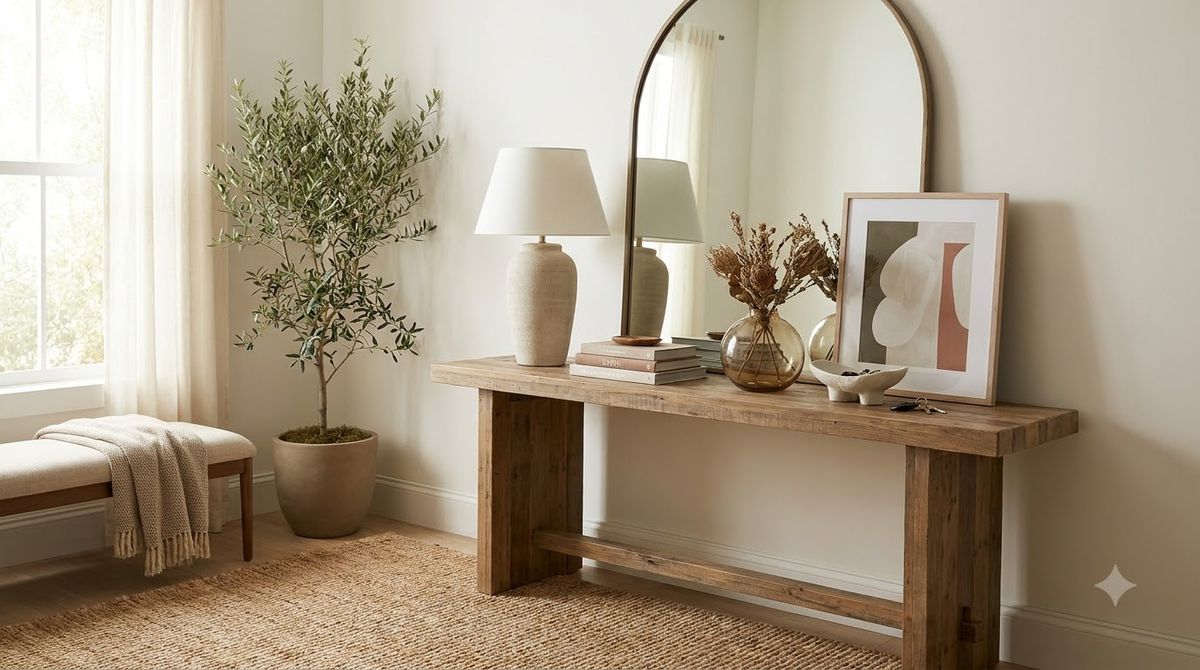
The fastest way to style an entryway table is the 5-item formula: one tall element behind (a mirror or art), a lamp or plant on one side, a catchall tray for keys, one sculptural object, and something living. Group these in odd numbers, vary the heights, and let the tallest piece reach roughly two-thirds of the wall above the console. This five-slot recipe works on a $40 IKEA table or a heavy vintage console. Here’s each slot, with the exact sizes and prices.
Key Takeaways
- The formula: tall element (mirror/art) + lamp or plant + catchall tray + one sculptural object + something living. Five slots, no guesswork.
- Odd numbers win: group items in 3s or 5s; the eye reads odd groupings as more natural than even ones (The Spruce, 2025).
- Mirror math: hang a mirror 60-75% of the console’s width, centered, with its bottom edge 6-8 inches above the tabletop.
- Vary heights: stagger tall, medium, and low so nothing lines up flat. A lamp gives the tallest tabletop point.
- Budget: you can fill all five slots for under $120 using IKEA, Target, and HomeGoods.
- Seasonal swaps: change only the tray contents and the living element each season; keep the anchors fixed.
What Is the 5-Item Entryway Table Formula?
The 5-item formula is a repeatable recipe that keeps a console from looking either bare or cluttered. In a 2025 Houzz survey, the entryway was the single room most people said they wanted to restyle but didn’t know where to start. The formula fixes that: every slot has one job, so you buy with intent instead of piling on decor.
Here are the five slots, in the order we place them:
-
Tall element behind: a mirror or a piece of framed art. This anchors the whole vignette and adds height.
-
Lamp or plant: a small lamp adds warm light and the tallest tabletop point; a plant does the same job cheaper.
-
Catchall tray: a shallow tray or bowl for keys, mail, and sunglasses. This is the functional heart of an entry.
-
One sculptural object: a stack of books, a small vase, a bowl, or a candle. It fills the medium-height layer.
-
Something living: a real or faux plant, a stem in a bud vase, or fresh eucalyptus. It softens the hard lines.
How Do You Style an Entryway Table Step by Step?
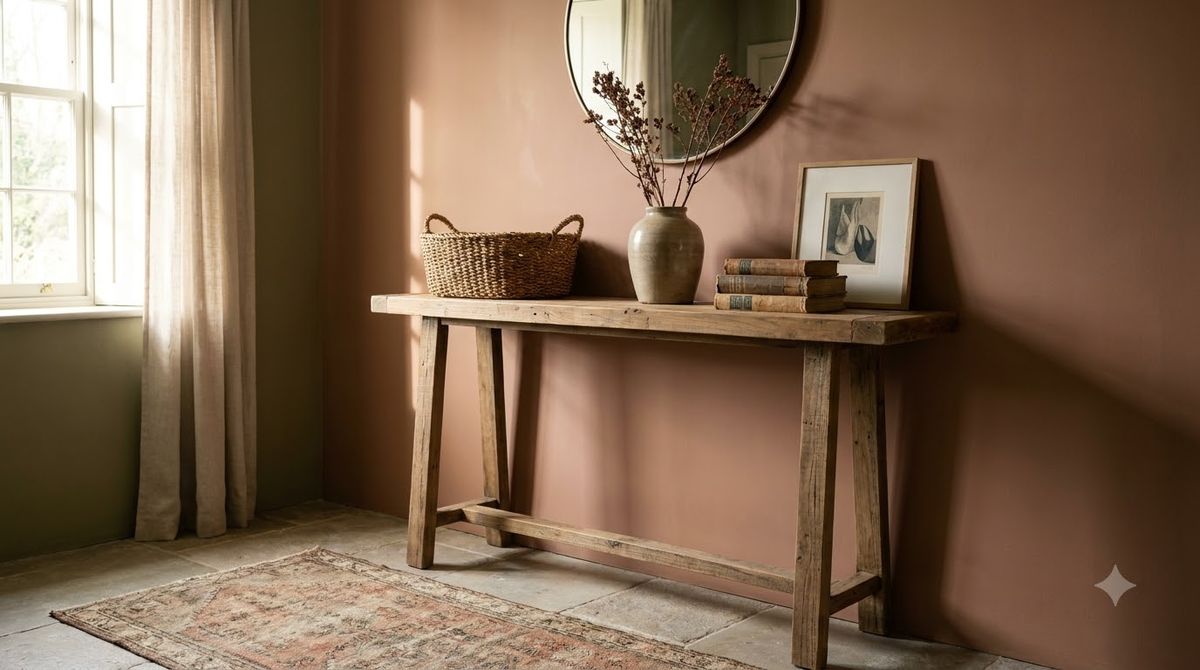
Start with the tall element, then work down in height. Design editors at Apartment Therapy note that most console-styling mistakes come from placing everything at the same height, which flattens the display. Build in layers instead, back to front, tall to short. We do it in this order every time, and it takes about ten minutes.
-
Hang the mirror or art first so you know your vertical anchor before adding anything else.
-
Place the lamp or tall plant on one end, off-center, not dead middle.
-
Set the tray toward the front-center where you’ll actually drop keys.
-
Add the sculptural object on the opposite side from the lamp to balance the visual weight.
-
Tuck in the living element last, filling any gap that still looks empty.
In a narrow rental hallway where the console is only 9 inches deep and there is no outlet nearby, skip the lamp and use a tall dried-stem arrangement for height instead. The formula still holds with a plant standing in for the lamp slot. That’s the point: the slots matter more than the exact objects.
What most guides miss: console depth decides whether the entry actually works before styling ever starts. In a hallway, keep the console 10-12 inches deep and leave at least 30-36 inches of clear walkway in front, the standard traffic-path width. A deeper 16-18 inch console needs a foyer roughly 3.5 feet wide, or it catches shoulders and bags every time you pass.
What Do You Put on a Console Table? (Slot-by-Slot Table)
Put one item in each of the five slots, chosen for the height layer it fills. Below is a shopping table with real options and current prices. The totals below land any full console under about $120.
| Slot | What it does | Options + where | Price |
|---|---|---|---|
| Tall element | Vertical anchor | Round mirror (IKEA LINDBYN), framed art (Target) | $25-60 |
| Lamp or plant | Warm light, height | Small table lamp (Target), pothos (HomeGoods) | $18-35 |
| Catchall tray | Function, corrals clutter | Marble/rattan tray (HomeGoods, Amazon) | $10-22 |
| Sculptural object | Medium layer | Book stack, ceramic vase, chunky candle (Target) | $8-24 |
| Something living | Softens, adds color | Faux eucalyptus stem + bud vase (IKEA) | $6-14 |
What most guides miss: where the tray sits matters as much as what you buy. Place the catchall on the side you naturally reach as you walk in, usually your dominant hand, about 4-6 inches from the front edge. Keys land there without you leaning across the lamp, and the cord stays clear. We keep the tray to one-third of the tabletop so the height layers still read.
For the wall behind, our empty wall ideas guide covers what to hang when a mirror isn’t the right call. If you’re working with a tight footprint, the small entryway ideas post has narrower console picks.
How Big Should a Mirror Be Over a Console Table?
A mirror over a console should span 60 to 75 percent of the console’s width, centered, with the bottom edge 6 to 8 inches above the tabletop. Don’t let a mirror or art exceed the width of the furniture below it, since anything wider looks top-heavy and unbalanced. For a standard 40-inch console, that means a mirror roughly 24 to 30 inches wide.
Use these quick sizes so you don’t guess:
- 32″ console to a mirror or art 20-24″ wide
- 40″ console to 24-30″ wide
- 48″ console to 28-36″ wide
- Hang height: center of the mirror around 57-60″ from the floor, the standard gallery height
- Clearance: leave 6-8″ between the tabletop and the mirror’s bottom edge so the lamp and objects have breathing room
If you’d rather hang art than a mirror, our how to hang wall art guide has the exact nail heights, and floating shelf wall styling shows a layered-ledge alternative above the console.
How Do You Vary Heights and Use Odd Numbers?
Stagger three height layers and group in odd numbers, because the eye reads odd, uneven arrangements as more relaxed and intentional. Interior stylists call this the “high-medium-low” rule, and it’s the single fastest fix for a console that looks off. Your lamp or mirror covers high, a vase or book stack covers medium, and the tray covers low.
- Odd groupings: cluster items in 3s or 5s, never neat pairs across the whole table
- Three heights: tall (lamp/mirror), medium (vase/books), low (tray/bowl)
- Triangle rule: arrange the three tallest points so they form a loose triangle, not a straight line
- Negative space: leave part of the tabletop empty so items can breathe
The one exception is deliberate symmetry: matching lamps or a pair of topiaries flanking a central mirror. That reads formal and works in a wide traditional entry. For everything else, we default to asymmetry and odd numbers.
How Do You Swap an Entryway Table for Each Season?
Change only the tray contents and the living element, and keep the anchors fixed. This is the cheapest way to keep an entry feeling current without rebuying decor. Pinterest’s 2026 trend data shows seasonal entry refreshes among the fastest-growing home searches, and you can ride that with a $10 stem swap rather than a full restyle.
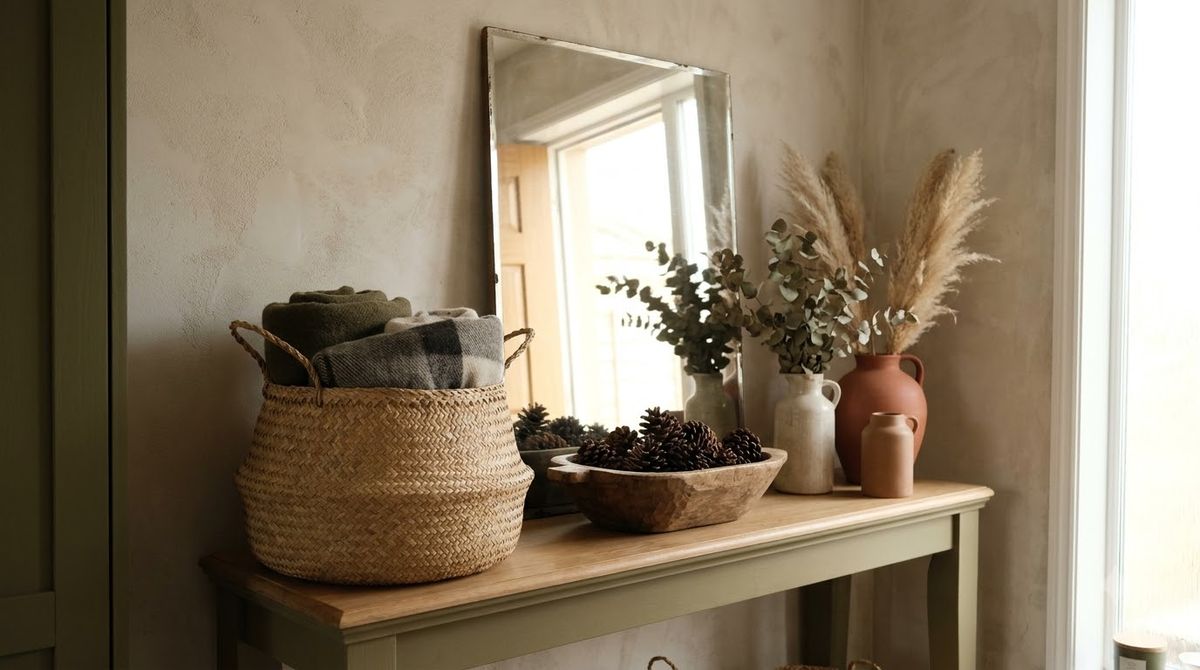
- Fall: swap in dried wheat or amber stems; add a small pumpkin to the tray edge
- Winter: eucalyptus or faux evergreen; a warm-toned candle in the sculptural slot
- Spring: tulips or a flowering stem in the bud vase; lighter tray liner
- Summer: fresh greenery or a citrus bowl as the living element
Keep the mirror, lamp, and tray exactly where they are year-round. For a broader room-by-room refresh plan, see our entryway decor ideas hub, and apply the same swap logic to your coffee table decor ideas.
Frequently Asked Questions
How do you style an entryway table?
Use the 5-item formula: a tall element (mirror or art) behind, a lamp or plant for height, a catchall tray for keys, one sculptural object like a book stack or vase, and something living. Group in odd numbers, vary the heights, and leave some empty space so nothing looks crowded.
What do you put on a console table?
Put one item in each of five slots: a mirror or art above, a lamp or plant, a tray for keys and mail, a sculptural object such as books or a candle, and a plant or fresh stem. This covers function and looks styled. You can fill all five for under $120 at IKEA, Target, and HomeGoods.
How big should a mirror be over a console?
Size the mirror to 60-75% of the console’s width, centered, and never wider than the table itself. For a 40-inch console, choose a mirror about 24-30 inches wide. Hang it with the center around 57-60 inches from the floor and leave 6-8 inches of clearance above the tabletop.
How tall should an entryway table lamp be?
Aim for a lamp between 16 and 26 inches tall so it becomes the tallest point on the tabletop without overwhelming a mirror above. On a standard 30-inch-high console, a 20-inch lamp reads balanced. Keep the shade below the mirror’s bottom edge for clearance.
What size tray for an entryway table?
Choose a tray that spans about one-third of the tabletop, usually 10-14 inches long on a standard console. It should hold keys, mail, and sunglasses without crowding the lamp or sculptural object. A shallow rattan or marble tray works and costs $10-22 at HomeGoods or Amazon.
How deep should an entryway console table be?
For a hallway, pick a console 10-12 inches deep and leave at least 30-36 inches of walkway in front, the standard traffic-path width. A deeper 16-18 inch table suits a wide, open foyer. In our narrowest rental, a 9-10 inch depth kept the path clear while still holding a tray and a slim lamp.