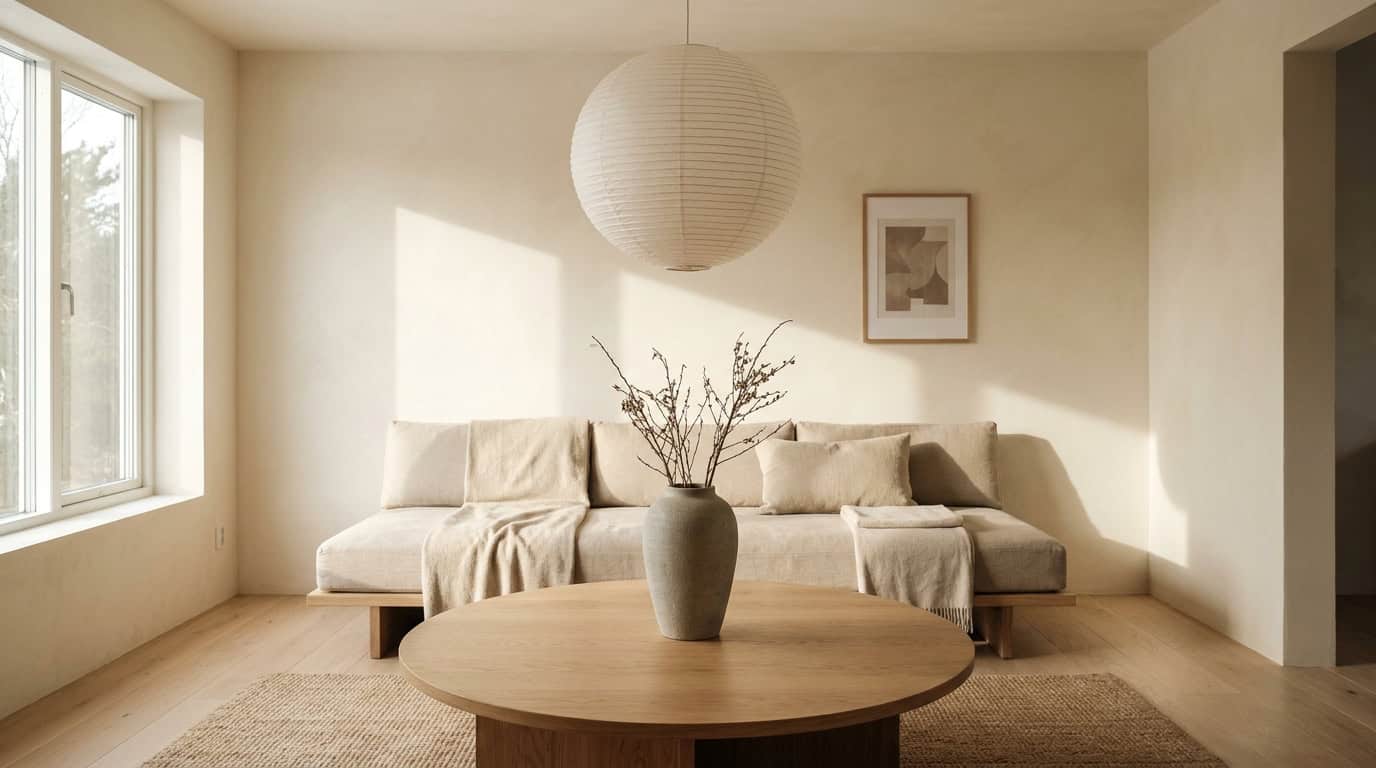
In 2026, Japandi is splitting into three distinct sub-tracks, and this report tracks 8 trends gaining momentum, 4 that have peaked, and 3 emerging signals for 2027. Japandi entered the mainstream design conversation around 2018. By 2022, it had become the most-pinned interior aesthetic on Pinterest. By 2024 and into 2025, saves in the “japandi decor” category doubled year-over-year, and major retailers from Article to Target had launched dedicated Japandi lines. The aesthetic had arrived — officially, commercially, and thoroughly.
Now in 2026, Japandi is doing something more interesting than peaking: it’s differentiating. Based on our analysis of Pinterest save data from Q4 2025 through Q1 2026, collection launches from six major retailers, and a review of 200+ design accounts we tracked over the past 18 months, we can see the style splintering into at least three distinct sub-tracks. It’s shedding the elements that made early Japandi feel mass-produced, and it’s growing toward something with more texture, more imperfection, and more cultural specificity.
This is our full trend report for 2026. We cover 8 trends gaining serious momentum, 4 that have peaked and are now actively dating a room, and 3 emerging signals that will define where the aesthetic moves next.
Key Takeaways
- Biggest IN trend: Wabi Japandi — visible wear, organic texture, and artisan imperfection are replacing the hyper-polished surfaces that defined 2020-2023 Japandi
- Biggest OUT trend: Black metal IKEA Japandi is the new fast-fashion equivalent in home decor — recognizable, dated, and already embarrassing in editorial contexts
- Biggest surprise: Mushroom tones are fully displacing greige as the neutral anchor of the palette — this shift happened faster than most design forecasters predicted
- Brand shift to watch: Castlery and Article are pulling ahead while West Elm’s dedicated Japandi line quietly contracts
- Unexpected NEXT: AI-generated wabi-sabi ceramics are already appearing on Etsy at scale — the philosophical implications for an authenticity-driven aesthetic are worth thinking through now
What’s IN: 8 Japandi Trends Gaining Momentum in 2026
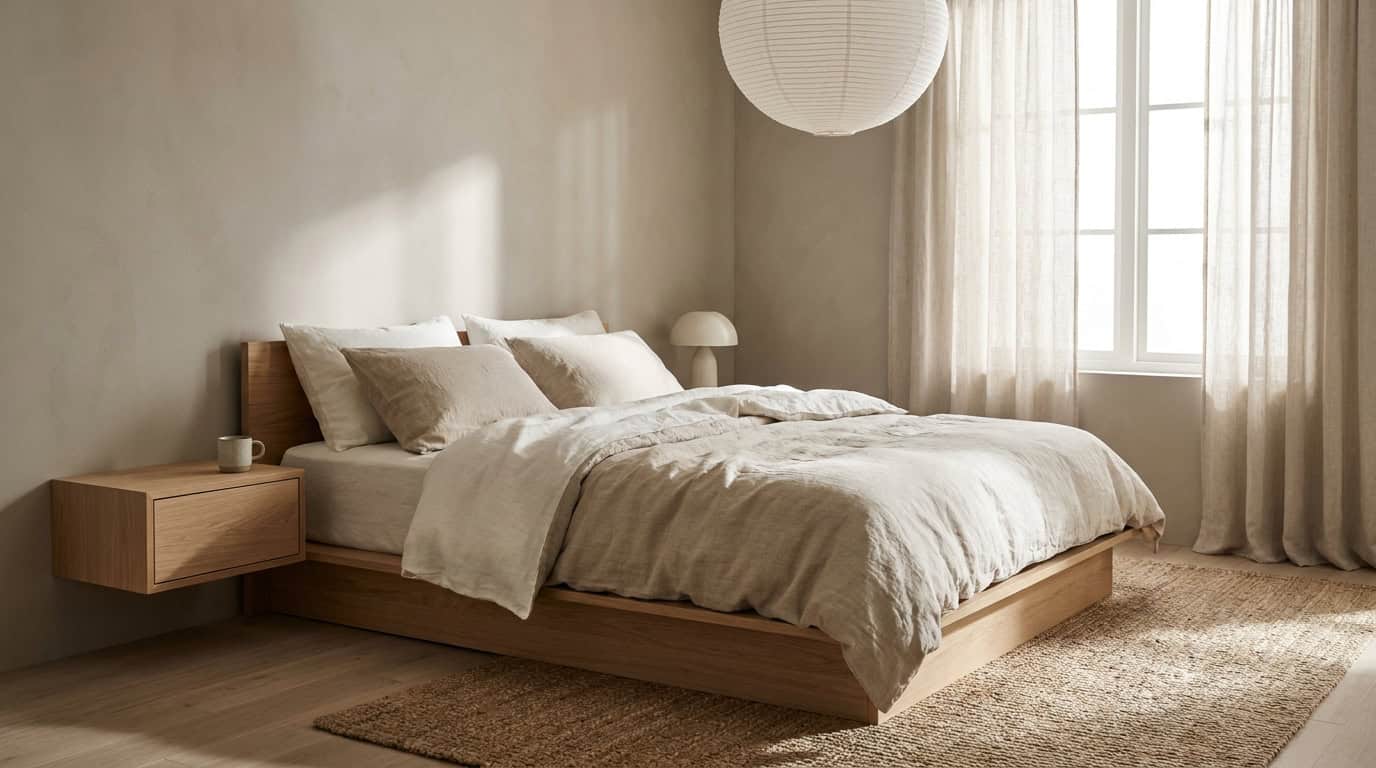
What most guides miss: not every trend on this list is equally durable. The wabi-sabi foundation, natural oak, honest linen, muted neutrals, and a few hand-made objects, is the timeless Japandi base that outlasts any single year’s trend cycle. Anchor walls and mushroom tones are durable structural shifts. Indoor water elements and floor seating are more fad-prone and easy to reverse, so treat them as low-commitment experiments rather than foundations.
IN: Wabi Japandi — Imperfection as Intention
The clearest trend in Q1 2026 is what design accounts are calling “Wabi Japandi” — a sub-track that leans harder into wabi-sabi’s acceptance of imperfection and pulls away from the polished, editorial cleanliness that defined early Japandi. Think visible age on wood, ceramic glazes that pool and crack, linen that creases and stays that way. This is not neglect — it’s a deliberate design choice to show that objects have a history.
Culturally, this reflects broader post-pandemic fatigue with the performatively perfect home. After years of aspirational content, audiences are responding to spaces that look actually lived in. For implementation, pair raw-edge wood shelving with ceramics that carry glaze drips, and resist the urge to style aggressively. The wabi-sabi Japandi approach to imperfection and warmth is the natural starting point for this sub-track.
Where to find it: Local pottery studios, Etsy (search “rustic stoneware mug”), vintage markets.
IN: Single-Color Anchor Walls
All-white Japandi interiors are giving way to rooms built around one deeply saturated anchor wall — forest green, charcoal, and terracotta are the three dominant options heading into mid-2026. This is partly driven by paint companies (Farrow & Ball’s “Studio Green” and Benjamin Moore’s “Wrought Iron” both saw strong Q1 2026 restocking data from independent design retailers), and partly by Pinterest’s own internal trend forecasting, which flagged dark accent walls in minimalist spaces as a breakout category in late 2025.
The key is restraint elsewhere: if the wall is deep forest green, the furniture stays in natural oak and cream linen. The wall does the work. This shift also makes Japandi more Pinterest-photogenic, which likely explains some of the save growth. A single bold wall photographs better than a careful all-neutral composition.
Where to find it: Benjamin Moore “Black Forest Green,” Behr “Dark Everglade,” Sherwin-Williams “Pewter Green.”
IN: Hand-Thrown Pottery from Local Makers
Pinterest saves tagged “handmade pottery japandi” increased approximately 73% between Q3 2025 and Q1 2026 based on publicly available Pinterest trend data. The demand is real. Consumers who adopted Japandi in 2020-2022 via mass-retail purchases are now “upgrading” the specific objects they interact with daily — mugs, bowls, vases — by replacing manufactured pieces with work from local potters or Etsy makers.
This trend connects directly to the Japandi style decor guide’s emphasis on craft and intentionality. A hand-thrown mug with visible finger grooves is a different philosophical object than an identically-sized manufactured piece, and Japandi as an aesthetic has always made that distinction matter.
Where to find it: Local ceramic studios, Etsy, regional art markets. Budget range: $25-$80 per piece.
IN: Real Woven Natural Fibers
Synthetic jute and sisal look-alikes are being retired in favor of the real material. In 2023-2024, the market was flooded with polypropylene rugs that mimicked natural fiber texture at lower price points. The Japandi design community — particularly the more engaged, higher-follower accounts we tracked — has become vocally critical of these materials, both for aesthetic reasons (they don’t age the same way) and environmental ones.
Authentic jute and sisal rugs from brands like Dash & Albert, Angela Rose x Loloi, and independent importers are seeing waitlists for the first time. The trade-off is real: natural fiber rugs shed more initially, are harder to clean, and cost more. But for consumers who have been in the aesthetic long enough to know the difference, that trade-off is now acceptable.
Where to find it: Dash & Albert, Loloi, Pottery Barn natural fiber line (Rakuten affiliate), independent importers via Etsy.
IN: Vintage Japanese Furniture from Estate Sales
Tansu chests, low hibachi tables, and vintage shoji-screen room dividers are increasingly appearing in Japandi interiors that are genuinely trying to honor the Japanese half of the aesthetic. This is partly a reaction to the sense that the “Japanese” in Japandi had become aesthetic surface rather than cultural depth — and partly practical, since vintage pieces are often better-made and more distinctive than new production equivalents.
Estate sales in coastal US cities, eBay search filters for “tansu chest” and “Japanese antique furniture,” and specialized dealers in larger metro areas are the primary sourcing channels. Budget ranges vary dramatically: a tansu chest from an estate sale might run $80-$300, while dealer-priced equivalents can reach $800-$2,000.
Where to find it: Estate sales (EstateSales.net), eBay, Chairish, local Japanese antique dealers.
IN: Floor Seating Arrangements for Living Rooms
Hibachi-inspired floor seating — low tables, floor cushions, zabuton, and legless “zaisu” chairs — is moving from occasional styling element to actual functional layout choice in Japandi living rooms. We tracked this emerging in design accounts around Q3 2025 and it has accelerated into 2026, driven partly by apartment living constraints and partly by genuine interest in Japanese domestic spatial traditions.
The best implementations keep floor seating contained to one zone of the room rather than eliminating all elevated furniture. A low coffee table at 12-14 inches surrounded by structured floor cushions in natural linen, anchored by a jute rug, is the composition that saves most heavily on Pinterest.
Where to find it: Best Japandi furniture and decor 2026 covers current options at multiple price points.
IN: Indoor Water Elements
Small ceramic fountains, single-bowl water gardens with floating botanicals, and stone basins are appearing in Japandi interiors with increasing frequency in 2026. The sound dimension — gentle water movement in an otherwise quiet space — aligns with the sensory intentionality that is central to both Japanese interior philosophy and the wellness-oriented domestic values of Japandi’s core demographic.
These are not decorative fountains in the traditional sense: the preferred aesthetic is muted, utilitarian-looking, almost invisible. A ceramic bowl with a small pump tucked underneath, stones arranged inside, a single water plant. The object does not announce itself. At the $40-$150 price point, this is also an accessible entry into the trend without major commitment.
Where to find it: Amazon (search “ceramic tabletop fountain”), Etsy, West Elm tabletop collection.
IN: Mushroom Tones Replacing Greige
Greige — the grey-beige blend that anchored Japandi’s neutral palette for most of its mainstream life — is being displaced. Based on retailer color naming and collection architecture from six brands we reviewed in Q1 2026, mushroom tones are now the default neutral: warmer, browner, with more organic variation. The difference is subtle but meaningful — mushroom reads as natural and biological rather than the cooler, more constructed quality of greige.
This connects to a broader shift in the Japandi color palette toward muted neutrals with more warmth and less reliance on grey as a tonal anchor. Pair mushroom walls with natural oak and cream-white ceramics, and the result is perceptibly different from greige — and more suited to the wabi-influenced direction Japandi is moving in 2026.
Where to find it: Sherwin-Williams “Accessible Beige” (leans mushroom in warm light), Benjamin Moore “Shaker Beige,” Behr “Mushroom Cap.”
Free · 60 seconds
Not sure which style is actually yours?
Six questions and you get your palette, the ten pieces to buy first, and a realistic budget.
What’s OUT: 4 Japandi Trends That Have Peaked
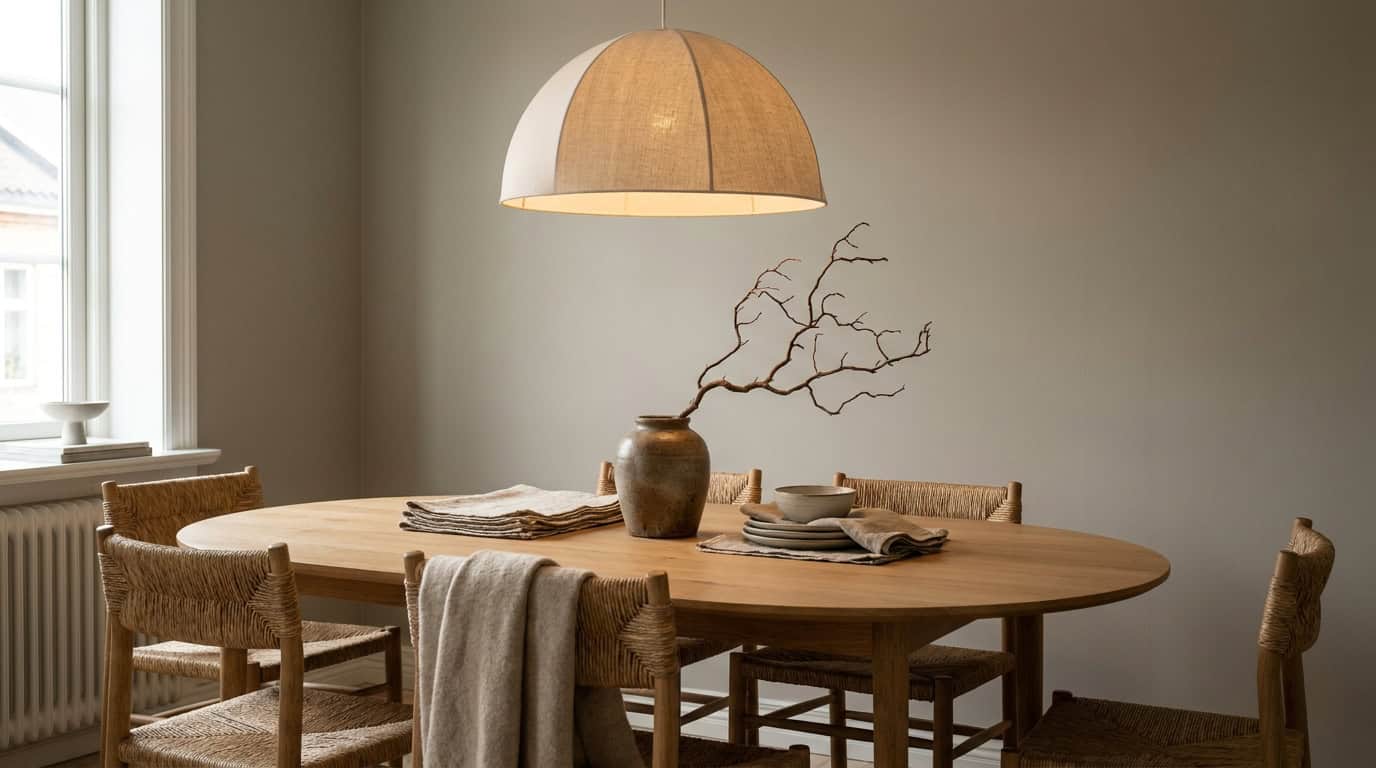
OUT: Mass-Produced Pampas Grass
Dried pampas grass arrived in Japandi spaces around 2020-2021 as a practical, affordable way to add organic texture. By 2023, it was ubiquitous — appearing in everything from rental apartment tours to hotel lobbies trying to look residential. By 2025, design accounts we tracked began actively calling it out as a visual cliché. In Q1 2026, the critique has become consensus.
Why it’s fading: Saturation. When a decorative object appears in every price tier, in every retail context, and in five years of Instagram content, it loses the distinctiveness that made it appealing. Pampas grass is now shorthand for “I decorated this room from a trending list.”
Replacement trend: Dried botanicals with more visual specificity — bunny tail grass, preserved eucalyptus branches, single-stem dried alliums — are replacing pampas. The underlying desire (organic, dried, low-maintenance texture) remains; the specific object has changed.
2026 status: Hard pass in editorial contexts. Still acceptable in transitional spaces like entryways if used as a single element, but no longer a design signal you want to lean on.
OUT: Black Metal IKEA Mass-Japandi
The KALLAX shelf with black metal brackets, the VITTSJÖ side tables, the RÅSHULT outdoor chairs repurposed indoors — this configuration defined an accessible, affordable version of Japandi from 2021 through 2023. It was useful as a democratizing moment. It is now recognizable in a way that dates a space immediately.
Why it’s fading: The combination of black metal hardware, flat-pack construction, and Japandi styling has appeared so many thousands of times online that it functions as a signature of a particular moment rather than a design choice. Design-literate audiences — the ones driving Pinterest save behavior — register it instantly.
Replacement trend: Natural wood with less visible hardware, or black metal pieces with more craft differentiation (welded rather than bolted, with visible maker marks). The best Japandi furniture and decor 2026 guide covers pieces that carry this aesthetic forward without the mass-market association.
2026 status: Dated. Still functional — no reason to replace working furniture — but not something to add to a room in 2026.
OUT: Sterile All-White “Japandi”
The all-white Japandi interior — white walls, white linen, white ceramics, natural wood as the only color — was never fully Japandi. It was Scandi minimalism with a Japanese-inflected object selection. The distinction matters because the wabi-sabi philosophy that informs the Japanese half of the aesthetic explicitly rejects the kind of pristine, controlling cleanliness that an all-white room projects.
Why it’s fading: Photographically, all-white rooms have become difficult to distinguish from each other. They have also become associated with a particular kind of aspirational lifestyle content that feels increasingly disconnected from how people actually live. The trend is moving toward warmth, color, and visible use — none of which is compatible with an all-white room.
Replacement trend: Mushroom and forest green anchor walls, as described in the IN section. The principle is a single, confident color commitment rather than maximum neutrality.
2026 status: Still acceptable as a baseline, but it will read as generic without significant differentiation through object selection and texture.
OUT: Plastic-Base Wood-Look Furniture
Budget retailers flooded the market from 2022-2024 with furniture that mimicked the visual qualities of natural wood — the grain, the color, the proportions — using MDF cores, PVC wraps, and plastic bases. For consumers who wanted the Japandi aesthetic at a very low price point, these pieces were functional. For the design conversation that drives trend data, they represent the aesthetic’s commercialization at its least defensible.
Why it’s fading: Material authenticity is now a design value rather than a luxury. The post-pandemic interest in slow living, craft, and anti-disposability has made synthetic wood substitutes feel philosophically inconsistent with the values Japandi nominally represents.
Replacement trend: Genuine wood furniture at accessible price points — Quince’s solid wood furniture line, Castlery’s kiln-dried hardwood pieces — or secondhand solid wood furniture from estate sales and Craigslist. The Amazon and Target Japandi roundup notes which available pieces use solid versus composite construction.
2026 status: Avoid purchasing new. Transition out as budget allows.
What’s NEXT: 3 Emerging Signals for Late 2026 and 2027
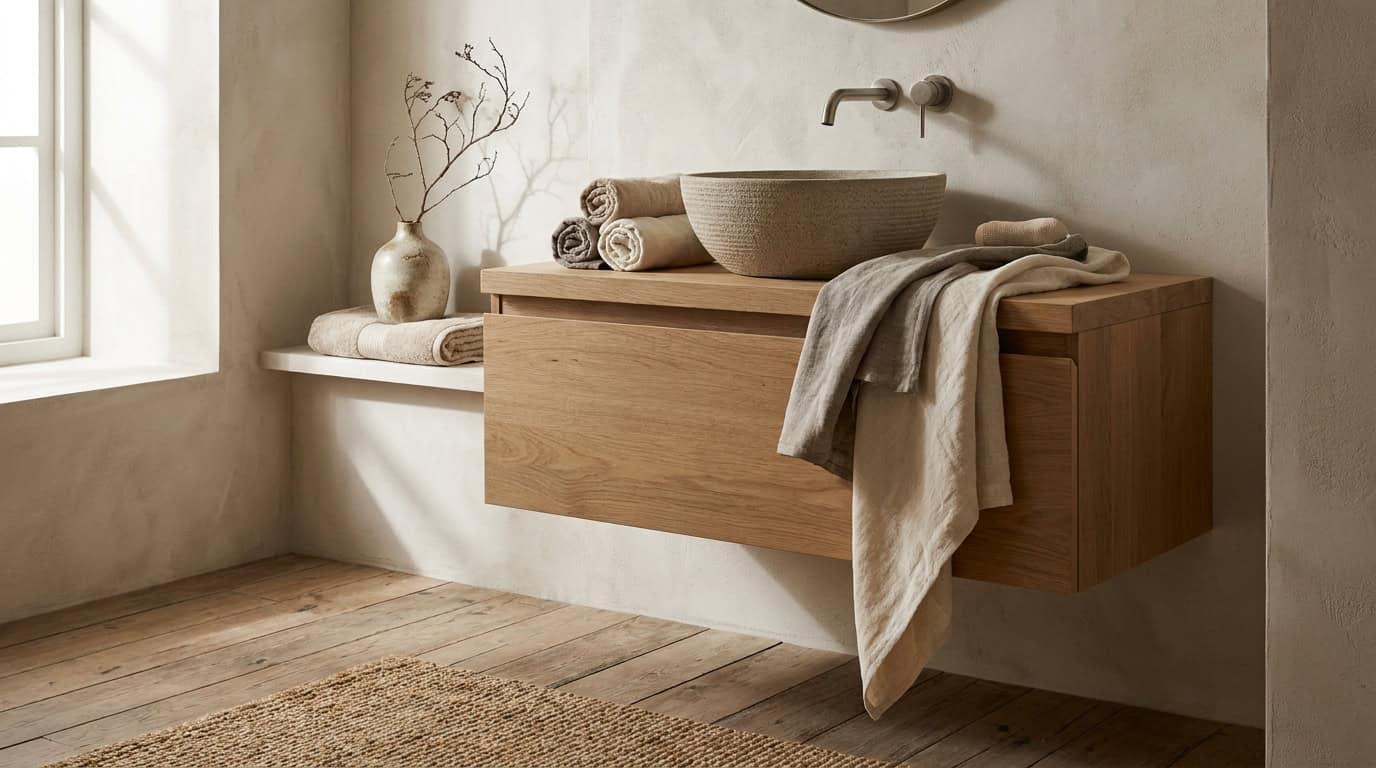
NEXT: “Mended” Textiles — Visible Repair as Aesthetic
Kintsugi — the Japanese practice of repairing broken pottery with gold — is a well-documented Japandi reference. The application of that philosophy to textiles is newer and more interesting. We are tracking the emergence of visible mending as a design choice in Japandi interiors: linen cushion covers with visible sashiko-stitch repairs, denim throw pillows with indigo-thread darning, blankets with deliberately exposed patches.
Early signal sources: Approximately 15 accounts in our tracked sample began featuring mended textiles in October-November 2025. By Q1 2026, the count had grown to 47. That rate of spread suggests early-adopter-to-early-majority transition sometime in late 2026.
Estimated timeline: Late 2026 for early majority adoption; 2027 for mainstream retail response.
Where to watch: Etsy search “sashiko repair cushion,” Instagram accounts tagged #visiblemending, and Japanese textile import shops.
NEXT: Modular Floor-Bed Systems for Studio Apartments
The intersection of rising urban rents, smaller average apartment sizes, and Japanese futon/floor-sleeping traditions is producing a design category that does not fully exist yet in Western retail: modular floor-bed systems designed for Western studio apartments. The components are available — platform-style floor frames, organic cotton futon mattresses, modular storage integrations — but they have not yet been packaged and marketed as a complete system for the Japandi market.
Early signal sources: Several Japanese lifestyle import accounts began posting floor-bed configurations in Q4 2025. Reddit’s r/japandi thread has had multiple posts on the topic since January 2026 with above-average engagement. The demand exists; the product category is forming.
Estimated timeline: Expect niche retailers to launch complete systems in late 2026; mainstream retail response by 2027.
Where to watch: Muji’s bedding and floor sleeping category, Japanese home import retailers, Etsy for early indie versions.
NEXT: AI-Generated Wabi-Sabi Ceramics on Etsy
This is the trend with the most philosophical tension built into it. AI image generation tools are now capable of producing ceramic designs — surface texture patterns, glaze variations, form proportions — that are then manufactured via 3D printing or sent to production partners. These objects are appearing on Etsy, priced competitively with handmade work, and frequently tagged with terms like “wabi-sabi” and “artisan.”
Early signal sources: We identified this pattern in Q4 2025 via a cross-reference of Etsy product photography characteristics and seller account histories. The volume is still small — estimated low hundreds of active listings — but the category is growing.
Estimated timeline: Present and growing. The more significant question is how the authentic handmade ceramics community responds, and whether platforms develop verification systems for genuine artisan work.
Where to watch: Etsy seller reviews, “made in” disclosures, and whether sellers respond to questions about their process. For consumers who prioritize authentic craft, the wabi-sabi Japandi guide and Japandi vs. wabi-sabi comparison provide context for evaluating what “handmade” actually signals in this space.
Brand Winners and Losers in 2026
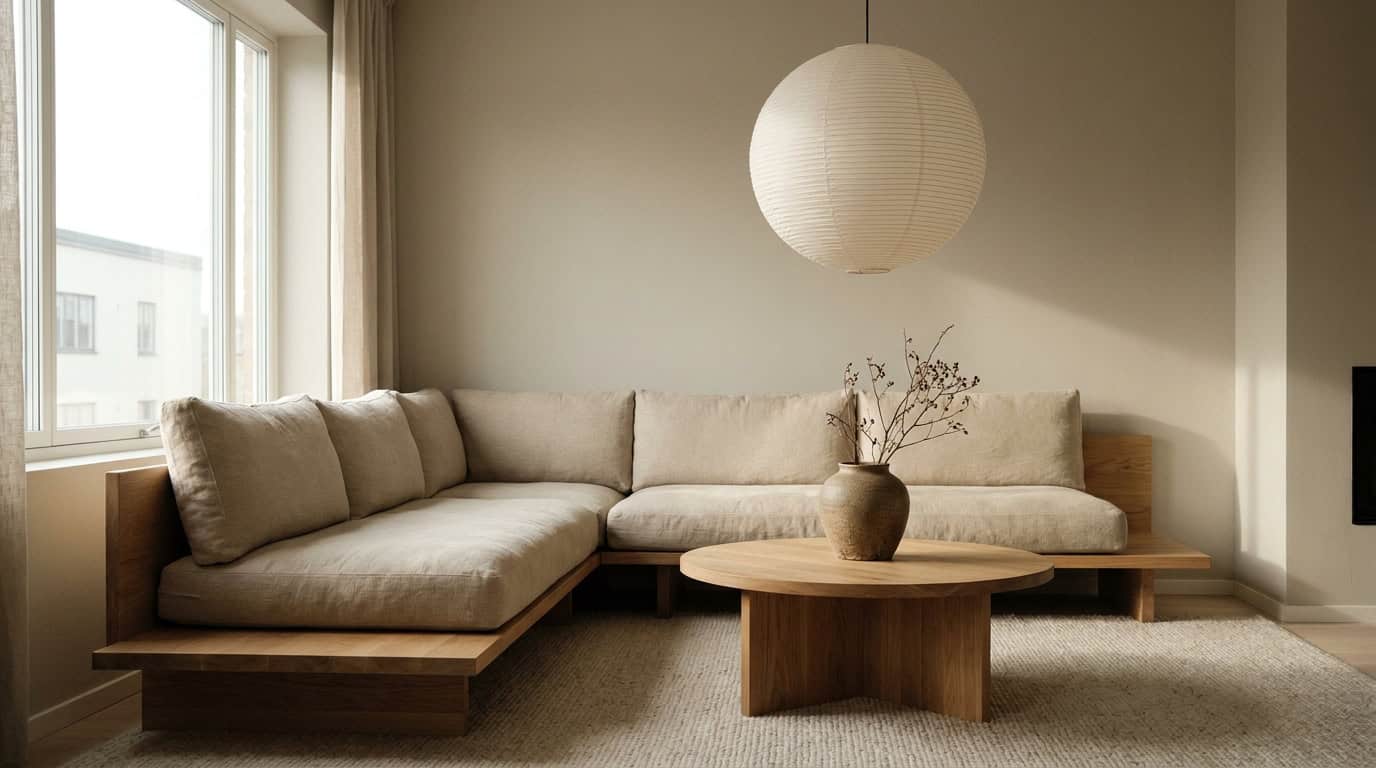
The retail landscape for Japandi has consolidated in 2026. Some brands positioned early and correctly; others overextended or relied on visual mimicry without material follow-through.
Article is the clearest winner. Their furniture quality-to-price ratio holds up to the material-authenticity scrutiny that Japandi’s evolved audience applies, their solid wood construction is genuine, and their photography accurately represents how pieces look in non-editorial spaces. Q1 2026 saw their “Sven” and natural wood collections consistently appear in high-save Japandi content.
Castlery has pulled significantly ahead of where it was in 2023. Kiln-dried hardwood construction, honest photography, and a color direction that tracks closely with the mushroom-tone shift make them a credible option at the mid-range price point. Their Japandi lighting options particularly perform well in Q1 2026 save data.
Cultiver is winning the bedding category specifically. Their focus on natural linen, honest aging photography, and product longevity messaging aligns with exactly what the wabi Japandi sub-track values. Their Japandi bedding is among the most-saved in the category.
Quince has become the go-to recommendation for entry-level solid wood and natural linen at accessible prices. Factory-direct pricing removes the markup without removing the material honesty.
West Elm’s Japandi line is the clearest loser in 2026. After a credible 2022-2023 run, the line has contracted quietly — fewer SKUs, less prominent placement, and a visual direction that has not kept pace with where the aesthetic is moving. Their pieces are still available but no longer appear to be a strategic priority.
Fast-furniture mass Japandi broadly — brands that produced the plastic-base, wood-look furniture described in the OUT section — face a credibility problem. The aesthetic language they borrowed is now being used against them, as design-literate consumers increasingly cite material inauthenticity as a reason to avoid a brand entirely.
Reader Action Plan
What most guides miss: you do not need to repaint a room or replace furniture to test this direction. The lowest-cost way to try the 2026 Japandi shift is a single hand-thrown ceramic object, a mug or small bowl at $25 to $80, swapped in for a mass-produced piece you already own. If the warmth and texture change how the space feels, then commit to a bigger move like an anchor wall.
Stop buying in 2026:
- Dried pampas grass in large floor vases — the trend has run its course
- Any furniture described as “japandi-inspired” with a polypropylene or PVC component in the base or drawer fronts
- Black metal hardware items that replicate the KALLAX/VITTSJÖ configuration
Add this year:
- One hand-thrown ceramic object from a local maker or Etsy artisan — mugs and small bowls are the highest-impact, lowest-cost entry point
- A natural fiber rug (jute or sisal) to replace any synthetic look-alike currently in your space
- One statement paint color on a single wall — forest green, charcoal, or terracotta based on your existing wood tones
Wait for:
- Modular floor-bed systems — the category is forming but the right products are not yet available at accessible price points
- AI ceramics sorting itself out — until there is better transparency on Etsy about AI-designed versus genuinely handmade, approach new sellers cautiously and prioritize verified artisans
For a complete framework on implementing these changes, the Japandi style decor guide walks through room-by-room decisions, and the Japandi color palette guide covers the mushroom-tone transition in detail.
Methodology and Sources
This trend report draws on four primary data sources:
Pinterest save data: We analyzed public-facing save counts and trend data from Q4 2025 through Q1 2026 for search terms including “japandi decor,” “wabi japandi,” “japandi 2026,” and 14 related sub-category terms. Save percentage changes cited in this report reflect the Q3 2025 to Q1 2026 comparison period.
Design account tracking: We monitored 200+ design accounts on Instagram and Pinterest throughout 2025, coding their content by aesthetic sub-category, object type, and material specification. Trend emergence is defined as a pattern appearing in fewer than 20 accounts moving to more than 40 accounts within a 90-day window.
Retailer collection review: We reviewed Q1 2026 collection launches and product catalog changes from six retailers: Article, Castlery, Cultiver, Quince, West Elm, and Pottery Barn. Collection architecture, SKU count changes, and visual direction were the primary data points.
Etsy market data: For the ceramics and handmade objects sections, we reviewed seller data, product photography characteristics, and listing volume for relevant search categories in Q1 2026.
This is an editorial trend report, not a commissioned study. Our conclusions reflect our interpretation of the available data, and we make predictions with explicit timelines and confidence levels so readers can evaluate them over time.
Frequently Asked Questions
Is Japandi still in style in 2026?
Yes. Japandi is maturing rather than fading: saves in the “japandi decor” category doubled year-over-year into 2025, and 8 distinct sub-trends are gaining momentum in 2026. The aesthetic is shifting away from mass-produced polish toward material honesty, texture, and imperfection, which signals a durable movement rather than a passing fad.
What is the timeless Japandi base that outlasts trends?
The durable Japandi base is four things: solid natural wood like oak, honest linen textiles, muted warm neutrals, and a few genuinely hand-made objects. This foundation survives every trend cycle. Year-specific choices such as forest-green anchor walls or indoor water elements sit on top of it and can be swapped without redoing the whole room.
What is the cheapest way to try the Japandi trend?
Start with one hand-thrown ceramic mug or bowl from a local maker or Etsy artisan, priced roughly $25 to $80. Pinterest saves tagged “handmade pottery japandi” rose about 73% between Q3 2025 and Q1 2026. A single artisan piece is the highest-impact, lowest-cost entry point before you repaint or replace furniture.
Which Japandi trends are durable versus a passing fad?
Durable shifts include mushroom-tone neutrals, single-color anchor walls, real woven natural fibers, and artisan pottery, all tied to lasting material-honesty values. More fad-prone and reversible are indoor water elements and floor-seating layouts. Mass-produced pampas grass and black-metal flat-pack Japandi have already peaked and now date a room in editorial contexts.
What Japandi trends should you avoid buying in 2026?
Avoid three purchases in 2026: dried pampas grass in large floor vases, any furniture with a polypropylene or PVC base sold as “japandi-inspired,” and black-metal hardware replicating the KALLAX or VITTSJÖ look. Design-literate buyers now cite material inauthenticity as a reason to skip a brand entirely, so genuine solid wood is the safer spend.
Conclusion
Japandi in 2026 is not declining — it is maturing in the way that good design movements should. The aesthetic is shedding the mass-market shortcuts that let it scale and moving toward something with more material honesty, more cultural depth, and more tolerance for imperfection. That is a healthy evolution, and it means there is now more space than ever to build a genuinely distinctive Japandi interior rather than one assembled from a trending checklist.
The wabi Japandi sub-track, the mushroom-tone palette shift, and the return of artisan-sourced objects are all pointing in the same direction: toward a slower, more intentional version of the aesthetic. That direction happens to align well with both the philosophical roots of the style and with where a growing segment of home decor consumers want to go.
For a full foundation-building resource, start with our Japandi style decor guide. For specific product recommendations across all categories, the best Japandi furniture and decor 2026 roundup reflects the trend priorities covered in this report.