
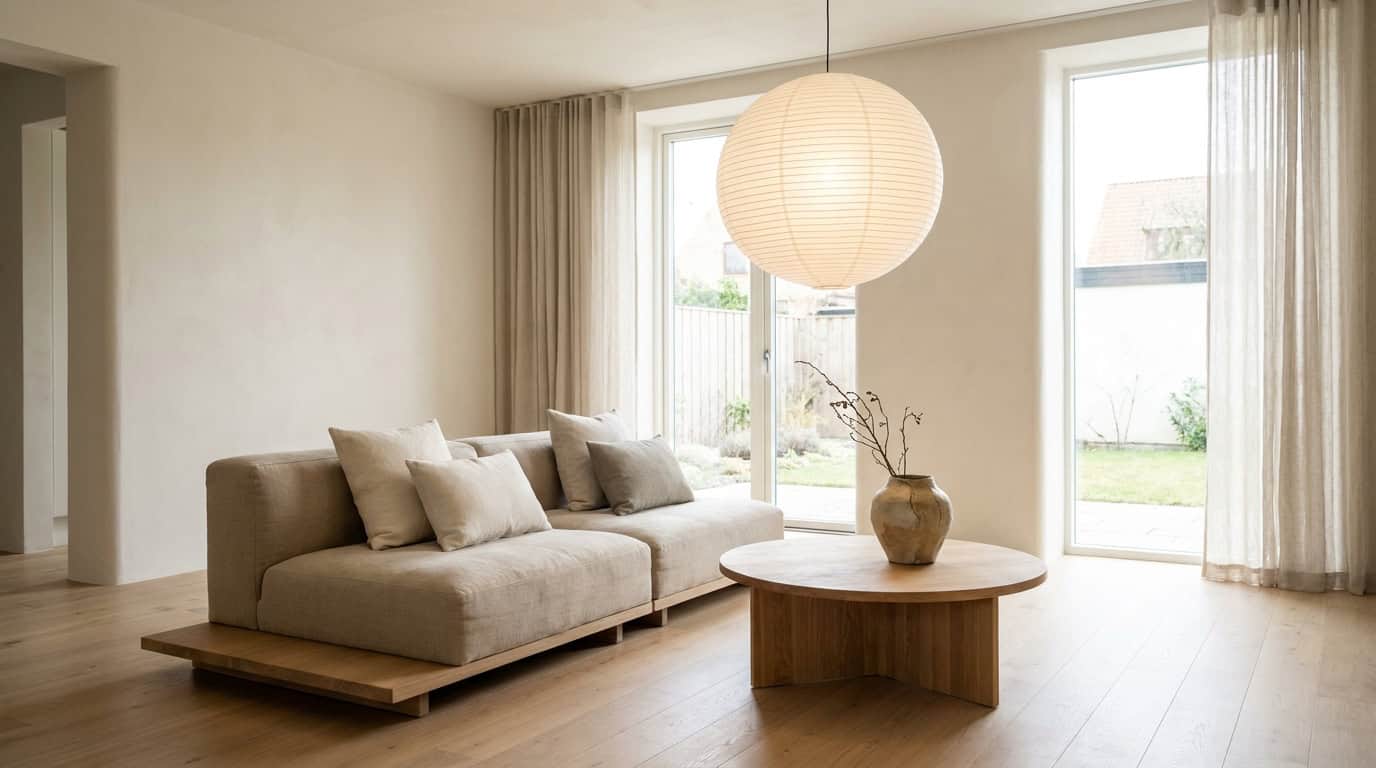
You can refresh a Japandi room for under $100 total by stacking two precise swaps: a warm 2700K dimmable bulb ($12-$25) plus three washed-linen pillow covers ($60-$90). A full Japandi makeover takes weeks, sourcing furniture, repainting walls, waiting on shipping. A refresh takes a Saturday. The aesthetic is built on restraint and intention, which means small, precise swaps carry more visual weight here than in almost any other style. We isolated 10 specific updates that each land under $100 and, when applied selectively, shift a tired room back toward calm without committing to a redesign.
You don’t need all 10. Pick 1-3 that match what’s actually bothering you about the room right now. A pillow swap takes 15 minutes. A lighting change takes an hour. A curtain panel swap takes a Sunday morning. The point is momentum — one deliberate change that makes the room feel curated again rather than accumulated.
These are the exact swaps we’ve tested in our own homes. Prices reflect current retail averages across IKEA, Target, Amazon, and specialty online retailers as of early 2026.
Key Takeaways
- 10 updates, each priced under $100 individually
- Combined cost range if you do all 10: approximately $330-$640 — but most refreshes need only 2-3
- Time per update: 15 minutes (pillow swap) to 3 hours (curtain panel + plant repot)
- Biggest single visual impact: Lighting temperature change (Update 3) — affects how every other element reads in the room
- Best two-item combo: Linen curtain panel + warm bulb — shifts the entire mood for under $115 combined
The Refresh Framework: Why One Trigger at a Time
The biggest mistake in any home refresh is trying to fix everything at once. You end up buying six things, none of them quite right, and the room still feels off because the real problem was never isolated.
For a Japandi decor refresh specifically, there are three triggers that cause a room to feel “off” over time:
1. Color drift — Japandi palettes are narrow by design: warm whites, warm grays, muted greens, natural wood tones. Drift happens when a brighter throw or a cool-toned art print sneaks in. Suddenly the whole palette reads disjointed.
2. Texture monotony — Japandi rooms rely on layering different tactile surfaces: linen, jute, wood grain, ceramic, matte cotton. When everything ends up the same weight and finish — usually smooth — the room goes flat.
3. Lighting flatness — Japandi lighting should feel like afternoon light through a shoji screen: warm, directional, calm. Cool overhead LEDs kill the aesthetic faster than any furniture mismatch.
The rule: identify which of the three is your actual problem, then fix only that one. If the room has color drift, don’t also buy a new rug and swap the lighting. Fix the color drift. Reassess. Add the next layer if needed.
What most guides miss: The highest-impact Japandi move costs nothing. Before you buy a single item, clear roughly 20% of what sits on your surfaces and shelves. Japandi reads as calm because of negative space, not because of new purchases. Declutter first, live with the room for a day, then swap only what still bothers you.
This is what makes Japandi refreshing to maintain — the constraints are clear enough that the fix is usually obvious once you’ve named the trigger.
See our full Japandi Style Guide for the core principles behind the palette and texture hierarchy.
Free · 60 seconds
Not sure which style is actually yours?
Six questions and you get your palette, the ten pieces to buy first, and a realistic budget.
10 Japandi Decor Updates Under $100 Each
1. Swap Throw Pillows to Washed Linen — $60-$90 total (3 pillows)
What you’re swapping: Any synthetic, polyester-sheen, or patterned throw pillows currently on your sofa or bed.
Why it works: Washed linen has a natural, slightly wrinkled texture that reads as intentional in Japandi spaces. It diffuses light rather than reflecting it, which is why synthetic pillows — even in the right color — can make a Japandi room feel slightly off.
Specific picks:
- IKEA GURLI cushion cover (50x50cm), muted beige or gray — around $8-12 each (cover only, stuff with existing inserts)
- H&M Home linen pillow covers, oatmeal or dusty sage — $20-25 each
- Amazon: “Mkono washed linen pillow cover” sets — $28-35 for 2
Time required: 15 minutes. Swap covers, fluff, done.
2. Add a Single Textural Floor Cushion — $45-$80
What you’re adding: A large floor cushion in natural cotton, wool, or jute-blend fabric — placed near a low table or beside a chair.
Why it works: Floor-level seating is a core Japandi and Japanese design principle. A single floor cushion introduces both texture and visual variety in height without adding furniture weight.
Specific picks:
- Pottery Barn Teen Large Floor Pillow (before price increase) — check clearance, often $55-70
- Amazon: “Floor cushion pouf round cotton knit” — $45-65, look for cotton or wool versions
- World Market woven floor pillow — $55-80 depending on size and material
Time required: 15 minutes. Place, style, done.
3. Replace Overhead Bulb to 2700K Dimmable — $12-$25
What you’re swapping: Any cool white (4000K+) or harsh LED in your primary overhead fixture or floor lamp.
Why it works: This is the highest-impact-per-dollar update on this list. Lighting temperature changes how every other element in the room reads. A 2700K bulb makes linen look warmer, wood grain more pronounced, and matte ceramic more alive. We’ve tested this in three different rooms and the effect is immediate and significant.
Specific picks:
- Philips Hue White single bulb (A19, 2700K, dimmable) — $15-20 at Target or Amazon
- GE Relax LED 60W equivalent soft white — around $8-12 for a 2-pack
- Sylvania Ultra LED 2700K dimmable — $12-18 at Home Depot
Time required: 15 minutes including the trip to the lamp.
4. New Paper Lantern Table Lamp — $40-$90
What you’re adding: A paper or washi-shade table lamp replacing a harsh metal or plastic shade.
Why it works: Paper lanterns and washi shades are directly tied to Japanese interior design. They diffuse light softly across a room rather than casting hard-edged pools. Even a $40 option from IKEA reads as high-intention in a Japandi space because the form itself carries the aesthetic weight.
Specific picks:
- IKEA REGOLIT floor/table lamp shade (replacement shade only) — $10-15, fits standard IKEA bases
- Amazon: “Paper lantern table lamp bamboo frame” — $40-65, look for natural bamboo with white washi paper
- CB2 or West Elm during sale: woven or paper shade lamps — $65-90
Time required: 30-60 minutes including assembly.
See our Japandi Lighting Guide for the full lamp hierarchy — bedside, floor, and overhead.
5. Replace Dated Wall Art with Single Matted Print — $25-$65
What you’re swapping: Any busy, colorful, or sentimentally cluttered wall art that has been accumulating over time.
Why it works: Japandi wall art follows the “one focal piece” principle. A single matted print — botanical illustration, abstract brushstroke, simple landscape — creates a visual anchor without visual noise. The mat itself adds breathing room between the image and the wall.
Specific picks:
- Society6 or Minted: botanical or minimalist abstract prints, A3 or 18×24 size — $25-45 unframed
- IKEA SANNAHED frame (25x25cm) with a single pressed leaf or branch — under $15 total if you forage the element
- Target threshold gallery frame with a solid mat insert — $30-50 depending on size
Time required: 30 minutes including hanging.
6. Add a Jute or Wool Runner Rug — $55-$95
What you’re adding: A natural-fiber runner (typically 2×8 ft or 2.5×8 ft) in an entryway, hallway, or beside the bed.
Why it works: Natural fiber rugs introduce floor-level texture that softer fabrics can’t replicate. Jute in particular reads very Japandi — it has the right earthy tone and coarse grain. A runner format is more affordable than an area rug and allows layering over existing flooring without full coverage.
Specific picks:
- IKEA HILLESTED jute runner — approximately $55-75 depending on size
- Target: Threshold natural jute braided runner — $60-85
- Amazon: “Handwoven jute runner rug” — $55-80 for 2×8 ft, read reviews for shedding
Time required: 15 minutes to place and straighten.
7. Single Ceramic Vase + Branch Swap — $30-$55 (vase) + $10-$15 (branch)
What you’re swapping or adding: Replace a busy floral arrangement or plastic plant with a single sculptural ceramic vase holding one or two dried branches.
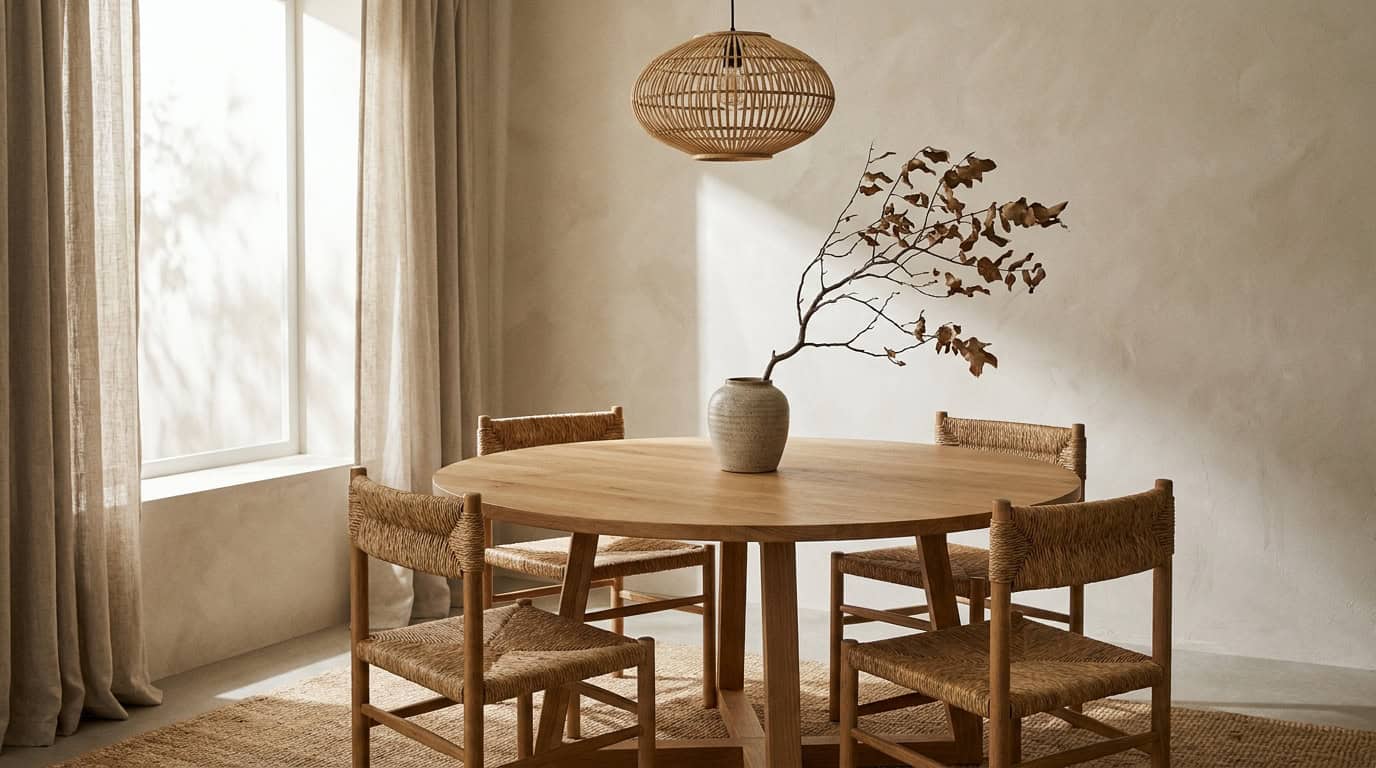
Why it works: The dried branch is one of the most Japandi-coded decorative elements — it’s the wabi-sabi principle of appreciating natural imperfection made visible. A clean ceramic vase (matte glaze, organic shape) + one or two cherry blossom branches, dried eucalyptus stems, or pampas grass stalks creates a corner or shelf moment that’s impossible to over-style.
Specific picks:
- Vase: Target threshold stoneware vessel — $25-40, or Amazon “matte ceramic bud vase” — $18-35
- Branches: IKEA SMYCKA dried pampas grass bundle — $10-15, or forage dried branches locally (free)
- West Elm sale: organic ceramic vase — $30-55 during markdown events
Time required: 20 minutes including arranging.
8. Linen Curtain Panel Swap (Single Window) — $40-$90
What you’re swapping: Heavy blackout curtains in synthetic fabric, or sheer polyester panels that read as clinical.
Why it works: Natural linen panels filter light rather than blocking it. They move with air, which adds subtle visual life to a still room. Single-window swaps keep the cost manageable — one 50×96 inch panel with rod-pocket or tab-top construction runs $40-90 depending on quality.
Specific picks:
- IKEA DYTAG linen-blend panel — around $30-45 each
- H&M Home linen curtain panel — $40-60, watch for sale
- Amazon: “100% linen curtain panel rod pocket natural” — $35-65, check thread count and weight reviews
What most guides miss: Some pieces are safe to buy cheap and some are not. Baskets, pillow inserts, and terracotta pots read fine at budget prices. Do not cheap out on linen curtains or the paper lamp shade. Thin synthetic “linen-look” panels hang stiff and reflect light, which breaks the whole calm effect. Spend the extra $20 there.
Time required: 1-2 hours including rehaning the rod if needed.
See our Japandi Bedding Guide for how linen panels work with bedding and pillow layering in the bedroom.
9. Plant Repot — Terracotta or Stoneware Planter — $25-$60
What you’re swapping: Any plastic nursery pot, bright ceramic, or glazed shiny planter currently housing a houseplant.
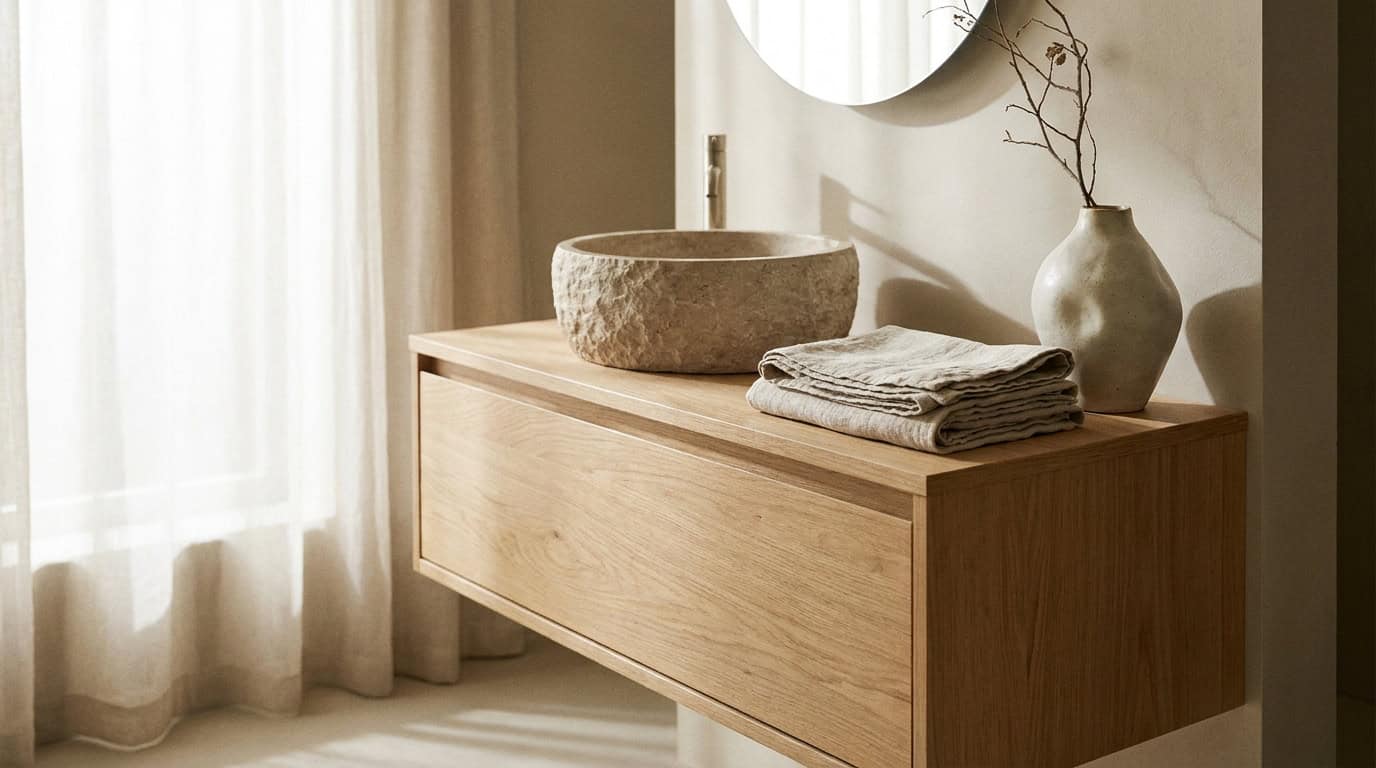
Why it works: The container matters as much as the plant in Japandi styling. Terracotta reads warm, porous, and natural — it ages visually in a way that synthetic pots never do. Matte stoneware carries the same organic quality. Repotting an existing plant costs only the planter — no new plant required.
Specific picks:
- Terra cotta pot (6-8 inch) from any garden center or Home Depot — $5-15
- IKEA MUSKOT terracotta planter — $8-15
- Amazon or Target: matte stoneware planter, speckled or solid — $20-40 for medium size
- CB2 sale: small sculptural stoneware planter — $35-60
Time required: 30-45 minutes including repotting and cleanup.
10. Closed-Front Basket Trio for Visible Clutter — $45-$85 (set of 3)
What you’re addressing: Visible clutter — remote controls, cables, magazines, small items — that reads as chaos rather than intentional display.
Why it works: In Japandi interiors, storage is styled. Closed-front or lidded baskets in seagrass, water hyacinth, or woven cotton hide clutter while adding texture. A set of three nested baskets in graduated sizes handles most common clutter categories (one per type) and doubles as a shelf-styling element.
Specific picks:
- IKEA KNIPSA seagrass basket set — around $35-55 for a trio
- Target: Threshold seagrass storage basket set — $40-70 for 3 sizes
- Amazon: “Seagrass storage basket set of 3” — $45-80, check depth for actual usability
Time required: 30 minutes to sort and place items.
Stacking 2-3 Updates: The Best Combinations
Single updates work. Two or three updates stacked with intention work better — when the combination targets the same trigger rather than scattering across all three.
Combo 1: Pillows + Lighting (biggest visual reset, $72-$115 combined)
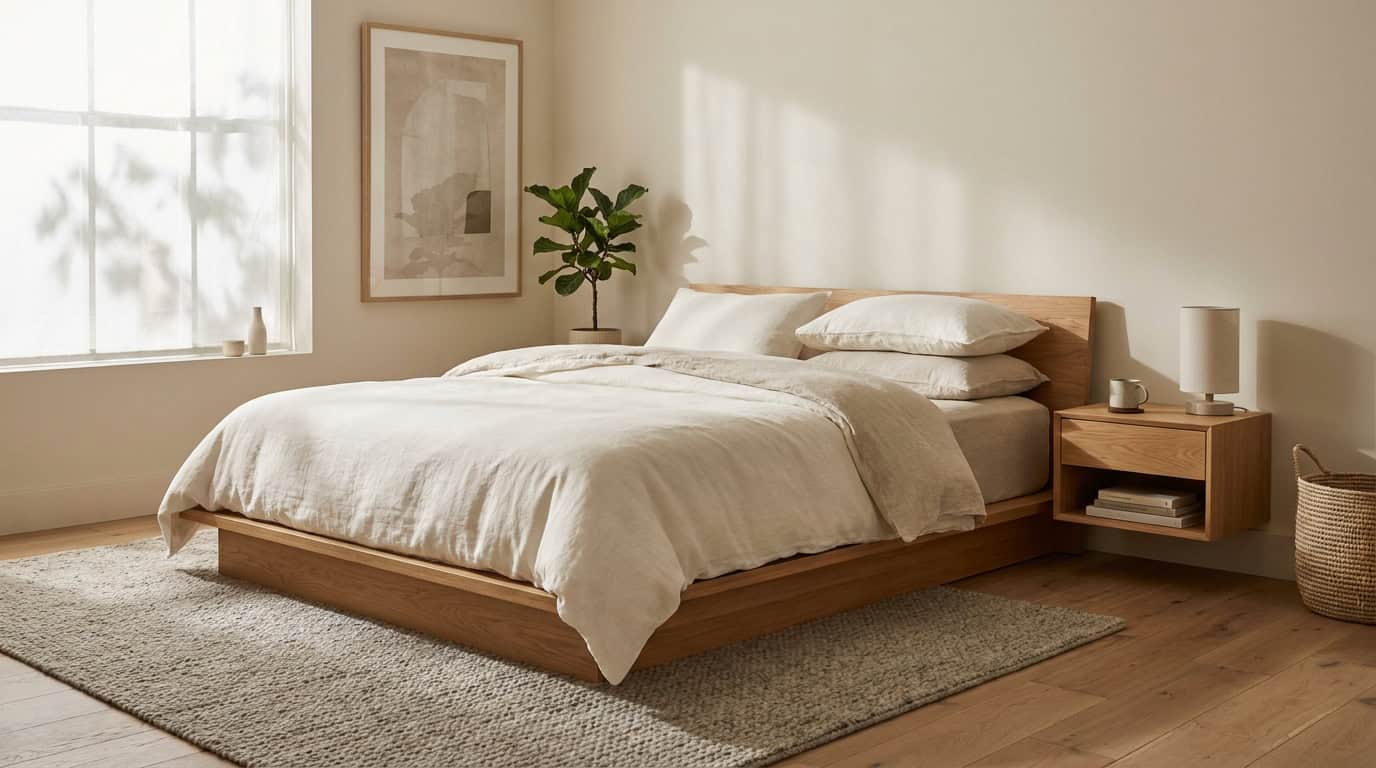
Lighting changes how fabric reads, and fabric is what you see most in a living room. Swapping to a 2700K bulb and simultaneously replacing polyester pillows with washed linen creates a coherent sensory shift — warmer light, softer texture, less visual noise. This is the single highest-impact two-item combo we’ve tested.
Combo 2: Curtain Panel + Plant in Terracotta (texture + organic life, $65-$150 combined)
Both updates address texture monotony. Linen at the window and a warm terracotta planter at mid-height create a layered natural material story from floor to ceiling. Add the dried branch vase at shelf height and you’ve covered three vertical zones for around $80-120 total.
Combo 3: Wall Art + Paper Lantern Lamp (mood shift, $65-$155 combined)
This combination addresses lighting flatness and visual anchor simultaneously. A single matted print creates a focal wall. A paper lantern nearby fills the room with diffused, warm light that makes the print glow without a spotlight. The result reads more curated gallery than Pinterest-try-hard. Best for a bedroom or reading corner.
Combo 4: Basket Trio + Floor Cushion (functional + intentional, $90-$165 combined)
For rooms where clutter is the primary problem, the basket trio removes visual noise while the floor cushion adds a design-intentional element at the same time. The room goes from “cluttered” to “considered” in a Saturday morning.
See our Japandi Color Palette Guide to confirm your palette is coherent before adding new textiles. For specific product recommendations across all categories, our Best Japandi Decor: Amazon + Target picks and Amazon Japandi Finds Under $40 are worth reading before purchasing.
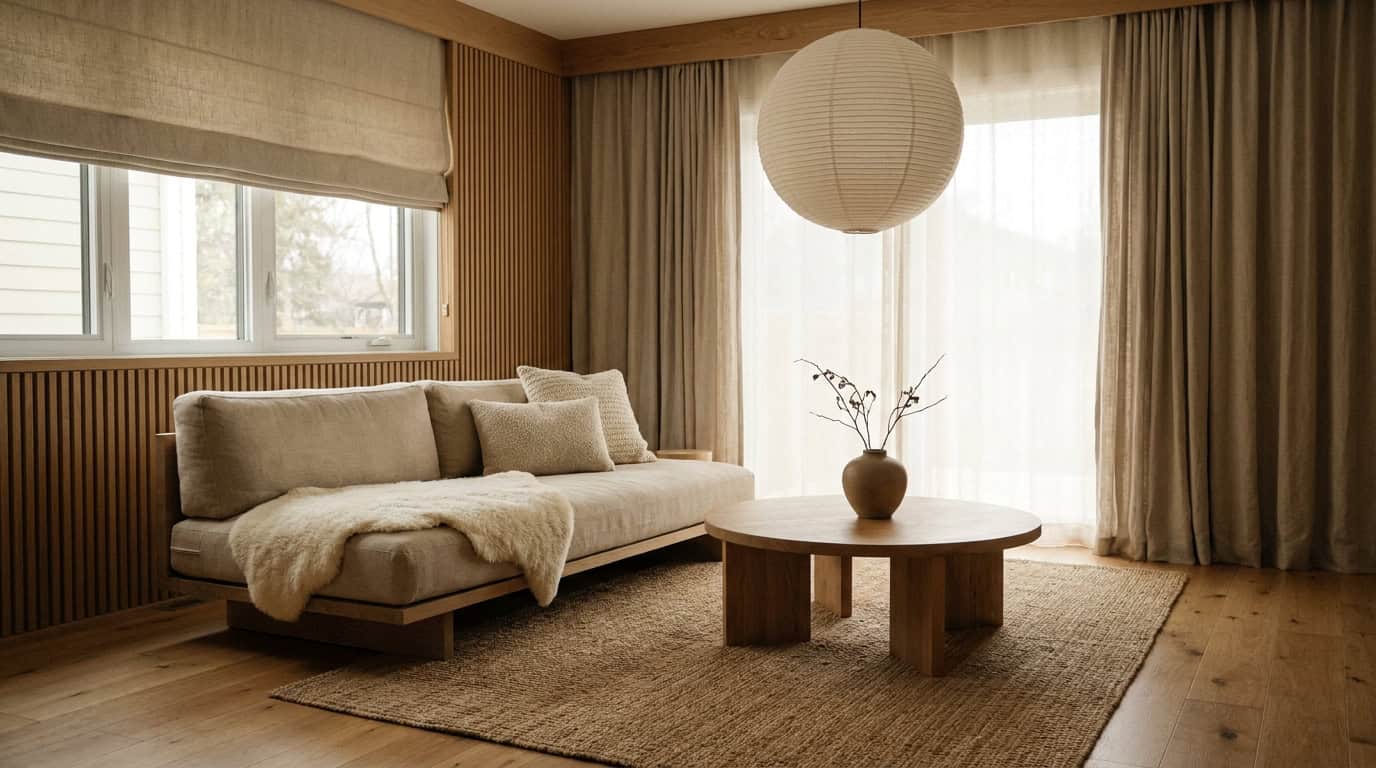
Best Refresh by Season
Japandi doesn’t change dramatically with seasons — the palette stays muted, the furniture stays fixed — but small textile and organic element rotations keep the space feeling alive without shopping for new furniture.
Spring: Swap heavy linen throws for lighter-weight cotton-linen blends. Replace the dried winter branch (bare, sculptural) with a fresh-cut cherry blossom or willow branch from a local garden center or florist — $8-15 for a few stems. Add a single potted plant in a terracotta pot as a new focal element.
Summer: Introduce a jute rug if you don’t have one — jute feels visually cooler than wool. Swap heavier pillow inserts for lighter ones. Keep textiles minimal and let the natural wood and ceramic elements carry the room.
Fall: Warm the lighting by one notch — if you’ve been running 2700K, consider even 2200K “candlelight” bulbs for evenings. Add a waffle-weave or tightly woven wool throw in a warm oat or charcoal tone. Replace summer’s light branch with a dried stem arrangement in deeper earth tones.
Winter: The paper lantern lamp becomes most valuable here — soft diffused light against short days. Add a heavier linen throw in a deeper natural tone. The closed-front baskets help manage the additional seasonal clutter (extra candles, holiday items stored away). Keep the palette clean — resist adding pattern, even in December.
3 Mistakes When Refreshing a Japandi Room
1. Buying without identifying the trigger. The most common refresh mistake: walking into a store without naming what’s actually wrong. You come home with a new vase, a throw, and a small lamp. None of them fix the underlying drift because you were shopping on impulse rather than diagnosis. Run through the three-trigger checklist first. Name the trigger. Shop specifically for that.
2. Matching too perfectly. Japandi looks effortless because elements don’t match — they coordinate. A room where every piece is from the same collection, in the same tone, with the same finish reads as sterile rather than calm. The wabi-sabi thread in Japandi requires some variation: slightly different whites, one older piece alongside newer ones, a handmade ceramic next to a store-bought frame. Perfect matching is the opposite of the aesthetic.
3. Forgetting that lighting is foundational. We list this as Update 3, but in practice it’s often the first thing to fix. A room with cool-white overhead lighting will feel tired regardless of what else you change. Warm throws, organic ceramics, linen curtains — all of them lose their quality under harsh fluorescent or cool LED light. If you only do one update, consider the bulb swap first. Then assess what else needs to change.
FAQ
Can you refresh a Japandi room for under $100 total?
Yes. Stack a 2700K bulb swap ($12-25) with three washed-linen pillow covers ($60-90) and you land around $72-115. Keep it to those two moves and you stay near or under $100. Run the free declutter pass first for the biggest visible difference at zero cost.
What’s the cheapest single update with the biggest visual impact?
The 2700K bulb swap, at $12-25. Lighting temperature affects how every other element in the room reads — fabric, wood, ceramic — and the change is immediate. We’ve seen rooms that felt completely flat come alive after a single bulb swap. If budget is the constraint, start here.
What should you not cheap out on in a Japandi refresh?
Linen curtains and the paper or washi lamp shade. Budget synthetic “linen-look” panels hang stiff and reflect light, which reads clinical rather than calm. Baskets, pillow inserts, and terracotta pots are safe to buy cheap, since the quality difference there is nearly invisible in a styled room.
How often should you refresh a Japandi room?
Seasonally is a natural rhythm — roughly four times a year. A seasonal refresh doesn’t mean replacing everything; it usually means swapping one textile (pillow cover or throw), rotating or replacing one organic element (plant or branch), and adjusting lighting if needed. Annual full refreshes where you reassess everything take about a half-day. The style’s built-in restraint means accumulation is the main thing to guard against.
When does a refresh become a redesign?
When the furniture itself no longer serves the aesthetic, a refresh won’t fix it. Specifically: if your sofa is the wrong scale for the room, if your main table is the wrong material (high-gloss, overly ornate), or if the floor plan creates flow problems — no amount of pillow swapping resolves those. Our Japandi Furniture Guide covers the threshold items worth investing in when a redesign becomes necessary.
Best stores for budget Japandi swaps in 2026?
In order of reliability: IKEA (unbeatable on linen textiles, basic ceramics, paper lamp shades), Target Threshold line (quality has improved, pricing on baskets and planters is competitive), Amazon (hit-or-miss quality but useful for specific search terms like “washed linen pillow cover” or “matte stoneware planter”), and H&M Home (good linen and ceramic finds, watch for 20-30% off sale events). West Elm and CB2 are worth checking during sale periods for ceramic and lighting pieces that hold up significantly longer than budget alternatives.
Wrap-Up
A Japandi decor refresh doesn’t require a renovation budget or a full weekend commitment. Identify the one trigger that’s making your room feel off — color drift, texture monotony, or lighting flatness — pick the 1-3 updates that address it directly, and spend a Saturday making those specific changes.
The 10 updates above cover every category that typically needs attention: textiles, lighting, art, plants, storage, and floor-level interest. Most cost under $60. The highest-impact combination (linen pillows + warm bulb) runs under $115 and takes two hours.
For the full cost breakdown across a Japandi room at every budget tier, see our Japandi Budget Cost Breakdown.