
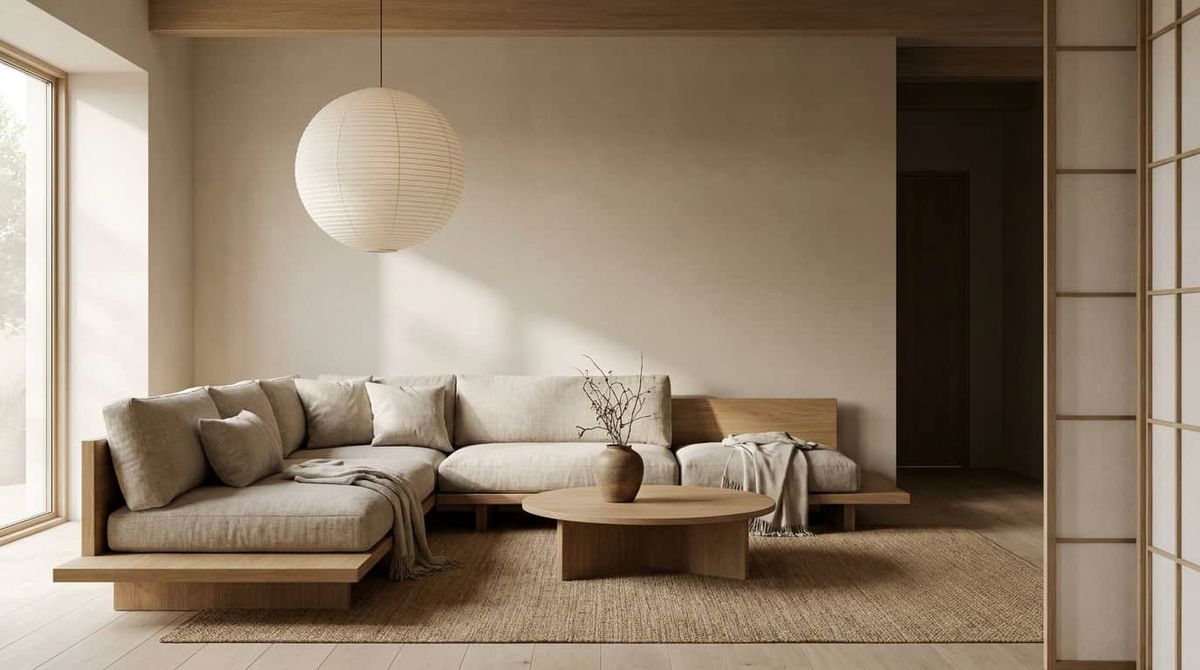
A complete Japandi reading nook fits a 4ft × 3ft footprint and costs under $250 to build in a single weekend. Reading nooks are one of the most reproducible setups in the style, which is why they hold a disproportionate share of Japandi’s best-saved Pinterest corners. Most fit in a 4ft × 3ft footprint, they work in any room with a wall and a power outlet, and the total build cost routinely lands under $250. We mapped 10 specific setups across window alcoves, bedroom corners, closet conversions, and studio apartments. Every one is weekend-buildable with items available at Target, Amazon, or IKEA.
The Japandi reading nook is not about a dedicated room or a built-in banquette. It is about a deliberate pocket of calm that communicates — through restraint, warm light, and a small number of quality objects — that this space is for one thing only.
Key Takeaways
- Five setup types covered: window-side, corner, closet/under-stair conversion, and studio/renter setups
- Average cost per setup: $120–220 — all 10 land under $250 at full build
- Footprint range: 3ft × 3ft minimum (foldaway studio) to 6ft × 4ft (bay window bench)
- Weekend-buildable: Yes, all 10 — no structural work, no power tools required
- Renter-friendly options: 6 of 10 setups require zero wall modifications or drilling
The 5-Element Japandi Reading Nook Formula
Every setup on this list follows the same underlying structure. Get these five right and the nook photographs well, functions well, and feels genuinely restful.
1 — Seat at low or floor level. Japandi reading nooks sit close to the ground. This is borrowed from Japanese floor culture: a zaisu chair (legless floor chair), a thick floor cushion, or a low-profile bench under 18 inches high. Standard Western armchairs feel too upright and too casual at the same time. The low seat signals that this corner is for stillness, not multitasking.
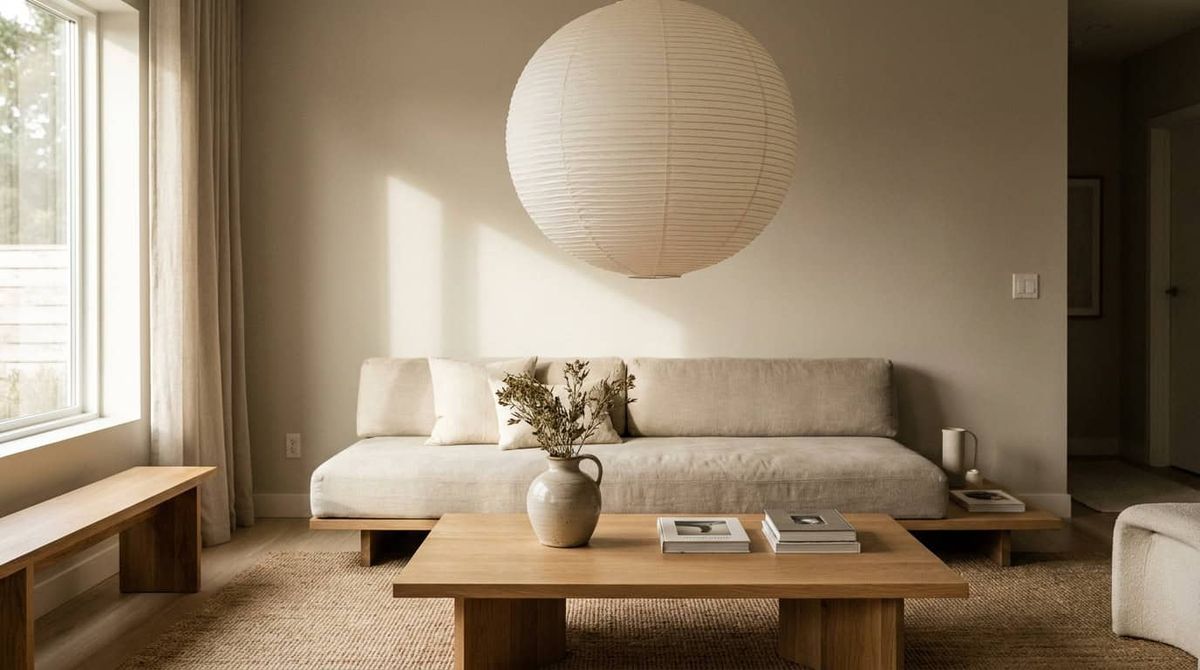
2 — A single warm light source. One lamp, positioned to the side or slightly above. Bulb temperature: 2700K only. This is not an arbitrary spec — 2700K produces the amber warmth that makes a nook feel recessed from the rest of the room. 3000K reads as neutral-office. 4000K kills the atmosphere entirely. Paper lantern floor lamps and arc brass desk lamps are the two most reliable formats.
3 — A small surface for tea. Not a full side table — a surface. A 10-inch round side table, a low wooden stool, a flat ceramic tray on the floor. Enough to hold a mug and a bookmark. This small functional anchor grounds the nook as a real space rather than a styled vignette.
4 — One textile. Linen throw or a thick floor cushion — not both. Adding a throw AND a cushion AND a sheepskin tips the setup into maximalist softness that works against the Japandi palette. Pick one. Linen or cotton in natural, oatmeal, or sage. 400–500 GSM weight for a throw that drapes rather than bunches.
5 — A curated stack of 5–7 books, spines visible. Not a full shelf. A small stack, placed deliberately. This is both functional and aesthetic — the stack signals that reading actually happens here, and the exposed spines add the one layer of color variation the palette allows without feeling busy.
The negative-space rule: target 50% of the nook’s visible area as empty — bare wall, floor, or air. This is the most counterintuitive rule and the one most people violate. The emptiness is load-bearing. It is what makes the few objects read as intentional.
What most guides miss: reading comfort is a matter of seat geometry, not softness. A reading seat works best at a 15–18 inch seat height with a 20–22 inch seat depth, deep enough to support your thighs when you tuck up with a book. For floor setups, stack cushions to a 6–9 inch seat height and add a back-support cushion so your hips sit slightly above your knees. That single adjustment is the difference between a nook you use for an hour and one you abandon after ten minutes.
Free · 60 seconds
Not sure which style is actually yours?
Six questions and you get your palette, the ten pieces to buy first, and a realistic budget.
10 Japandi Reading Nook Setups Under $250
Window-Side Nooks
1. Bay Window Floor Cushion — Classic Japanese Floor Reading
Setting: Bay window recess, living room or bedroom. Minimum width 36 inches.
5 items:
- Thick floor zafu cushion, 25-inch diameter, natural cotton (Amazon, $45)
- Linen throw, oatmeal, 50 × 70 inches, 450 GSM (Target Threshold, $28)
- Paper lantern floor lamp, white rice paper shade, 6ft cord (Amazon, $58)
- Low bamboo tray, 12 × 8 inch, for mug + bookmark (IKEA BOHOLMEN, $7)
- Small ceramic pot with trailing pothos (Target Studio McGee line, $22)
Total: ~$160
Why it works: The bay recess frames the cushion on three sides — you get the enclosed feeling of a nook without building anything. The paper lantern reads as Japanese rather than Scandinavian, which anchors the aesthetic direction clearly.
Source: Amazon (cushion, lamp), Target (throw, plant), IKEA (tray).
2. Narrow Window Bench + Linen Curtain Panel
Setting: Single standard window, 28–36 inch wide. Apartment living room or bedroom.
5 items:
- Low wood bench, 36 × 12 × 15 inches, oak or birch (IKEA SKOGSTA, $60)
- Linen floor cushion, seat-width, natural (Amazon, $38)
- Linen curtain panel, one side only, cream or light sage, 96 inch drop (Target, $30)
- Slim plug-in wall sconce with 18-inch cord cover, brass or matte black (Amazon, $44)
- Stack of 6 books + small ceramic bookmark dish ($0 existing books, $12 dish)
Total: ~$184
Why it works: Hanging one curtain panel rather than two creates an asymmetric frame that photographs extremely well. The single panel also partially softens the window light into the reading position without blocking it. The plug-in sconce keeps this fully renter-friendly — no electrical work.
Source: IKEA (bench), Amazon (cushion, sconce), Target (curtain).
3. Window-Side Hanging Chair — Statement Japandi Nook
Setting: Living room or bedroom corner near a window. Requires ceiling anchor stud — check before buying.
5 items:
- Cotton rope hanging chair, natural/cream, with hardware (Amazon, $95)
- Knit cotton throw, taupe, 55 × 70 inches (Amazon, $32)
- Paper lantern pendant (repurpose as floor lamp with a tall stand, $65 total)
- Low round side stool, 12-inch diameter, rattan (Target, $28)
- Three-plant cluster in matching ceramic pots on the floor (IKEA MUSKOT pots, $15 set)
Total: ~$235
Why it works: The hanging chair introduces movement into the nook — it swings slightly, which is kinetically appealing in a way no floor cushion replicates. Keep the palette strict: natural rope, cream throw, terracotta or matte white pots. Avoid cushions with prints.
Note: Verify ceiling joist or use a freestanding hanging chair stand (+$40, keeps total under $280 — slightly over budget but structurally optional for stud-heavy ceilings).
Source: Amazon (chair, throw, lantern stand), Target (stool), IKEA (pots).
Corner Nooks
4. Living Room Corner — Low Chair + Arc Floor Lamp
Setting: Empty living room corner, any size. 4ft × 4ft footprint.
5 items:
- Low-profile accent chair, 16-inch seat height, boucle or linen (Target Studio McGee, $180 — keep other items minimal)
- Slim arc floor lamp, matte black, 60-inch arc, E26 socket (Amazon, $46)
- 2700K Edison-style LED bulb, 60W equivalent (Amazon, $8 for 4-pack)
- Round jute rug, 4-foot diameter, natural (Amazon, $35)
- Single book stack on the floor beside the chair
Total: ~$245 (chair is the budget anchor)
Why it works: The arc lamp swings over the reading zone without requiring a side table, keeping the floor open. The jute rug defines the corner as its own zone without a visible edge line. The low chair brings the reading position closer to floor level than a standard armchair.
Source: Target (chair), Amazon (lamp, bulb, rug).
5. Bedroom Corner — Sheepskin Floor Cushion Setup
Setting: Bedroom corner, typically 3ft × 3ft beside a dresser or wardrobe.
5 items:
- Natural sheepskin floor pad, 24 × 36 inches (Amazon, $55)
- Low meditation floor cushion for back support, 20-inch round, buckwheat fill (Amazon, $42)
- Clip-on book light OR small plug-in table lamp (Amazon, $18–28)
- Mini side table, 10-inch diameter, bamboo or pine (Amazon, $22)
- Linen bookmark + 6-book stack (existing books)
Total: ~$140–160
Why it works: The sheepskin provides both the textile layer and the seat-surface, eliminating the need for a chair. The back-support cushion means you can actually read for an hour without strain. This is the smallest viable nook footprint — 3ft × 3ft — which makes it the right pick for apartments.
Source: Amazon (all items).
6. Hallway-End Built-In Bench Style — No Building Required
Setting: End of a hallway, typically 30–36 inches wide and 4–6 feet of dead length.
5 items:
- Cube storage ottoman, 18-inch cube, linen upholstered (Target, $48)
- Two foam seat cushions stacked for height, linen cover (Amazon, $38 for set)
- Plug-in wall sconce, angled, matte black (Amazon, $42)
- Floating wood shelf above (no-drill picture ledge, 24-inch, IKEA MOSSLANDA, $15) for book display
- Single trailing plant in hanging ceramic pot above shelf ($20)
Total: ~$163
Why it works: A hallway end that goes unused is wasted square footage. The cube ottoman gives you seat + storage. The picture ledge above acts as a display shelf without requiring full shelf installation. The result looks like an intentional built-in without the build.
Source: Target (ottoman), Amazon (cushions, sconce), IKEA (shelf).
Closet & Under-Stair Nooks
7. Reading Closet Conversion — Door-Off, Curtain-In
Setting: Standard reach-in closet, 24–30 inches deep × 36–48 inches wide. Remove door (or keep and open permanently), hang a linen curtain instead.
5 items:
- Tension rod + linen panel for doorway (Amazon, $22 total)
- Floor cushion, 24-inch round, kapok or buckwheat fill (Amazon, $45)
- String lights, warm white 2200K, battery-operated (Amazon, $14)
- Mini floating shelf inside closet at shoulder height (Amazon, $18)
- Stack of 7 books on the shelf + one small plant
Total: ~$99–120
Why it works: The closet walls on three sides create the most enclosed nook feel of any setup on this list — it genuinely feels like a room-within-a-room. The linen curtain replaces the door and allows you to draw it for privacy when reading. String lights at 2200K (warmer than 2700K) work in such a small enclosed space because there is no ambient light competing. The budget comes in well under $150, leaving room for cushion upgrades.
Source: Amazon (all items).
8. Under-Stair Tucked Nook — Single Sconce + Low Bench
Setting: Under-stair storage area, reclaimed. Minimum clearance: 36 inches at the tall end.
5 items:
- Low platform bench or wide cushion, 48 × 18 inches (custom cut foam + linen cover, Amazon, $55)
- Hardwired or plug-in angled wall sconce at reading height — 55 inches from floor (Amazon plug-in, $44)
- Small side tray or stool (existing or IKEA FROSTA stool, $15)
- Printed linen throw (one botanical print allowed — Japandi permits quiet natural motifs) ($28)
- Book stack + single candle in ceramic holder
Total: ~$145
Why it works: Under-stair spaces have a natural ceiling taper that physically creates the enclosed nook geometry. You do not need to build anything — you need a seat, light at the right height, and restrained styling. The tapered ceiling is actually an asset for the Japandi aesthetic because it enforces simplicity.
Source: Amazon (bench foam/cover, sconce, throw), IKEA (stool).
Studio & Small-Space Nooks
9. Bedside Floor Reading Spot — No Chair Required
Setting: Studio apartment or bedroom with unused floor space at the bed’s foot or side. 3ft × 2ft minimum.
5 items:
- Oversized floor cushion, 30 × 30 inch, removable linen cover (Amazon, $48)
- Low side table OR a wood cutting board used as a floor tray (IKEA APTITLIG, $8)
- Arc desk lamp on the floor tilted upward — used off-label as a reading lamp ($38, Amazon)
- Linen throw draped over cushion (already part of the bed styling — repurpose it) ($0)
- 5-book stack organized by spine color tone (no purchase required)
Total: ~$94
Why it works: No dedicated reading furniture needed. The oversized floor cushion doubles as overflow seating. The wood tray on the floor reads as intentional — far more than a plastic side table. The arc desk lamp used on the floor is a specific trick: it produces a small pool of directed warm light that standard floor lamps cannot match at this price.
Source: Amazon (cushion, lamp), IKEA (tray).
10. Foldaway Floor Cushion — Renter Nook With Zero Footprint
Setting: Any studio or apartment with at least one open wall section 4ft wide. Nook exists only when in use.
5 items:
- Tri-fold floor cushion with carrying handle, 72 × 24 inches folded flat (Amazon, $65)
- Foldable paper lantern with cord, stored in closet when not in use (Amazon, $18)
- Linen storage basket to hold throw + books when nook is packed down (Target, $24)
- Linen throw, 50 × 70 inches, oatmeal (Amazon, $28)
- Power strip with 6ft cord run to the lantern (existing or $12 Amazon)
Total: ~$135–147
Why it works: The foldaway format is the right answer for renters in sub-500 sq ft apartments. When in use, unfold the cushion against the wall, set the lantern beside it, drape the throw — you have a complete reading nook in under 90 seconds. When packed down, everything fits into the storage basket plus a closet hook. Zero permanent footprint, zero landlord issues.
Source: Amazon (cushion, lantern, throw), Target (basket).
Lighting That Makes a Nook
The single variable that separates a functional reading corner from an actual Japandi nook is bulb temperature. We have called out 2700K throughout this list because it is not interchangeable with other warm-white categories.
2700K produces amber-leaning warmth — the color of a candle seen across a room. It makes skin tones glow, makes natural wood look richer, and makes the nook feel recessed from the brighter parts of your home. 3000K is cooler and more neutral — fine for kitchens, wrong here. 4000K is office lighting.
What most guides miss: warm color is only half the equation, you also need enough light on the page. Aim for 400–450 lumens at the book (a 2700K, 40–60W-equivalent LED), placed beside and slightly behind your shoulder, roughly 15–24 inches from the page. Keep the bulb below eye level or fully shaded so it never glares back at you. Too dim and you strain, too bright and the amber pool collapses into flat task light. That 400–450 lumen window is the sweet spot for an hour of comfortable reading.
Three specific picks that work in every setup above:
-
Paper lantern floor lamp — look for a rice-paper shade (not synthetic), height adjustable, E26 socket. Load it with a 2700K 40W-equivalent LED. About $55–65 from Amazon. This is the most versatile Japandi nook lamp because the shade diffuses the light in every direction, eliminating harsh shadows.
-
Brass arc desk lamp — slim arm, weighted base, 18-inch reach. About $75–85 from Amazon or West Elm. Works as a directional reading lamp when you need focused light rather than ambient. Brass finish reinforces the warm-metal Japandi palette.
-
Plug-in wall sconce — hardwired look without the electrician. Cord cover kits run about $15. Choose matte black or antique brass. About $40–50 from Amazon. Best for closet conversions and under-stair nooks where floor space is at a premium.
Avoid: LED puck lights, under-cabinet strips, smart bulbs in color-shifting modes (use 2700K static only), and any bulb above 3000K in a nook context.
Sound + Scent Layer
Most reading nook guides stop at the visual. Here is what they skip.
Sound. Soft surfaces — linen, wool, cotton — absorb echo. A bare corner with hard walls produces a subtle acoustic flatness that reads as “empty room” rather than “private retreat.” The textiles in every setup above serve a dual purpose: visual warmth and mild sound dampening. If your nook is in a particularly echo-prone space, a wall-hung tapestry (12 × 24 inches, wool or cotton) adds another absorption layer without visual weight.
A white-noise machine or a small indoor water feature — a compact ceramic dripper runs about $35 on Amazon — introduces a neutral audio baseline that separates the nook acoustically from the room around it. This is particularly effective in studios where the “reading space” is technically the same room as everything else.
Scent. One scent source only. The Japandi palette here matches the visual one: sandalwood, hinoki wood, white tea, or lavender. A single soy candle or a reed diffuser with a 4–6 reed bundle (not 12 — that is too strong) placed on the side tray. The rule is singularity: one scent, one source, no combinations. Layering scents — candle plus diffuser — creates a sensory busy-ness that contradicts the quiet the nook is trying to establish.
3 Mistakes That Ruin a Reading Nook
1. Too cushy. A thick seat cushion + a sheepskin + a linen throw + a lumbar pillow + a knit blanket equals a pile, not a nook. The textile surplus reads as maximalist comfort culture, not Japandi. Pick one primary textile and one accent. Let the seat do the structural work.
2. No textile layer at all. The opposite mistake. A low bench with no textile looks unfinished and reads as “forgot to style this.” Even one object — a folded throw draped over one corner of the seat — signals that the space is inhabited and intentional.
3. Overhead light on. If the room’s overhead light is on while you are in the nook, the nook does not exist. The ambient overhead light washes out the warm pool your nook lamp creates and collapses the sense of separation. Turn off the overhead. Use the nook lamp only. This is the single most impactful change you can make to an existing reading corner that is not working.
FAQ
What is the smallest viable Japandi reading nook?
3ft × 2ft — enough for a tri-fold floor cushion and a single lantern beside it. Setup 10 in this list works at that footprint. The nook does not need to be a room, a recess, or a dedicated corner. It needs a seat, a light, and a defined edge (a small rug works as the edge marker).
Can renters build a Japandi reading nook without drilling?
Yes. Six of the 10 setups above require zero wall modifications. Plug-in sconces with cord covers, tension rod curtain panels, freestanding floor lamps, and peel-and-stick shelf anchors cover all functional requirements without involving a landlord or a security deposit. See setups 2, 5, 9, and 10 specifically.
What is the best fabric for a reading nook floor cushion?
Linen or cotton canvas for the cover — both hold shape, wash well, and photograph neutrally against the Japandi palette. Avoid velvet (too formal), microfiber (too synthetic-looking), and chunky knit (too trendy, dates fast). For fill: buckwheat holds position and does not compress flat after two weeks of use. Kapok is lighter and slightly softer. Foam slab is the most durable. Avoid polyester fiberfill — it compresses to nothing within a month of daily use.
Does a standing reading spot work as a Japandi nook?
Not really, no. The Japandi reading nook borrows from Japanese floor culture — the low position, the groundedness, the deliberate slow-down of sitting close to the floor. A standing reading ledge can be Japandi-styled, but it does not produce the nook effect (the sense of a contained, separate space within a room). If standing is the preference, a tall stool at counter height beside a window works better than a strict standing position.
How much does a starter Japandi reading nook cost?
A basic starter nook runs $94–160 all in. The cheapest complete setup on this list (setup 9, the bedside floor spot) lands at $94 using an oversized floor cushion, a wood floor tray, and an arc desk lamp used off-label. Reuse books and an existing throw and you can open under $100. Full-build corner setups with a low chair push toward $245, still under the $250 ceiling.
What seat height and depth make a reading nook comfortable?
Aim for a 15–18 inch seat height with a 20–22 inch seat depth on a chair or bench, deep enough to support your thighs when you pull your knees up. For floor setups, stack cushions to a 6–9 inch seat height and add a firm back-support cushion so your hips sit slightly above your knees. That geometry keeps your spine supported through a full reading session.
Build Your Quiet Corner
A Japandi reading nook is one of the few home projects where less budget consistently produces better outcomes than more. The restraint in the formula — one textile, one lamp, one surface, a curated stack of books, and 50% empty space — means that adding objects typically makes the nook worse rather than better. The $94 bedside floor setup (setup 9) outperforms many $500 custom reading corners because it follows the formula without exception.
Start with your existing space: find the most under-used corner, alcove, or wall section in your apartment or home. Measure it. Then pick the closest matching setup from this list. All 10 are available in a single Target + Amazon order delivered by the weekend.
For the broader Japandi style behind these nooks, see our Japandi Style Decor Guide. For the full range of Japandi corners beyond reading spots, 18 Aesthetic Japandi Corners & Nooks covers living room, entryway, office, and bedroom setups. The Japandi Color Palette Guide is worth reading before you buy textiles — the muted neutral palette is tighter than it looks in store lighting.
For the furniture behind every setup above, Best Japandi Furniture & Decor 2026 and Best Japandi Furniture Under $300 cover the full sourcing picture. If you are budgeting the full nook against a broader room refresh, Japandi Decor Budget & Cost Breakdown gives you the honest per-room numbers.
Related: Japandi Living Room Ideas · Wabi-Sabi & Japandi: Imperfection & Warmth