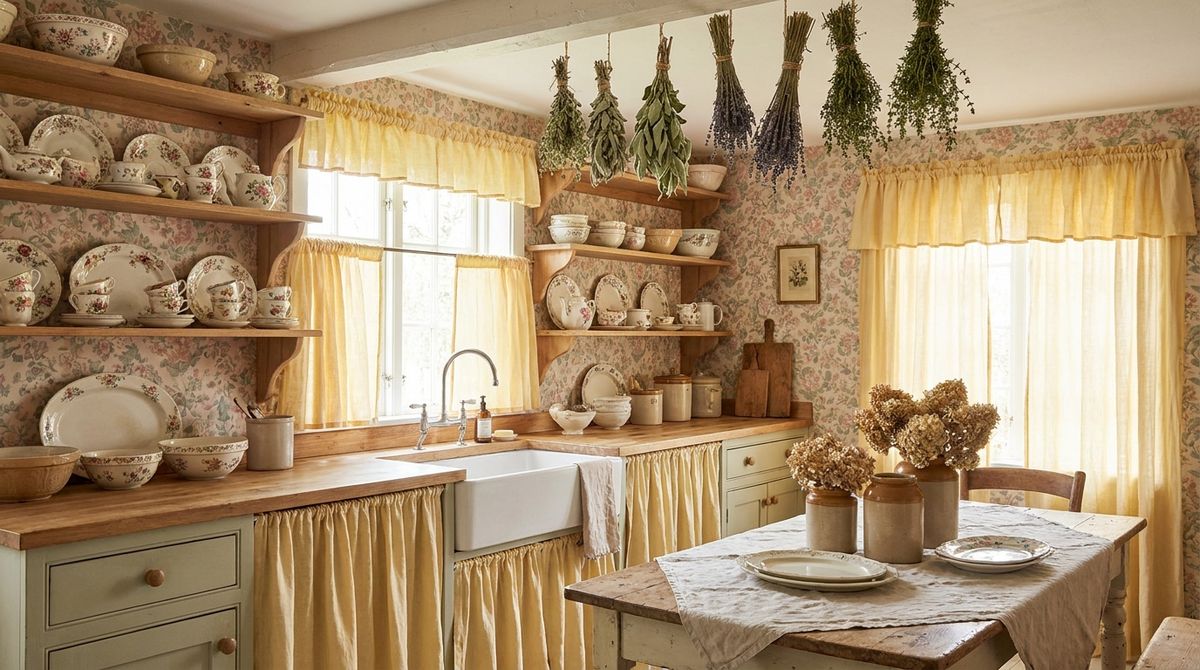
To build a cottagecore room, work in seven layers and in this order: choose a sub-vibe, lock a three-color palette, start with linen textiles, add one anchor furniture piece, layer botanicals, add vintage accents, then finish with intentional styling. Most people attempting cottagecore for the first time make the same mistake: they buy individual items labeled “cottagecore” on Etsy or Pinterest and arrange them in a room that has no underlying structure. The result is a collection of whimsical objects floating in a room that doesn’t feel like anything.
This guide is the framework. Seven steps, in the right order, with specific products and prices at each stage.
Key Takeaways
Key Takeaways
- Cottagecore has three distinct sub-styles: English countryside, fairycore, and dark cottagecore — pick one before buying anything
- Textiles deliver the highest ROI per dollar spent; linen bedding or sofa covers transform a room faster than any furniture purchase
- Vintage and handmade accents from Etsy or thrift stores often cost less than new “cottagecore-styled” product
- Follow the 7-step order: sub-vibe → palette → textiles → anchor furniture → botanicals → vintage accents → final styling
Step 1: Choose Your Cottagecore Sub-Vibe
Cottagecore is not one aesthetic — it’s three, and they require different palettes, furniture, and sourcing strategies. Choosing before you buy anything is what separates a cohesive cottagecore room from a confusing one.
Pick one. You can blend later once you understand the rules.
English Countryside
This is the most common interpretation and the easiest entry point. Think florals, chintz upholstery, warm cream walls, oak furniture, and the general feeling of a well-loved English country home. The color story centers on cream, dusty rose, warm sage, and soft terracotta. Pattern is present but controlled — one floral fabric as the room’s main textile, balanced with solid linens.
Best for: people who love traditional warmth but want visual richness without the moody darkness of maximalism.
Fairycore
Fairycore is cottagecore’s most romantic and fantastical sub-style. Soft pastels — blush, lavender, pale mint, warm white — combine with delicate lighting (string lights, candles, botanical lanterns), ethereal fabrics like gauze and voile, and an emphasis on all things that feel magical and luminous. Mushroom ceramics, crystal accents, and trailing plants are recurring elements. It skews dreamier and lighter than English countryside.
Best for: smaller spaces, bedrooms, reading nooks, and anyone who wants the room to feel like a softly lit storybook.
Dark Cottagecore
Dark cottagecore keeps the botanical and handmade elements of the aesthetic but shifts the palette into deeper, moodier territory. Burgundy, forest green, deep brown, charcoal, and dusty plum replace the creams and pinks. Dried mushroom decor, dark botanicals, aged leather, candles in darker hues, and antique-style frames give the look a gothic-romantic quality. It’s intellectually rich and visually dramatic.
Best for: north-facing rooms, bedrooms designed for evening atmosphere, and anyone who finds standard cottagecore too sweet.
Free · 60 seconds
Not sure which style is actually yours?
Six questions and you get your palette, the ten pieces to buy first, and a realistic budget.
Step 2: Lock In Your Color Palette
A focused color palette is what keeps a cottagecore room from reading as cluttered. Limit yourself to three or four colors and repeat them across walls, textiles, and accents.
The rule: choose one dominant color (60%), one secondary (30%), and one accent (10%).
For English countryside: dominant cream or warm white, secondary dusty rose or sage, accent terracotta or warm brown.
For fairycore: dominant blush or soft lavender, secondary pale mint or warm white, accent gold or soft amber candlelight.
For dark cottagecore: dominant forest green or charcoal, secondary burgundy or deep plum, accent cream or aged brass.
Before ordering a single product, confirm that it falls within your chosen palette. This one filter eliminates most bad purchases before they happen.
Step 3: Start With Textiles (The Highest ROI Layer)
Textiles are where the cottagecore aesthetic lives or dies, and the textile layer does the most work regardless of budget. A room with no furniture but the right linen bedding, floral pillow covers, and a crochet throw reads as intentional. A room with expensive furniture but wrong textiles reads as nothing.
Start here before touching anything else.
Linen Bedding or Sofa Cover
Linen is the foundational textile for cottagecore. Its natural texture, slight wrinkle, and earthy tones sit at the center of all three sub-styles. For bedrooms: a linen duvet cover in warm white, dusty rose, or sage costs $45-$85 on Amazon or H&M Home. For living rooms: a linen slipcover in cream or natural transforms an existing sofa without replacing it ($60-$180 depending on size).
Swapping a microfiber or polyester bedding set for a washed linen cover changes a cottagecore room more than most furniture or accessory swaps. Linen’s soft, slightly rumpled texture reads as lived-in in photos and in person.
Floral or Vintage-Print Cushions
Two to four cushion covers in a floral or vintage botanical print bring the cottagecore personality into the room without requiring a furniture investment. Look for ditsy florals, pressed-botanical prints, or William Morris-inspired patterns. Etsy sellers offer handmade linen cushion covers in these prints for $18-$35 each. Target’s Opalhouse line and H&M Home both carry affordable versions at $12-$22 per cover. Stick to your sub-vibe’s palette when selecting patterns.
Knit or Crochet Throw
A handmade-looking knit or crochet throw adds dimension and the “made with intention” quality that defines cottagecore. Chunky knit throws in cream or warm oat are widely available at Target and Amazon for $28-$45. Genuine handmade crochet throws from Etsy sellers run $55-$120 but carry the authentic handmade quality the aesthetic depends on. Drape it over one arm of the sofa or the foot of the bed, never folded symmetrically.
Step 4: Add the Anchor Furniture Piece
Once the textile layer is in place, you need one furniture piece that commits the room to the cottagecore identity. This is the piece that a visitor looks at and immediately understands the aesthetic. It doesn’t need to be expensive. It needs to have the right visual qualities.
What Makes Furniture Look Cottagecore
Three qualities signal cottagecore furniture: aged or natural wood (oak, pine, whitewash), curved or rounded lines (not angular), and cane, rattan, or wicker detailing. A curved-back armchair with fabric upholstery in a floral or velvet, a small wood side table with a turned leg, a whitewashed bookcase with visible grain — these read immediately. Prices range from $45-$180 for cane or rattan accent chairs at Target and Amazon, up to $250-$450 for upholstered vintage armchairs from Etsy or Facebook Marketplace.
What to Avoid
Straight-line, angular furniture reads modern or Scandi rather than cottagecore. Clean-lined IKEA pieces in their unmodified state (MALM dressers, KALLAX shelves, LACK side tables) fight the cottagecore aesthetic. This doesn’t mean you can’t use them — an IKEA BILLY bookcase painted sage green with new ceramic knobs and a row of trailing plants on top becomes cottagecore-adjacent. Modification is the key. Without it, the geometry reads as too contemporary.
Step 5: Layer Botanicals and Plants
Botanicals are non-negotiable in cottagecore. They represent the core ideology of the aesthetic: a connection to the natural, growing, and foraged.
Dried Botanicals
Dried botanicals require no maintenance and stay within the cottagecore palette year-round. The most versatile options: dried lavender bundles ($8-$16, Amazon), dried pampas grass ($12-$25, Amazon), eucalyptus sprigs ($6-$14), and dried wildflower bunches from Etsy sellers ($15-$28). Arrange in ceramic vases, hang in bundles from ceiling hooks, or lay flat on a shelf as a styling element. Dried botanicals work especially well for dark cottagecore and English countryside sub-styles.
Real Plants
For living botanicals, prioritize trailing or spreading plants that feel naturally abundant rather than contained. Pothos in a hanging macrame planter ($14-$22 for the planter, $5-$12 for the plant), trailing ivy on a shelf edge, and ferns in terracotta pots are the cottagecore plant canon. Small terracotta pots in graduated sizes cost $3-$8 at most garden centers. A cluster of three terracotta pots at different heights on a windowsill is one of the highest-impact styling moves in the entire aesthetic.
Step 6: Add Vintage and Handmade Accents
This layer is what makes a cottagecore room feel genuinely lived-in and personal rather than assembled from a product list. The distinction between a room that photographs well on Pinterest and one that feels emotionally resonant is almost always in this layer. Sourcing vintage and handmade pieces is central to the aesthetic’s appeal.
Where to Find Them
Thrift stores: The single best source for cottagecore accents at low cost. Look specifically for ceramic pieces (mismatched cups, hand-thrown pottery, vintage pitchers), wicker and rattan baskets in any size, ornate picture frames in gold or dark wood, and candle holders in glass or metal. Budget: $2-$15 per piece.
Etsy: The primary online source for handmade and vintage cottagecore pieces. Search “hand-thrown stoneware,” “vintage botanical print,” “cottagecore candle,” and “crochet home decor.” Etsy sellers who specialize in cottagecore accents typically run $15-$65 per piece, with handmade ceramics at the higher end.
Facebook Marketplace: Underrated for furniture-scale vintage pieces. Curved armchairs, small wooden tables, and ornate mirrors appear frequently in the $25-$95 range, versus $180-$400 for similar items new.
What to Look For
Pottery in earth tones or speckled glazes. Picture frames in gold, dark wood, or ornate carved styles. Wicker and rattan baskets in any size (used as plant holders, blanket storage, or shelf accents). Candles in beeswax, taper, or pillar form. Mismatched vintage books with cloth or decorative spines. Small glass bottles and apothecary jars. Each piece should look like it could have been found rather than purchased.
What most guides miss: Layering vintage without clutter is a spacing problem, not a quantity problem. The rule we use when styling: group thrifted pieces in odd numbers on one surface, then leave the surface next to it almost bare. A crowded shelf reads as a spare room full of hand-me-downs; the same pieces split across a shelf, a windowsill, and a single wall hook read as collected over years. Vary height and material (ceramic, glass, wicker) but keep every piece inside your three-tone palette, so the eye reads it as intentional rather than accidental. That palette discipline is what separates modern cottagecore from the dated, matchy version most people picture.
Step 7: Final Styling (The Details That Make It Look Intentional)
The final layer is where styling instinct matters more than product selection. A room can have every correct element and still look flat if the final details are missed. Cottagecore rooms look best when the styling reflected visible human touch rather than retail-display symmetry. Asymmetry, stacking, and layering signal “lived in.” Symmetry signals “just bought.”
Books Stacked Spine-In
Turning a portion of your books spine-inward creates the soft, creamy visual texture that appears in almost every high-save cottagecore shelf photo. Mix spine-in stacks with a few face-out books showing natural or botanical covers. Intersperse small ceramic objects between stacks. The visual effect is one of accumulated reading and gentle imperfection rather than organized display.
Candles at Different Heights
Never group candles at the same height. A taper candle in a brass holder next to a short pillar candle next to a small glass votive creates a visual rhythm that reads “cottage hearth” rather than “store display.” Aim for at least three different heights when grouping candles. Budget: $8-$20 for a set of mixed pillar and taper candles at Target, World Market, or HomeGoods.
Natural Light Optimization
Natural light is the most powerful styling tool in cottagecore. Lace or sheer curtain panels ($20-$35, Amazon) diffuse direct sunlight into the soft, dappled quality that makes cottagecore rooms glow in photographs and in person. Add a second rod behind the lace panel for a heavier linen or floral curtain you can close in the evening. Mirrors placed opposite windows amplify natural light. A vintage-framed mirror ($25-$75, thrift or Etsy) reflecting a window into the room does more for the aesthetic than almost any other styling move.
What most guides miss: Nearly every cottagecore room tour features wallpaper, and renters skip it assuming it is off-limits. Peel-and-stick floral wallpaper ($30-$45 a roll from brands like Tempaper or RoomMates) lifts off most rental walls cleanly, and applying it to just one alcove, a headboard wall, or the back panel of a bookcase delivers the floral moment without a whole-room commitment or a deposit dispute. For florals you can fully undo on move-out, a tension rod holding a floral panel and a large framed fabric swatch leaned against the wall carry the same pattern with zero holes.
The Cottagecore Starter Kit: What to Buy First Under $200
If you’re starting from zero, this is the order that delivers the most visual impact per dollar spent. Following this sequence builds a recognizable cottagecore foundation before any furniture purchases.
| Priority | Item | Price Range | Where to Buy |
|---|---|---|---|
| 1 | Washed linen duvet cover or sofa slipcover | $45-$85 | Amazon, H&M Home |
| 2 | Floral or botanical cushion covers (set of 2) | $24-$44 | Etsy, H&M Home, Target Opalhouse |
| 3 | Dried botanical bundle (lavender + pampas) | $18-$28 | Amazon |
| 4 | Knit or crochet throw in cream or oat | $28-$45 | Target, Amazon |
| 5 | Lace or sheer curtain panels | $20-$35 | Amazon |
| 6 | Terracotta pots (set of 3) + trailing pothos | $20-$30 | Garden center + Amazon |
| 7 | One vintage ceramic piece (thrift or Etsy) | $5-$22 | Thrift store, Etsy |
Total range: $160-$289 for the full starter kit, depending on sourcing. The linen cover and cushion covers are where to spend; the botanicals and ceramics are where to save.
What to add in the second phase (once the textile foundation is solid): an anchor furniture piece, more vintage accents, real plants, and lighting adjustments. Don’t rush the second phase. Living with the textile foundation for a few weeks shows you exactly what the room needs next.
Frequently Asked Questions
Q: Do I need to buy everything new, or can cottagecore work with existing furniture?
A: Existing furniture works in most cases. The textile layer (linen covers, cushion swaps, throws) can completely reframe an existing sofa or bed without replacement. If the furniture is very angular or modern in profile, focus on layering textiles heavily and adding vintage accent pieces to redirect visual attention. Cottagecore is one of the few aesthetics where the accessories carry the aesthetic more than the furniture frame.
Q: How is cottagecore different from farmhouse or vintage styles?
A: Farmhouse is controlled and edited; cottagecore is intentionally layered and abundant. Vintage style focuses on specific historical periods; cottagecore is more atmospheric than historically precise. The key cottagecore indicators are the botanical layer (dried flowers, trailing plants), the handmade quality (crochet, pottery, woven baskets), and the romantic imperfection in styling. For a full comparison, our modern farmhouse vs cottagecore guide covers the differences in detail.
Q: What’s the minimum budget to make a room look intentionally cottagecore?
A: Around $80-$120 covers the highest-impact moves without touching furniture. A washed linen cushion cover set ($24-$44), a dried botanical bundle ($18-$28), a crochet throw ($28-$35), and a handful of terracotta pots with a trailing pothos ($15-$20) transform the textile and botanical layers of a room at very low cost. The linen cover is optional at this budget level — start with the cushions and botanicals first.
Q: Can I do cottagecore in a small apartment or studio?
A: Yes, with a focused approach. In small spaces, choose one corner or zone (a reading nook, a windowsill, a single shelf) and build the full cottagecore layering there rather than spreading it across the whole apartment. This “cottagecore corner” approach reads more intentional in tight spaces than attempting to cover every surface. Fairycore, with its lighter palette and delicate scale, often works better in very small spaces than English countryside or dark cottagecore, which require more visual breathing room to land correctly.
Q: How do I keep cottagecore from looking dated or “grandma”?
A: The dividing line is restraint plus palette discipline. Dated rooms pile matching florals onto wallpaper, curtains, and upholstery all at once; modern cottagecore picks one floral as the hero and keeps everything around it in solid linen. Swap brass-and-mauve for warm sage, cream, and raw wood, and leave negative space between pieces. Cluttered plus matching reads old-fashioned; edited plus tonal reads current.
Conclusion
Seven steps, one clear sequence, and one decision that makes or breaks everything: choosing your sub-vibe before you buy a single thing. Cottagecore fails when it becomes a collection of individually correct items without a cohesive foundation. It succeeds when the palette is locked, the textiles establish the base, and the vintage and botanical layers add the personal, accumulated-over-time feeling that defines the aesthetic.
If you’re starting from zero, begin with the linen layer and one dried botanical arrangement. That two-purchase foundation is enough to make the direction clear and to tell you what the room needs next.
For the full color reference to support Step 2, our cottagecore color palette guide covers every sub-vibe’s palette in detail. For budget sourcing strategies across every layer, the cottagecore decor on a budget guide walks through the best thrift, Etsy, and retailer finds by price range.
Related reads: