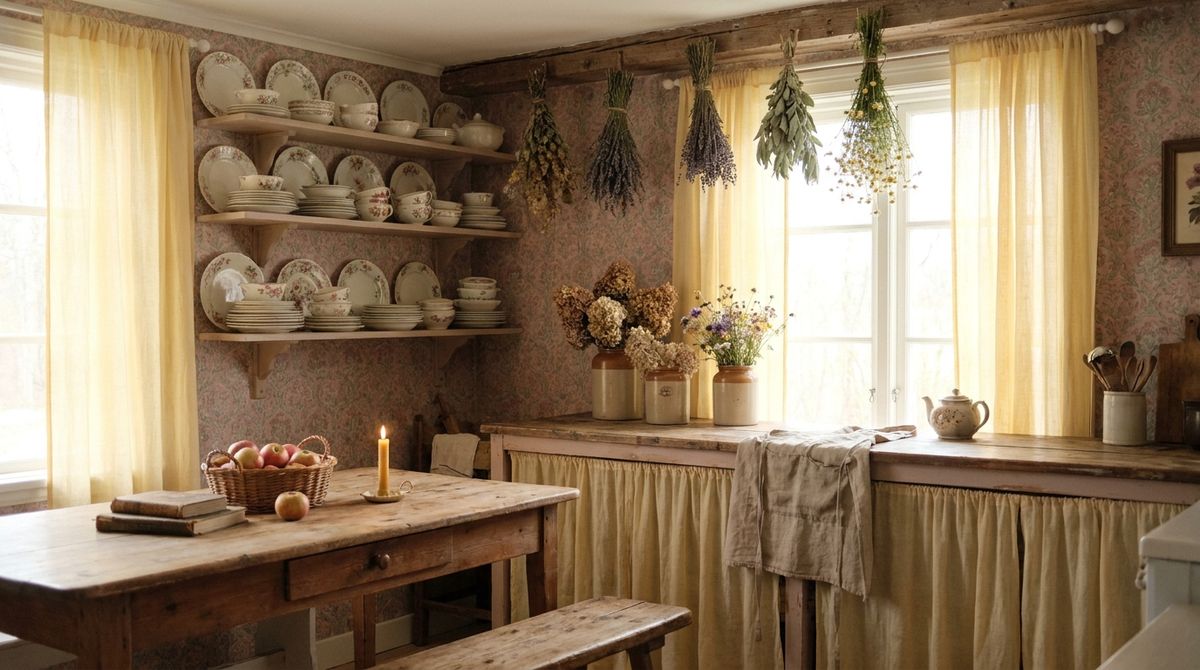
You can build a complete cottagecore room for as little as $100, and a well-planned $500 version beats a $2,000 makeover spent on the wrong categories. Cottagecore is one of the most achievable aesthetics for renters on a real budget, because it leans on textiles, dried botanicals, and secondhand ceramics instead of statement furniture like mid-century modern or Japandi. According to a 2024 Houzz survey, homeowners who redesigned a room spent a median of $1,500, but cottagecore buyers routinely report full bedroom transformations for under $300. The reason: thrift stores and Amazon carry almost everything this aesthetic needs. Here’s exactly what you can do at three budget levels.
Key Takeaways
- Cottagecore is textile-heavy, so the 60/25/15 spend split (textiles, botanicals, art) gets you the most visual return per dollar.
- A $100 starter kit transforms a single shelf or nightstand into a full vignette.
- At $250, you can make a reading nook or bedroom corner look intentionally cohesive.
- At $500, a rattan armchair plus peel-and-stick floral wallpaper delivers a full room transformation.
- Houzz reports the average room redecoration runs $1,500+ — cottagecore beats that by a wide margin (Houzz U.S. Houzz & Home Study, 2024).
The Cottagecore Budget Rule of Thumb
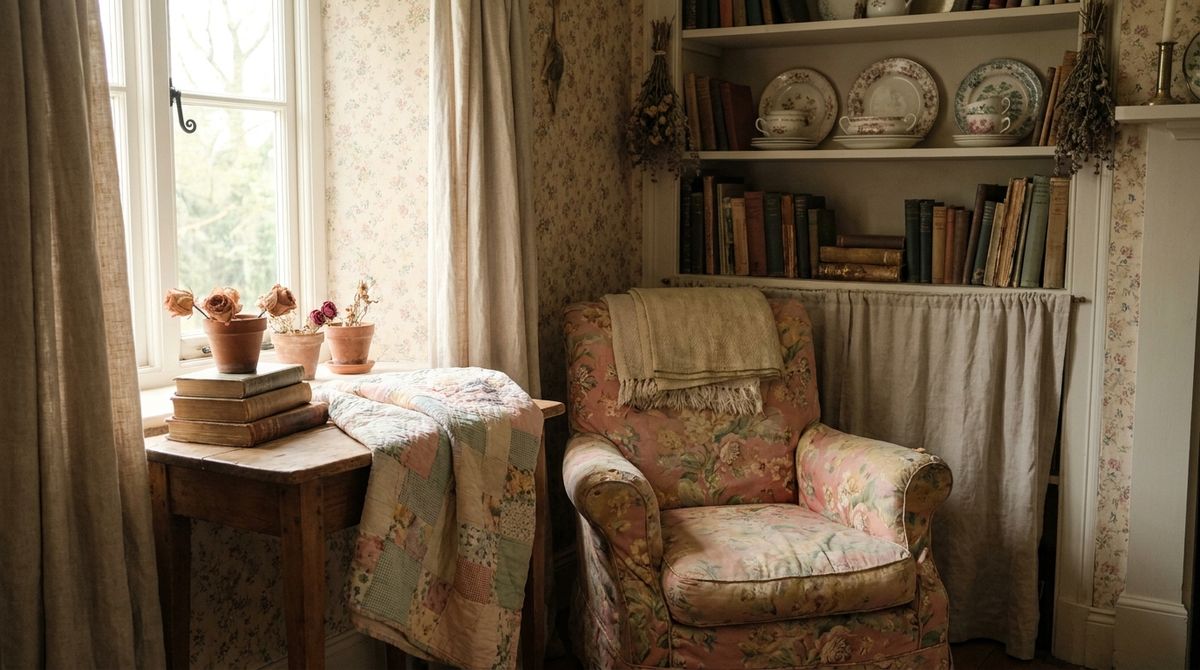
Cottagecore transforms rooms through layering, not replacement — and that’s why it’s so accessible. Based on the aesthetic’s core visual elements, the spend split that actually works is: 60% textiles, 25% botanicals and ceramics, 15% art and frames. Textiles do the heaviest lifting because they add warmth, color, and texture simultaneously, which is the fastest way to shift a room’s mood.
The 60/25/15 rule matters because it prevents the most common mistake: spending too much on a single decorative object. One $90 ceramic vase doesn’t read as cottagecore. A $35 linen throw, a $12 dried pampas bundle, and a $5 thrifted frame do. The aesthetic is about accumulation of soft, handmade-feeling layers, not a single hero piece.
What most guides miss: The same cottagecore vignette sourced new versus thrifted splits roughly 3 to 1 on price. A styled shelf of new ceramics, dried stems, and frames runs $80-$120, while the identical grouping pulled from Goodwill, an estate sale, and Dollar Tree lands closer to $25-$40. The look reads the same in photos, so the split is pure savings, not a downgrade.
$100 Cottagecore Room — The Starter Kit
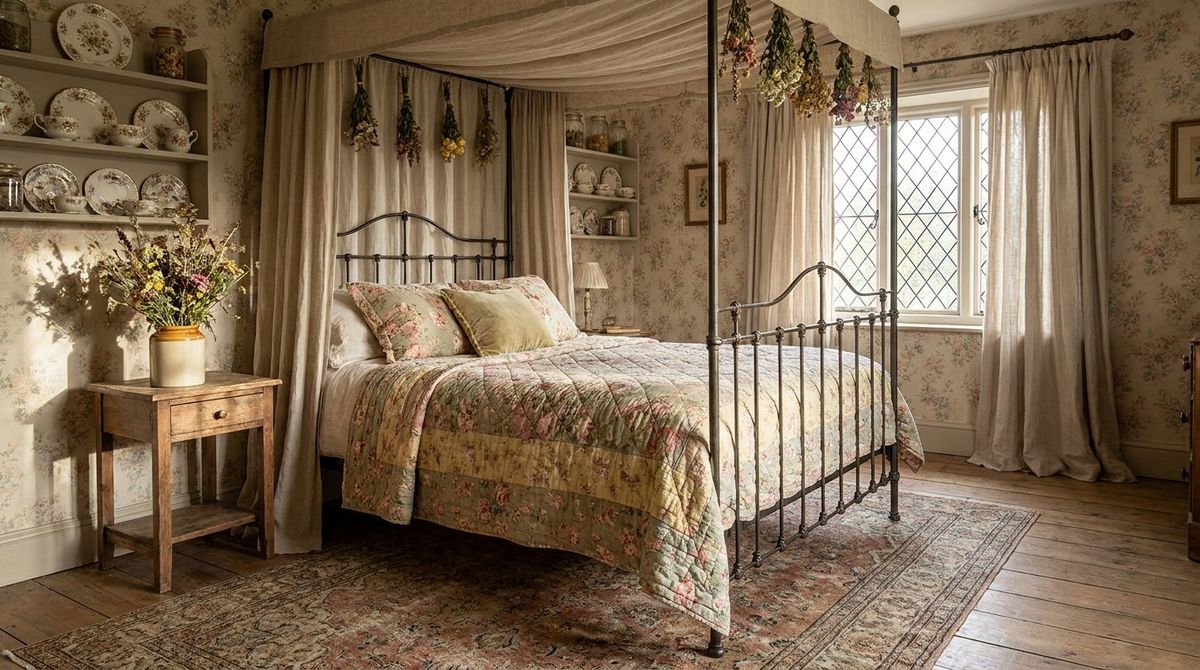
For $100, you’re not buying furniture. You’re building a vignette — a styled corner, shelf, or nightstand that anchors the aesthetic. That’s a realistic and worthwhile goal: according to a 2023 Statista report on U.S. home decor spending, the average consumer spends $85 per decorating project at the accessory level (Statista, U.S. Home Furnishings & Decor Consumer Spending, 2023). A focused $100 outperforms that average when the spend is intentional.
The biggest mistake at this budget is spreading money across too many rooms. Pick one surface and nail it.
What most guides miss: Cheap plastic florals cost you twice. A $6 faux bunch reads shiny and fake in photos and yellows within a year, so it becomes a repeat purchase. Real dried stems run $12 up front but hold up for three seasons, and a DIY bundle of foraged grasses or hydrangea clippings costs nothing at all.
Exact $100 Picks
Here’s what actually works at this tier. All prices are current Amazon and Target listings:
- Floral linen cushion covers x2 — $24 (Amazon, search “cottagecore floral cushion cover linen”)
- Dried pampas grass bundle — $12 (Amazon)
- Rattan wicker basket — $14 (Amazon or Target)
- Botanical print in a thrifted frame — $0-5 (thrift store frame + free printable from Etsy or Pexels)
- Soy candle + simple candleholder — $8 (HomeGoods, TJ Maxx, or Amazon)
- Linen table runner — $10 (Amazon)
Total: $68-$80, which leaves a $20-$30 buffer for a small bud vase or a handful of fresh or dried wildflowers.
What This Achieves
Grouped on a nightstand or floating shelf, these items create a complete cottagecore vignette. The cushion covers on a bed immediately shift the visual language of the space. The dried pampas adds height and organic texture. The rattan basket handles visual grounding. It reads as intentional rather than randomly collected.
What to Skip at $100
Skip furniture, wallpaper, and curtains at this budget. A single rattan side table eats your entire budget and won’t look like much without the softer layers around it. Save furniture for the $250 tier.
Free checklist
Spending $100 on a room? Spend it in this order.
The four phases we use, starting with the free one that changes more than any purchase.
$250 Cottagecore Room — The Real Transformation
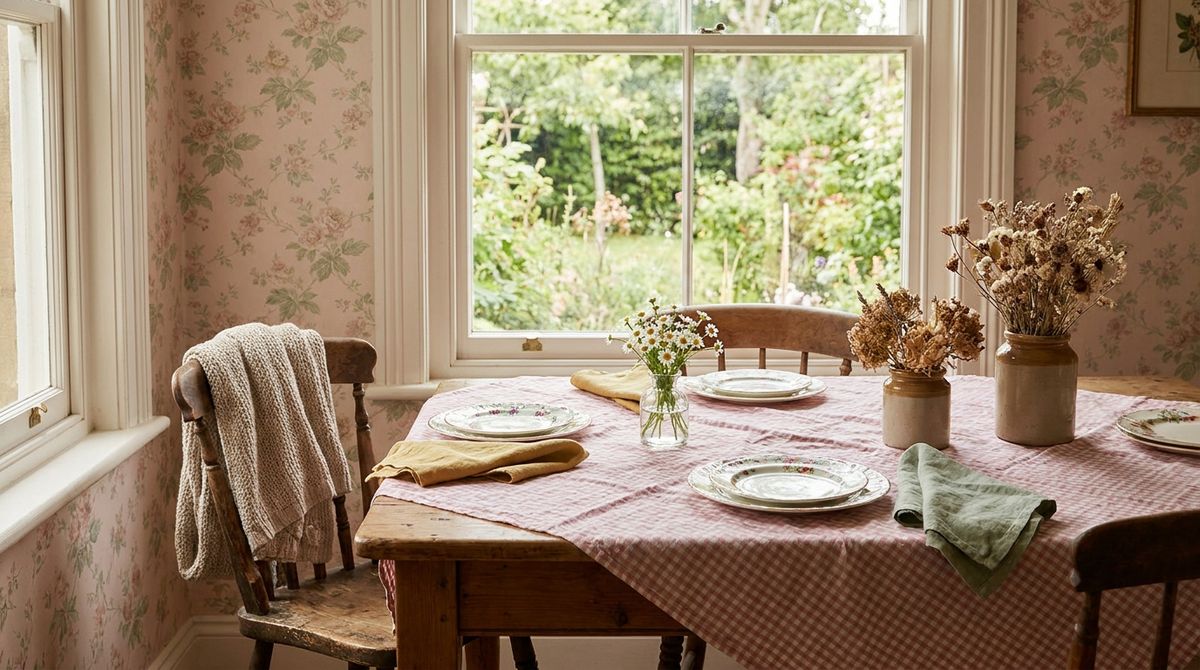
At $250, you’re moving from a vignette to a cohesive corner or full reading nook. This is where most renters report the first real “room feels different” moment. The key addition at this tier is a proper linen textile — either a throw or a duvet cover — which does more work than any other single item.
The $250 tier has a hidden leverage point: a quality linen duvet cover (IKEA PUDERVIVA at $60 or Sijo at $90-120) resets the entire visual tone of a bedroom. It makes everything else around it look intentional, even older or cheaper pieces.
$250 Picks (Building on the $100 Kit)
Adding these to your starter kit reaches a full corner or nook:
- Linen throw, H&M Home or Amazon — $35-45
- Floral-patterned cushion x2 — $30-40 (Amazon or HomeGoods)
- Wicker or rattan side table — $45-60 (Amazon, search “rattan accent table”)
- Vintage ceramic pitcher — $5-15 (thrift store or eBay — search “ironstone pitcher” or “vintage stoneware pitcher”)
- Dried wildflower wreath — $20 (Amazon or Michaels)
- Bud vases x3 — $12 (IKEA, the HJÄRTELIG set works well)
Total added: $147-$192. Combined with your $68-$80 starter kit, you’re at roughly $215-$272 — squarely in the $250 tier.
What This Achieves
A bedroom corner with a rattan side table, linen throw draped over a chair or bed, cushions, wildflower wreath above the headboard, and a ceramic pitcher with dried stems looks like a styled room, not a collection of things. It photographs well. It feels consistent.
Best Single Purchase at $250
If you can only add one thing at this tier, make it a linen duvet cover. IKEA PUDERVIVA ($60) is the budget choice; Sijo’s linen duvet ($90-120) is the quality upgrade. Either one sets the tone for everything else in the bedroom.
$500 Cottagecore Room — The Full Look
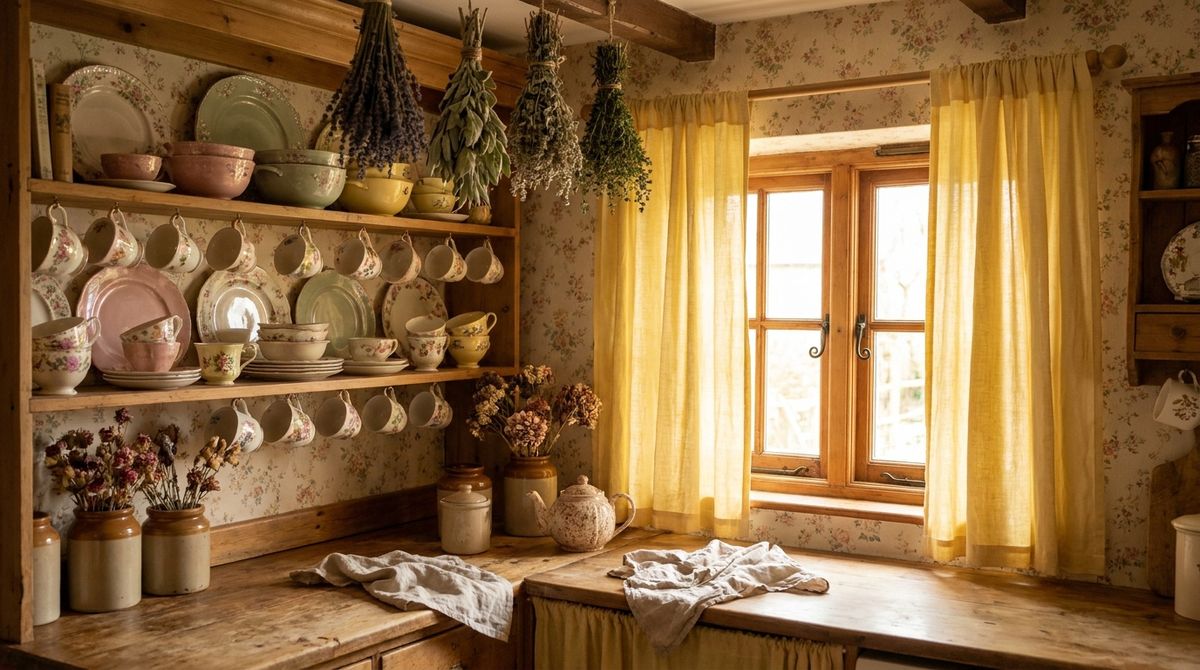
At $500, you can transform an entire room — not just a corner. This tier adds furniture and a statement wall treatment, which is what pushes a space from “cottagecore-adjacent” to a room someone screenshots. The rattan armchair is the single highest-impact purchase at this budget level.
$500 Picks (Building on the $250 Kit)
- Rattan armchair — $120-180 (Amazon search “rattan accent chair” or Wayfair; the Novogratz Amara is a reliable sub-$160 option) —
- Peel-and-stick floral wallpaper, accent wall — $60-80 for one wall (NuWallpaper and RoomMates both carry removable cottagecore-adjacent floral prints, renter-safe)
- Gallery wall of botanical prints — $30-50 (combination of free printable PDFs from Unsplash or Etsy + IKEA RIBBA frames at $5-7 each)
- Potted plants x3 — $20-35 (Trader Joe’s, Home Depot, or IKEA for small ferns, pothos, or trailing ivy)
Total added: $230-$345. Combined with your $250 kit, you’re at $445-$617 — with $500 as the sweet spot when you shop sales and use free printables.
What This Achieves
A rattan armchair with a linen throw, paired with a floral wallpaper accent wall and a botanical gallery wall opposite, creates a full room moment. The potted plants add life and reinforce the botanical thread running through the space. This is the level where the room feels fully realized.
Best Single Purchase at $500
The rattan armchair delivers the most visual impact per dollar at this tier. It’s a piece of furniture with immediate cottagecore identity, and it functions — a place to actually sit. Everything else at this budget level supports it.
Which Room Should You Start With?
Budget priority order matters when you’re working in stages. Start with the bedroom, not the living room.
The bedroom gets the most daily use and has the highest emotional payoff — it’s also the most photographed room for renters sharing their space online. A cohesive cottagecore bedroom at the $250 tier consistently reads as more “done” than a living room at the same spend, because living rooms have more furniture that needs to coordinate.
After the bedroom, prioritize a living room corner (not the full room — anchor it with a styled bookshelf or reading nook). The kitchen and dining area come last because cottagecore touches there — ceramic canisters, a linen table runner, a herb planter on the windowsill — are low-cost finishing details, not transformation-level spends.
Where to Save vs. Splurge in Cottagecore
Across the cottagecore article research we’ve done for DecorQuarter, a consistent pattern emerges: readers consistently overspend on decorative objects (candles, ceramics, figurines) and underspend on textiles. Flipping that ratio is the single adjustment that produces the most visible improvement.
Where to Save
- Art prints: Free printables from Unsplash, Pexels, or Etsy (search “free botanical print download”) cost nothing. A $5-7 IKEA RIBBA frame does the rest. Spending $30-$50 on a framed print from a boutique shop is rarely worth it at this aesthetic.
- Dried botanicals: Thrift stores often carry dried floral arrangements for $2-5. Dollar Tree stocks seasonal dried stems. Michaels runs 40-50% off dried flower sections regularly.
- Ceramic mugs and pitchers: Thrift stores are the correct answer here. A $2 cream-colored ironstone mug from Goodwill reads identically to a $28 “aesthetic ceramic mug” from an Instagram shop.
Where to Splurge
- Linen duvet cover: The quality difference between a $30 synthetic duvet cover and a $60-90 linen one is visible in photos and feel. This is the one area where spending more pays off directly.
- One vintage statement piece: A genuine antique ceramic, a hand-thrown pottery vase, or a vintage botanical illustration in a gilt frame gives a room something that can’t be replicated with new purchases. Budget $20-50 for one real find from an estate sale, eBay, or a local antique shop.
What You Can Actually Do at Each Level
Cottagecore is one of the few aesthetics where budget constraints often improve the outcome. Thrifted ceramics, dried botanicals, and linen textiles are exactly what the aesthetic calls for — and they happen to be cheap. A $500 budget done right beats a $2,000 budget spent on the wrong categories.
The three-tier framework here is a starting point, not a formula. Most people find that hitting the $100 starter kit first gives them enough visual feedback to know which direction to push next. Start there, see what the room actually needs, then decide whether $250 or $500 is the right next step.
For more on sourcing vintage and thrift pieces that fit the cottagecore look, see our full guide on sourcing thrift and vintage for cottagecore. And if the bedroom is your priority room, our cottagecore bedroom ideas guide covers layout, color, and layering in more detail.
Frequently Asked Questions
How much does a cottagecore room cost on a budget?
A styled cottagecore vignette starts around $100, a cohesive corner or reading nook lands near $250, and a full-room transformation with furniture and an accent wall runs about $500. That beats the $1,500 median room redecoration Houzz reported in 2024, because the aesthetic relies on affordable textiles and secondhand pieces.
Is thrifting really cheaper than buying new for cottagecore?
Yes. The same vignette of ceramics, dried stems, and frames costs $80-$120 new but $25-$40 sourced from Goodwill, Dollar Tree, and estate sales, roughly a 3 to 1 split. Because cottagecore prizes worn, handmade-looking pieces, thrifted finds often read more authentic than new ones in photos.
What should I buy first for a cottagecore room?
Start with textiles, which should absorb about 60% of your budget under the 60/25/15 spend split. A $35 linen throw or a $60 IKEA PUDERVIVA duvet cover shifts a room’s mood faster than any single ceramic or candle. Layer botanicals and framed prints in second.
Are dried or faux florals better for cottagecore?
Dried stems win for budget and looks. A $6 plastic faux bunch photographs shiny and yellows within a year, becoming a repeat cost. Real dried stems cost around $12 and last three seasons, while foraged grasses or hydrangea clippings cost nothing and suit the aesthetic perfectly.
Can renters do cottagecore without painting or drilling?
Absolutely. Peel-and-stick floral wallpaper from NuWallpaper or RoomMates covers one accent wall for $60-$80 and removes cleanly. Layer draped throws, freestanding rattan pieces, and command-hook gallery frames. None of these require paint, holes, or landlord approval, which makes cottagecore one of the most rental-friendly aesthetics.
DecorQuarter covers affordable home decor for renters and first-time homeowners. All price ranges reflect current listings and may vary by retailer and region.