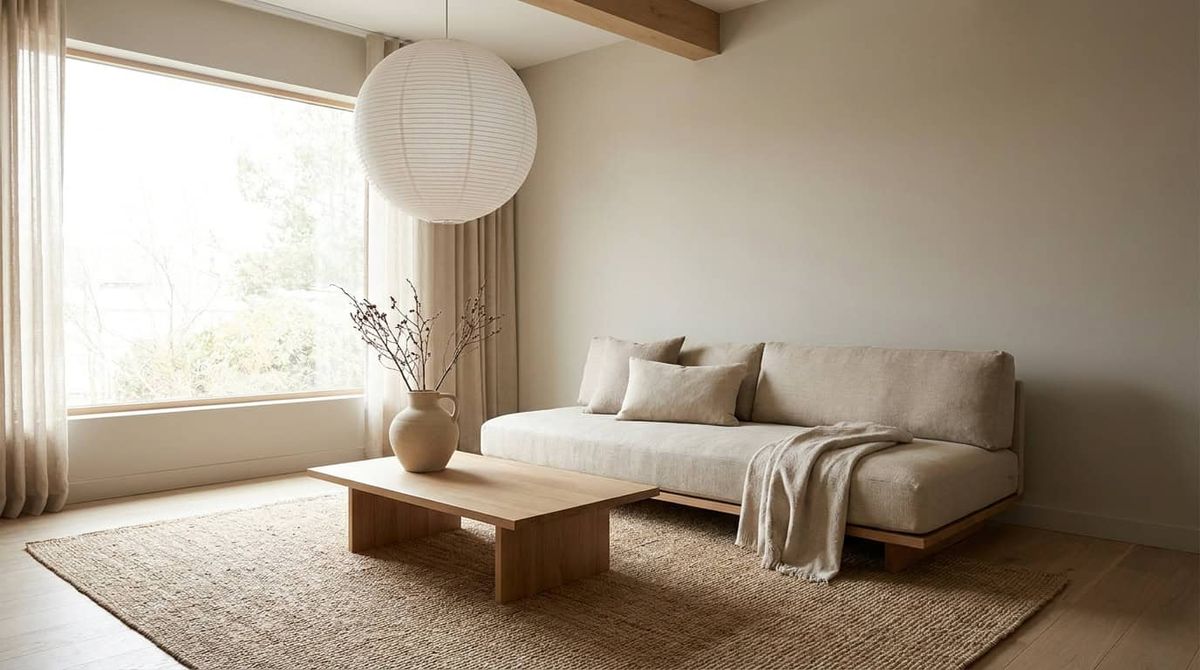
The best Japandi lighting runs a warm 2200K–2700K bulb behind a diffused paper, linen, or frosted-glass shade, never a bare bulb at 3000K or higher. Across fixtures from $12 to $450, that single spec matters more than brand or budget. Get it wrong and the whole atmosphere collapses into something that reads less “serene Tokyo apartment” and more “well-lit dentist’s waiting room.”
This guide covers 14 fixtures across four categories, from $40 paper lantern alternatives to $400 Noguchi Akari originals. Each pick is judged on how it diffuses light, how it behaves on a dimmer, and whether it suits a warm, low-glare room. The takeaway: the category matters far less than the light quality coming out of it. A $45 washi pendant on a dimmable 2200K bulb will give a warmer, softer result than a $300 “Japandi-inspired” arc lamp running a 3000K bare LED.
This guide tells you exactly when to spend and when to save — and gives you the bulb specs to lock in the atmosphere either way.
Key Takeaways
- Color temperature is the non-negotiable: 2200K–2700K only. Anything 3000K or above reads clinical, not calm.
- Diffused light sources — paper, linen, frosted glass — are mandatory. Bare bulbs break the aesthetic instantly.
- The Noguchi Akari UF series is worth the price if you have a large open space that demands a centerpiece. For most rooms, a $45–$80 washi alternative delivers 90% of the effect.
- Sconces are the most underused category for Japandi rooms — a single plug-in brass or oak sconce at 2200K changes an entire wall.
- Bulb selection saves rooms that fixture selection can’t. A $9 dimmable 2200K bulb is the highest-ROI upgrade in this guide.
What Makes Lighting Truly Japandi
Before the product picks, the filter — because the Japandi label gets applied to a huge range of lighting that fails on basic criteria.
Criterion 1: Color temperature 2200K–2700K. This is the hard line. Japandi interiors draw warmth from natural materials, light oak, undyed linen, raw ceramics, and that warmth reads correctly only under warm-spectrum light. At 3000K, the same room shifts toward Scandinavian-office. At 4000K+, the wabi-sabi undertones disappear entirely. Check the bulb in the listing: fixtures sold as “Japandi lighting” sometimes ship with 3000K or 4000K bulbs as default. The fixture may be fine. The default bulb kills it.
Criterion 2: Diffused source. Paper, linen, frosted glass, and thin natural rattan all scatter light correctly. Bare-bulb pendant styles — popular in industrial and Scandi interiors — do not work in Japandi rooms. The light point is too harsh. This is not subjective: wabi-sabi aesthetics are grounded in indirect, imprecise light (engawa light, paper-shoji light). See our Japandi style decor guide for the full material philosophy.
Criterion 3: Low-profile silhouette. Japandi fixtures are quiet. No visible hardware stacks, no decorative chains, no ornate ceiling medallions. The fixture exists to provide light and recede.
Criterion 4: No chrome, no cool-toned steel. Brushed brass, matte black, raw wood, and aged iron all work. Polished chrome and brushed nickel both read too contemporary-neutral for Japandi’s warmer material story.
What most guides miss: color temperature is only half the spec. Aim for a bulb rated CRI 90 or higher, which keeps oak, linen, and raw clay reading true instead of muddy. For output, target roughly 800 lumens for a main ambient fixture, 400–600 lumens for a bedside or accent lamp. A truly restful Japandi room layers three sources: one ambient (pendant or floor lamp), one task (desk or bedside), and one accent (sconce or low table lamp), each on its own dimmer.
Fail any two of these criteria and the fixture is not Japandi — regardless of what the listing says.
Free · 60 seconds
Not sure which style is actually yours?
Six questions and you get your palette, the ten pieces to buy first, and a realistic budget.
Paper Lanterns and Pendants
This is the category that defines the aesthetic. Paper-lantern pendants originated in Japanese washi craft traditions and connect directly to the Japandi sensibility in a way no other fixture type does.
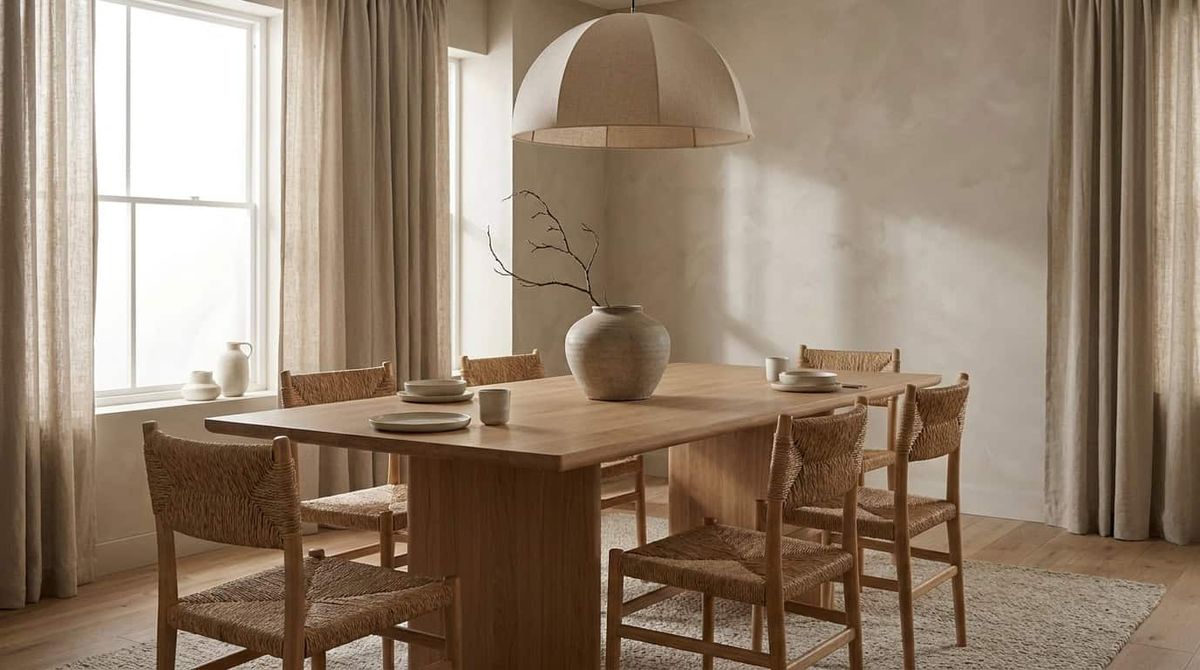
What most guides miss: real washi and rice paper are flammable, so run them on cool LED bulbs only, never incandescent or halogen, and keep at least 4 inches of clearance between the bulb and the paper. Hang height matters just as much: drop a dining pendant so its base sits 30–36 inches above the tabletop, and lower it to 24–28 inches above a nightstand so the shade rests near seated eye level.
1. Noguchi Akari UF Series — $200–$450 (Noguchi Museum Shop)
The original. Isamu Noguchi designed the Akari series beginning in 1951 using handmade washi paper over bamboo-ribbed frames. The UF (upright floor/pendant hybrid) series is the pendant variant most suited to Japandi interiors.
The Akari 7A pendant ($265) and the Akari 10A ($345) are washi paper stretched over a bamboo rib frame, which holds its shape well under heat. The washi creates a warm gradient at the top of the globe that few alternatives fully replicate.
Worth it if: You have a high-ceiling dining room, open-plan living area, or entry hall where the pendant is the primary visual statement. At 24–30 inches diameter, these are statement pieces, not ambient fixtures. Pair with a Lutron Caseta dimmer and a Philips WarmGlow 2200K–2700K bulb ($12).
Where to buy: shop.noguchi.org — only source for authenticated pieces.
2. NOGY Rice Paper Pendant — $65–$95 (nogy.shop)
NOGY is a close alternative to the Akari at a third of the price. Its thinner washi paper diffuses light a touch more evenly (actually preferable for bedroom use). Available in globe, oval, and teardrop shapes. The bamboo ribbing is visible on close inspection but not from across a room.
Best for: Bedrooms, reading nooks, low-ceiling spaces where a $300+ fixture would be disproportionate. Works at heights of 7–8 feet without overwhelming.
3. Captain’s Bamboo Washi Pendant — $80–$120 (captainsbamboo.com)
Handcrafted with a wooden ring accent at the pendant collar, a small detail that reads as intentional craft rather than value-engineering. Globe and elongated oval versions available. The 14-inch oval suits a bedside table, where the diffusion at 2700K stays soft.
Best for: Paired pendants over a dining table, or solo in a reading nook. The collar detail photographs well for Pinterest if that is part of your planning — relevant context in our aesthetic japandi corners nooks guide.
4. Pearl River Mart 24-Inch Paper Globe — $12–$18
The budget baseline. These cross-frame paper globes are the raw material behind many $60–$80 “Japandi pendant” resellers. At $12–$18 direct, they work — provided you fit a dimmable 2700K bulb (not the included cool-white). Frame quality is lower; expect a 12–18 month lifespan before the paper begins to yellow. Not for primary living room use, but valid for dorm rooms, rentals, and spaces where budget is the constraint.
Floor Lamps
Floor lamps carry ambient load in living rooms and reading nooks where a ceiling fixture would be too dominant.
5. Arc Floor Lamp with Linen Shade — $120–$180
A gently curved arc in matte black or brushed brass with a 14–16-inch drum shade in undyed linen. A 60W-equivalent dimmable LED through a linen shade puts the light pool at floor level where it suits reading, without creating hotspots. Look for linen shades only; polyester shades can block too much light at lower dim levels and may give off a faint synthetic smell under heat.
Pricing anchor: $140–$160 for a quality arc with metal base (not plastic-weighted). See budget breakdown for Japandi decor for floor lamp allocation in a full room plan.
6. Paper-Pleated Tripod Floor Lamp — $85–$130
A three-leg birch tripod with a pleated washi-paper shade. The pleating creates a subtle texture gradient when lit that reads as handmade and quiet — more interesting at close range than most linen drums. Height typically 58–62 inches, which works in standard 8-foot ceilings without crowding.
Quality in this category varies widely: the best versions have solid birch legs with visible grain; cheaper versions use bamboo-print vinyl over MDF. Confirm material in listing description before ordering.
7. Tall Minimalist Stem Floor Lamp (IKEA Vidja-Style) — $60–$85
The IKEA Vidja ($50 retail) earns its place here because the design logic is correct: a thin steel stem, wide diffusing shade, low visual profile. The stock shade is white polyester, which is fine with a 2700K bulb. For a more Japandi result, swap the stock shade for an aftermarket linen drum (12–14 inch, ~$20–$30 on Etsy). Total cost: $70–$80. Visual result: directly competitive with $150 alternatives.
Sconces and Wall Lights
Sconces are underused in Japandi rooms. A wall-mounted fixture at 55–65 inches height creates a layer of light that neither a ceiling pendant nor a floor lamp can replicate — it illuminates the middle zone where art, shelving, and ceramics live.
8. Plug-In Brass Sconce (Renter-Friendly) — $45–$75
A simple wall plate in aged or brushed brass with a fabric-wrapped cord and a small linen or paper shade. No hardwiring. The cord runs down the wall and plugs into a standard outlet — fully renter-compliant, fully removable.
Plug-in brass sconces from Amazon and Etsy are worth a look; a good one pairs a 4-inch linen shade with a 6-foot fabric cord. At 2700K with a 4W LED, it draws almost no energy and provides the right amount of accent light for a bedside or living room alcove.
9. Oak Wood Sconce — $55–$95
A single arm in solid white oak with a minimal paper or frosted-glass cup shade. The wood grain does meaningful visual work in a Japandi space — it connects the fixture to furniture and floors in a way metal alone cannot. Most versions are hardwired; check listing. Best above a ceramic vignette, beside a reading chair, or flanking a bed.
10. Frosted-Glass Minimalist Sconce — $35–$65
The lowest-profile option. A round or elongated frosted-glass diffuser on a matte-black or brass arm. Works in bathrooms, hallways, and spaces where a fabric shade would read as too decorative. The frosted glass creates a clean, even glow at 2700K — no hot spots, no texture.
Best used in pairs at 60 inches height, 24–36 inches apart on either side of a mirror or art piece.
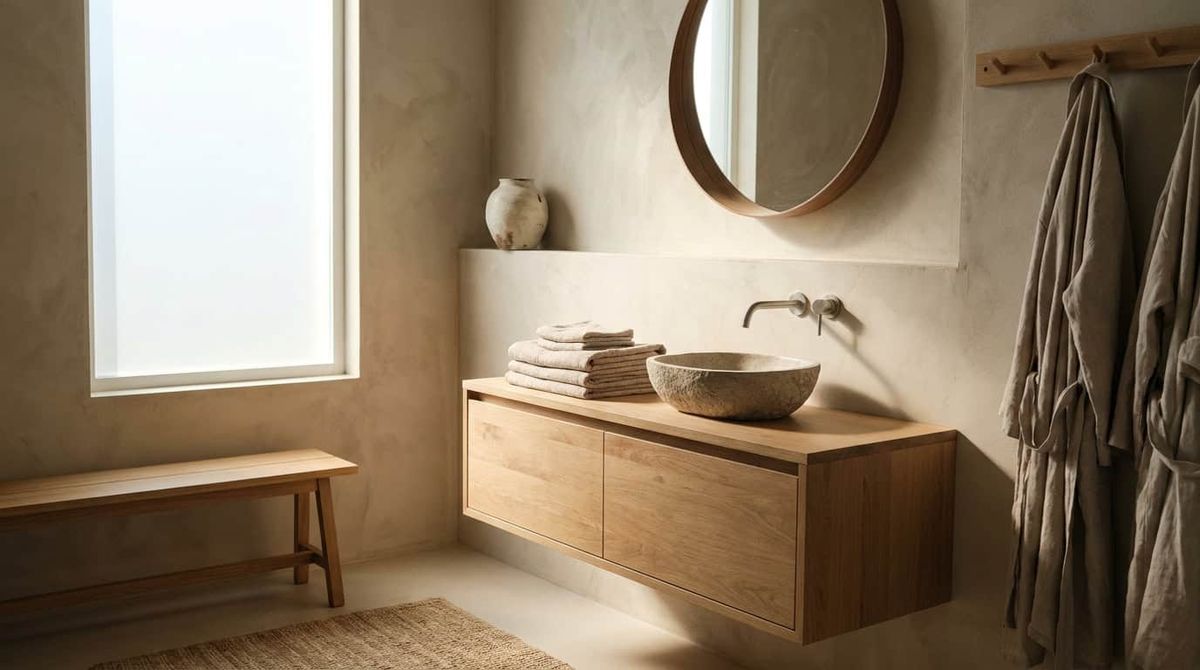
Table and Desk Lamps
Table lamps provide task light and anchor vignettes. In Japandi interiors, the lamp is part of the still-life composition — its off-state silhouette matters as much as its lit performance.
11. Linen Drum Table Lamp — $55–$95
A ceramic or simple wood base with a straight-sided linen drum shade, 10–12 inches diameter. This is the most versatile table lamp format for Japandi rooms: it works on nightstands, console tables, bookshelves, and side tables. Look for an off-white or natural undyed linen shade — stark white reads too clean for the wabi-sabi undertone. Pair with a 2700K dimmable bulb in a candelabra or medium base.
12. Brass Arc Desk Lamp — $65–$120
A slender brass arm with a small paper or metal cone shade, adjustable angle. Primarily a task lamp, but the brass warm finish integrates into Japandi room palettes naturally. Works at desks, beside reading chairs, and on nightstands where directional light is needed. Avoid versions with chrome accents — even a chrome shade collar breaks the palette. Full desk setup context in our Japandi living room ideas guide.
13. Paper-Cylinder Bedside Lamp — $40–$65
A tall, narrow washi-paper cylinder on a minimal wood base. Height typically 14–18 inches. The format is purpose-built for nightstands: it provides enough ambient light for reading without illuminating an entire room. At 2200K on a dimmer, this lamp creates the closest approximation to candlelight available in an electric fixture.
A $45 version from a Japanese-import Etsy seller is an option for a nightstand. Washi yellows slightly over time, which is expected, and the light stays warm and soft.
14. Ceramic Base Table Lamp with Linen Shade — $80–$150
The high-craft option. A hand-thrown ceramic base — matte glaze in warm gray, sand, or sage — paired with a linen drum. The ceramics do the aesthetic work that most other bases leave to the shade. Works on consoles, shelving, and dining sideboards where the lamp reads as a decor object even when off. For sourcing Japandi-adjacent ceramics as decor, see our Japandi color palette guide.
3 Brands to Avoid
Not every brand tagged Japandi delivers on it. These three categories consistently underperform.
Big-box “Japanese-inspired” lines with polyester drum shades. Several mass-market retailers (we are not naming them to avoid affiliate conflicts) sell linen-look shades that are 100% polyester. Polyester shades block light more aggressively than linen at lower wattages, which forces users to run higher-wattage bulbs — which produces harsher, more direct light. The tell: if the shade is described as “linen-look” or “fabric,” confirm fiber content before ordering.
Plastic-base “wood-look” lamps. A wood-print vinyl wrap over a plastic base does not read as organic in a Japandi room — the proportions are wrong, the weight is wrong, and the material story falls apart the moment the lamp is touched. Real wood bases in birch, oak, or bamboo are available in the $55–$95 price range; there is no reason to accept the substitute.
Ultra-cheap paper lantern string lights with cool-white LEDs. These are sold as party decor with Japandi tags added. The LEDs are fixed at 4000K–6500K, the paper is tissue-weight with a lifespan of 2–3 months, and the string hardware is visible. They do not belong in a Japandi interior in any application.
Bulb Spec Is Half the Work
The most impactful single change most Japandi rooms can make costs $9 and takes 30 seconds.
The target spec: 2700K warm white, 60W-equivalent (9W LED), CRI 90+, dimmable, A19 or globe base depending on fixture. Roughly 800 lumens covers an ambient fixture; 400–600 lumens is enough for bedside and accent lamps.
For rooms where you want the full wabi-sabi atmosphere — bedrooms, reading nooks, evening living rooms — go to 2200K. Philips WarmGlow bulbs (model 548659) dim from 2700K at full brightness down to 2200K at low dim, which gives you a single bulb that handles both task and ambient light. Retail price: $9–$12 for a two-pack.
For fixtures without a dimmer, lock in at 2700K and accept a fixed output. Still a significant improvement over 3000K+.
Dimmer pairing matters. A leading-edge dimmer (the cheap incandescent-era type) often flickers with LED loads. Use a trailing-edge or universal LED dimmer. Lutron Caseta ($45) and Leviton Decora Smart ($35) are two options built for LED loads. The $35–$45 dimmer investment, combined with a 2200K–2700K bulb, changes the atmosphere of an entire room more than a fixture upgrade usually does.
Best $5–$12 bulb options:
- Philips WarmGlow A19 2700K–2200K dimmable — best for most fixtures, pack of 2 ~$10
- GE Reveal HD+ 2700K — cleaner color rendering, slightly cooler at high dim, ~$9 for 2
- Sylvania Ultra LED 2700K dimmable — budget option, reliable dimming range, ~$7 for 2
Pairing Guide by Room
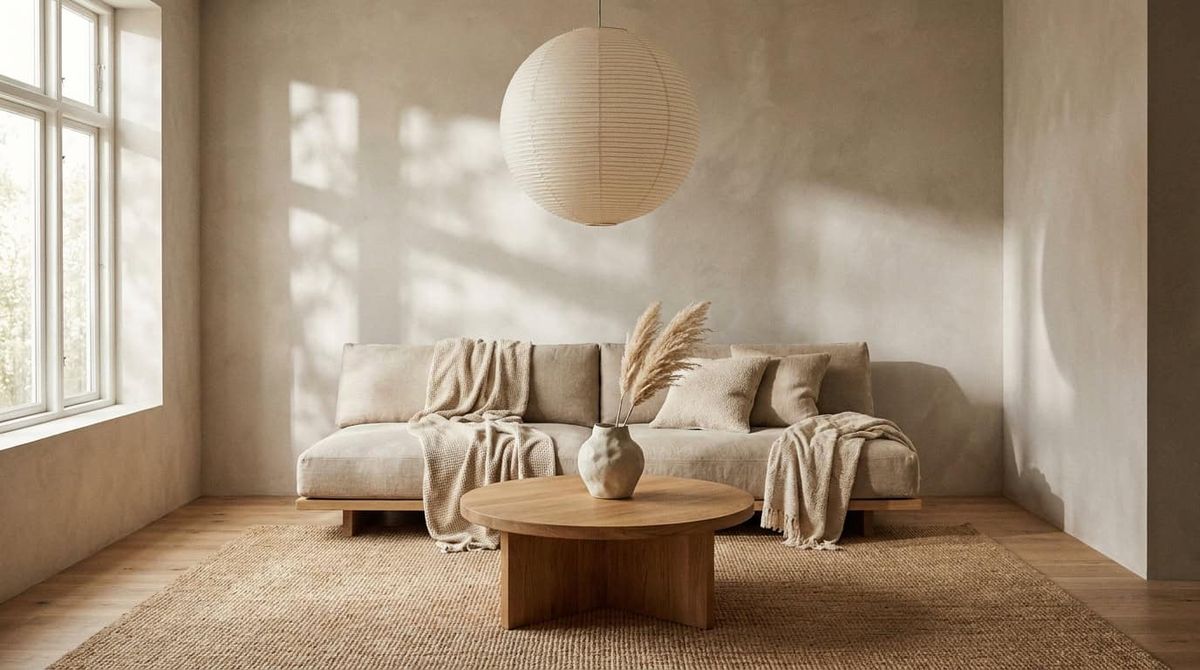
Living room: One pendant (center or over seating anchor) + one floor lamp (reading corner) + two table lamps (console or side tables). All on 2700K. Floor lamp on dimmer, pendant on dimmer. Table lamps can be fixed output if dimmer switches are not available. For full room composition, see Japandi living room ideas.
Bedroom: One pendant or floor lamp (ambient) + two bedside lamps (task). Run bedside lamps at 2200K on dimmers. The ambient fixture can run at 2700K. This layering — warm ambient, very warm task — creates the evening-light gradient that makes Japandi bedrooms feel genuinely restful. For how lighting integrates with the full bedroom palette, see our best Japandi furniture decor 2026 guide.
Reading nook: One dedicated light source at 2700K–3000K positioned at shoulder height from the reading direction, supplemented by an ambient floor lamp or sconce at 2200K. Do not use overhead lighting as the primary reading source — the shadows are wrong and the color temperature flattens the page. See aesthetic japandi corners nooks for full nook setup including furniture and material pairing.
FAQ
What color temperature is best for Japandi lighting?
Stay in the 2200K–2700K warm-white range, paired with a CRI 90+ bulb so oak, linen, and clay read true. Use 2700K for main ambient light and drop to 2200K for bedside and evening task lamps. Anything at 3000K or above reads clinical and breaks the calm, wabi-sabi atmosphere Japandi depends on.
How high should a Japandi pendant hang?
Over a dining table, hang the pendant so its base sits 30–36 inches above the tabletop. Over a nightstand or side table, drop it lower to 24–28 inches so the shade sits near seated eye level. In an open walkway, keep the base at least 7 feet off the floor for clearance while preserving the low, quiet silhouette Japandi favors.
Are Akari Noguchi lamps worth $400?
For spaces where the fixture is the room’s primary visual anchor — a dining room, an open-plan entry, a studio apartment’s single pendant — yes. The washi quality, the handmade bamboo structure, and the light gradient are measurably better than alternatives. For secondary spaces (guest bedroom, hallway, reading nook), a $65–$95 NOGY or Captain’s Bamboo equivalent delivers 90% of the result.
Best dimmable 2700K bulbs for Japandi rooms?
Philips WarmGlow A19 is the consistent first choice — the variable dim from 2700K to 2200K gives you a single bulb that handles both task and deep ambient modes. GE Reveal HD+ at 2700K is the runner-up for spaces where color accuracy matters (art walls, ceramics displays).
Are paper lanterns durable?
Washi-paper lanterns from quality sources (Noguchi, NOGY, Captain’s Bamboo) hold shape for 3–5+ years with normal use. Avoid fixtures near open windows where moisture cycling accelerates yellowing. Paper lanterns from tissue-weight sources (ultra-cheap string lights, bulk party suppliers) degrade in 2–4 months. The material gap is visible before purchase — quality washi has a slight texture and opacity; tissue paper is translucent when held to light.
Can wall sconces work in rentals?
Plug-in sconces are fully renter-compatible. They mount with a single small hook or adhesive plate, the cord runs down the wall (tuck behind furniture if visible), and the fixture removes cleanly at move-out. Hardwired sconces require landlord approval or professional installation. For a full overview of renter-safe Japandi upgrades, see Japandi decor on a budget.
Conclusion
Most Japandi rooms are already closer to right than they realize. The furniture is sourced, the palette is set — and then a single 4000K fixture or bare-bulb pendant breaks the atmosphere that everything else worked to build. The fix is rarely a full lighting overhaul: it is usually one dimmable 2700K bulb, one quality paper pendant, and a dimmer switch installed on a Saturday afternoon.
Start with the bulb. Then layer from ceiling down. For how lighting connects to the full Japandi room picture, explore our best Japandi furniture under $300 guide and the full Amazon and Target Japandi picks roundup.