Every Japandi furniture roundup we read lists the same $1,200 bed frames and $900 dining tables — beautiful, aspirational, and completely useless for most budgets. Here’s what nobody tells you: the defining features of Japandi style (low profile, natural materials, minimal hardware, muted tones) are achievable under $300 per piece when you know exactly what to look for and what to ignore. We tested furniture across six categories, and this is what actually holds up to the aesthetic.
Key Takeaways
- Low profile is non-negotiable. Japandi beds and sofas sit close to the floor — if a bed frame has tall legs or a tall headboard, it is not Japandi regardless of the label.
- Solid wood beats veneer, but good veneer beats plastic. At this price point, quality MDF with real wood veneer is acceptable. Plastic trim, metal edges, and faux-wood grain film are disqualifying.
- Closed storage wins over open shelves for that calm, uncluttered Japandi energy — especially in bedrooms and living rooms.
- Rattan and linen are the two textures that do the most work in accent chairs and lighting at this budget.
- Buy in sequence, not all at once. The 30-day plan at the bottom of this article shows the purchase priority that builds the aesthetic without gaps.
What Makes Furniture Truly Japandi
The word “Japandi” has been slapped onto everything from plastic storage bins to mass-produced bedroom sets with chrome handles. Here is the actual criteria — use it as a filter before buying anything.
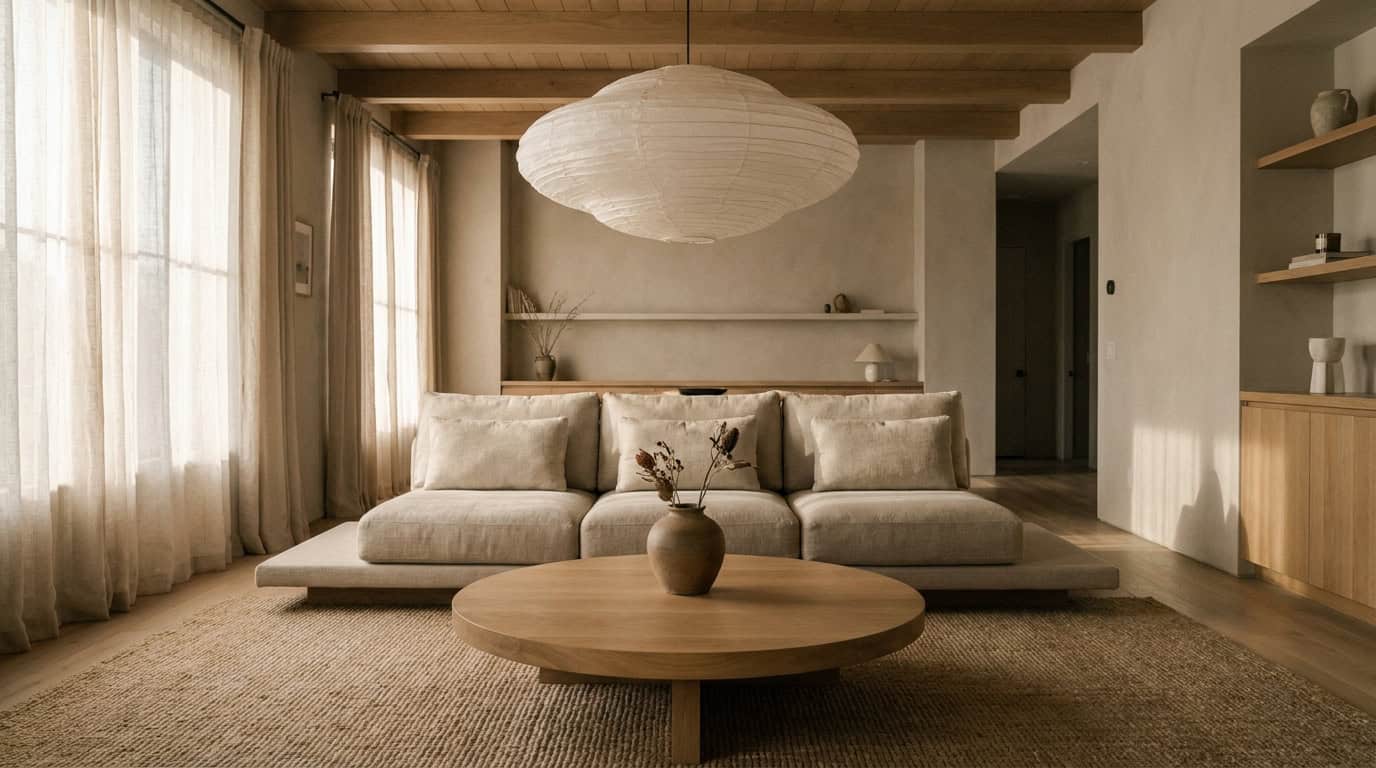
Low silhouette. Japanese interior design sits closer to the ground than Western conventions. A bed frame with a platform height under 14 inches, a coffee table under 18 inches, a sofa with legs under 5 inches — these proportions create the grounded, calm feeling Japandi is known for. Tall, leggy furniture is Scandinavian, not Japandi.
Natural materials, no fakes. Solid oak, solid ash, solid pine, bamboo, rattan, linen, cotton, natural jute — these are in. Melamine-wrapped particleboard, faux-leather with plastic base, chrome or brass hardware, and printed wood-grain film are out. At the sub-$300 price point, you will encounter both; the picks below have been filtered for the former.
What most guides miss: almost nothing under $300 is solid wood all the way through. A genuine solid-oak queen frame starts near $600, so at this budget you are buying solid wood legs plus an MDF core wrapped in veneer. That is fine when the veneer is real sliced wood (0.6mm or thicker) rather than a printed film. The fast in-store tell is weight: a real veneer-and-MDF panel feels dense and heavy (an IKEA KALLAX 2×2 weighs about 55 lb), while a printed-particleboard panel feels light and slightly hollow, and its grain pattern repeats every 12 to 18 inches.
Minimal or zero hardware. Japandi cabinetry and storage lean toward push-to-open mechanisms, recessed handles, or simple leather pull tabs. Visible chrome knobs, decorative hinges, or ornate pulls break the visual calm immediately.
Neutral, warm tones. Off-white, warm beige, sand, stone gray, sage green, natural wood honey — all correct. Cool gray, stark white, or anything with a high-gloss finish reads as generic modern, not Japandi.
Functional intent. Every piece should have a clear purpose. Decorative-only furniture is not Japandi. The aesthetic rewards objects that earn their place.
Keep these five criteria in mind for every purchase below and throughout your Ultimate Japandi Style Guide.
Free · 60 seconds
Not sure which style is actually yours?
Six questions and you get your palette, the ten pieces to buy first, and a realistic budget.
Bed Frames Under $300
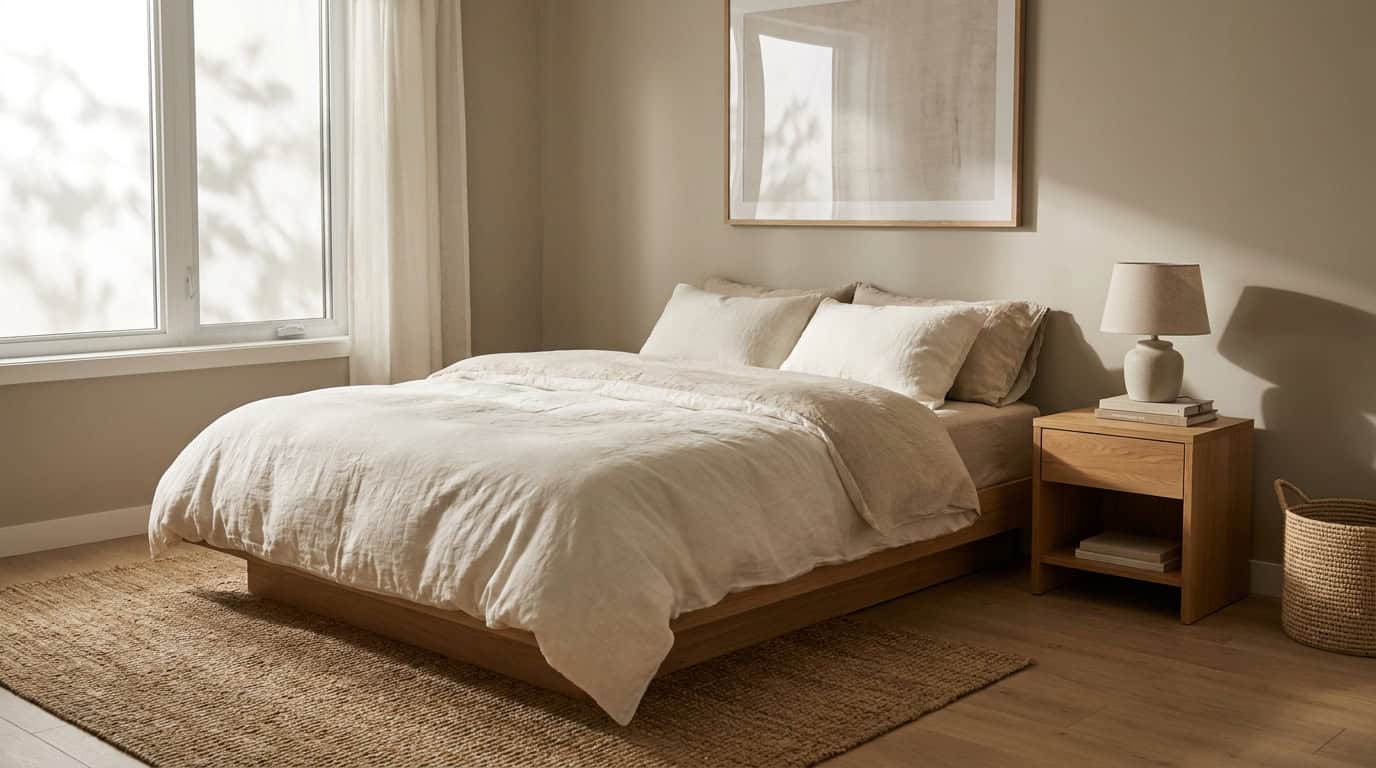
The bed is the most impactful piece in the room, and fortunately it is also where the low-profile requirement makes budget options more competitive — premium platform beds charge for minimalism, and minimalism is easy to manufacture.
What most guides miss: Japandi’s low profile has actual numbers, not vibes. Aim for a platform bed 8 to 14 inches high, a coffee table 15 to 18 inches, and a sofa or chair seat 16 to 18 inches off the floor. Under $300 the compromise almost always shows up in the joinery and the edges: you get metal cam-lock fasteners instead of wedge dowels, and a veneer top that can chip at the corner rather than a solid, rounded edge. Neither ruins the look if the height and finish are right, but it is where the money you saved went.
Pick 1: Zinus Shawn 14-Inch Platform Bed — ~$180–$240
Available on Amazon in sizes from twin to king, the Zinus Shawn is a solid steel platform bed with wood slat support — not Japandi material-wise, but the silhouette is exactly right. The 14-inch platform height, no headboard option, and clean rectangular form read as low-profile Japandi when dressed with linen bedding. Use it as a foundation layer while you save for a solid-wood frame. Pairs well with a tatami-style mattress or a low-profile memory foam.
Pick 2: Nathan James Harlow Low-Profile Wood Bed — ~$250–$290
Nathan James makes solid-wood-accent beds that land at the right price. The Harlow features a slatted wood headboard (slats are horizontal, not vertical, which softens the look), solid wood legs, and a platform height around 12 inches. Available in warm walnut and light oak tones. King sizes may push above $300; queen and full are reliably under. Assembly is clean and takes about 40 minutes.
Pick 3: IKEA TARVA Bed Frame — ~$179–$249
The TARVA is unfinished solid pine, which means you can leave it natural (wabi-sabi, unpredictable grain), apply a light wood stain, or use tung oil for a matte natural finish — all three land squarely in the wabi-sabi Japandi aesthetic. The low headboard and floor-adjacent profile are correct. Skip the TARVA if you want something ready-to-use out of the box; embrace it if you want furniture that develops character.
Floor bed alternative: If you are renting and want the most authentic Japandi look, a Japanese-style floor bed (tatami platform or shikibuton on a low slatted wood base) achieves the grounded aesthetic for $80–$150. Brands like D&D Futon Furniture and FULI make slatted bases under $150 that work well under any standard mattress.
Coffee and Dining Tables Under $300
The round-versus-rectangle debate is real in Japandi design. Here is the working rule: round tables in smaller rooms (under 200 sq ft living space), rectangle in larger rooms or when you need dining functionality.
Pick 1: Walker Edison 3-Piece Round Coffee Table Set — ~$179–$219
Walker Edison’s wood and metal round coffee tables occupy a gray zone — the metal legs are a compromise, but the round top in light ash or natural wood finish and the low 18-inch height hit the Japandi mark. The 3-piece nesting set is useful for small apartments where flexibility matters more than a single statement piece. Skip the dark walnut colorway; it reads more mid-century modern.
Pick 2: Mopio Aaron Round Coffee Table — ~$159–$199
Solid rubberwood legs, MDF top with real wood veneer, 36-inch diameter, 15.7-inch height. The rubberwood legs are the key detail — rubberwood is a dense, sustainable hardwood that holds up better than pine at this price. The 15.7-inch height is correct for Japandi proportions. Available in natural and walnut tones; the natural is the stronger Japandi choice. Assembly is 20 minutes.
Pick 3: IKEA LISABO Dining Table — ~$179–$229
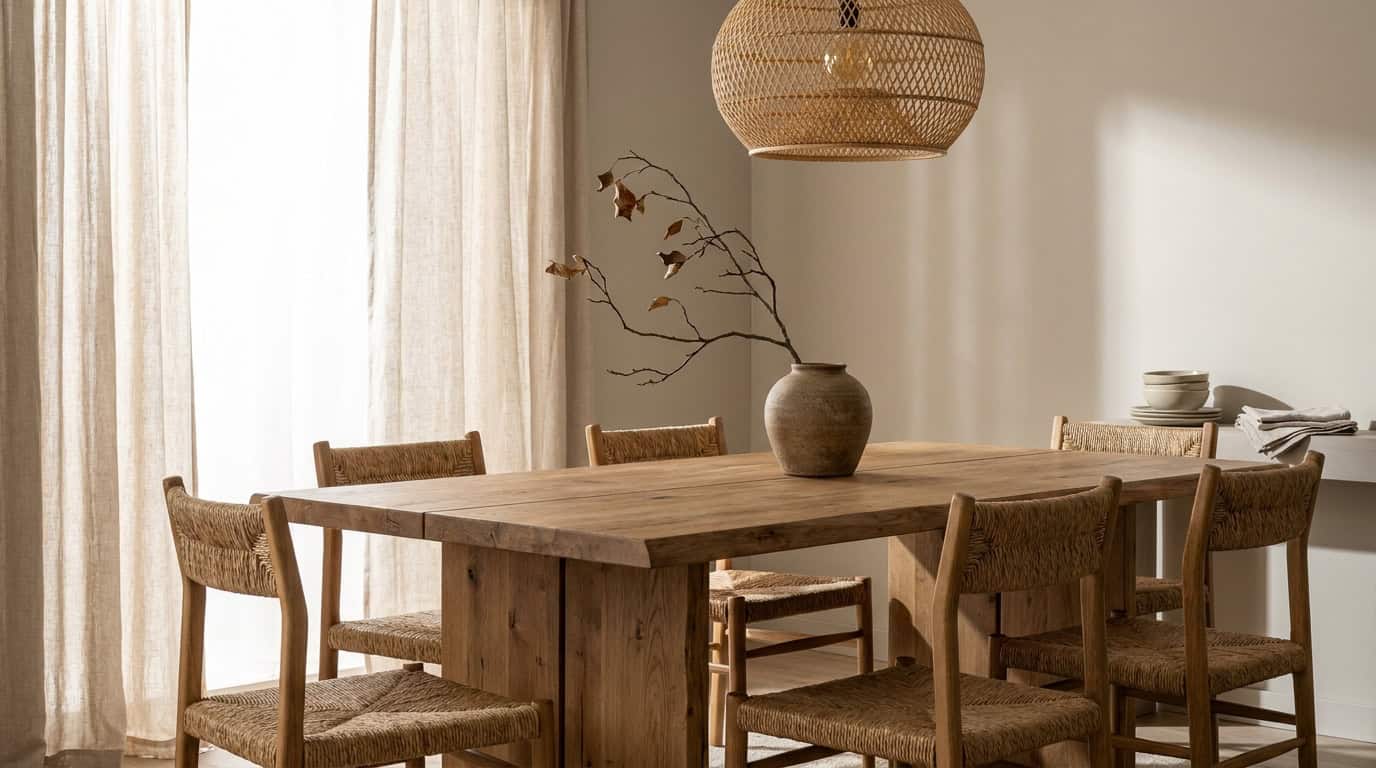
Solid ash veneer with ash legs, clean rectangular form, 55×31 inches — seats four comfortably. The LISABO is one of the few IKEA tables where the material is genuinely appropriate for Japandi (ash is a traditional Japanese cabinetry wood). Wedge dowel assembly means no visible hardware on the surface. Pair with simple wooden or wicker chairs for a full dining setup under $600 total.
For a full breakdown of what each category should cost at different budget tiers, see the Japandi decor budget breakdown by tier.
Storage: Sideboards and Shelves Under $300
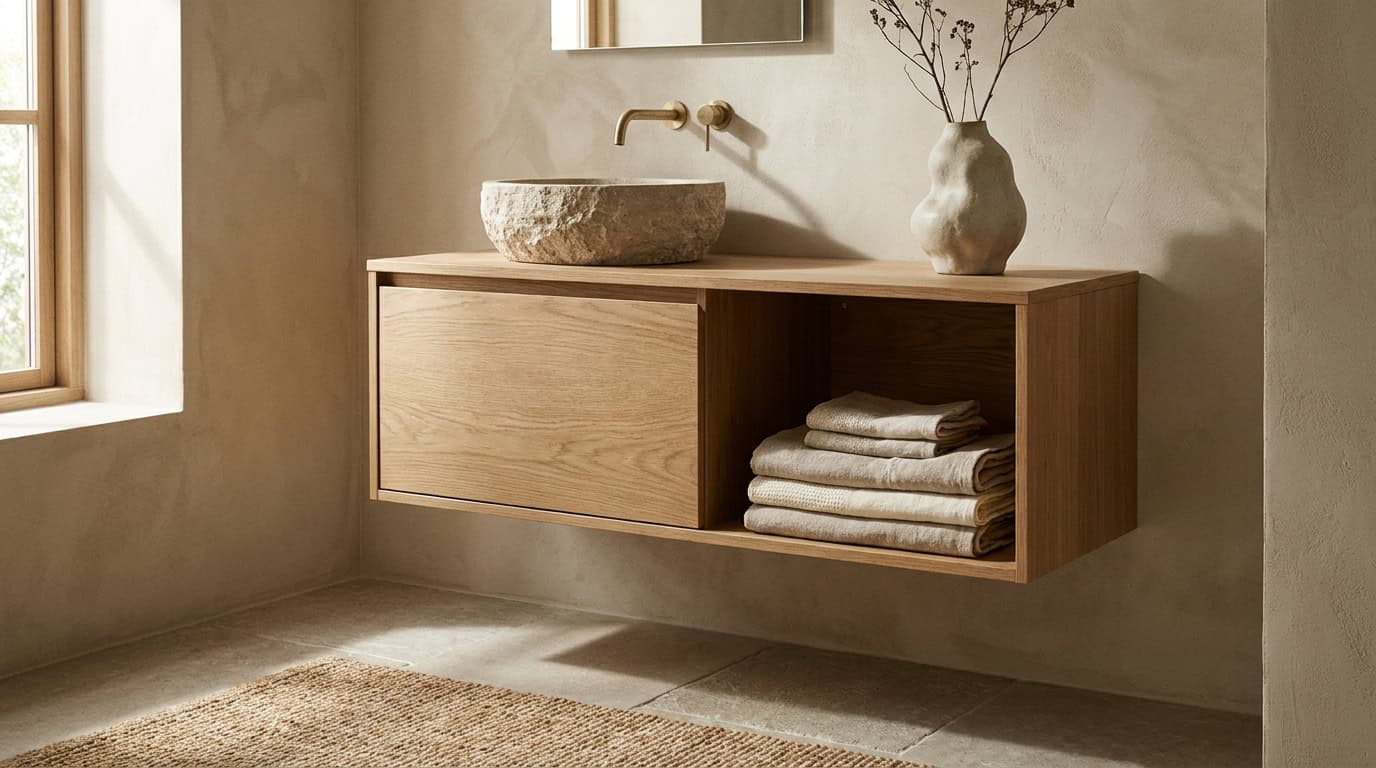
In Japandi design, storage does the heavy lifting of maintaining visual calm. The principle: if it is out in the open, it should be beautiful. If it is functional clutter, it should be behind a door. Closed storage wins.
Pick 1: Nathan James Bragen Sideboard — ~$230–$270
Two doors, two drawers, solid wood legs, linen-textured door panels. The Bragen sits at 30 inches height — low enough to double as an entryway console or bedroom dresser. The push-to-open drawer mechanism (no visible hardware) is one of the few features at this price that is genuinely Japandi-correct. Available in white oak, which is the strongest colorway for the aesthetic.
Pick 2: Prepac Floating Wall Shelf with Drawer — ~$79–$119
When floor space is limited, floating shelves with enclosed storage solve the display-versus-clutter tension. Prepac’s version is MDF with wood veneer, features one hidden drawer, and mounts cleanly at any height. Stack two at different heights for a gallery-wall-adjacent storage moment. The white finish works with warm-white Japandi walls; the espresso does not.
Pick 3: IKEA KALLAX 2×2 Shelf Unit — ~$79–$99
The KALLAX is the entry-level workhorse. Plain, the open cubbies undercut the closed-storage principle. Used with KALLAX insert doors ($15 each), it becomes legitimate Japandi storage at roughly $110–$140 total for a 2×2 unit with inserts. The white-stained oak effect version (not the plain white) is the right choice — it reads as natural wood rather than office furniture.
Note: Avoid the IKEA KALLAX in plain white without door inserts if you are putting it in a living room — the visible cubby clutter will undermine everything else you do to the space.
Accent Chairs Under $300
Two textures dominate Japandi accent seating at this budget: rattan and linen. Both are correct. The reason: both communicate natural material, both age gracefully, and both photograph well (critical for a Pinterest-optimized room).
Why curves matter: Japandi chairs often feature gently curved backs or rounded silhouettes — not dramatic curves, but enough to soften the geometry of a low-profile room. Hard, boxy chairs push the aesthetic toward cold Scandinavian rather than warm Japandi.
Pick 1: Christopher Knight Home Prita Rattan Chair — ~$150–$200
Natural rattan frame, cushioned seat in a neutral fabric, round back shape. This chair is the closest to a direct Japandi reference at this price point. The curved back, natural rattan material, and modest scale (it does not dominate a small room) are all correct. Replace the included cushion with a linen or cotton cover in stone or sand if the default fabric color skews too beige.
Pick 2: Amazon Basics Linen-Upholstered Chair — ~$120–$170
A simple barrel chair in a natural linen fabric with solid wood legs. Nothing exciting about it — which is exactly the point. Japandi does not require statement chairs. A well-proportioned, honest-material chair that sits correctly in the room is the goal. The natural linen version pairs with any of the wood tones above without clashing.
For more guidance on how accent pieces fit into the full room, see the Japandi living room ideas guide.
Lighting Under $100
Lighting is the fastest Japandi upgrade in any room and the one category where under $100 is not just achievable — it is the correct price range. Premium Japandi lighting is deliberately understated.
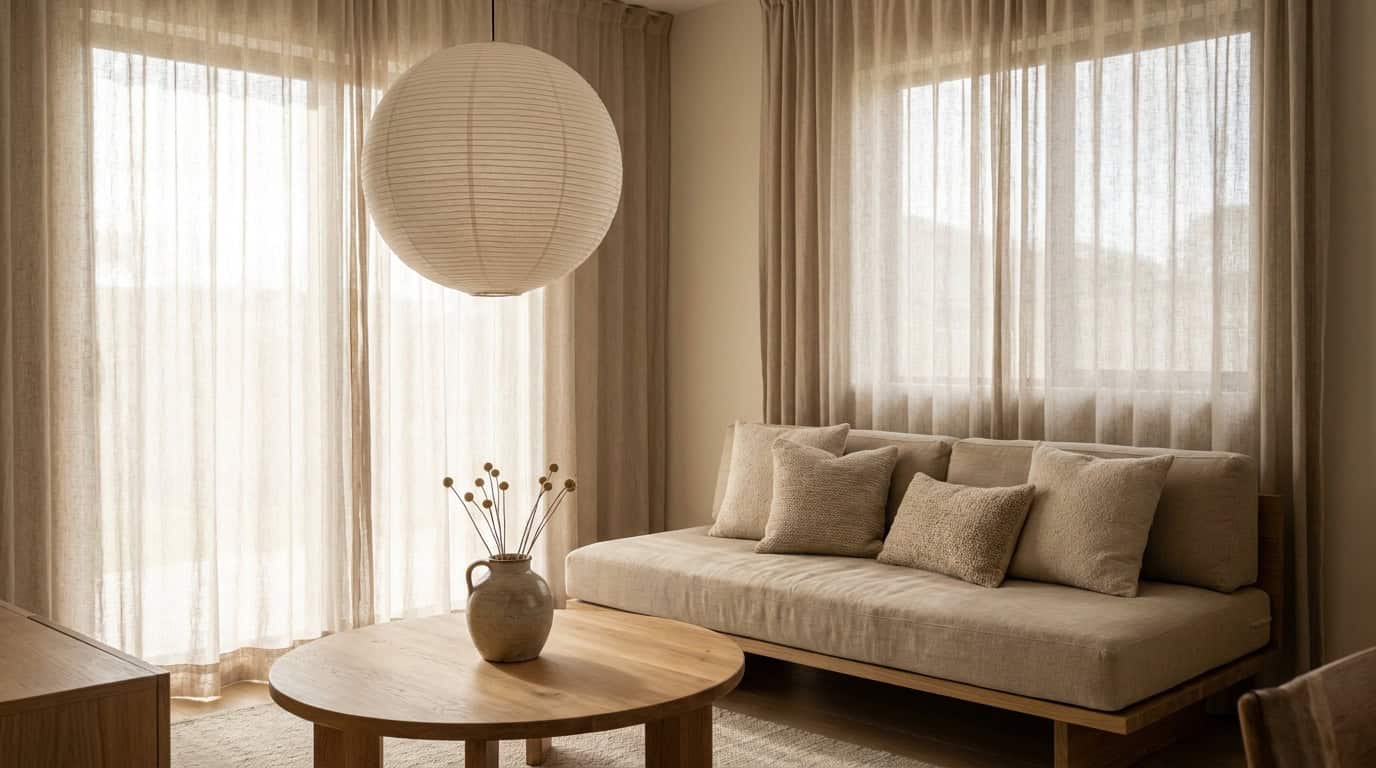
Paper lanterns: The Noguchi-style paper pendant light ($20–$45 on Amazon) is one of the most recognizable Japandi lighting forms. Look for rice paper or washi paper shades, not plastic. The Govee and AUKORA versions on Amazon have adequate shade quality. Hang at 60–66 inches from the floor in living rooms, lower (48–54 inches) over dining tables.
Warm bulbs are mandatory. No cool white, no daylight. Japandi requires 2700K–3000K bulbs — the amber range that makes natural wood glow rather than look flat. If you change nothing else in a room, switching to 2700K bulbs shifts the mood significantly. Budget $15–$25 for a 4-pack of Philips or GE warm-tone LEDs.
Rattan table lamps ($40–$80): Target’s Threshold and Studio McGee lines carry rattan-wrapped table lamps in the $40–$75 range that are genuinely correct for Japandi. Pair with a linen shade (not a plastic drum shade) and a warm-tone bulb.
Skip: Track lighting, recessed grid lighting, chrome floor lamps, and anything with a cool-white LED built in. These are the fastest way to make a Japandi room look like a tech office.
3 Brands to Avoid
Not every brand that uses “Japandi” or “minimalist” in their listing titles delivers on the aesthetic. These three are worth skipping.
1. Generic Amazon third-party “Japandi” bed frames (unbranded listings, under $120): The price signals the issue. These frames use particleboard cores with plastic edge banding, visible hardware in poor-fitting chrome finishes, and measurements that are off by 1–2 inches from listing specs. The finish also tends toward cold gray, not warm neutral. The $30–$60 savings over a Nathan James or IKEA frame costs you the entire aesthetic.
2. Homfa storage units: Homfa is a high-volume Amazon furniture brand that produces storage cabinets and sideboards using descriptions like “modern minimalist” and occasional “Japandi” tags. The hardware is the problem — visible silver or gold metal handles on pieces that should have push-to-open or no-hardware fronts. The materials are decent MDF, but the hardware choices consistently undercut the calm Japandi surface language.
3. “Japanese-inspired” collections from big-box stores with harsh leg angles: Several major retailers (not naming specific collections, but you will recognize them) produce dining sets with very angular, sharply-tapered legs and high-gloss tabletop finishes. The marketing calls them Japanese-inspired; the design language is actually mid-century modern American. The giveaway: any table leg that tapers to a sharp point, any surface with a lacquer-level gloss finish. Both are wrong for Japandi.
For a full list of design missteps to watch for, the Japandi mistakes to avoid guide covers both furniture and decor decisions.
30-Day Japandi Furniture Roadmap
The temptation is to buy everything at once. The better approach is sequenced — it lets you see how each piece works in the room before committing to the next, and it prevents the budget collapse that comes from buying too many mid-tier pieces simultaneously.
Week 1 — Foundation layer ($150–$250):
Start with lighting. Swap every bulb in the target room to 2700K warm LED. Add one paper pendant or rattan table lamp. This single change shifts the room’s mood before you spend anything else. Cost: $25–$75.
Week 2 — Primary furniture ($180–$290):
The bed frame (if bedroom is the target room) or the coffee table (living room). One piece, chosen from the picks above. Assess how the material and height work with your existing pieces before buying anything adjacent.
Week 3 — Storage ($80–$270):
Closed storage unit — sideboard, KALLAX with inserts, or floating shelf. This is where the room’s visual calm either succeeds or fails. Clutter contained behind doors is the Japandi variable most people underestimate. See the how to start Japandi decorating guide for room-by-room sequencing.
Week 4 — Accent and texture ($120–$200):
Accent chair, throw blanket (linen or cotton, not synthetic), and one ceramic or woven accent piece. By week 4 you have enough of the primary furniture in place to see what the room needs — and more importantly, what it does not need. Japandi living room ideas has room-by-room guidance if you are working on multiple spaces.
Total 30-day spend: $375–$810 (spanning multiple budget cycles, or spread across four paychecks).
Frequently Asked Questions
Where do I find real solid wood furniture under $300?
IKEA’s TARVA (solid pine) and LISABO (solid ash) lines are the most reliable sources of genuine solid wood at this price. Nathan James uses solid wood in leg construction with veneer tops — acceptable for surfaces that take less wear. For 100% solid wood, expect to spend $200–$280 for small pieces (nightstands, side tables) and approach the $300 ceiling for bed frames. Etsy makers also offer solid wood pieces direct-from-workshop, particularly in walnut and pine, often in the $150–$300 range for small furniture.
How can I tell real wood veneer from printed laminate before buying?
Check three things. Real wood veneer shows non-repeating grain, while printed laminate repeats the same pattern every 12 to 18 inches. Run a fingernail lightly across the surface: veneer has faint grain texture you can feel, laminate is uniformly smooth. Finally, check the listed weight — a veneered MDF panel is dense and heavy for its size, while hollow particleboard feels surprisingly light. Listings that say “engineered wood” with no mention of a wood veneer layer are usually printed film over particleboard.
Is rattan actually Japandi, or is that a Western reinterpretation?
Rattan is not a traditional Japanese material — it is more strongly associated with Southeast Asian and mid-century Western design. However, it has been absorbed into the Japandi aesthetic because it satisfies the natural material requirement and adds the textural warmth that pure Scandinavian minimalism can lack. The short answer: rattan accent chairs and storage baskets are Japandi-compatible when the rest of the room is grounded in the correct palette and low-profile furniture. Rattan as the dominant material in a room (rattan sofa, rattan table, rattan shelves) reads as boho, not Japandi.
Can you actually do IKEA Japandi, or is it a compromise?
Yes, with specific pieces. The TARVA bed, LISABO table, KALLAX with insert doors, and the LÖVBACKEN side table are all legitimate Japandi building blocks. IKEA fails on Japandi when you use pieces with visible chrome hardware (MALM dresser handles), high-gloss finishes (BESTÅ with gloss doors), or the too-cool-gray color palette (much of the BRIMNES line). The IKEA Japandi approach works best as a foundation layer that you build on with natural-material accents and proper lighting. For a deeper look at the full design language, the 25 Japandi furniture picks for 2026 covers both IKEA and non-IKEA options across budget tiers.
What about a Japandi mattress — does it matter?
The mattress itself is not visible in a Japandi room (it lives under linen bedding), so the aesthetic does not require a specific mattress type. What matters: bedding. Linen in natural, oatmeal, or stone tones — not cotton sateen, not microfiber. For the floor-bed direction, a Japanese-style shikibuton (a thick, firm floor mattress in cotton) from FULI or D&D Futon runs $80–$180 and is the most authentic choice if you want to go low-profile without a platform frame.
Conclusion
Japandi furniture under $300 is not a compromise — it is a sourcing problem. The aesthetic rewards restraint and natural materials, which are not expensive criteria when you know where to look and which labels to ignore. Start with the lighting swap this week. Pick one primary furniture piece next. The Japandi color palette guide will help you make sure every new piece lands in the same visual register before you buy.