
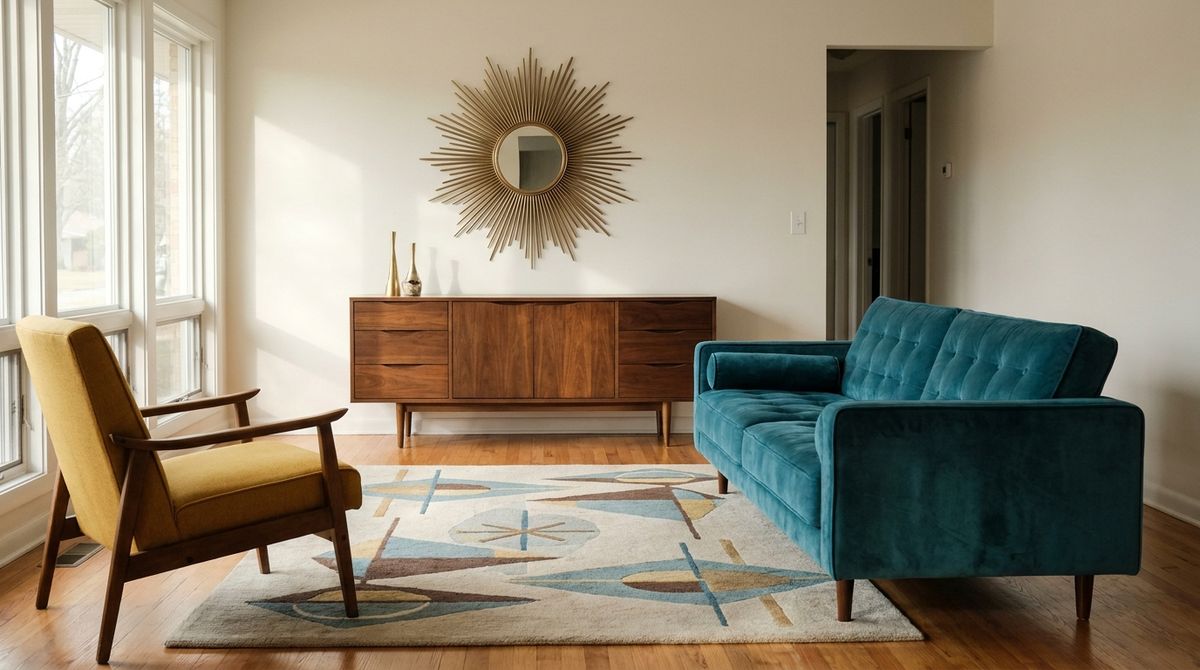
Mid-century modern style applies differently room by room — the same walnut-and-tapered-leg formula needs different emphasis depending on what a room is actually for. In the living room, furniture silhouette does the heavy lifting. In the bedroom, restraint matters most. In a home office, MCM’s built-in obsession with functional design becomes its biggest asset.
This guide breaks each room into numbered steps with honest price ranges, then closes with a comparison table so you know where to spend and where to pull back.
Key Takeaways
- MCM style shares four universal rules across all rooms: tapered legs, warm wood tones, organic shapes, and intentional negative space.
- A mid century modern bedroom starts with the platform bed ($400–$1,200) — all other pieces scale from there.
- The living room demands the highest per-piece investment; the home office delivers MCM character on the leanest budget.
- Warm neutrals (walnut, ivory, olive, mustard) unify a multi-room MCM home without making every space look identical.
What Every MCM Room Has in Common
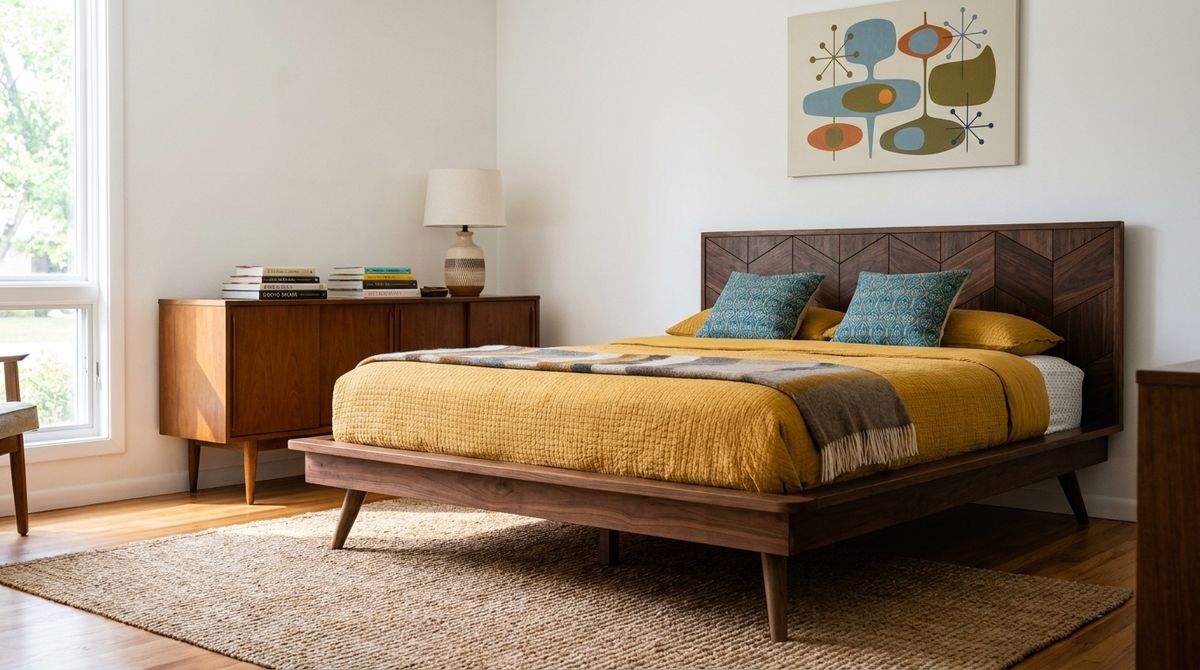
Four principles carry across every room without change. Clean lines — not minimalism exactly, but deliberate simplicity that avoids ornament for its own sake. Warm wood tones, typically walnut, teak, or oak with visible grain. Organic shapes that soften the geometry: rounded chair backs, kidney-shaped tables, curved cabinet fronts. And negative space — MCM rooms breathe. Furniture doesn’t fill every corner.
What changes between rooms is the weight you put on each principle. Living rooms put organic shape and statement silhouette front and center. Bedrooms lean hardest into restraint and warmth. Home offices rely on MCM’s original commitment to purposeful, functional design — the style was born from post-war optimism about how good design could improve daily life.
What most guides miss: The same credenza changes proportion by room, and that is how one silhouette serves three spaces. In the living room it runs long and low (60–72 inches) to anchor the sofa wall. In a bedroom it sits shorter and taller (36–42 inches) as a dresser. In the office it lands mid-height for files. One shape, three dimensions, three jobs.
Worth noting: The biggest mistake people make is treating MCM as a furniture catalog rather than a spatial philosophy. You can own a Saarinen tulip table and still miss the point entirely if the surrounding room is cluttered or inconsistent in material warmth. The philosophy comes first; the pieces follow from it.
Before you buy anything, the mid-century modern decor guide hub maps every sub-topic across the style. For a deep-dive into the foundational principles, our complete MCM decor guide for 2026 covers everything in one place.
Actionable takeaway: Write down your room’s dominant function before purchasing a single piece. That function determines which MCM principle deserves the most emphasis.
How to Apply MCM Style in the Living Room
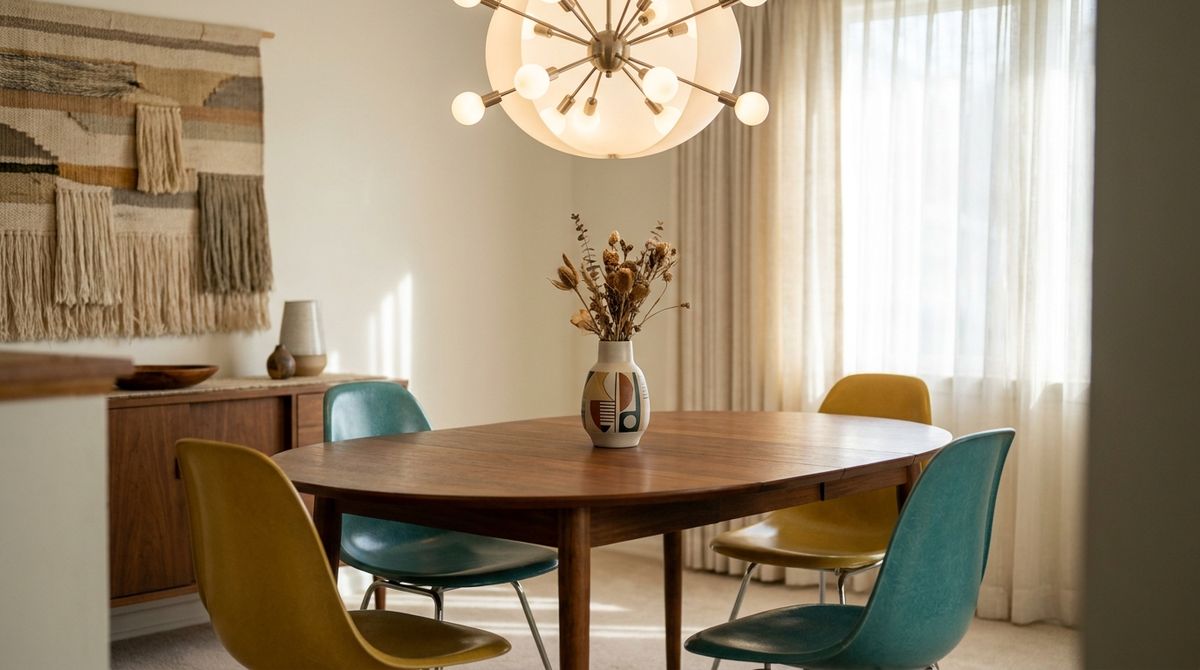
The living room is where MCM shows its best face — and where it’s easiest to overspend on one iconic piece while underinvesting in the rest. The sofa anchors the room, but the overall spatial silhouette matters more than any single item.
Step 1: Choose a low-profile sofa with tapered legs.
Budget $800–$2,500 for a quality piece. Look for a clean back profile (channel-tufting if you want texture, but avoid heavy button-tufting), solid upholstery in a warm tone — camel, ivory, olive, or deep teal — and exposed wood legs, not a full base. Anything with a skirt doesn’t belong here.
Step 2: Add a walnut or teak coffee table.
Price range: $200–$700. The table should sit low (16–18 inches) with a shelf or slatted base beneath. Hairpin-leg versions ($150–$400) are widely available and period-correct. Solid walnut constructions hold their look better over time than veneer.
Step 3: Place one accent chair — maybe two, never three.
Eames-style shell chairs in reproduction run $150–$500; genuine Herman Miller shells start at $650. One well-positioned accent chair creates the conversation cluster MCM is known for. Two can work in larger rooms. Three tips into visual clutter.
Step 4: Run a credenza or media console along one wall.
Budget $350–$1,100 for a solid walnut or walnut-veneer credenza with tapered legs. It handles media storage and decorative objects, and — with sliding doors — conceals cables without a dedicated entertainment cabinet. It’s the room’s hardest-working MCM piece.
Step 5: Light in layers.
A Sputnik chandelier or Nelson bubble pendant over the seating area ($150–$600) plus one arc floor lamp in the corner ($100–$350). No recessed downlights as primary sources. MCM lighting is intentional, directional, and warm — 2700K bulbs only.
For a full photo breakdown of what these decisions look like in real rooms, 30 mid-century modern living room ideas that never go out of style is the natural next read.
Actionable takeaway: Lock in the sofa, coffee table, and credenza first. Those three pieces establish the MCM silhouette. Lighting, art, and plants can come later without disrupting the room’s character.
Free · 60 seconds
Not sure which style is actually yours?
Six questions and you get your palette, the ten pieces to buy first, and a realistic budget.
How to Design a Mid Century Modern Bedroom That Actually Works
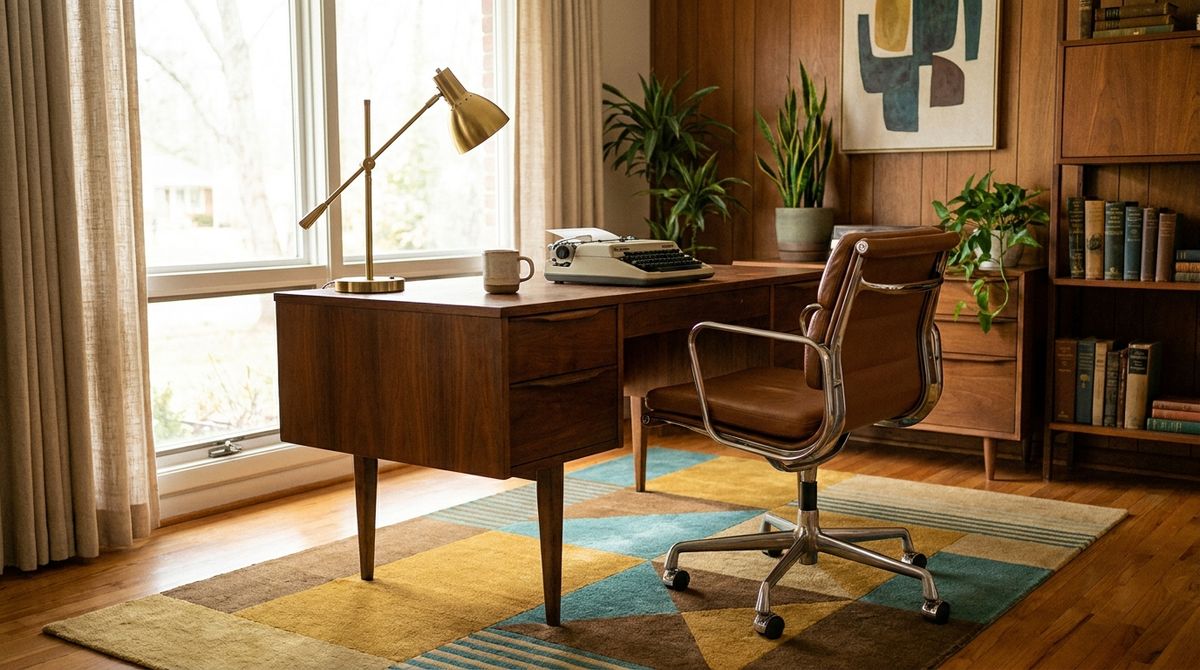
The mid century modern bedroom has one job: make sleep feel like a retreat, not a showroom. That means restraint is the guiding principle here more than anywhere else. Every piece should earn its presence.
MCM bedroom design consistently ranks among the most-searched interior styles on platforms like Houzz (which currently surfaces 75+ dedicated MCM bedroom idea boards) and Architectural Digest. That sustained interest isn’t nostalgia — it’s that the style’s low profile and warm palette genuinely support sleep-space design in ways that heavier trends don’t.
Step 1: Anchor with a platform bed.
This is the non-negotiable foundation of any MCM bedroom. Budget $400–$1,200. Look for a low headboard — upholstered in warm linen or boucle, or solid walnut — no footboard, and legs that keep the frame 6–8 inches off the floor. Storage beds undermine the silhouette; avoid them.
Step 2: Choose nightstands at the right height.
Floating nightstands ($120–$300 per pair, wall-mounted) are the most authentic MCM choice and keep the floor plane open. Hairpin-leg nightstands ($150–$400 per pair) work equally well. Either way, they should sit 2–3 inches above mattress height — standard nightstands are often too tall for low-profile MCM beds and throw off the proportions.
Step 3: Replace a bulky dresser with a credenza-style chest.
Credenza-style dressers ($300–$900) sit low and wide — typically 36–42 inches tall — with tapered legs. They hold the same storage as a standard dresser but read as furniture, not a box. Place one against the wall opposite the bed as a visual anchor and surface for a lamp, a plant, and nothing else.
Step 4: Keep textiles disciplined.
One duvet in a solid warm neutral — ivory, stone, dusty sage. Two sleeping pillows plus two accent pillows maximum. A single throw. Avoid pattern-heavy bedding; MCM lets wood grain and furniture shape carry the visual interest. If you add a rug, go geometric and low-pile ($150–$500).
Step 5: Light with wall-mounted sconces.
Swing-arm wall sconces on either side of the bed ($80–$250 each) free up the nightstand surface and look period-correct. An arc floor lamp works for larger rooms with a dedicated reading corner. Skip harsh overhead downlights — they conflict with both the MCM palette and basic sleep hygiene.
Our finding: In rooms under 200 square feet, swapping a standard dresser for a low credenza-style chest — at equal storage volume — makes the room read noticeably larger. The visual floor space returned by those four exposed legs is real, not imagined.
Getting the color balance right is what separates a well-executed MCM bedroom from one that just has MCM furniture in it. Our MCM color palette guide with 10 period-accurate combinations covers every hue you’ll need, from warm walnut-and-teal pairings to the classic all-neutral approach.
Actionable takeaway: In the midcentury bedroom, buy less and buy better. A $900 platform bed with $300 floating nightstands consistently outperforms a $400 bed surrounded by mismatched furniture from three different eras.
How to Set Up an MCM Home Office
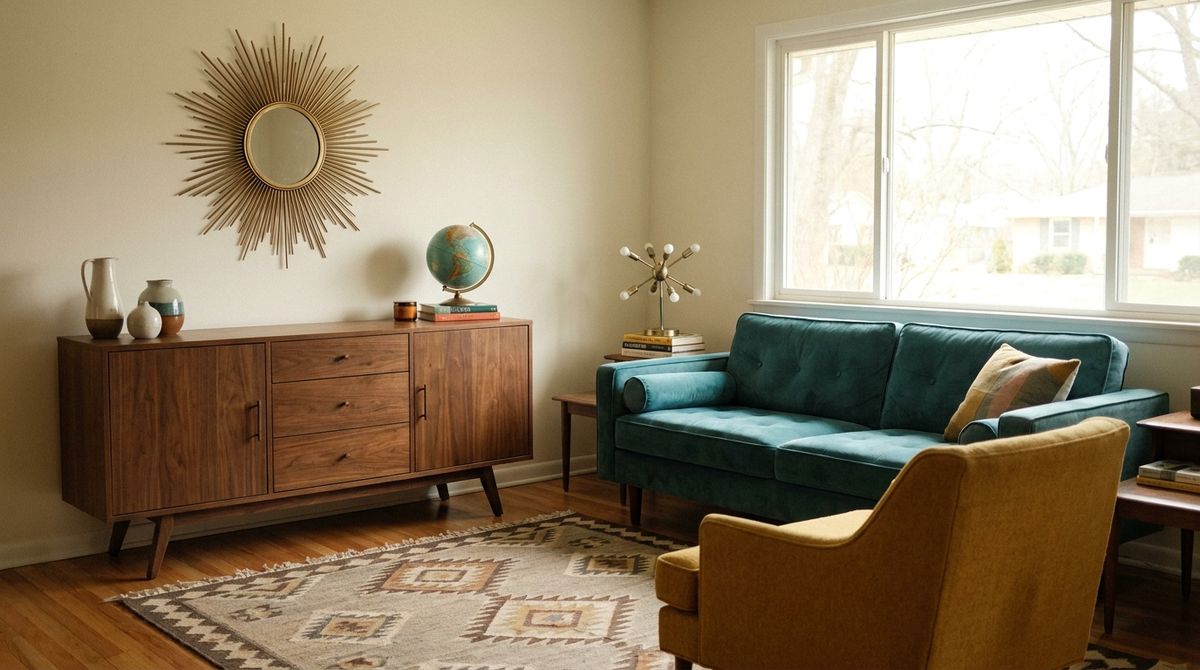
Of the three rooms, the MCM home office is the most accessible on a tight budget. The style’s core values — purposeful design, warm materials, clean work surfaces — translate directly into a productive workspace without requiring expensive signature pieces.
Step 1: Choose a walnut desk with tapered legs.
Budget $300–$1,000. A clean-topped writing desk ($300–$600) paired with a separate credenza or floating shelf for storage is more flexible and more period-authentic than a built-in pedestal desk. If you need drawers, a simple two-drawer pedestal in warm wood runs $500–$1,000.
Step 2: Invest in a proper task chair.
An Eames-style molded shell chair with a task base runs $200–$500 in quality reproduction. Genuine Herman Miller Eames aluminum group chairs start at $1,400. For eight-hour workdays, ergonomics matter more than aesthetics — look for MCM silhouettes that also include lumbar support.
What most guides miss: A period-correct shell or aluminum-group chair is built for about 4–5 hours of comfort, not a full workday spine. For eight-hour sessions, pair the MCM silhouette with a firm seat cushion, or pick a reproduction that hides seat-height and lumbar adjustment under the shell. Style and all-day support are two separate purchases, not one.
Step 3: Add warm, directional desk lighting.
A cone-shade or mushroom-shade desk lamp in brushed brass or matte black ($60–$200) provides the directional warmth an MCM office needs. Cold-white LEDs kill the palette. Pair with a floor lamp in the corner if the room is large enough.
Step 4: Handle storage with floating shelves or a credenza.
Floating walnut shelves ($150–$400 for a set of three) display books without adding visual weight to the floor plane. A credenza beneath them ($350–$900) closes out the storage. Keep surfaces at 30% occupied — negative space isn’t optional in an MCM workspace.
Step 5: Add one textile and one plant.
A small geometric rug under the desk ($100–$300) grounds the workspace. One large-leaf plant — fiddle-leaf fig, monstera, or snake plant — supplies the organic element that MCM rooms need without competing with the clean lines of the furniture.
New to the style entirely? Our 6-step MCM decor guide for first-time buyers walks through the full buying sequence and the most common early mistakes.
Actionable takeaway: The MCM home office works through surface discipline. Cable management trays ($20–$60) under the desk plus a closed credenza for everyday storage solve 90% of the clutter problem before it starts.
Room-by-Room Comparison: Where to Put Your Budget First
Not every budget covers all three rooms at once. Here’s how to think about sequencing:
| Room | Anchor Piece | Anchor Budget | MCM Priority | Single Best ROI Move |
|---|---|---|---|---|
| Living Room | Low-profile sofa | $800–$2,500 | Shape & silhouette | Replace TV stand with walnut credenza |
| Bedroom | Platform bed | $400–$1,200 | Restraint & warmth | Swap dresser for credenza-style chest |
| Home Office | Walnut desk | $300–$1,000 | Function & surface clarity | Add swing-arm sconce + clear desk surface |
Which room to start with? Begin where you spend the most waking hours. For most people, that’s the living room or the home office. The MCM bedroom is often the easiest to execute because the style’s restraint aligns naturally with what a sleep space should be anyway.
What most guides miss: MCM scales down better than heavier styles because its legs are exposed and its profiles sit low. In rooms under 120 square feet, drop anchor-piece heights by 2–4 inches, keep the sofa under 72 inches wide, and protect at least one 30-inch walkway. The floating floor plane is what makes a small MCM room read open, not the number of pieces in it.
The overlap principle: A credenza works in all three rooms. If budget is tight, buy one excellent credenza and place it where it’s most needed now. It can move later. The platform bed can’t.
Actionable takeaway: If you’re starting from scratch, do the living room first for the highest daily visual reward. If you work from home full-time, the office delivers a better quality-of-life return per dollar spent.
Frequently Asked Questions
What’s the most important piece of furniture in a mid century modern bedroom?
The platform bed is the non-negotiable anchor. Its low profile and clean headboard set the proportional logic for everything that follows — nightstand heights, dresser scale, rug placement, and lighting all work off the bed frame’s geometry. Budget $400–$1,200 for a quality version that holds its shape over time.
Can you mix MCM furniture across different rooms without it feeling repetitive?
Yes — use the same wood tone throughout (walnut is the most forgiving) but vary silhouette and scale per room. A living room credenza should be longer and lower than a bedroom version. Consistent material language ties rooms together without making them look like catalog pages from the same shoot.
What colors work in an MCM bedroom without looking dated?
Warm neutrals — ivory, stone, warm white — as the base, then one or two accent tones from the period palette: dusty sage, deep teal, mustard, or terracotta. Avoid cool grays; they fight the warmth of walnut and teak at every turn. Our MCM color palette guide covers the full range of period-accurate combinations.
Is the MCM aesthetic hard to maintain in a home office?
The challenge is that MCM desks don’t hide anything — open legs and clean tops expose every cable and stray item. Cable management trays ($20–$60), a closed credenza for storage, and a weekly surface reset are all it takes. The discipline the style demands also tends to make the workspace more productive.
How do I add MCM character to a bedroom on a tight budget?
Start with lighting and hardware before touching furniture. Replacing a flush-mount ceiling fixture with a cone-shade pendant ($60–$150) and swapping chrome pulls for matte brass ($2–$8 each) changes the room’s character immediately — no new furniture required.
Does mid century modern work in a small apartment or studio?
Yes, often better than bulkier styles. Exposed legs and low profiles keep sightlines open, so a studio reads larger. Anchor each zone with one piece: a sofa under 72 inches, a single credenza that doubles for storage and display. Trim standard heights by 2–4 inches and the room feels intentional, not cramped.
Conclusion
MCM style isn’t one uniform look applied to every room. It’s a consistent design philosophy — clean lines, warm wood, organic shapes, negative space — applied with room-specific intelligence. The living room gets the statement pieces and the social silhouette. The mid century modern bedroom gets restraint and warmth. The home office gets surface discipline and purposeful lighting.
Start with the room you use most, anchor it with one excellent piece, and let the rest follow. You don’t need all three rooms finished simultaneously to live with good MCM design. Deliberate choices, made room by room, get you there faster than any single shopping haul.
For the full style foundation in one place, the mid-century modern decor guide is where to go next.