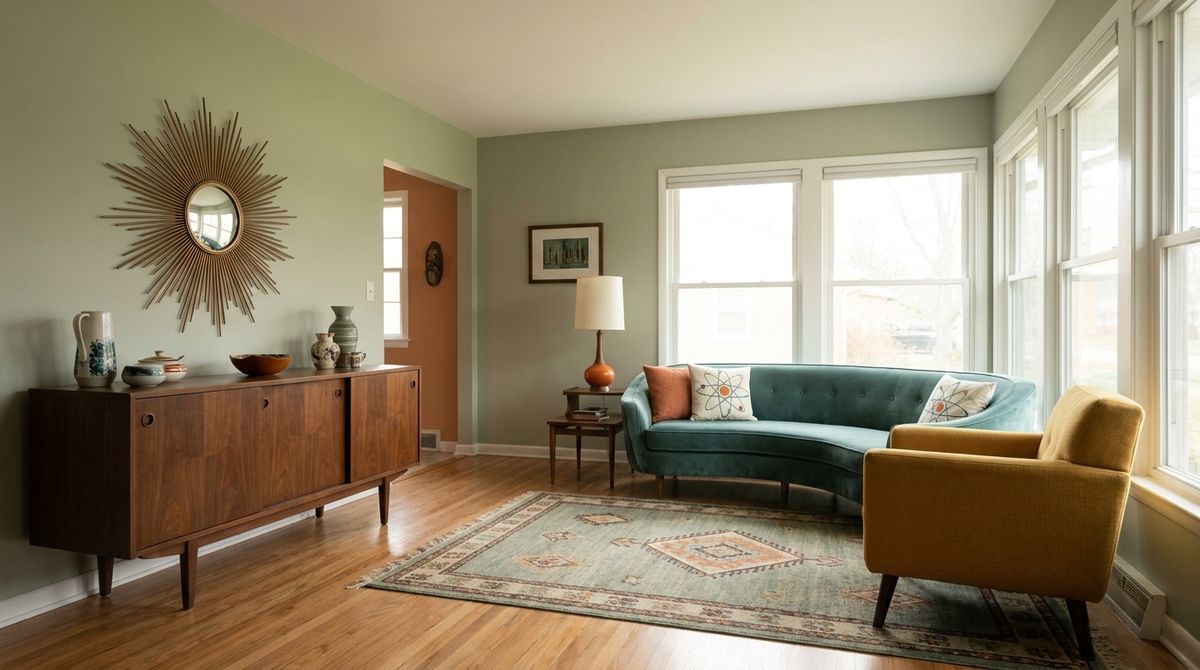
A true mid-century modern color palette runs on earth tones that breathe: warm ochres, tobacco browns, avocado greens, punctuated by sharp jewel-tone accents like teal, coral, or cobalt. The style, which dominated American interiors from roughly 1945 to 1969, never used color loudly. It used it surgically: one bold wall, one upholstered accent chair, one ceramic lamp base. That restraint is exactly what makes it so livable in 2026. Whether you’re starting a room from scratch or just tired of greige, the ten combinations below are period-correct and genuinely wearable today.
Key Takeaways
Authentic MCM color centers on warm earth tones — ochre, avocado, burnt
sienna — with one jewel-tone accent per room, not two or three.The 60-30-10 rule (neutral base / secondary hue / accent) governs every
combination here — break it and the palette falls apart.Sample pots from Benjamin Moore and Sherwin-Williams ($5–$9) let you test
colors under your actual light before spending $65+ on a gallon.
What Actually Separates MCM Color From Every Other Retro Palette?
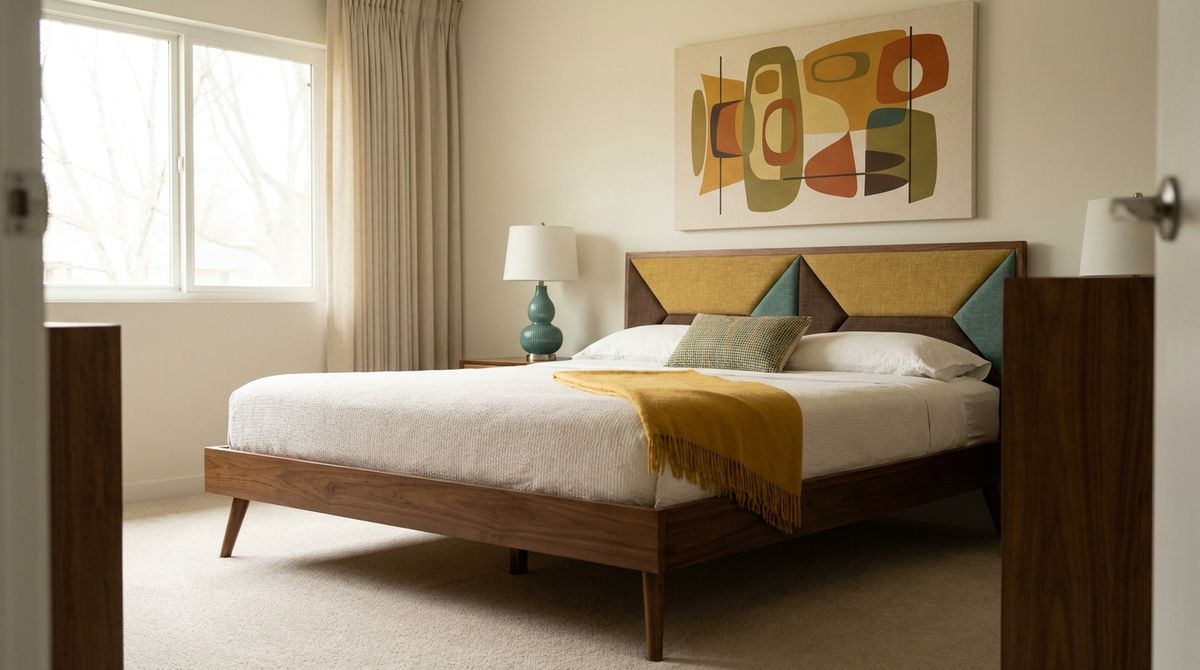
Mid-century modern color is defined by three structural rules that its
contemporaries didn’t share. Victorian rooms stacked competing saturated
patterns. Art Deco leaned hard on black and metallic gold. MCM stripped
all of that back to a three-tier system: neutral base, one supporting hue,
one accent. That hierarchy — the 60-30-10 split — is what gives every
authentic MCM room its calm authority, and it’s non-negotiable.
Saturation levels also ran lower than most people expect. True MCM paints
carry a muted, slightly dusty quality. Avocado isn’t bright kelly green —
it’s green with brown in it. Harvest gold isn’t pure canary yellow — it’s
yellow with orange and gray. That muddied quality was intentional. It’s
what prevented walls from competing with the walnut and teak furniture that
defined the era’s aesthetic.
What most guides miss: The 60-30-10 split isn’t vague styling
advice, it’s a measured ratio. A warm neutral base (Alabaster #F4EFE2
or Pale Straw #EDD88A) should hold roughly 60% of visible surface,
the period hue 30%, and the jewel-tone accent no more than 10%. The dated
1970s look almost always starts when that accent creeps well past its 10%.
Our observation: Most MCM color guides focus on hue but ignore
undertone. Color worked in these interiors because teak and walnut furniture
carry warm red-orange undertones. Wall colors were chosen to complement
wood grain, not fight it. Before you pick a single paint chip, identify your
dominant wood finish. Warm woods (teak, walnut, oak) demand warm neutrals.
Cool finishes (ebony stain, chrome, white lacquer) open the door to slate
blues and smoky greens.
Actionable takeaway: Write down your furniture finish before shopping
for paint. That single step will eliminate 80% of the wrong choices before
you spend a dollar.
If you’re still building your MCM room from the ground up, the
6-step guide for first-time MCM buyers
covers the full decision sequence before color enters the picture.
The 10 Period-Accurate MCM Color Combinations
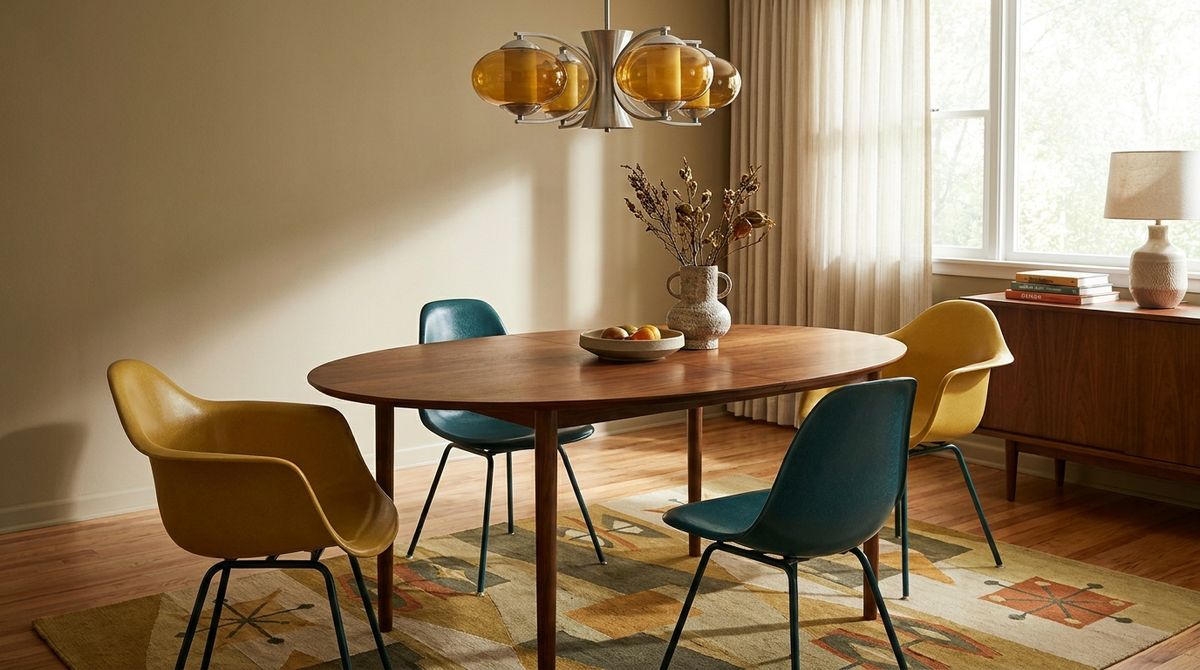
Each combination below lists a wall base, a secondary hue, and an accent.
Paint names are from major US brands; hex codes are for digital swatch
reference. The “best room” suggestion reflects where the combination’s
visual weight works best, though none are strictly limited to that space.
1. Harvest Gold + Warm White + Walnut Stain
- Base (walls): Benjamin Moore Pale Straw 2154-50 —
#EDD88A - Secondary (cabinetry or large upholstery): BM Harvest Gold 2152-40 —
#C8972A - Accent: Natural walnut stain — furniture legs, open shelving
- Best room: Kitchen or dining room
2. Avocado Green + Antique Cream + Teak
- Base: Sherwin-Williams Antique White SW 6119 —
#F5EBDA - Secondary: SW Avocado SW 6697 —
#7B8C43 - Accent: Teak wood tones — furniture and flooring
- Best room: Living room or home office
3. Burnt Sienna + White Dove + Espresso
- Base: Benjamin Moore White Dove OC-17 —
#F3EFE0 - Secondary: BM Copper Mountain 2175-30 —
#B5612A - Accent: Espresso-stained wood — credenza, side tables
- Best room: Bedroom
4. Atomic Teal + Revere Pewter + Brushed Brass
- Base: BM Revere Pewter HC-172 —
#C2B9A7 - Secondary: BM Tropical Teal 2164-30 —
#3D8C8A - Accent: Brushed brass — lamp bases, drawer pulls, mirror frames
- Best room: Living room
5. Prussian Blue + Alabaster + Ochre Textiles
- Base: Sherwin-Williams Alabaster SW 7008 —
#F4EFE2 - Secondary: SW Naval SW 6244 —
#2B3F5C - Accent: Ochre — wool throw, area rug, woven cushions
- Best room: Home office or study
6. Coral + Linen White + Dusty Teal
- Base: BM Linen White OC-146 —
#F3EAD3 - Secondary: BM Coral Gables 2166-40 —
#D97B6A - Accent: Dunn-Edwards Dusty Miller DE6107 —
#5E8B8C(ceramics, plant pots) - Best room: Sunroom, breakfast nook
7. Charcoal + Mustard Yellow + Light Walnut
- Base (feature wall only): SW Tricorn Black SW 6258 —
#2B2B2C - Remaining walls: SW Alabaster SW 7008 —
#F4EFE2 - Secondary: BM Golden Harvest 2152-20 —
#C08220 - Accent: Light walnut — furniture, picture frames
- Best room: Living room or media wall
8. Slate Blue + Warm White + Terracotta
- Base: BM Chantilly Lace OC-65 —
#F8F6F0 - Secondary: BM Newburyport Blue HC-56 —
#496A7E - Accent: SW Cavern Clay SW 7701 —
#BE7355(planters, ceramics) - Best room: Bedroom or bathroom
9. Olive Green + Warm Ivory + Copper
- Base: Dunn-Edwards Warm Ivory DEW380 —
#F0E8D0 - Secondary: SW Oakmoss SW 6180 —
#7A8151 - Accent: Raw copper — pendant lights, vases, kitchen hardware
- Best room: Kitchen or entryway
10. Sunflower Yellow + Alabaster + Muted Aqua
- Base: SW Alabaster SW 7008 —
#F4EFE2 - Secondary: BM Sun-Kissed Yellow 2151-40 —
#D4AA44 - Accent: BM Woodlawn Blue HC-147 —
#8AADA8(ceramic lamps, textile trim) - Best room: Reading nook, studio, or bedroom
Actionable takeaway: Don’t use more than one secondary and one accent
in a single room. Two bold hues — say, a teal wall and an orange sofa —
cancel each other out. Pick one to own the room; let the other one whisper.
What most guides miss: Period-accurate MCM hues sit lower on
saturation than most reproductions sold today. Keep secondary colors in the
LRV 20-50 band and let warm neutrals, not the bold hue, carry the room.
Authentic avocado #7B8C43 reads right; a cleaner, brighter green
tips straight into 1970s theme-park territory.
For real-room inspiration across all of these combinations, browse our
30 mid-century modern living room ideas that never go out of style.
Free · 60 seconds
Not sure which style is actually yours?
Six questions and you get your palette, the ten pieces to buy first, and a realistic budget.
How to Apply Your Chosen Palette Room by Room (3 Steps)
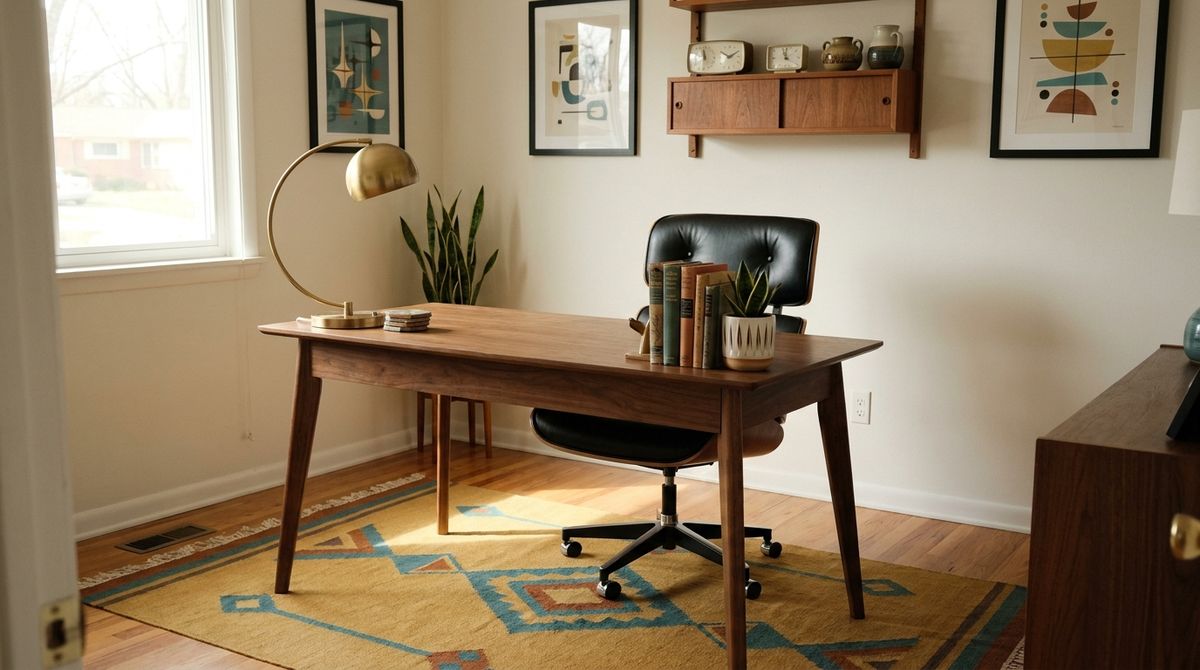
Choosing a combination is the easy part. Distributing it correctly is what
separates a polished MCM room from something that looks like a theme-park
recreation. Here’s the three-step process that holds up across every
combination above.
Step 1 — Lock in your base (60%). For most rooms, this is an off-white,
warm cream, or light warm gray applied to all four walls and large neutral
textiles (curtains, rugs in natural fiber tones). Combinations 1, 2, 3, 5,
8, 9, and 10 use a neutral base deliberately — it lets wood furniture read
correctly and keeps the room from closing in. Only combination 7 breaks this
pattern, and it works only because the charcoal covers a single wall, not
the room.
Step 2 — Introduce your secondary at 30%. One cabinetry color, one large
upholstered piece, or one full accent wall — not all three simultaneously.
MCM secondaries like avocado, teal, and mustard earn their place by being
contained. Spread them across multiple surfaces and they lose all authority.
Step 3 — Add your accent at 10%. Hardware, lamp bases, throw pillows,
ceramic vases, and the underside of open shelving are all fair game.
Brass, copper, and walnut-stained wood do serious work here without
requiring a paint decision at all.
Easy swap: On combination 4 (Teal + Revere Pewter + Brass), changing only the drawer pulls from brushed nickel to unlacquered brass, with zero repainting, moves a room from “generic gray” toward “unmistakably mid-century.” The 10% accent layer does more work than most people expect.
Actionable takeaway: Follow the sequence in order: buy and apply the
base, live with it for a week, add the secondary, live with it for another
week, then add accents. Rushing all three phases at once is how rooms end
up looking muddy.
See how these three layers apply differently depending on whether you’re
working on a living room, bedroom, or home office in our
MCM room-by-room application guide.
Where to Buy: Paint Brands and Real Price Ranges
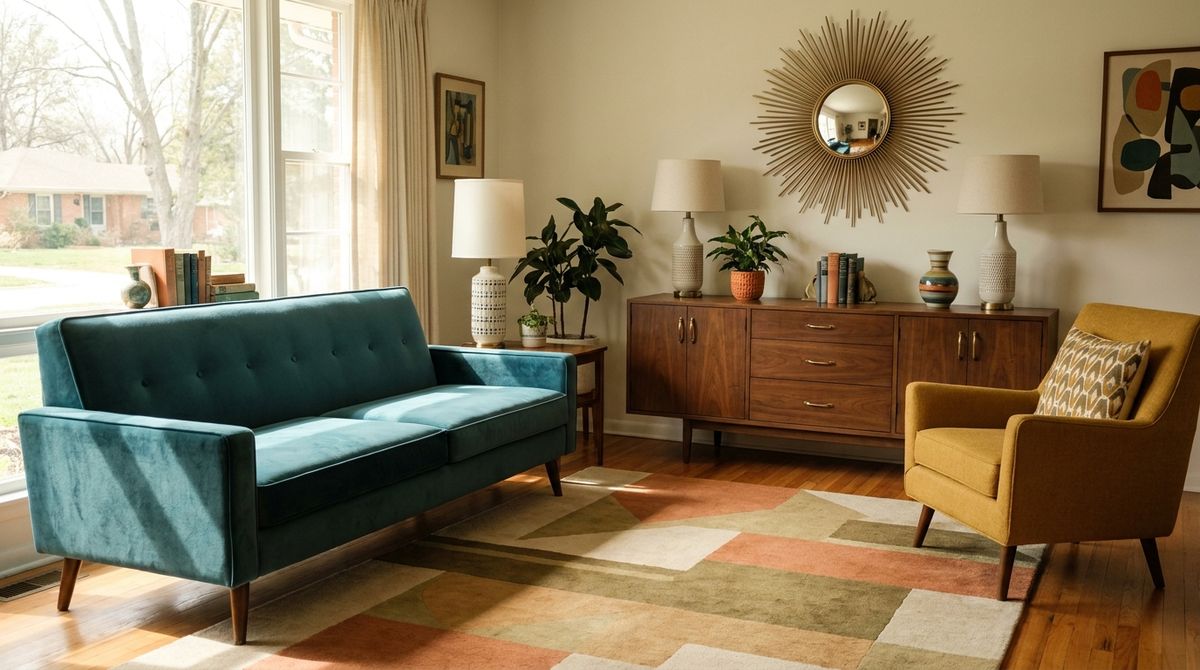
Paint quality matters more in MCM palettes than in most other styles.
The slightly matte, chalky finish that earth-tone MCM hues require doesn’t
survive in bargain-grade latex — cheaper paints tend to shift warm grays
toward lavender and muddy greens toward khaki under LED lighting.
Benjamin Moore Aura Interior is the strongest option for MCM earth tones.
Their Historic Colors and Classic Colors lines carry authentic ochres,
avocados, and dusty teals with pigment depth that holds under multiple
light conditions. Sample pots (2 oz): $5–$7. Quarts: $30–$40.
Gallons: $60–$75.
Sherwin-Williams Emerald performs best on darker MCM secondaries —
teal feature walls, charcoal accent walls, and deep slate blue cabinetry.
The Emerald line holds color depth better than their Cashmere range when
darker pigments are involved. Samplize peel-and-stick samples (12 oz):
$5–$8. Quarts: $35–$45. Gallons: $65–$80.
Dunn-Edwards Evershield is worth seeking out for warm ivories and
California-style terracottas (especially combinations 6 and 9). Less
widely distributed but available in western US stores and online.
Quarts: $28–$38. Gallons: $55–$68.
Farrow & Ball Estate Emulsion justifies its price point for
combinations 5 and 7. Elephant’s Breath No. 229 and Mole’s Breath
No. 276 are arguably the best warm-gray MCM wall paints on the market,
with a depth that cheaper paints can’t replicate. Sample pots: $11–$13.
Quarts: $55–$65. Gallons: $110–$130.
Actionable takeaway: Budget $30–$50 for samples across three candidate
colors before buying a gallon of anything. Test each sample under morning
light, afternoon light, and warm lamplight — an MCM earth tone that reads
perfectly at noon can pull blue-green under 2700K LEDs at night.
For the broader spend breakdown across furniture, textiles, and paint,
the mid-century modern decor hub guide
shows where paint sits in the overall room budget.
Three MCM Color Mistakes That Age a Room Overnight
Even with the right combination, a handful of common errors push a room
from “considered design” into “period costume.” Here’s what to watch for.
Mistake 1: Repeating your accent color across every surface. If teal
is your accent, one or two placements. Not the walls, the rug, the cushions,
and the curtains. Over-repetition kills the contrast that made the accent
worth choosing in the first place.
Mistake 2: Using bright, clean versions of MCM hues. Avocado isn’t lime
green. Harvest gold isn’t canary yellow. Burnt sienna isn’t neon orange. If
a paint chip looks vivid and punchy on the card, it’s almost certainly too
saturated for authentic MCM use. Look for an LRV (Light Reflectance Value)
between 20 and 50 for secondary MCM colors — that’s the muted, period-accurate
range.
Mistake 3: Choosing the wrong paint finish. This one is overlooked by
almost every MCM color guide. Satin finish on MCM walls catches too much
reflected light and kills the matte, organic quality the palette depends on.
Use eggshell on walls, satin on trim and doors, flat on ceilings. That’s the
finish hierarchy that keeps earth tones reading as earth tones.
Actionable takeaway: Run a quick LRV check on every secondary color you’re
considering. Most paint brand websites list it on the color detail page.
If the LRV is above 55 for your secondary, it’s too bright — go one shade
deeper.
For the full picture on building out the entire MCM aesthetic — furniture
silhouettes, textiles, lighting, and layout alongside color — start with the
ultimate mid-century modern decor guide for 2026.
Frequently Asked Questions
What are the most authentic mid-century modern colors?
The most period-accurate MCM colors are harvest gold, avocado green, burnt
orange, warm off-white (not bright white), teak brown, and jewel-tone accents
like teal and coral. These dominated American interiors from the late 1940s
through 1969. Sherwin-Williams Avocado SW 6697 and Benjamin Moore Harvest
Gold 2152-40 are the closest modern equivalents to original period pigments.
Can I use gray in a mid-century modern color palette?
Yes — but only warm grays. Cool grays with blue or green undertones read as
contemporary Scandinavian, not MCM. Benjamin Moore Revere Pewter HC-172 and
Sherwin-Williams Accessible Beige SW 7036 both carry the warm, slightly
brown undertone authentic to the period. Avoid any gray that looks blue
under LED lighting; test with a Samplize sample ($5–$8) before committing.
How many colors should an MCM room use?
Three, structured as 60-30-10: one dominant neutral (walls and large textiles),
one secondary color (cabinetry, a large upholstered piece, or an accent wall),
and one accent (hardware, ceramics, throw pillows). Adding a fourth color
almost always breaks the calm authority that makes MCM rooms feel resolved
rather than busy.
What paint finish is correct for mid-century modern walls?
Eggshell. It cleans easily, reflects light softly, and preserves the muted
quality of earth-tone pigments without the flat finish’s tendency to show
every scuff. Avoid satin on MCM walls — it catches too much light. Use flat
only on ceilings. Trim and doors get satin or semi-gloss for contrast.
Do I need to repaint everything to achieve an MCM look?
Not necessarily. If walls are already an off-white or warm cream, you may only
need to address the 30% secondary layer — a painted credenza, reupholstered
sofa, or one accent wall. In many rooms, swapping hardware to unlacquered
brass and adding walnut-toned furniture does more visual work than any
paint choice.
How do I keep an MCM palette from looking like a 1970s cliche?
Keep the accent hue to 10% and choose muted, dusty versions over clean bright
ones. Authentic avocado (#7B8C43) carries brown; harvest gold
(#C8972A) carries gray. Let warm neutrals hold about 60% of the
room, and the palette reads timeless rather than dated.
The Palette Is the Starting Point, Not the Finish Line
A great mid century modern color palette isn’t about cramming every retro hue
into one room. It’s about choosing the right three, applying them in the right
proportions, and letting the finish do the rest. The ten combinations above
cover everything from a quiet earth-tone bedroom to a boldly accented media
wall — each one traceable back to what was actually used in the homes that
defined this era.
Start with a $5 sample pot. Test it under every light condition your room sees
in a day. Then build outward from there.
For the full framework on applying MCM beyond paint — furniture, textiles,
lighting, and spatial layout — the
ultimate mid-century modern decor guide for 2026
covers every decision in one place.