
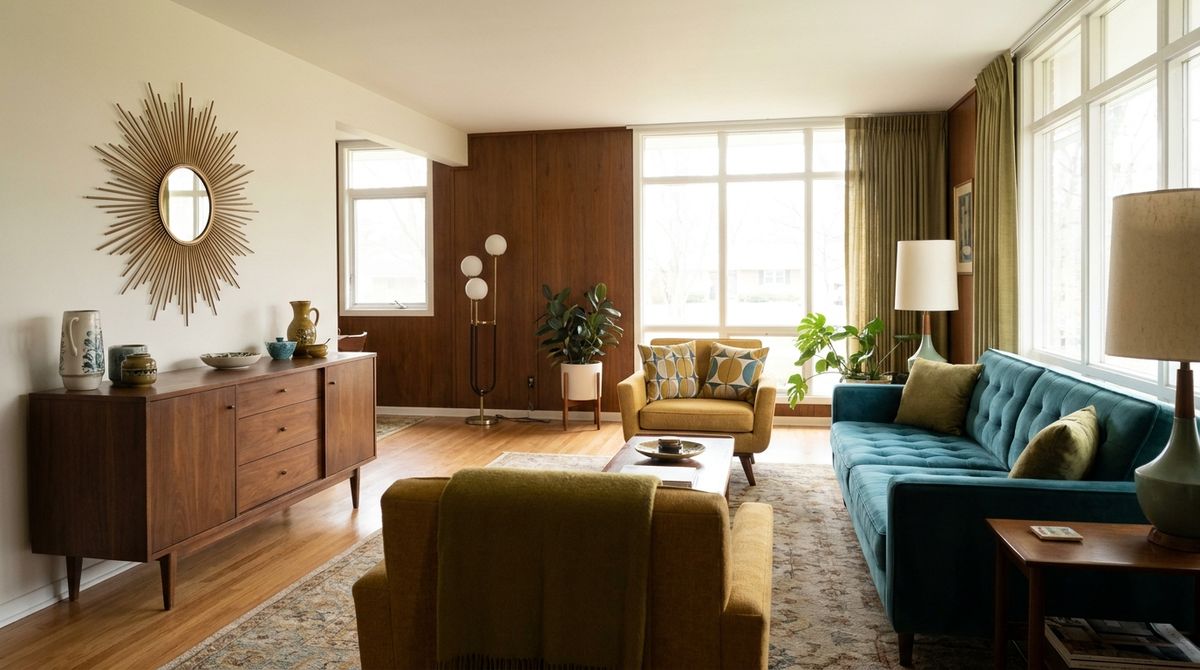
Mid-century modern has been one of the most consistently searched interior styles on Pinterest for over a decade, and it shows no signs of fading. The reason is simple: clean lines, organic shapes, and warm wood tones solve real decorating problems. There’s no fussiness, no clutter, no heavy ornamentation to date the space. Whether your home is a 1958 ranch or a new-build condo, these mid century modern living room ideas translate beautifully. Bookmark this list alongside our mid-century modern decor guide for the full picture.
Key Takeaways
- Mid-century modern furniture relies on walnut, teak, and birch as its core materials — warm woods that pair with almost any wall color.
- Google Trends data shows “mid century modern living room” has held top-tier search interest continuously since 2014.
- Just 3–5 signature pieces are enough to establish the look convincingly.
1. Walnut-Leg Sofa Against White Plaster Walls
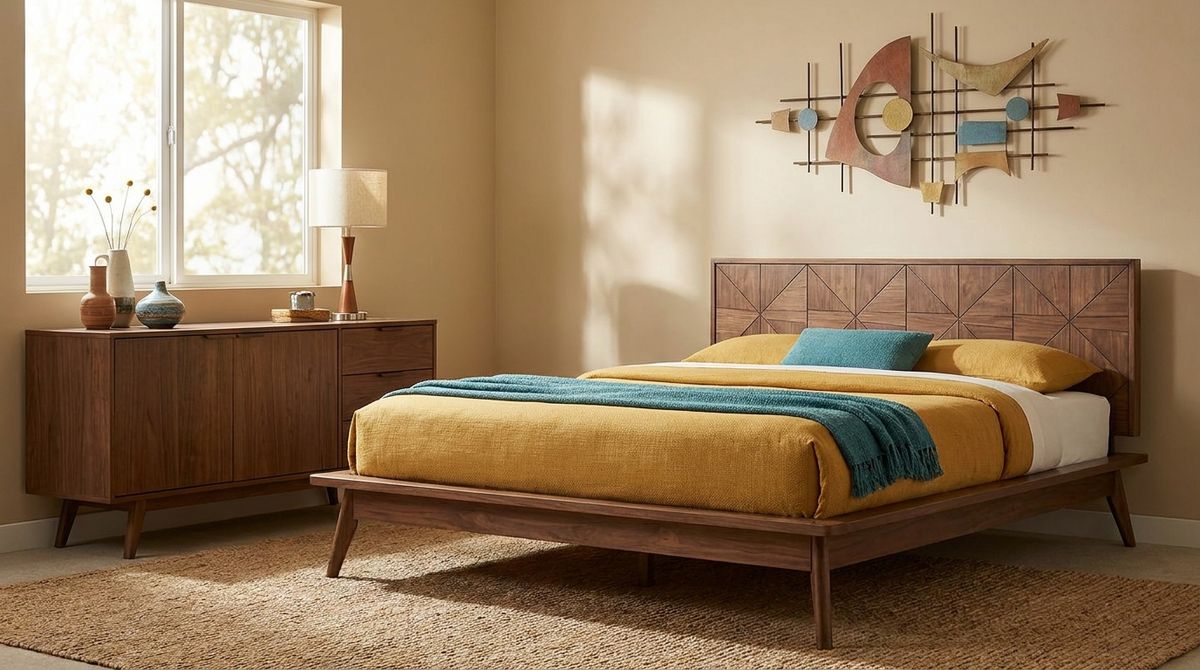
This is the foundational MCM pairing. A low-slung sofa in warm gray or cream upholstery, suspended on four angled walnut legs, reads immediately as mid-century. White plaster walls keep the focus on the furniture’s silhouette. Add a single abstract print and a slim floor lamp, and you’ve got 90% of the look without trying too hard.
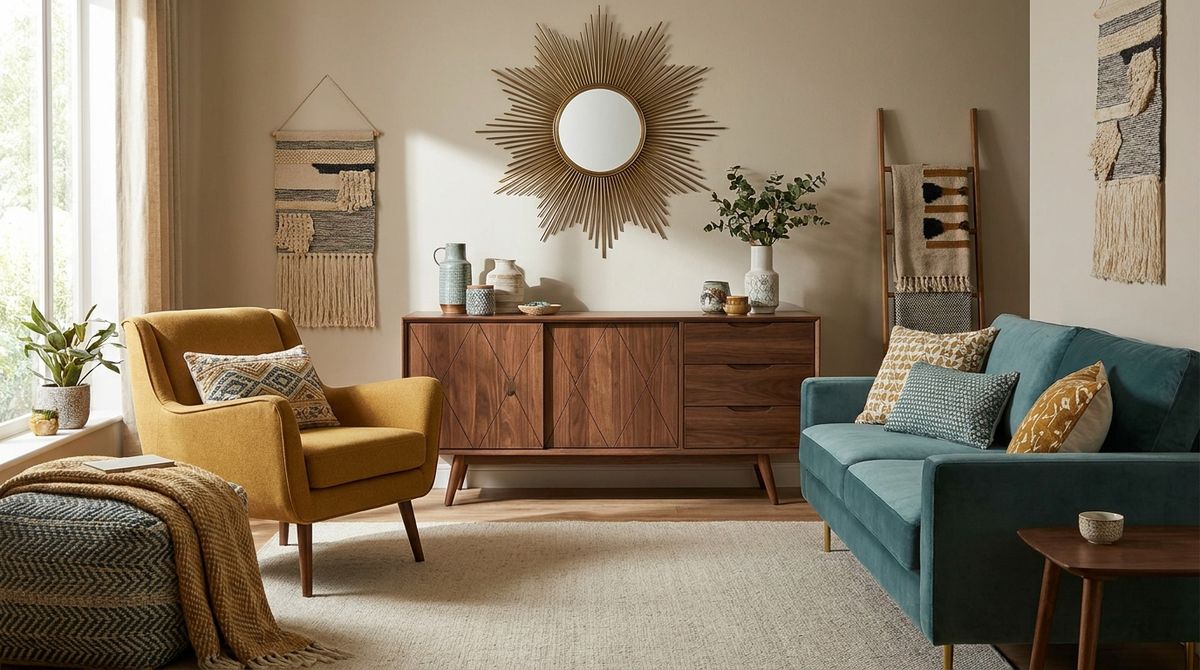
2. Sunburst Mirror Above the Fireplace
The sunburst mirror works architecturally as much as decoratively. Mounted above a simple brick or plaster fireplace, its radiating brass or gold rays fill vertical space without adding visual weight. It bounces light around the room, makes ceilings feel higher, and ties directly into the atomic-age optimism that defines the whole style.
Free · 60 seconds
Not sure which style is actually yours?
Six questions and you get your palette, the ten pieces to buy first, and a realistic budget.
3. Eames Lounge Chair and Ottoman in the Corner
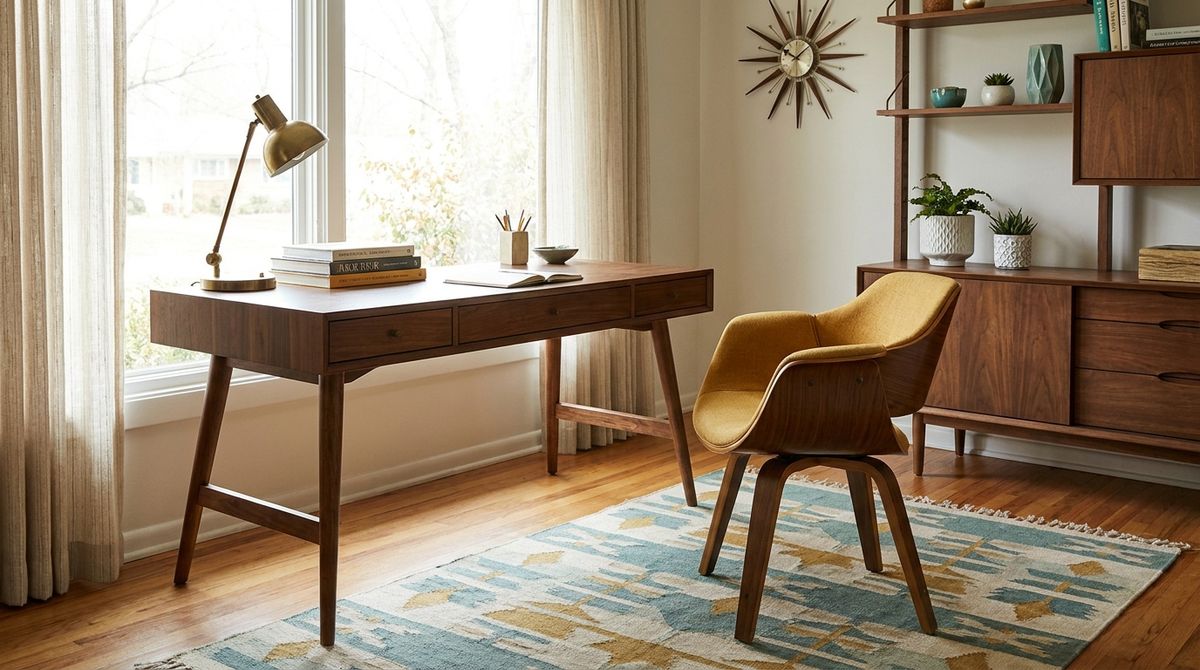
Few pieces carry more visual authority than the Eames Lounge Chair. Tuck it into a corner with a slim side table and a good reading lamp, and it becomes a complete vignette. The molded walnut shells and black or caramel leather upholstery hold their own against bolder furniture. It’s a statement that whispers rather than shouts — authentic or well-made replica versions both work.
4. Avocado Green Accent Wall
Avocado green reads as nostalgic without being kitschy when you pair it with the right materials. Paint one wall in a deep, muted green and let natural wood furniture do the rest. The color grounds the room, creates warmth in north-facing spaces, and gives lighter upholstery something to play against. For more period-accurate combinations, the MCM color palette guide is worth reading closely.
5. Low-Profile Teak Coffee Table
Height is everything in an MCM living room. A teak coffee table sitting just 14–16 inches off the floor reinforces the horizontal emphasis that defines the style. Look for a rectangular or slightly rounded form with tapered legs. Leave the surface mostly clear — a small ceramic bowl and one design book are enough. The wood grain and the legs carry all the visual interest you need.
6. Geometric Area Rug in Earthy Tones
A flat-weave or low-pile rug with angular patterns in ochre, burnt orange, cream, and brown anchors the seating area without competing with the furniture. MCM rugs borrowed from Scandinavian and Navajo geometric traditions. The pattern adds visual texture where a solid rug would feel flat, and the earthy palette ties together wood tones, leather, and linen upholstery in a single horizontal plane.
What most guides miss: an MCM rug should sit under the front legs of every seating piece and extend 6 to 8 inches past the sofa on each side. In a standard 12×15 room that usually means an 8×10, not a 5×8. A too-small rug floats in the middle of the floor and makes the whole grouping look shrunken.
7. Sputnik Chandelier as the Room’s Focal Fixture
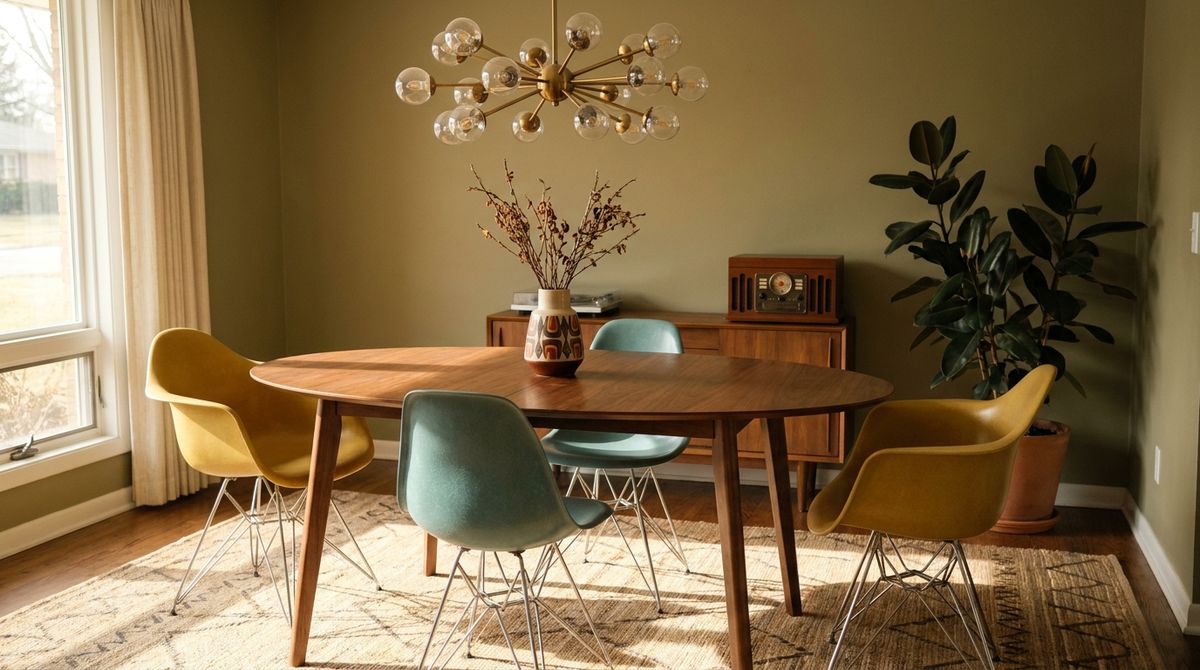
The Sputnik chandelier is pure atomic-age theater. Its branching arms and exposed bulbs reference the Space Race optimism of the late 1950s. In brass or matte black, it works equally well. Hang it lower than you think necessary — ideally 7 feet from the floor in standard rooms — so the sculptural form is at eye level when you’re seated. It’s a fixture that starts conversations.
8. Hairpin-Leg Credenza as Media Console
A low walnut or teak credenza on hairpin legs keeps the TV zone looking intentional rather than accidental. The negative space beneath the credenza is part of the design — it keeps the piece from feeling heavy. Style the top with a table lamp, a small plant, and one or two ceramic objects. Hide cables inside and you’ve got a media wall that looks more like a living room than a home theater.
9. Bold Mustard Yellow Sofa
A mustard yellow sofa is a commitment, and it pays off. The color reads as unmistakably MCM without being retro-costume. Pair it with charcoal or warm gray walls, natural wood side tables, and a neutral rug so the sofa remains the clear focus. Keep throw pillows in cognac leather or ivory boucle — the contrast is subtle enough to feel considered. This is the piece your room gets remembered for.
10. Floor-to-Ceiling Linen Curtains
Linen curtains hung from ceiling to floor add height, softness, and a warmth that blinds can’t replicate. In natural white or oat tones, they frame windows without competing with furniture or wall color. The slightly rumpled texture of linen sits comfortably alongside walnut wood and wool upholstery. Mount the rod as close to the ceiling as possible — those extra few inches change everything about how the room reads.
11. Atomic Age Arc Floor Lamp
The arc lamp is one of the most practical MCM design moves available. A brass or matte black arc sweeps over a reading chair or sofa, delivering focused light without requiring a ceiling fixture. The curves and the single-stem silhouette echo the organic, forward-leaning lines found throughout the style. Position the shade roughly 5–6 feet above the floor — high enough to diffuse light, low enough to feel intimate.
12. Organic Boomerang-Shaped Coffee Table
The boomerang or kidney-shaped coffee table is classic 1950s design logic: functional form with a sculptural edge. It works particularly well in front of curved or L-shaped sofas because the organic outline breaks up straight upholstered lines. In walnut veneer with tapered legs, it hits every MCM note at once. It’s also surprisingly practical — the curved edge allows easier access from multiple seating angles.
13. Tulip Pedestal Side Table in White or Marble
Eero Saarinen’s Tulip table remains one of the most elegant side table solutions in any style. The single pedestal eliminates the “forest of legs” problem in tight seating arrangements. In white or with a marble top, it brings a lightness that heavy wood tables can’t match. Place one beside the Eames chair or at the end of a low sofa for a composition that looks deliberately curated.
14. Large Abstract Canvas in Primary Colors
A 40×50-inch or larger canvas in bold primary colors — red, cobalt, yellow, and black — does more work than any other single decorating decision. It introduces color without a paint commitment, adds vertical scale, and signals the playful-intellectual spirit of the era. Position it on the wall opposite your main seating for maximum impact. The scale and the palette do the work, not the price tag.
15. Open-Shelf Credenza Styled with Ceramics
An open-shelf credenza is both storage and gallery. The key is restraint — style only 60% of the available space and leave the rest deliberately empty. Group ceramic vessels in earthy tones, a few paperback books, and one small trailing plant. The negative space is as important as the objects. This approach appears throughout our ultimate MCM decor guide as a core styling principle.
16. Terracotta and Teak Color Story
Terracotta walls paired with teak furniture create a sun-warmed, earthy palette that feels both period-accurate and completely current. The orange-red of terracotta picks up the warm undertones in teak grain. Add cream linen upholstery as the neutral mediator, a small jute rug, and brass hardware. Every element shares the same warm, slightly dusty undertone — no cool grays allowed here.
17. Minimalist Slate Fireplace Surround
A flat slate surround with a simple rectangular opening strips the fireplace back to its essential geometry — no mantels heavy with molding, no ornate tile work. The stone’s natural texture and dark color ground the room vertically while the horizontal furniture pulls the eye across. Mount your sunburst mirror or a single large artwork directly above for a focal wall that respects the architecture instead of fighting it.
18. Oversized Fiddle Leaf Fig in a Brass Planter
MCM interiors always included plants — real, living ones. An oversized fiddle leaf fig in a tall cylindrical brass planter fills a corner better than a floor lamp and adds a scale smaller plants can’t match. The glossy, graphic leaves echo the bold, simplified forms of the furniture. Position it near natural light, keep the planter elevated on a small stand, and the corner looks like a magazine shot.
19. Two-Tone Wall: White Upper, Walnut Panel Lower
Wainscoting gets a 1960s update when you swap painted panels for actual walnut or teak veneer. Run horizontal wood panels from floor to 36–42 inches, then paint the upper half white or warm cream. The wood lower half visually lowers the room’s center of gravity and wraps the space in warmth. It’s a technique common in Scandinavian-influenced MCM interiors and pairs perfectly with low-profile seating.
20. Boucle Accent Chair with a Brass Frame
Boucle fabric solves a real design problem: it provides texture without pattern. An ivory or warm white boucle accent chair on a thin brass or walnut frame reads as both MCM and contemporary. It softens a room full of hard wood tones and leather surfaces. Place it at a slight angle to the sofa to signal that it belongs to the conversation, not just to the wall behind it.
21. Architectural Floor-to-Ceiling Bookcase
A full-wall bookcase in walnut or teak veneer transforms a living room into a space with real character. Style shelves with a mix of books (spines facing out), ceramic objects, small framed prints, and trailing plants. The key rule: no two identical rows. Vary heights, leave gaps, and group objects in odd numbers. A well-styled MCM bookcase looks assembled over years, not ordered from a single catalog.
22. Burnt Orange Throw Pillows and a Ceramic Vase
Accent accessories are where you inject personality without risk. Two or three burnt orange throw pillows on a gray or cream sofa, paired with a hand-thrown ceramic vase in rust or amber, create an instant MCM accent moment. These are the pieces you can swap seasonally. The colors reference the warm harvest palettes common in 1960s textile design and look good under both natural and artificial light.
23. Natural Jute Rug Under a Low-Slung Sectional
A natural jute or sisal rug grounds a large sectional without competing with it. The rough, woven texture contrasts cleanly with smooth leather or linen upholstery. Jute’s warm beige tone sits comfortably between walnut wood floors and lighter walls. Size up — the rug should extend at least 18 inches beyond the sectional on all open sides to properly define the seating zone.
24. Exposed Brick Wall with Floating Walnut Shelves
Raw brick and warm wood create real material tension — the irregular, handmade texture of brick against the precise, finished grain of walnut. Float two or three walnut shelves at staggered heights on the brick wall and style them simply: a few books, a ceramic object, a trailing plant. It works equally well in urban loft spaces and suburban ranch homes.
25. Low-Slung Caramel Leather Sectional
Caramel leather is the natural choice for an MCM sectional — it ages well, softens over time, and its warm amber tone plays directly off walnut and teak. Keep the profile low, with cushions no higher than 24 inches from the floor. Add a chunky wool throw in cream or rust, a jute rug underneath, and a Sputnik fixture overhead. For guidance on applying this look beyond the living room, see our piece on applying MCM per room.
26. Gallery Wall of Mid-Century Prints and Posters
A curated gallery wall works in MCM if you follow one rule: consistent framing. Use the same slim walnut or brass frames throughout. Mix vintage travel posters, abstract geometric prints, and botanical illustrations in a horizontal band rather than a stacked arrangement. Keep the spacing tight — 2 to 3 inches between frames. Uniform framing and tight arrangement read as intentional rather than random.
27. Conversation Pit with Modular Seating
The conversation pit is the most dramatic MCM idea on this list. A sunken square or circular seating area lined with low modular cushions creates a room-within-a-room feeling. Where structural changes aren’t possible, approximate the effect with a very low platform sectional in a U-shape on a large area rug. The goal is the same: a defined, intimate zone that encourages actual conversation.
28. Mixed Wood Tones: Walnut, Teak, and Birch
The idea that all wood in a room must match is a decorating myth. MCM interiors routinely mixed walnut, teak, and lighter woods like birch or beech — the key is ensuring all tones share a warm undertone. A walnut coffee table, teak credenza, and birch bookcase feel cohesive when upholstery and rugs bridge the differences. This approach, covered in our 6-step MCM starter guide, makes sourcing furniture far easier.
What most guides miss: when you mix walnut, teak and birch, cap it at two dominant tones plus one lighter accent, and repeat each wood at least twice across the room. That repetition is what reads as a planned palette instead of mismatched hand-me-downs. Skip any wood with a cool, gray, or orange-pine undertone, since it fights the warm base the style is built on.
29. Muted Olive Velvet Sofa
Olive green velvet sits in a sweet spot between warm and cool, making it one of the most versatile MCM sofa choices. The velvet pile adds texture and depth — it reads differently under morning light than it does under evening lamplight. Pair it with natural wood side tables, a cream area rug, and brass lighting. Add terracotta or rust accessories to keep the palette grounded in the earthy MCM tradition.
30. The Full MCM Room: Walnut, White, and One Bold Color
When you’re ready to commit fully, the classic MCM formula is walnut furniture, white walls, and one bold accent color carried through textiles and accessories. Choose your color — mustard, rust, avocado, or cobalt — and let it appear in the rug, two throw pillows, one piece of art, and one ceramic object. Nothing else. The restraint is the point. This is the room that looks effortless precisely because every decision was deliberate.
Frequently Asked Questions
What colors are most typical in a mid-century modern living room?
The MCM palette centers on warm neutrals — white, cream, and warm gray — as the base, with accent colors pulled from nature: avocado green, mustard yellow, burnt orange, terracotta, and rust. Cool colors were used sparingly. Walnut and teak wood tones act as a warm neutral throughout. Our MCM color palette guide covers ten period-accurate combinations in detail.
Do I need authentic vintage furniture to achieve the MCM look?
No. The look is defined by silhouette, proportion, and material — not provenance. Well-made reproductions and contemporary MCM-inspired pieces work perfectly well alongside genuine vintage finds. What matters is low profile, tapered or hairpin legs, warm wood tones, and simple upholstery. Mixing eras is not only acceptable, it’s how most real MCM rooms are assembled today.
How do I stop an MCM living room from looking like a museum?
Lived-in warmth comes from layering: add a few books left open, a real plant (not artificial), a throw draped casually over a chair, and personal objects on open shelves. Avoid matchy-matchy styling where everything looks like it arrived in the same box. A slight sense of accumulation over time is exactly what keeps MCM rooms from feeling like showrooms.
What flooring works best with mid-century modern furniture?
Warm hardwood in walnut, teak, or oak finish is the natural choice. Light-stained oak or natural maple also work well because they contrast with darker furniture pieces. Avoid very dark or very cool-toned floors, which pull the palette in a direction MCM wasn’t designed for. Polished concrete with a large warm-toned area rug is a strong contemporary option that suits the style’s clean-geometry principles.
Can I mix mid-century modern with other styles?
Yes, and it usually looks better than pure MCM in isolation. MCM blends well with Japandi minimalism (shared clean lines and natural materials), bohemian (layer in textiles and plants), and contemporary design (the clean silhouettes already read as current). The moves to avoid are heavy traditional ornamentation, ornate Victorian pieces, or ultra-industrial raw-steel finishes that conflict with MCM’s warm material palette.
How should you light a mid-century modern living room?
Layer three sources instead of relying on a single ceiling light. MCM rooms combine a sculptural overhead fixture (a Sputnik or globe pendant hung around 7 feet up), a task light like an arc lamp over the seating, and a low table lamp for warmth. Choose 2700K warm-white bulbs; cool daylight bulbs flatten the walnut and teak tones the whole style depends on.
Ready to Build Your MCM Living Room?
These 30 ideas work individually or in combination. Start with one or two signature pieces — a walnut-leg sofa, a Sputnik fixture, a sunburst mirror — and build outward from there. You don’t need to do everything at once. For a structured approach, visit the full mid-century modern decor guide where we cover every room, every budget, and every experience level in one place.