
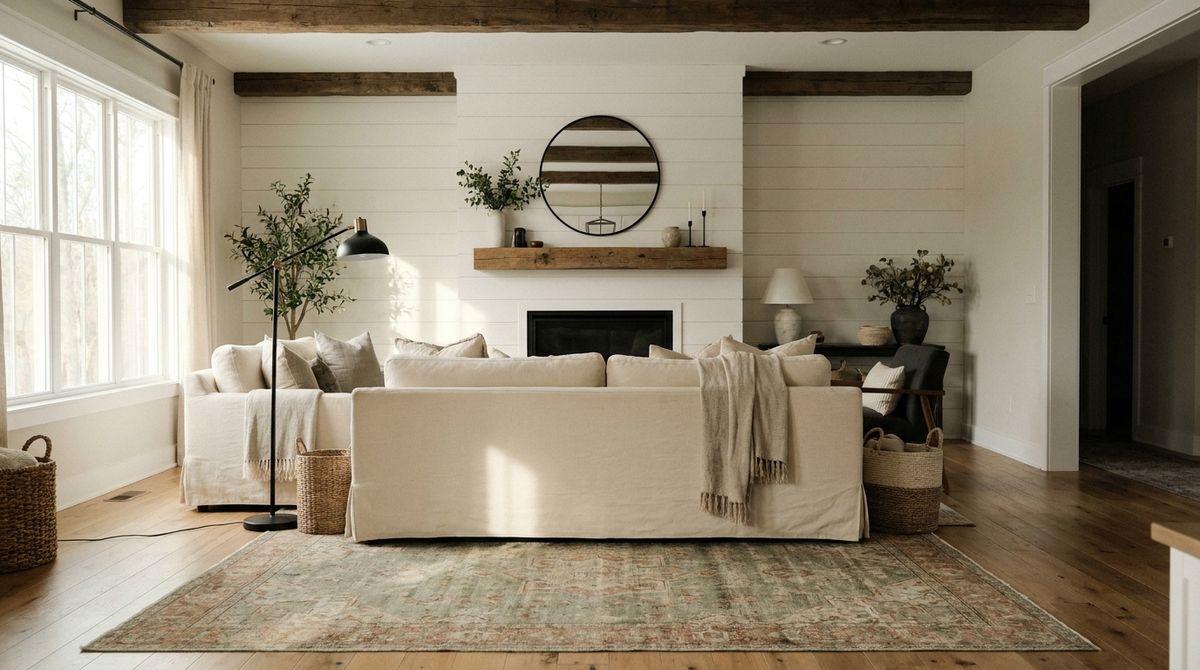
Modern farmhouse changes emphasis in every room: the kitchen leans on structural materials, the bedroom softens into layered textiles, and the living room balances both. The farmhouse bedroom is the highest-volume search in this category, reaching 3,600 searches per month at a $0.92 CPC (SEMrush Keyword Data, 2025). That volume tells us something true about how people decorate: they think room-by-room, not whole-home. And correctly so. The kitchen prioritizes function-forward materials and structural elements. The bedroom softens significantly into layered textiles. The living room is the most balanced, requiring both structural anchors and cozy layering. This guide breaks down what matters most in each space, with rental alternatives for every major element.
Key Takeaways
- Kitchen priority: Structural elements (shaker cabinets, farmhouse sink, black hardware) — high impact but high cost; rental alternatives exist for all three
- Bedroom priority: Textile layering — most accessible and affordable room to do farmhouse correctly
- Living room priority: The sofa-rug-curtain trifecta anchors everything before accessories are added
- Consistency rule: Use one wood tone and one metal finish (matte black) across ALL rooms — this single habit creates whole-home cohesion
- Best starting room if budget-limited: Bedroom. Cotton duvet cover + two pillow shams + one throw achieves the look for $80-$150
1. Why Each Room Needs Different Farmhouse Emphasis
Modern farmhouse is not a kit you drop into every room identically. Each space has a primary function, and the farmhouse interpretation should serve that function first.
The kitchen prioritizes materiality: shaker cabinet doors, a farmhouse apron sink, open wood shelving, black iron hardware, and butcher block surfaces. After styling over 30 farmhouse kitchens across different budgets, these structural elements cost more and are harder to replicate in rentals, but they also deliver the most transformation.
The bedroom softens. Hard materials largely disappear, replaced by cotton and linen bedding, a simple wood or upholstered headboard, and quiet natural-fiber accents. This makes the bedroom the easiest room to farmhouse-ify on a budget.
The living room requires balance — enough textile softness to feel cozy, enough structural anchors (rug, curtains, a clean-lined sofa) to feel intentional rather than just piled-up.
What most guides miss: Modern farmhouse is roughly a 70/30 split, about 70% clean modern lines and 30% rustic country warmth. Push past 40% rustic (distressed signs, roosters, burlap, barnwood on every surface) and the room tips into country cottage, not modern farmhouse. The modern half is what keeps it current: straight cabinet fronts, plain linen, matte black, and breathing room on the walls.
Free · 60 seconds
Not sure which style is actually yours?
Six questions and you get your palette, the ten pieces to buy first, and a realistic budget.
2. Modern Farmhouse Kitchen
The kitchen is the highest-profile farmhouse room. It’s where the style’s most iconic elements appear, and it’s also where the gap between “renter reality” and “farmhouse inspiration” is widest.
The Priority Elements
Shaker-style cabinets are the foundational kitchen element. Flat-panel shaker doors in white or off-white set the entire kitchen’s character. For homeowners: cabinet door replacement runs $80-$180 per door installed at a cabinet shop. For renters: you can’t swap cabinet doors, but painting existing flat-panel doors (if your landlord approves) or adding shaker-style door inserts ($8-$15/door on Amazon, peel-and-stick) creates the visual effect.
The farmhouse (apron-front) sink is the most recognizable element. Installed cost runs $400-$900 for a basic fireclay or stainless apron-front sink plus plumbing modifications. Renters can’t access this. The rental workaround: a wooden dish drying rack ($22-$35) positioned next to the sink, a black iron faucet upgrade if landlord allows ($85-$150 for basic black gooseneck faucets), and a linen dish towel hanging from the oven handle ($8-$15). These three moves reference the farmhouse sink aesthetic without touching the plumbing.
Open wood shelving above the counter or beside the refrigerator delivers significant visual change in a kitchen. For renters, freestanding open shelving units ($55-$90, black metal frame with wood shelves) work without wall contact. Style them with white ceramics, a few cookbooks, one small plant, and clear glass storage jars.
Black iron hardware is the most renter-accessible element in the farmhouse kitchen. Pull the existing cabinet pulls and replace with matte black bar pulls or cup pulls ($1.50-$3.50/pull, Amazon). Ten to fifteen pulls swap in about 30 minutes with a screwdriver and cost $20-$50 total. This is the single highest-return action per dollar in the entire kitchen.
Butcher block as a counter material — either full countertop installation (expensive, permanent) or a portable butcher block cart ($85-$150 from IKEA, the RÅSKOG or FÖRHÖJA) brings the warm wood counter element into even a rental kitchen with no modifications.
The hardware swap is consistently the most dramatic kitchen transformation we’ve seen on a small budget. One reader swapped 14 cabinet pulls from cheap nickel to matte black bar pulls for $42 total. The before-and-after was striking — the kitchen read as a completely different caliber without a single structural change.
3. Modern Farmhouse Bedroom
The farmhouse bedroom is the gentlest version of the style. Hard materials soften, structural elements recede, and textiles do most of the work. This makes it the most approachable room for first-timers and the most budget-accessible.
Bedding: The Foundation of the Farmhouse Bedroom
The duvet cover or quilt is the bedroom’s equivalent of the wall color — it sets the entire room’s tone. For farmhouse, the target is a linen or cotton duvet in warm white, oatmeal, or soft natural stripe. IKEA DYTÅG linen duvet cover ($89.99 King) is the most commonly recommended farmhouse bedding at mid-range price. The texture is visible enough to read on screen and in person, and the neutral tone works in any color scheme.
Layer over the duvet: two matching pillow shams in the same fabric ($20-$35/pair), one or two euro shams in a complementary texture ($25-$45/pair), and one woven cotton blanket folded at the foot of the bed ($35-$55). This four-piece layering creates the “hotel farmhouse” look without requiring a full bed set.
Headboard Styles That Work
Three headboard shapes read consistently farmhouse: the simple wood plank headboard (DIY-able for $30-$65 using pine boards from a lumber yard), the upholstered channel-stitch headboard in cream or oatmeal fabric ($85-$180 at Amazon or Wayfair), and a shiplap-style built headboard (DIY or purchased as a wall-mounted wood panel, $60-$120).
The shape to avoid: ornately carved wood or heavily padded tufted headboards. Both read too formal or too contemporary for the farmhouse aesthetic.
What most guides miss: You don’t have to install real shiplap to get the plank look in a rental. Peel-and-stick shiplap panels ($30-$45 per 4-foot section) and paintable shiplap wallpaper ($35-$60 per roll) both peel off cleanly with a hair dryer at move-out. One 4-foot panel behind the headboard reads as farmhouse without touching the drywall permanently, and it packs flat when you go.
Nightstand and Window Treatment
Two matching nightstands in light wood or natural finish ($35-$75 each, IKEA, Target, or Amazon) with either a simple matte black table lamp ($35-$55 each) or wall-mounted black iron sconces ($25-$45 each). A matching pair reads as more intentional in a farmhouse bedroom. Keep the nightstand surface minimal: one lamp, one small plant or dried sprig, and a book.
Window treatments in the bedroom: linen panels in warm white or natural, hung from a matte black rod at ceiling height. Length to floor. In a bedroom, slightly puddling the fabric by 1-2 inches reads softer and more luxurious than precise floor-length.
4. Modern Farmhouse Living Room
The living room requires the most deliberate structure of the three spaces. It has more surface area, more furniture pieces to coordinate, and more ways to go wrong. The anchor sequence is non-negotiable: sofa, rug, curtains first — then everything else.
The Sofa Anchor
The sofa is the largest piece and the room’s visual center. For farmhouse, the target is: clean-lined (no rolled arms, no tufting, no skirts), upholstered in linen, cotton, or linen-blend, in cream, warm white, oatmeal, or light warm gray. IKEA UPPLAND in Hallarp beige ($499-$699 depending on configuration), Target’s Threshold linen sofas ($399-$599), or Amazon basics linen sofas in natural tones all work.
The Rug Foundation
A natural fiber rug — jute, sisal, or cotton in a natural, cream, or very subtle pattern — anchors the seating arrangement. Rule: the rug should extend at least 18 inches beyond the sofa on each side, meaning an 8×10 rug for most standard living rooms. Ruggable, World Market, and Target’s Threshold line all offer farmhouse-appropriate rugs at $85-$180 for an 8×10.
Wood Pieces and the Iron Layer
The living room needs one or two wood pieces (coffee table, side table, or open shelf unit) in the chosen wood tone. Then one to two black iron elements (curtain rod, lamp base, open shelving brackets). Beyond these, keep the iron count disciplined — three or more visible iron pieces can tip into industrial territory rather than farmhouse.
Completing the Room
Throw pillows (four covers, neutral palette), one throw draped on the sofa, and one natural fiber accent (tray or basket). Then one plant. Then stop before adding more. The full 30-idea breakdown for farmhouse living rooms lives at 30 modern farmhouse living room ideas.
5. The Bathroom Bonus
The bathroom is often overlooked in farmhouse guides because it has the fewest square feet and typically the least flexibility for renters. But a few moves deliver significant effect in even a basic rental bathroom.
Highest-impact rental bathroom moves:
- Replace the toilet paper holder and towel bar with matte black versions ($12-$22 each, Amazon, using adhesive mounting if needed)
- Add a linen hand towel in warm white or natural ($8-$15, H&M Home or Target)
- Place one small wood tray on the vanity counter for soap and a candle ($12-$20, World Market)
- Swap the shower curtain for a white waffle-weave or linen-look curtain ($20-$45, Amazon or IKEA) with matte black rings ($8-$12)
Total investment: $60-$110 for a bathroom that reads intentionally farmhouse rather than rental-default. These are all reversible — every item either freestanding or adhesive-mounted.
The shower curtain swap is the single highest-visibility change in a small bathroom. Most rental shower curtains are clear vinyl or a generic white plastic liner. A white waffle-weave curtain with matte black rings transforms the bathroom’s entire feeling for under $55 — and it moves with you when you leave.
6. Cross-Room Consistency Rules
Whole-home farmhouse coherence depends on two consistency rules. Break either and the house starts to feel like a collection of separate themed rooms rather than one unified style.
Rule 1: One wood tone throughout. Every wood surface in every room — coffee table, bed frame, nightstands, shelving, cutting board on the kitchen counter — should be within the same tone family. Medium-warm oak or natural pine throughout. Not light oak in the bedroom, dark walnut in the living room, and bleached ash in the kitchen. Pick your tone before you buy any furniture and check new purchases against it.
Rule 2: One metal finish throughout. Matte black, exclusively. Cabinet hardware, curtain rods, lamp bases, towel bars, toilet paper holders, shower curtain rings — all matte black. This rule is even stricter than the wood tone rule because metal finishes read as either cohesive or chaotic at a glance. A single brushed gold piece in a matte black house reads as an accident, not an accent.
What most guides miss: The wood tone that carries modern farmhouse best is a medium-warm, low-sheen finish, think natural white oak or honey pine, not the orange-red of old builder oak or the near-black of espresso. Undertone matters more than the wood species. If two pieces share a warm, slightly golden undertone, oak and pine can sit in the same room and still read as one tone.
| Room | Primary Neutral | Wood Tone Role | Metal Element |
|---|---|---|---|
| Kitchen | White shaker/cabinets, white walls | Shelving, butcher block, tray | Cabinet pulls, faucet, pendant |
| Bedroom | Linen duvet, warm white walls | Headboard, nightstands | Lamp base, sconces, rod |
| Living Room | Cream sofa, jute rug | Coffee table, side table, shelves | Curtain rod, lamp, brackets |
| Bathroom | White waffle curtain, white towels | Tray, wood soap dish | Towel bar, hardware, rings |
Frequently Asked Questions
Q: What’s the easiest farmhouse room to start with on a budget?
A: The bedroom. A linen or cotton duvet cover ($45-$90), two pillow shams ($20-$35/pair), and a waffle-weave throw ($28-$40) achieve a credible farmhouse bedroom for $95-$165. No furniture changes, no hardware, no curtain rod required to start. It’s the most affordable entry point in the house.
Q: Can I do farmhouse in a rental kitchen with no modifications allowed?
A: Yes, with three moves: replace cabinet pulls with matte black bar pulls (reversible — keep the originals in a bag), add a freestanding open shelving unit ($55-$90) styled with white ceramics and wood accents, and place a portable butcher block cart ($85-$150) as a kitchen island or extra counter space. These three changes require zero permanent modifications.
Q: How many wood tones is too many?
A: More than two is too many in a single room; more than three is too many in a whole house. The most common violation is having light wood floors, medium walnut furniture, and a dark espresso bookcase in the same room. Choose your dominant tone, allow one secondary tone at most, and keep them close enough in warmth that they read as related rather than conflicting.
Q: What’s the biggest mistake in farmhouse bedroom styling?
A: Over-pillowing the bed. More than six pillows on a queen or king bed — including decorative throws — crosses from “layered farmhouse” into “hotel gift shop.” The correct count: two sleeping pillows in shams, two to four decorative pillows, and one lumbar. Five to six total. Anything beyond that comes off the bed and into storage.
Q: What’s the hardest farmhouse room to pull off in a rental?
A: The kitchen. After reviewing dozens of reader-submitted rental kitchens, the kitchen is consistently where the farmhouse look is hardest to achieve because its most defining elements — farmhouse sink, shaker cabinets, open wood shelving on the wall — are structural and permanent. The workarounds (hardware swaps, freestanding shelving, butcher block carts) help significantly, but they can’t fully replicate a renovated farmhouse kitchen.
Q: Should I apply the same farmhouse rules to a home office?
A: Yes, with one adjustment. The most effective approach mirrors the living room rules: neutral base (warm white walls or a cream-toned desk), one wood tone (desk surface, floating shelves), one black iron element (lamp, curtain rod), and minimal accessories. The difference is that function takes priority over decoration — your monitor and equipment come first, decor layers around them.
Q: Do you have to use shiplap to get a modern farmhouse look?
A: No. Shiplap is optional, not required. Modern farmhouse reads through materials and restraint: matte black hardware, one warm wood tone, and linen textiles carry the style on their own. If you want the plank texture in a rental, peel-and-stick shiplap ($30-$45 per 4-foot panel) or paintable shiplap wallpaper removes cleanly at move-out.
Q: What’s the difference between modern farmhouse and country farmhouse?
A: The balance of modern to rustic. Modern farmhouse runs roughly 70% clean contemporary lines and 30% rustic warmth: straight shaker fronts, matte black, uncluttered walls. Country farmhouse flips heavier into distressed wood, floral prints, and decorative signage. If a room feels busy or themed, it has drifted from modern toward country.
Conclusion
Each room has its entry point, and knowing which elements matter most prevents you from spending money in the wrong order. Kitchen: the hardware swap first, then open shelving, then structural changes if budget allows. Bedroom: bedding first — it delivers the entire look for under $150. Living room: rug and curtains before any accessory purchases. Keep one wood tone and one metal finish consistent across all three rooms, and the house begins to read as a coherent whole rather than individual farmhouse attempts. For the full style system connecting all these spaces, the hub lives at the ultimate modern farmhouse decor guide. For 30 living room-specific ideas, our modern farmhouse living room ideas post has the visual breakdown.
Related reads: