
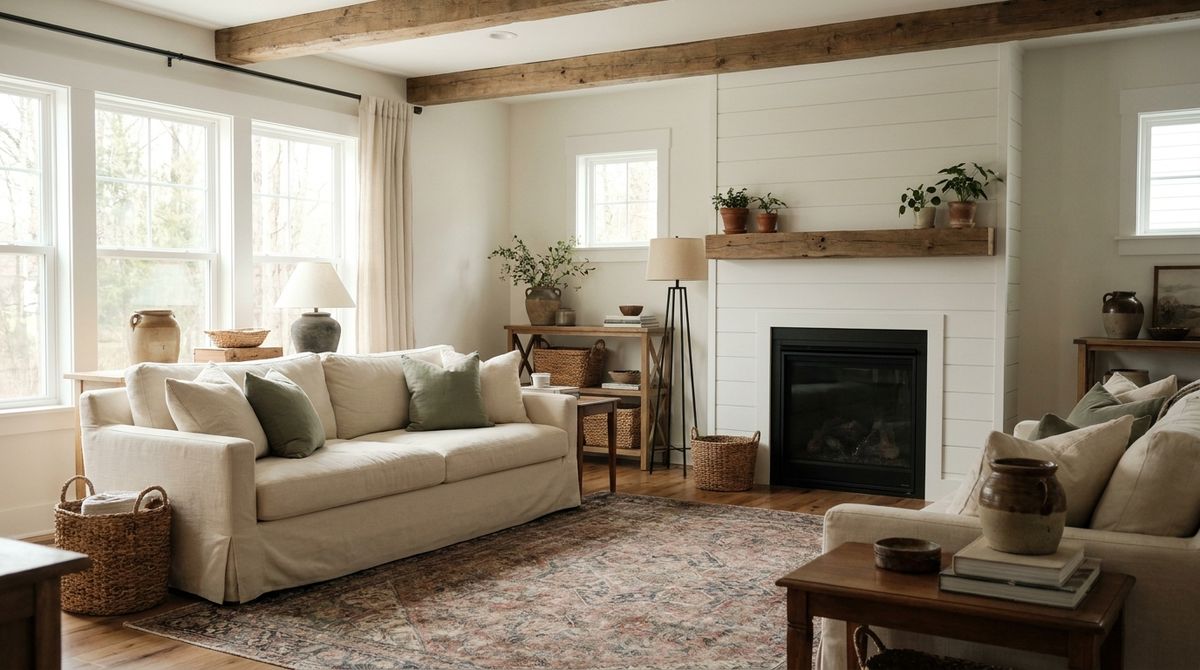
First-time decorators struggle with modern farmhouse not because the style is complicated, but because they start in the wrong place. The sequence matters here. This guide gives you six steps in the correct order, with specific products, price ranges, and the one phase most decorators skip that makes the difference between “cluttered farmhouse” and “the real thing.”
Key Takeaways
- Start with the neutral base, not the accessories — most first-timers buy accessories first and wonder why the room doesn’t cohere
- Limit to two wood tones maximum across the entire room — more than two creates visual chaos
- One black iron anchor (a light fixture, a curtain rod, or a hardware swap) changes the room’s character immediately
- The edit-down phase (Step 6) is what separates good rooms from great ones — removing things is harder than adding them
- Buy in this order: rug first, curtains second, pillows third, accessories last
1. Why First-Timers Get This Wrong
The most common mistake we see from readers attempting modern farmhouse for the first time — and after reviewing hundreds of reader room photos, it’s consistent — is buying individual “farmhouse” items without establishing the neutral base first. According to designer Emily Henderson, most decorating failures happen when people buy “vibes” instead of building a system — statement pieces that don’t connect to a cohesive foundation (Emily Henderson Design Blog, 2024).
What this looks like in practice: a sign that says “Home” in barn wood script, a galvanized metal bucket, a wicker basket, three mismatched throw pillows, and a shelf of collected mason jars — all “farmhouse” items, but without the neutral base and proportion structure that makes them cohere.
Here’s what actually works: you establish the foundation first (neutral walls or textiles, the right rug, the right curtains), then you add contrast (black iron), then you add texture (natural materials), and finally you edit down to only what earns its place.
Skip that sequence and you end up with the Pinterest version of farmhouse — lots of individual correct pieces that somehow add up to visual noise.
What most guides miss: Modern farmhouse is a ratio, not a theme. Aim for roughly 70% clean modern lines (a simple sofa, flat-front cabinets, unfussy frames) to 30% rustic warmth (one reclaimed-wood piece, a woven basket, a bit of black iron). Tip past 50% rustic and the room stops reading modern and slides into country cottage, the exact cliche that makes farmhouse feel dated.
Free · 60 seconds
Not sure which style is actually yours?
Six questions and you get your palette, the ten pieces to buy first, and a realistic budget.
2. Step 1: Lock Your Neutral Base
Before buying a single accessory, establish the dominant neutral tone in the room. This is the decision that everything else will be evaluated against. Choosing the wall color first means every later purchase has something to match.
If You Can Paint
Choose Sherwin-Williams Alabaster (SW 7008) for a warm, creamy result, or Benjamin Moore White Dove (OC-17) if your room has limited natural light and you want a slightly brighter neutral. Paint walls, trim, and ceiling in the same color or near-identical tones. The monochromatic white approach — walls, trim, and ceiling reading as one warm envelope — is a defining farmhouse move. Budget: $35-$55/gallon, two coats typically required, one room needs 1-2 gallons.
If You Can’t Paint (Renter Approach)
Lock the neutral base through your largest textile instead. A cream or warm-ivory slipcover over your existing sofa ($35-$65 on Amazon for basic slipcovers, $120-$250 for fitted versions) or a large warm-neutral sofa purchase ($349-$599 for basic linen-blend sofas at IKEA or Amazon) establishes the same dominant tone. Pair immediately with a jute or natural cotton rug in a similar value range — this two-piece textile base functions as your “painted room” without a single drop of paint.
What most guides miss: You can fake shiplap in a rental without losing your deposit. Peel-and-stick shiplap panels ($2.50-$4 per sq ft) and paintable removable wallpaper go up with a level and a utility knife, then peel off clean at move-out. One accent wall (roughly 40 sq ft) runs $100-$160 in materials, far less than the $700-$1,200 a contractor quotes for real nickel-gap boards.
3. Step 2: Choose Your Wood Tone
Wood is the warmth element in modern farmhouse. Every exposed wood surface — coffee table, floating shelves, side table, picture frames, cutting board on the counter — contributes to the wood tone story. The rule: choose one primary wood tone and limit yourself to a maximum of two tones total.
The safest primary tone: Light to medium oak, natural pine, or honey-toned wood — this range is forgiving and hard to get wrong. These sit in a warm mid-range that pairs with Alabaster walls without the contrast becoming stark. They’re also the most widely available wood tone at mid-range retailers — IKEA’s natural pine and light oak finishes, Target’s Threshold wood pieces, and Amazon’s acacia furniture all live in this range.
The secondary tone (if any): Can go slightly darker — a medium walnut or warm brown — but only in one piece. A dark walnut coffee table with light oak shelves reads intentional if the contrast is deliberate. Three different wood tones (light, medium, and dark) in the same room reads accidental.
Avoid: Very dark espresso, cool-gray whitewash, and bleached ash. All three fight the warm undertone of the farmhouse palette. Espresso in particular creates a contrast so severe it visually fractures the room.
Specific affordable picks: IKEA LACK side tables in birch ($14.99), Target Threshold Windham floating shelf in natural ($19.99), Amazon live-edge acacia coffee table with black iron legs ($85-$140).
4. Step 3: Add One Black Iron Anchor
This is the step that makes everything click. One black iron element — a single piece in the right place — establishes the contrast anchor that makes all the warm neutrals read as intentional rather than beige.
The highest-impact single item depends on the room. In a living room: a matte black curtain rod ($18-$28, Amazon), installed at ceiling height with linen panels ($35-$55/pair, IKEA or H&M Home). In a kitchen: cabinet pull swap to matte black bar pulls ($25-$45 for a full set of 10-15, Amazon). In a bedroom: matte black lamp base or a black iron wall-mounted sconce ($35-$65 each).
The rule: once you pick matte black as your metal finish, every metal in the room follows. Curtain rods, lamp bases, hardware, picture frames, candle holders — all matte black. No mixing bronze, gold, or brushed nickel with matte black in a farmhouse room. The consistency of that one finish is what makes it look deliberate.
5. Step 4: Layer Cotton and Linen Textiles
Textiles are the step that makes a farmhouse room feel warm rather than just looking neutral. The correct farmhouse textile palette: cotton, linen, jute, and wool in cream, oatmeal, warm white, soft gray, and the occasional muted stripe or subtle plaid. Natural fibers only — synthetic-looking fabrics (microfiber, polyester velvet) undermine the organic warmth the style depends on.
Curtain panels: Linen or linen-look in natural or warm white. Hang from ceiling to floor. IKEA HANNALILL ($39.99/pair) or H&M Home linen panels ($35-$55/pair) are the standard mid-budget picks. The length matters — 84-inch panels on 8-foot ceilings look truncated. Go 96+ inches and mount the rod high.
Throw pillows: Four covers in the same neutral family. Two solid cream in a textured cotton weave (IKEA GURLI, $7.99 each), one in warm gray or natural linen, one in a subtle ticking stripe or muted check. Total covers: $40-$65 across these sources.
Throw blanket: One waffle-weave cotton throw ($28-$40, Target or H&M Home) draped over one sofa arm. Not folded symmetrically — draped casually with one corner falling lower. This single styling choice makes a sofa look inhabited rather than staged.
What to skip: Heavy velvet, faux fur, chenille, bold geometric patterns, and anything that reads “contemporary hotel.” These fabrics undercut the organic farmhouse quality.
6. Step 5: Add Organic and Natural Elements
One large plant plus one natural fiber object is the formula. Not five plants scattered everywhere — one. Not a collection of baskets in every corner — one basket used deliberately.
The single large plant: A fiddle-leaf fig, bird of paradise, or oversized monstera in a natural woven basket ($35-$75 total — plant from a local nursery at $25-$45, basket from Target or Amazon at $18-$30). Position it in a corner with natural light, not in front of a window as a silhouette. The plant serves as a vertical element and a natural color break from the neutral palette.
The one natural fiber object: A seagrass tray on the coffee table ($15-$25, World Market or Amazon), a rattan basket on a shelf ($12-$22), or a jute-wrapped vase ($10-$18). One natural texture used intentionally signals “hand-selected” rather than “bought a farmhouse kit.” Resist adding more than two natural fiber objects to one room — beyond that, it starts to compete with the clean farmhouse structure.
Dried botanicals: An alternative to live plants that requires no maintenance. Dried pampas grass in a simple white ceramic vase ($15-$28 for the bundle, Amazon), placed on a shelf or as a floor arrangement. The feathery pale tones stay within the neutral palette and add softness.
7. Step 6: Edit Down
This is the hardest step and the most important. Every first-timer adds too much — it’s a natural instinct to fill a room until it feels complete. But modern farmhouse reads right when there’s deliberate negative space. Negative space is not “empty” — it’s the pause that makes each element readable.
We’ve walked through the editing process with dozens of readers’ room photos. The consistent finding: removing 30-40% of the displayed objects improved the room’s readability every single time. Surfaces that felt “empty” to the homeowner read as “calm and considered” in photographs and in person.
The editing protocol:
-
Stand in the doorway and photograph the room.
-
Look at the photo — objects that blend together are competing, not contributing.
-
Remove every object from a surface.
-
Replace only what you can justify: “this earns its place because of its shape, color, or texture.”
-
Leave 40-50% of each shelf surface empty.
-
Walk away. Come back in 30 minutes. If it feels sparse, add back one item at a time. Stop before it feels full.
8. What to Buy First vs What to Wait On
The order of operations prevents the most common mistake — buying statement accessories before the foundation is in place.
| Priority | Item | Budget Range | Why First |
|---|---|---|---|
| 1 | Area rug (8×10 or 5×8) | $85-$180 | Anchors the room, defines the space |
| 2 | Curtain panels + rod | $55-$85 | Second largest visual surface |
| 3 | Throw pillow covers (4) | $40-$70 | Changes sofa character immediately |
| 4 | Matte black curtain rod | Already in item 2 | — |
| 5 | One matte black light/lamp | $35-$75 | Establishes the iron anchor |
| 6 | Throw blanket | $28-$40 | Adds warmth and texture |
| 7 | Natural fiber accent (basket/tray) | $15-$30 | Organic warmth layer |
| 8 | Open shelving with brackets | $30-$60 | Adds architectural character |
| 9 | White ceramics for shelf | $15-$35 | Styling after structure |
| 10 | Dried botanicals or plant | $25-$50 | Final organic layer |
What to wait on: Wall art, decorative trays beyond one, additional vases, seasonal accents, and any “farmhouse sign” items. These are additions you make after the structure is solid — not before.
Frequently Asked Questions
Q: How long does it take to complete a modern farmhouse room update?
A: A single room refresh following these six steps takes most people one weekend of shopping and one weekend of styling — roughly 2-3 weeks total including delivery times for online orders. The editing phase (Step 6) often requires another week because you have to live with the room before you know what to remove.
Q: What’s the minimum budget to make a room look intentionally modern farmhouse?
A: Around $150-$200 covers the highest-impact moves: curtain rod swap ($20-$28), one pair of linen curtain panels ($35-$55), four pillow covers ($40-$65), and one waffle-weave throw ($28-$35). This approach changes the room’s detail layer without touching the furniture.
Q: Do I need shiplap for modern farmhouse?
A: No. Shiplap is the most iconic element but not the foundation. The foundation is the neutral palette and the black iron accent. Shiplap is a texture layer — nice to have, but entirely optional. If you want the effect without the commitment, peel-and-stick alternatives start at $2.50/sq ft.
Q: Can I use Amazon basics for modern farmhouse decor?
A: Yes. The most useful Amazon categories for farmhouse: matte black curtain rods, bar-pull cabinet hardware in black, linen-look curtain panels, waffle-weave throws, and natural seagrass baskets. Amazon pricing for farmhouse-appropriate pieces typically runs 20-40% below comparable Target or World Market options for basic shapes.
Q: What’s the first thing a beginner decorator should buy for a farmhouse room?
A: The rug, every time. It sets the room’s scale and color direction before you buy accessories or wall treatments. A jute or cotton rug in natural or cream gives you the room’s anchor — everything else scales off it.
Q: How do I know when I’ve added too much to a farmhouse room?
A: A reliable rule: if you can’t identify three clear negative spaces (empty shelf sections, bare wall segments, open floor area) when you stand in the doorway, you’ve added too much. Rooms that feel “almost right but off” almost always improve by removing rather than adding.
Q: What’s the difference between modern farmhouse and traditional farmhouse?
A: Modern farmhouse keeps the warmth of traditional farmhouse but strips the fuss. Traditional leans country: floral prints, ornate wood, and lots of collected knick-knacks. Modern farmhouse runs cleaner, roughly 70% simple modern lines to 30% rustic texture, with a tighter neutral palette and matte black in place of oil-rubbed bronze.
Q: Is modern farmhouse still in style in 2026?
A: Yes, though it has evolved. Pinterest and designer trend reports show the look shifting toward warmer, earthier neutrals and less gray, sometimes labeled “organic modern” or “transitional farmhouse.” The core formula, neutral base plus one black iron anchor plus natural texture, still reads current when you skip the dated gray-and-white version.
Conclusion
Six steps, a clear sequence, and one underrated final stage that most decorators skip. The modern farmhouse look is not complicated — it’s structured. Neutral base first. Wood tone second. Black iron anchor third. Textiles fourth. Natural elements fifth. Edit down sixth. Follow that sequence and you end up with a room that looks considered rather than collected. For the complete color and palette reference that supports Step 1, visit our modern farmhouse color palette guide. For the full style overview and budget roadmap, the ultimate modern farmhouse decor guide is your hub.
Related reads: