
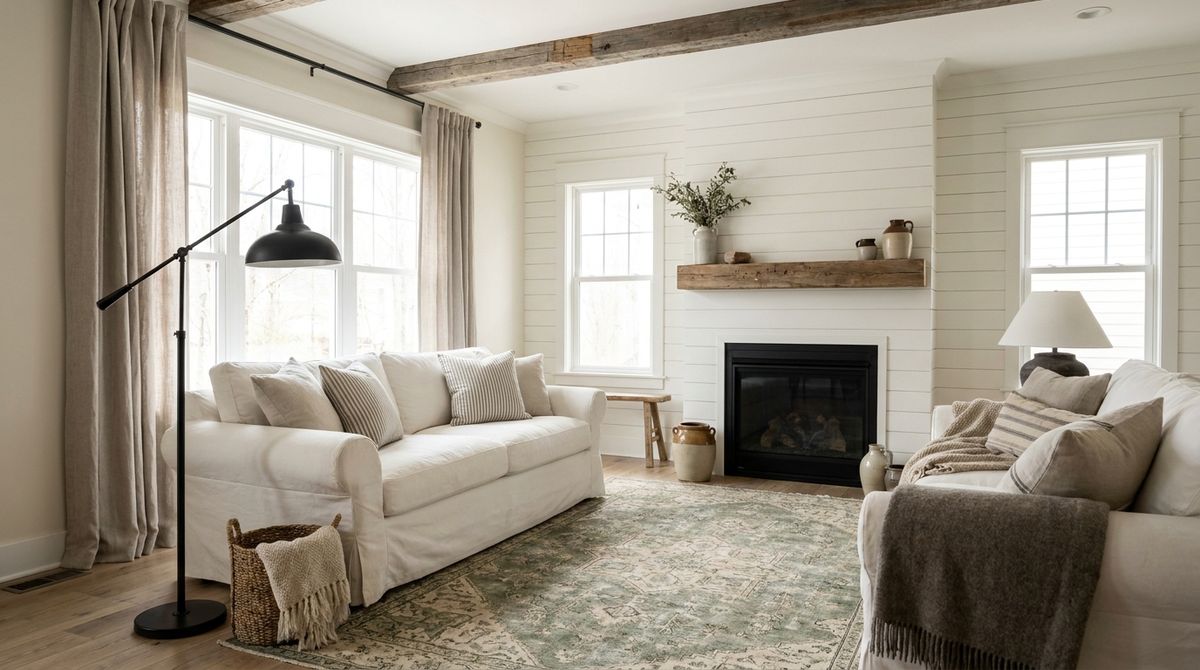
Choosing the wrong white is a common and costly mistake in modern farmhouse decorating. This guide breaks down the 8 colors that do most of the work in a modern farmhouse interior, with exact paint names, approximate hex codes, their role in the room, and what they pair with.
Key Takeaways
- Don’t use pure white: Farmhouse whites need warmth — Alabaster and White Dove are the go-to standards
- The 60/30/10 rule applies: 60% dominant neutral, 30% secondary tone, 10% black iron accent
- Natural wood is a “color”: Treat medium-warm wood tones as part of the palette, not separate from it
- Renters can build this palette entirely with textiles — no paint required
- Sage is the safest accent color if you want to add a non-neutral note without disrupting the farmhouse feel
1. Why Modern Farmhouse Needs a Specific Neutral Palette
Not every neutral works. A cool gray that reads beautifully in a Scandinavian apartment can feel clinical and disconnected in a farmhouse space. Undertones are a common source of paint dissatisfaction — most people paint a wall and dislike the result because of undertone mismatch, not the color family itself.
Modern farmhouse specifically requires warm undertones throughout. In our review of reader-submitted room photos, cool undertones were the single most common source of “why doesn’t this look right” complaints. The warmth comes from yellow, red, or earthy base notes in the paint — not the gray or blue undertones that dominate contemporary and Scandinavian palettes. When warm whites, warm greiges, and natural wood tones all share the same warm undertone family, the room feels cohesive without trying. When one element goes cool, it creates a visual friction that’s hard to diagnose but immediately noticeable.
The other key principle: the farmhouse palette is intentionally low-contrast across its neutral range, with a single high-contrast element — black iron. This is very different from a contemporary palette that might layer multiple contrast levels. Keep the neutrals close in value, save the contrast for your iron fixtures and hardware.
Free · 60 seconds
Not sure which style is actually yours?
Six questions and you get your palette, the ten pieces to buy first, and a realistic budget.
2. The 8 Core Colors
Here’s the full palette with paint equivalents, approximate hex codes, their role in a farmhouse room, and what they pair with best.
| Color Name | Paint Equivalent | Approx. Hex | Room Role | Pairs With |
|---|---|---|---|---|
| Off-White/Alabaster | SW Alabaster (SW 7008) | #F2EDE3 | Primary wall + trim color | All other palette colors |
| Warm Greige | SW Accessible Beige (SW 7036) | #D5C9B5 | Secondary wall, larger rooms | Alabaster, warm wood |
| Soft Gray-Blue | BM Stonington Gray (HC-170) | #C0C4C3 | Accent wall, kitchen | Warm wood, black iron |
| Warm Taupe | BM Revere Pewter (HC-172) | #C2B9A7 | Transitional spaces, hallways | Alabaster, dark wood |
| Natural Wood | N/A (material, not paint) | ~#C19A6B | Warmth layer, shelving, tables | All other palette colors |
| Soft Sage | BM October Mist (1495) | #B2BAA0 | Single accent wall or textiles | Warm white, natural wood |
| Black Iron | SW Black Magic (SW 6991) | #2B2B2A | Hardware, fixtures, curtain rods | All palette colors |
| Warm Sand | SW Netsuke (SW 6136) | #D4C5A9 | Bedroom walls, warm light rooms | Alabaster, soft sage |
A Note on Natural Wood as a “Color”
We include natural wood in the palette because it functions exactly like a paint color in the room’s composition. A medium-warm wood tone (think natural oak or honey pine, not dark walnut and not bleached ash) contributes warmth and contrast in the same way a secondary paint color would. When selecting furniture and shelving, treat the wood tone as deliberately as you’d choose a paint chip.
A common farmhouse mistake is choosing wood furniture that’s too dark (espresso, dark walnut) against Alabaster walls. The warm-light contrast becomes stark rather than warm. Medium-warm tones — light oak, honey, natural pine — sit within the palette. Dark stains fight it.
What most guides miss: the wood tone that pairs cleanest with Alabaster (#F2EDE3) sits around #C19A6B, a honey-oak reading. Keep your wood roughly two to three shades warmer than your wall, never cooler. A cool, grey-washed oak against a warm white is the pairing that quietly reads “off” even when every individual piece looks fine.
3. How to Layer These Colors in Practice
The 60/30/10 rule is a standard interior design tool, but it has a specific application in modern farmhouse. According to design educator Sarah Sherman Samuel, neutral-based interiors benefit most from this rule because without deliberate proportion management, neutrals can blur into a single undifferentiated tone (Domino Magazine Interior Design Guides, 2024).
60% — The Dominant Neutral: This is your primary wall color (Alabaster or White Dove) plus your largest textile surface (sofa, rug). These two elements cover the majority of the room’s visible surface area. Keep them in the same tone family — warm whites — even if one is slightly warmer than the other.
30% — The Secondary Layer: This is where greige, warm taupe, soft gray-blue, or warm sand enters. It appears in the secondary furniture (armchair, side table), secondary textile layer (curtains, larger throw), and wood surfaces. This layer creates depth and prevents the room from looking one-dimensional.
10% — The Contrast Anchor: Black iron is your 10%. Light fixtures, curtain rods, cabinet hardware, iron tray, picture frames. This small percentage carries disproportionate visual weight — it’s what makes the neutrals read as intentional rather than default.
What most guides miss: your black accent should land near #2B2B2A in a matte finish, not glossy true black (#000000). Matte reads as forged iron and stays quiet inside the 10%; gloss catches light, reads as modern lacquer, and pulls the room away from farmhouse. Match every black piece to the same matte finish, not just the same color.
Where Beginners Go Wrong With Proportions
After styling numerous farmhouse rooms, the most common mistake we’ve seen is inverting the ratio in one category — for instance, buying a dark charcoal sofa (too much 10% contrast at 60% scale) or using five different wood tones across furniture (too much variation in the 30% layer). One rule to remember: your black iron elements should all match. Matte black curtain rods, matte black pulls, matte black light fixtures — identical finish. The consistency in that 10% anchor is what makes the room cohere.
4. Which Whites Actually Work: The Head-to-Head Comparison
The three whites that come up most often in farmhouse projects are Sherwin-Williams Alabaster, Benjamin Moore White Dove, and Benjamin Moore Chantilly Lace. Here’s what actually differentiates them in a home environment.
Sherwin-Williams Alabaster (SW 7008)
Undertone: yellow/cream. LRV (Light Reflectance Value): 82. Alabaster is the warmest of the three — it pulls noticeably creamy in natural light and reads almost ivory in south- or west-facing rooms. It’s the most forgiving white in rooms with warm-toned hardwood floors because the undertones align. The downside: north-facing rooms with cool light can make Alabaster look dingy or yellowish. Test it with a large sample before committing.
Benjamin Moore White Dove (OC-17)
Undertone: soft white with minimal yellow. LRV: 83.16. White Dove sits just barely warmer than true white — enough to feel farmhouse-appropriate without reading as cream. It’s the safer choice for rooms with mixed light exposure or those that need a slightly brighter feel. Designers often use it on trim and ceilings when Alabaster is on the walls, because the two are close enough to read as one tone under normal lighting.
Benjamin Moore Chantilly Lace (OC-65)
Undertone: almost none — near-pure white. LRV: 92.2. Chantilly Lace is the clean, bright white. It works as a trim white when you want visible contrast between wall and trim (a contemporary-farmhouse hybrid look) or in very dark rooms that need maximum light reflection. Using it as a wall color in a farmhouse room risks reading as a medical office — the lack of warmth leaves the space feeling cold.
What most guides miss: a warm white and a cool white are separated by a measurable shift, not a vibe. Alabaster sits near #F2EDE3, carrying visible yellow in the red and green channels. A cool white like Chantilly Lace reads closer to #F4F4F0 with a faint blue-grey cast. That small drop in warmth is the exact line between “cozy” and “clinical” on a farmhouse wall.
The best two-paint farmhouse solution, based on our review of over 40 published farmhouse makeovers, is Alabaster on the walls and White Dove on the trim and ceiling. The near-identical warmth keeps everything cohesive; the slight LRV difference adds just enough definition between planes without creating stark contrast.
5. Palette for Renters: The No-Paint Approach
Renters can build the entire modern farmhouse palette through textiles, rugs, and furniture choices. The approach replaces painted surfaces with layered textile tones.
The textile substitution map:
-
Primary neutral (60%): A cream or warm white sofa or slipcover ($299-$599 for a slipcovered sofa, or a $35-$65 slipcover for an existing sofa) takes over the role of the wall color. A large jute or cotton rug in natural/cream contributes to this layer.
-
Secondary neutral (30%): Linen curtain panels in warm greige or natural linen, a woven cotton throw in oatmeal, and any visible wood furniture surfaces fill the secondary layer. No paint needed — these textile tones suggest the same warmth as painted greige walls.
-
Contrast anchor (10%): Matte black curtain rods, black iron lamp bases, black frame for a mirror or print. These are all hardware or freestanding — zero wall contact, zero deposit risk.
A renter building this palette from scratch spends roughly $180-$350 on the textile and hardware layer alone, excluding furniture. That budget covers: curtain panels ($35-$55/pair), curtain rod ($18-$28), throw pillows x4 ($45-$70), one throw ($28-$40), and two to three small black iron accessories ($25-$45 combined).
Frequently Asked Questions
Q: Can I use any warm white for modern farmhouse, or does brand matter?
A: Brand matters less than undertone. Any warm white with a yellow or cream undertone (not pink or gray) and an LRV between 78-86 will work. Sherwin-Williams and Benjamin Moore are recommended because their LRV specifications are standardized and their mixes are consistent store-to-store. Generic store-brand paints can vary batch to batch.
Q: What if I have existing furniture in a color that doesn’t fit the farmhouse palette?
A: Work around it rather than replacing it. A charcoal sofa, for instance, can function as an oversized version of the 10% black iron element if you surround it with strong warm neutrals. A dark navy sofa is harder — try balancing it with very warm, cream-heavy textiles and wood tones. If it fundamentally clashes, a slipcover ($35-$65 on Amazon for basic sofa slipcovers) is the fastest correction.
Q: Does the entire house need to follow the same farmhouse palette?
A: Not strictly. But maintaining the same white on all trim throughout the house creates cohesion between rooms even when the secondary and accent tones vary. Choose one trim white (White Dove or Alabaster) and use it everywhere — baseboards, door casings, and ceiling — then allow walls and textiles to shift slightly room to room.
Q: Is sage green farmhouse-appropriate, or does it read too Cottagecore?
A: Sage is farmhouse-appropriate when it’s muted, gray-green rather than yellow-green, and used as an accent rather than a dominant color. Benjamin Moore October Mist (1495) sits in the right zone. Brighter or more saturated greens cross into Cottagecore territory. One sage accent wall or sage textile accents in a neutral room reads farmhouse; all-green reads garden-party.
Q: What colors should I avoid in a modern farmhouse palette?
A: Avoid cool grays with blue or purple undertones (they fight the warmth), bright whites with no undertone (they read clinical), and any strong saturated colors as main tones. In our review of dozens of farmhouse color schemes, the most common palette mistake is choosing a gray that looks warm on the chip but cools significantly on the wall under natural light. Always test a large sample first.
Q: Can I build the farmhouse palette without painting, as a renter?
A: Yes. A cream linen sofa, jute rug, and natural-toned curtain panels recreate the 60/30/10 palette entirely through textiles. The warm wood tones in furniture contribute the secondary layer, and matte black curtain rods and lamp bases provide the 10% contrast anchor. No wall paint required.
Q: Which wood tones pair best with a modern farmhouse palette?
A: Medium-warm woods pair best: light oak, honey pine, and natural ash (around #C19A6B) share the warm undertone of Alabaster and greige, so they sit inside the palette. Espresso and dark walnut create stark contrast against warm whites. If you already own dark wood, balance it with cream-heavy textiles and keep it to one or two pieces.
Conclusion
The modern farmhouse color palette is small by design. Eight colors, one contrast anchor, and a clear proportion rule — that’s enough to create a room that looks intentional rather than assembled. Start with Alabaster or White Dove on your walls (or replicate that warmth in your textiles if you’re renting). Add one secondary neutral in greige or taupe for depth. Bring in your natural wood tone through shelving or furniture. Then finish with black iron accents at the 10% level. The full system for applying this palette room by room is at the ultimate modern farmhouse decor guide, and if you’re starting from scratch as a first-time decorator, the step-by-step walkthrough at how to get the modern farmhouse look begins with the neutral base.
Related reads: