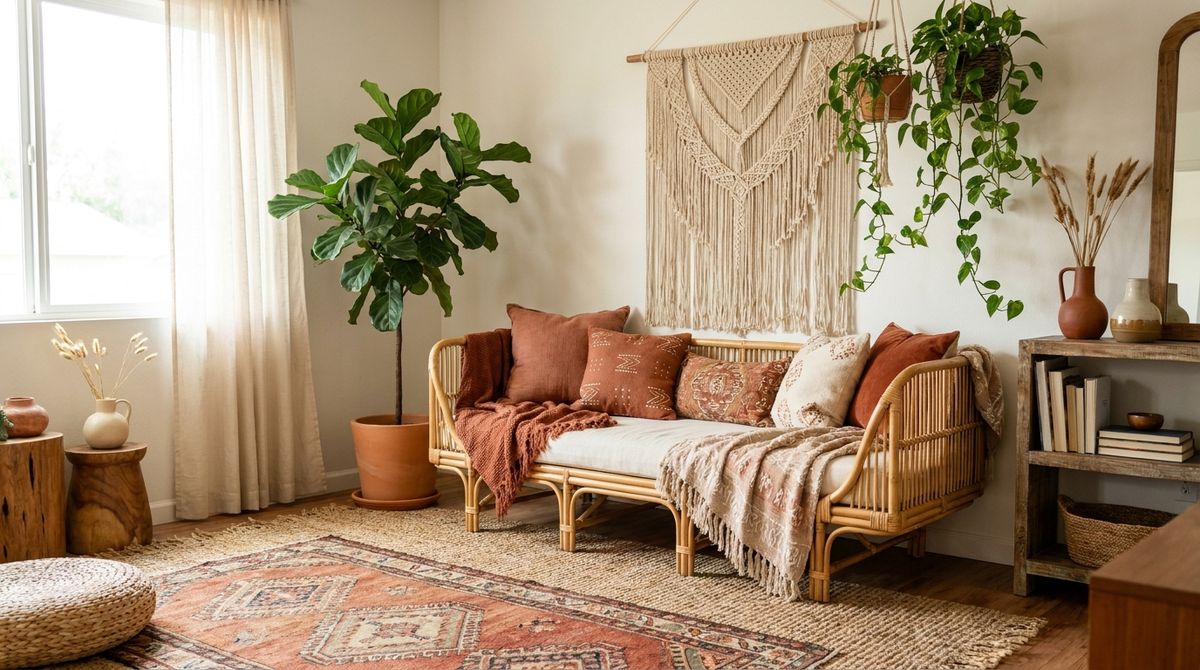
Boho splits into three distinct sub-styles that retailers wrongly sell under one label: Traditional Boho (maximalist, jewel-toned, globally sourced, roughly $800–$2,500 per living room), Bohemian Modern (edited warm neutrals with only 1–2 patterns, $600–$1,400), and Western Boho (terracotta, leather, and Southwest references). Scroll Pinterest for ten minutes under that tag and you’ll see all three treated as the same thing — a jewel-toned maximalist space packed with global textiles, a warm-neutral living room with two tasteful rattan pieces, and a terracotta-and-cowhide desert vibe that looks more Texas ranch than Marrakech souk. Interior designers treat them as distinct categories. That gap is exactly where decorating mistakes happen.
Here’s what actually works: treating Traditional Boho, Bohemian Modern, and Western Boho as separate design languages that share distant DNA but diverge sharply in execution. Traditional Boho leans 1970s Romani-Marrakech eclecticism — maximalist, pattern-dense, globally sourced. Bohemian Modern (often called Modern Boho) is the post-2018 restraint correction — warm and layered but deliberately edited. Western Boho is the 2020s desert-frontier offshoot — terracotta, leather, and prairie references dominate.
Pick the wrong one and your room looks chaotic. Pick the right one and it looks effortlessly intentional. This guide gives you the clean three-way breakdown most articles skip.
What most guides miss: All three sub-styles read as “warm,” but the undertone is the fastest tell. Traditional Boho warmth skews golden-yellow (saffron, brass, aged gold), while Western Boho skews orange-red (rust, terracotta, burnt orange). That single undertone shift is why a brass lantern looks slightly wrong in a Western Boho room and a filament iron pendant looks wrong in a Traditional Boho one.
Key Takeaways
- Traditional Boho = maximum layering, jewel tones, global mix — best for collectors and committed maximalists.
- Bohemian Modern = restrained warmth, neutral palette, curated textiles — best for renters and people who want warmth without chaos.
- Western Boho = desert palette, leather, prairie references — best for warm-climate homes and people with a Western sensibility.
- All three share organic textures and an anti-sterile ethos — that’s where the similarity ends.
- Mixing all three in one room almost always produces visual noise, not character.
The 5 Design Signals That Separate Them
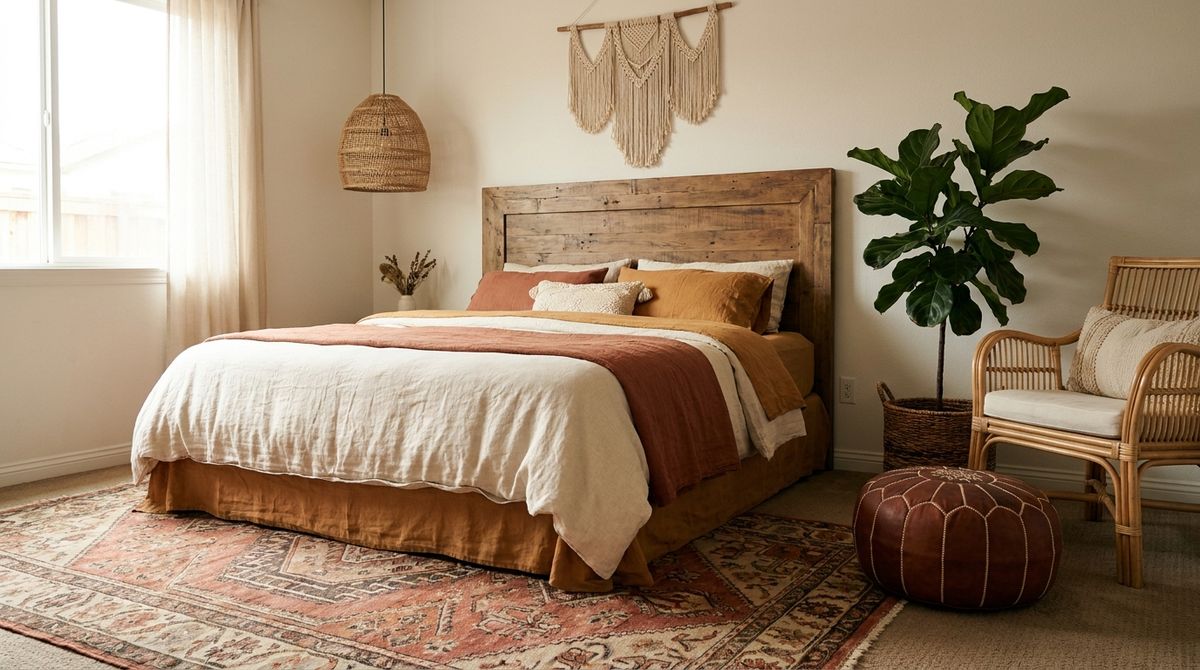
Interior pros don’t guess which boho sub-style a room belongs to. They read five signals — and the signals rarely lie.
1. Pattern density. Traditional Boho layers kilim rugs over patterned textiles over printed cushions with zero apology. Bohemian Modern allows one or two dominant textile patterns and lets everything else breathe. Western Boho leans geometric (Aztec, Navajo-inspired), with pattern used as accent rather than foundation.
2. Palette warmth and saturation. Traditional Boho runs deep: sapphire, emerald, burgundy, and saffron. Bohemian Modern stays in warm neutrals — sand, oatmeal, terracotta, dusty sage. Western Boho narrows further: terracotta, burnt orange, cream, rust, with almost no green or jewel tones.
3. Texture mix. All three use organic textures, but the specific materials diverge. Traditional Boho reaches globally — Moroccan wool, Indian block print, jute, rattan, raw silk. Bohemian Modern edits to a few: linen, natural cotton, light rattan, smooth ceramic. Western Boho adds materials Traditional Boho rarely touches: leather, suede, cowhide, rough-hewn wood.
4. Ornament tolerance. Traditional Boho has high ornament tolerance — brass lanterns, carved wooden trays, layered wall hangings, clusters of candles. Bohemian Modern curates ornament: one large statement plant, a single gallery wall, deliberate negative space between objects. Western Boho uses ornament sparingly but with high visual weight: a mounted antler, one quality leather chair, a single large cactus.
5. Geographic inspiration. Traditional Boho draws from Morocco, India, South America, and 1970s Europe. Bohemian Modern has no specific geography — it’s more of a mood (warm, lived-in, not clinical). Western Boho looks to the American Southwest, Arizona, Texas, and frontier Americana.
What most guides miss: The single fastest way to identify a room is the rug and the seating material together. A kilim or vintage-Persian rug points to Traditional Boho, a flatweave or plain jute rug with a linen sofa points to Bohemian Modern, and a cowhide (real or printed) under a leather armchair points to Western Boho. Cowhide is the one material the other two sub-styles almost never use, which makes it the clearest single tell of the five.
Free · 60 seconds
Not sure which style is actually yours?
Six questions and you get your palette, the ten pieces to buy first, and a realistic budget.
Traditional Boho: Maximalist, Global, Unapologetic
Traditional Boho traces directly to the 1960s–70s counterculture revival of Romani bohemian and Marrakech-inflected aesthetics — the era of Talitha Getty in a Moroccan riad, of macrame plant hangers in every Berkeley apartment, of “more is more” as both aesthetic philosophy and political statement. The style re-emerged as a mainstream interior trend in the mid-2000s and hit mainstream retail around 2012–2015.
The iconic moves are: deep jewel tones (sapphire, aubergine, forest green, saffron) layered over each other with no single dominant neutral. Multiple patterns coexist — a kilim rug under a floral-printed sofa, throw pillows in four different textiles, a macrame wall hanging next to framed Indian block-print fabric. Global sourcing is the point, not just the aesthetic: the story is that these objects came from somewhere, each one a small trophy of lived experience.
Two brands that execute Traditional Boho well: Jungalow (Justina Blakeney’s line — deeply pattern-forward, globally inspired, unapologetic about color) and World Market (affordable global-mix pieces that land closer to Traditional Boho than any other sub-style). IKEA’s RÅSKOG line also gets recruited into Traditional Boho rooms, though the style requires supplementing with non-IKEA pieces.
The defining feature of Traditional Boho is its maximalist tolerance. There is no such thing as too many plants, too many textiles, or too many small objects on a shelf. Visual rest is not the goal. Richness is.
Budget reality: Traditional Boho done well typically runs $800–$2,500 for a living room, partly because it requires volume. You can’t fake the layered-global look with three items.
Bohemian Modern: Restrained, Warm, Curated
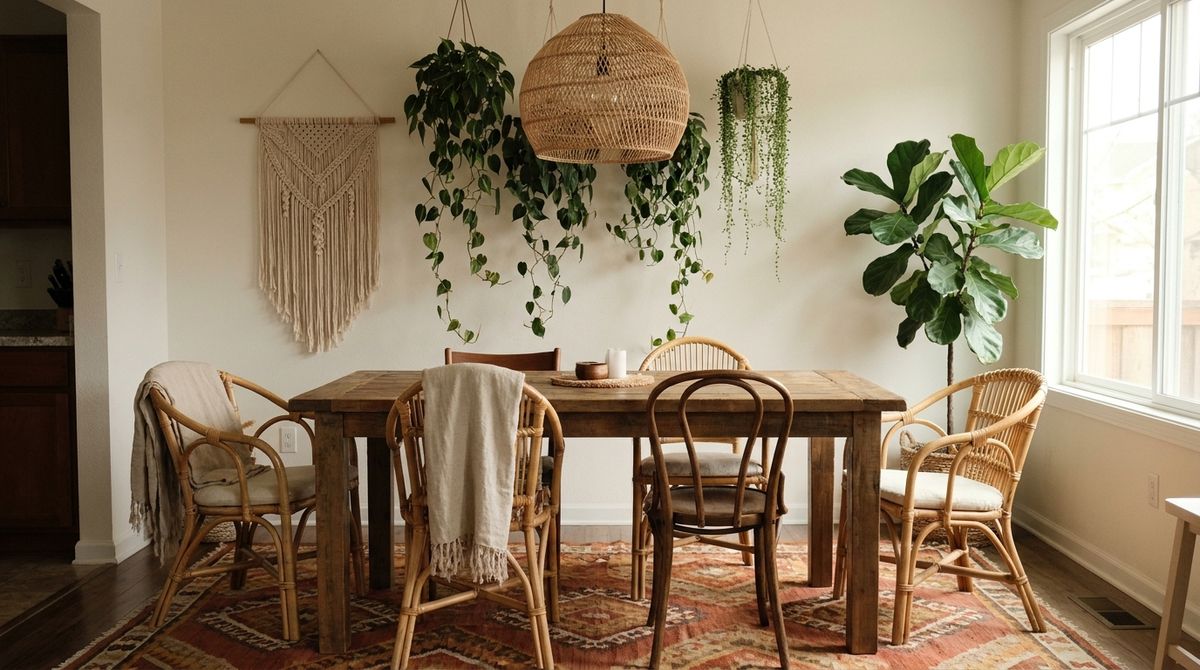
Bohemian Modern (also called Modern Boho) emerged clearly around 2018 as a reaction to two things simultaneously: Traditional Boho fatigue (too much, too busy) and Scandinavian minimalism fatigue (too cold, too beige). It borrowed warmth and organic texture from Traditional Boho, borrowed restraint and clean lines from Scandi minimalism, and built a style that felt both relaxed and adult.
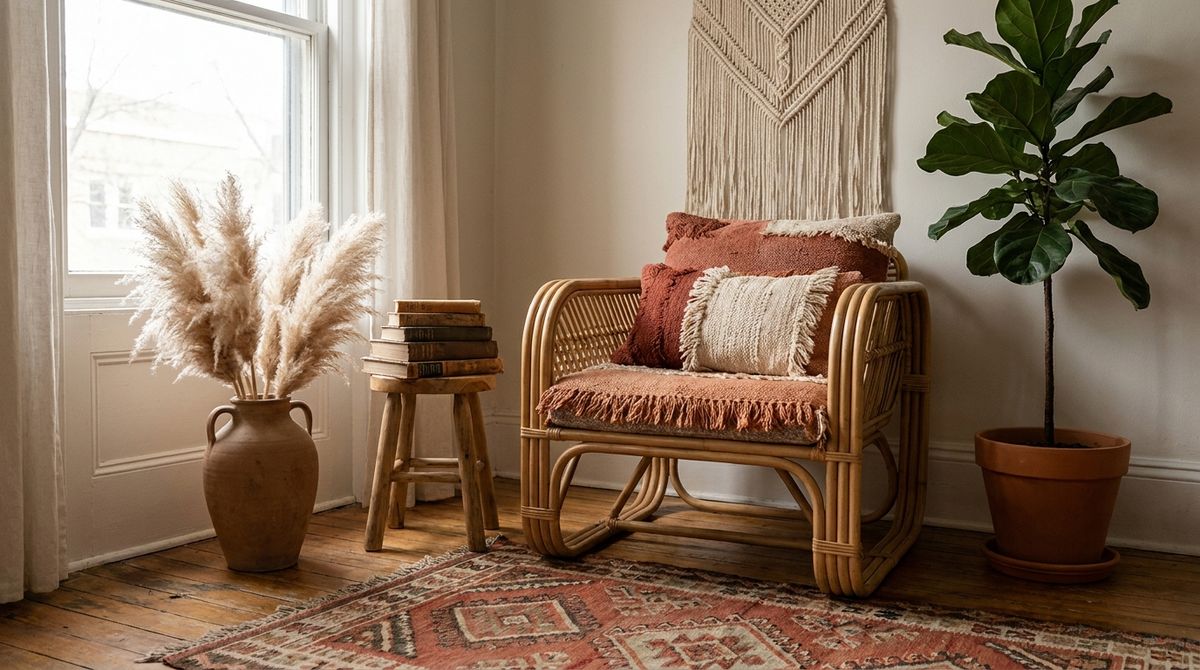
The palette is warm but neutral: oatmeal, sand, warm white, dusty sage, soft terracotta. You’ll rarely see jewel tones in a well-executed Bohemian Modern room. One or two textile patterns are allowed — typically a subtle geometric or a simple botanical print — but they don’t compete with each other. The plant count is deliberate: one large fiddle-leaf fig or monstera as a living anchor, maybe two smaller pots, not the fifteen-plant jungle of Traditional Boho.
Clean lines appear in the furniture — low-profile sofas in textured linen, rattan or cane chairs with simple silhouettes — where Traditional Boho would have an ornate carved wooden piece. The wall decor is selective: a single large gallery wall or one oversized artwork, not three competing installations.
Two brands that capture this well: Anthropologie’s minimal-edit collections (specifically their furniture lines, which lean Modern Boho rather than maximalist) and Article (whose “Boho” furniture category lands squarely in warm-neutral, clean-lined Modern Boho territory, with pieces in the $300–$900 range).
What most guides miss: Most “boho” furniture sold at mainstream retail is actually Bohemian Modern, not Traditional Boho. A “boho” sofa listed by Article, West Elm, or Wayfair in the $300–$900 range is almost always the edited, warm-neutral version, because true Traditional Boho depends on layered accessories and vintage sourcing that a single retail SKU can’t deliver. Read the product photo styling, not the label.
The defining feature is selective restraint. Bohemian Modern asks what to leave out more than what to add. A room in this style should feel curated, not collected.
Renter advantage: Bohemian Modern is the easiest boho sub-style to execute in a rental. Neutral walls don’t fight the palette, the limited pattern density prevents clashes, and the lower object count means fewer things to pack.
Western Boho: Desert, Frontier, Grounded
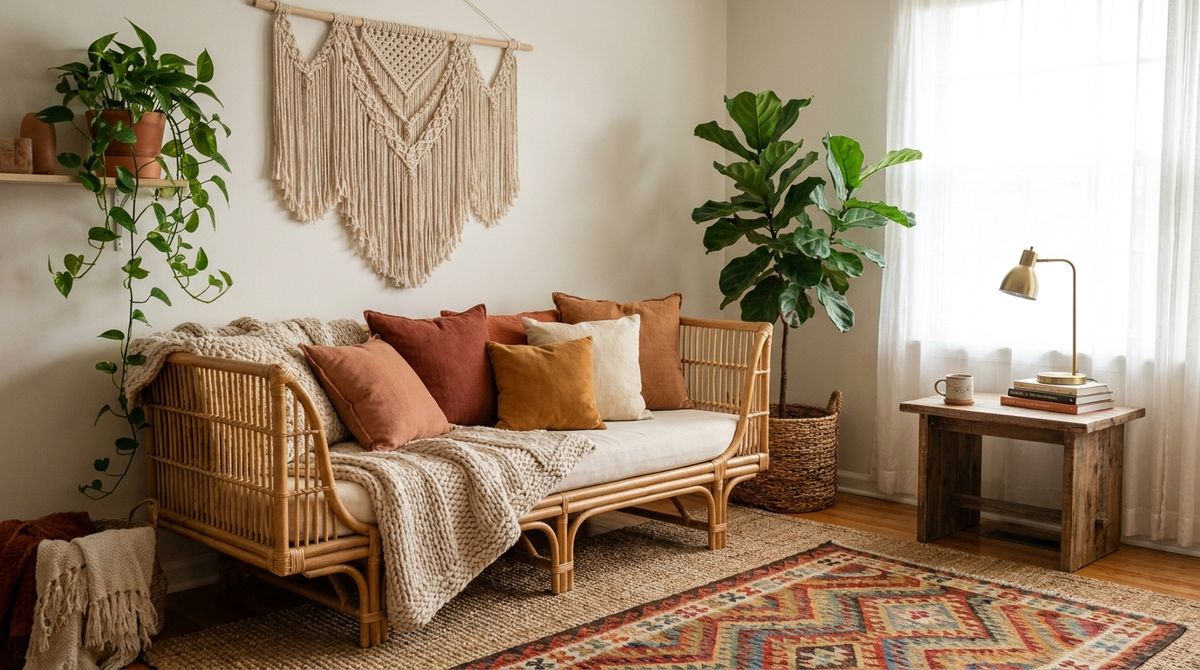
Western Boho crystallized as a named aesthetic around 2021–2022 alongside the broader “cowgirl-coded” cultural moment and the renewed interest in Southwestern design driven partly by remote-work migration to Texas, Arizona, and New Mexico. It’s the most geographically specific of the three sub-styles: if Traditional Boho draws from the whole world and Bohemian Modern draws from a mood, Western Boho draws from one corner of North America.
The palette is narrow and warm: terracotta, burnt orange, cream, rust, warm tan, and dusty brown dominate. There is almost no jewel tone presence, almost no green other than cactus, and the warmth skews more orange-red than the golden-yellow warmth of Traditional Boho. Leather and suede appear as actual materials — not printed patterns, but real or high-quality faux leather chairs, suede throw pillows, and cowhide rugs. Cowhide, whether real or printed fabric, is a Western Boho signal that the other two sub-styles almost never use.
Furniture profiles are heavier and more structural than Bohemian Modern: thick-legged wooden tables, oversized leather sofas, iron light fixtures with filament bulbs. Plants are architectural — a large cactus or agave rather than trailing vines. Wall art tilts toward landscape photography of red-rock terrain, vintage maps of the Southwest, or geometric Navajo-inspired prints.
Two brands that define this territory: Magnolia (Joanna Gaines’s line, which has shifted progressively toward Western-Boho-adjacent warmth and frontier references) and the aesthetic language of Joshua Tree boutique hotels (Pioneertown, Sacred Sands), which have become visual reference points for the whole sub-style across Pinterest and design media.
The defining feature is frontier grounding. Western Boho rooms feel earthy and solid — the opposite of Traditional Boho’s airy eclecticism. The materiality is tactile and heavy, not layered and textile-rich.
Side-by-Side Comparison
| Signal | Traditional Boho | Bohemian Modern | Western Boho |
|---|---|---|---|
| Origin | 1960s–70s Romani/Marrakech revival | 2018+ minimalism-warmth hybrid | 2021+ Southwest/frontier Americana |
| Pattern density | High — multiple competing patterns | Low-medium — 1-2 curated patterns | Medium — geometric accents only |
| Color palette | Deep jewel tones + warm spice | Warm neutrals — oatmeal, sand, sage | Terracotta, rust, cream, burnt orange |
| Key textures | Global mix — Moroccan wool, block print, rattan, raw silk | Linen, natural cotton, light rattan, smooth ceramic | Leather, suede, cowhide, rough-hewn wood |
| Iconic objects | Macrame wall hanging, kilim rug, brass lanterns, layered cushions | Single statement plant, cane chair, oversized linen sofa | Cowhide rug, leather armchair, large cactus, iron fixtures |
| Lighting | Layered — floor lamps, string lights, candle clusters | Warm single-source or subtle layering | Iron pendants, filament bulbs, minimal layering |
| Plant types | Many — trailing vines, snake plants, 10+ varieties | Selective — 1 large focal plant + 2 small | Architectural — cactus, agave, succulent cluster |
| Renter-friendliness | Medium (requires volume, pattern on walls helps) | High (works in any neutral apartment) | Medium (some pieces are large/heavy) |
Which One Should You Pick
The honest answer is: the one that matches how you actually live, not the one that looks best in a single Pinterest photo.
Pick Traditional Boho if: You collect. You travel. You genuinely enjoy rooms that reward ten minutes of looking. You’re not renting, or you are renting but you’ve committed to a long lease and don’t mind removing wall installations when you move. You have a budget of $1,500+ for the room and you’re comfortable with ongoing curation. You’re not a person who feels stressed by visual complexity — this style needs maintenance to not look messy.
Pick Bohemian Modern if: You’re a renter who wants warmth without chaos. You’ve tried minimalism and found it cold. You want a room that photographs well for listing photos or social media. Your budget is $600–$1,400 for a living room. You want the option to refresh one or two items each year without the whole room unraveling. This is the most versatile sub-style and the most forgiving of incremental building.
Pick Western Boho if: You live in a warm climate or a home with warm natural light. You’re drawn to frontier and Southwestern aesthetics on an ongoing basis, not just as a trend. You prefer fewer, heavier, higher-quality pieces over many smaller objects. You have a sofa budget above $800 because the anchor furniture in this style runs larger and heavier. You’re comfortable with a palette that commits hard to earth tones — the style does not accept cool grays or blues.
The Hybrid Mistake
We see this frequently: someone pins Traditional Boho rooms for the color, Bohemian Modern rooms for the calm, and Western Boho rooms for the leather chair — and then tries to build all three in a single room. The result almost always reads as incoherent.
Here’s why the mix fails. The palettes actively fight: deep jewel tones (Traditional Boho) clash with warm neutrals (Bohemian Modern) and the saturated earth tones of Western Boho pull in a third direction. The pattern density expectations contradict: Traditional Boho’s layered patterns create visual noise next to Bohemian Modern’s deliberate restraint. The material weights don’t coexist naturally: Western Boho’s heavy leather and rough wood read as grounding against delicate global textiles, not complementary.
The hybrid mistake usually looks like a cowhide rug (Western Boho) under a macrame wall hanging (Traditional Boho) in front of a neutral linen sofa (Bohemian Modern) surrounded by random cushions from all three. The room’s visual language is undefined. It doesn’t look “boho” — it looks unfinished.
The fix is to choose one sub-style as the primary axis — the one that owns 80% of your purchases — and treat the others as off-limits except for one deliberate accent. A Bohemian Modern room can tolerate one Traditional Boho kilim as a rug. A Western Boho room can tolerate one Bohemian Modern linen throw. The accent needs to be outnumbered.
FAQ
Can I shift between these styles over time without starting over?
Bohemian Modern is the most shift-friendly starting point. Its neutral palette accepts Traditional Boho additions (add a kilim, add some brass) or Western Boho additions (swap in a leather chair, add a cowhide). If you start with Traditional Boho or Western Boho, moving toward a different sub-style typically requires selling or storing your major anchor pieces.
Which boho variation is most timeless?
Bohemian Modern has the longest design runway because its restraint and neutral palette don’t date the way trend-specific maximalism does. Traditional Boho has the deepest historical roots and cycles back reliably every decade. Western Boho is currently in a strong trend moment (2022–2026) but is more regionally specific — it reads less universally than the other two.
Which costs the most to execute well?
Traditional Boho typically costs the most because the layered-volume effect requires significant purchasing. Western Boho’s large leather anchor pieces (sofas, armchairs) also run expensive. Bohemian Modern is the most budget-accessible — its lower object count and neutral palette let you build meaningfully with fewer pieces.
Which is easiest in a rental with white walls and no modifications?
Bohemian Modern, without competition. Its warm neutrals work with white walls, its limited pattern density doesn’t clash with existing fixtures, and its curated plant approach doesn’t require built-in infrastructure. Traditional Boho requires more wall coverage to look intentional. Western Boho’s heavy pieces can feel oversized in smaller rental units.
Is boho still in style in 2026?
Yes, but as three distinct sub-styles rather than one trend. Bohemian Modern is the mainstream default in 2026 because renters and first-time homeowners favor its warm-neutral flexibility. Western Boho is peaking as a named aesthetic (2022–2026). Traditional Boho stays evergreen through its 1970s roots and reliably cycles back every decade.
Conclusion
The three boho variations share a DNA — organic texture, anti-sterile warmth, a preference for lived-in over showroom-perfect. But they diverge sharply in palette, pattern tolerance, geographic reference, and the specific objects that anchor them. Traditional Boho maximizes eclecticism. Bohemian Modern edits it. Western Boho redirects it toward one specific landscape.
Pick the one that matches your life, your budget, and your tolerance for visual complexity — then commit to it. Rooms that try to speak all three languages at once end up speaking none clearly.
Ready to build your boho room? Start with our Boho Style Decor Guide for a full foundation overview, or jump directly into How to Decorate Boho Style in 7 Steps if you’re ready to move.
Related reads: