
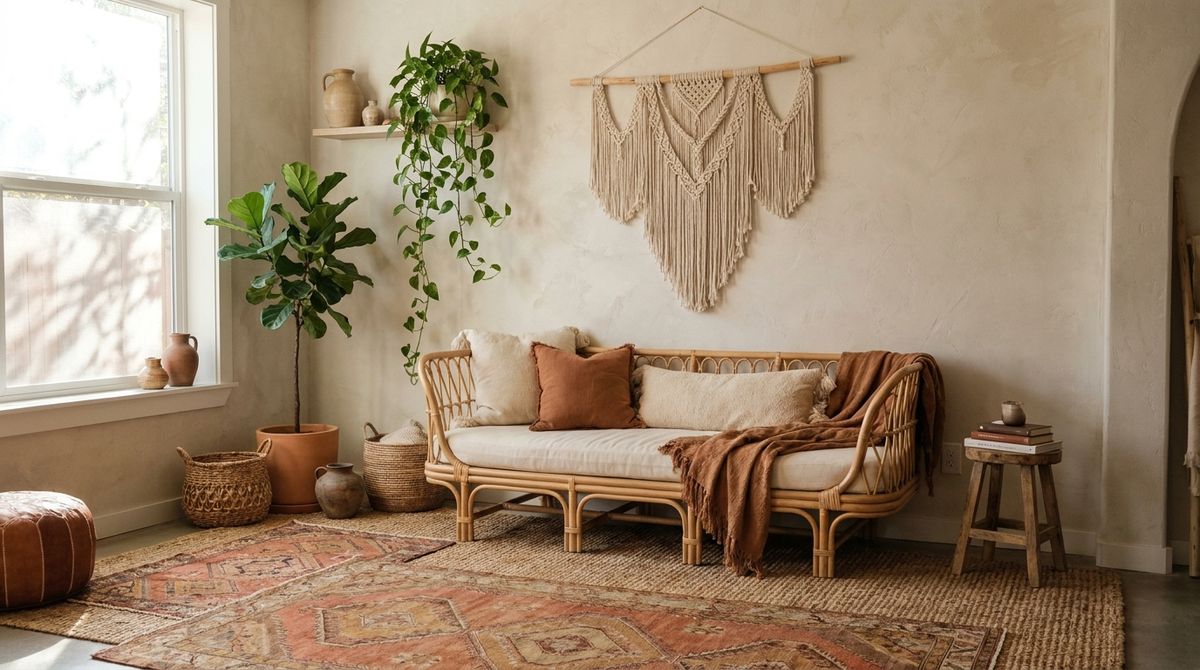
The one rule that makes boho macrame work: hang a single large anchor piece per room, and cap the total at three pieces. We’ve walked into 10×12 living rooms with five macrame pieces competing for attention on every surface, and the result is visual noise that reads as clutter, not character. We’ve also seen a single 4-foot cotton cord wall hanging anchor an entire room, turning a bare plaster wall into the focal point that ties every other element together.
The difference between those two outcomes is almost never the macrame itself. It’s placement. It’s knowing how many pieces a room can hold, which walls can carry the weight of a large fiber piece, and which corners are already too busy to absorb one more textured layer.
This guide breaks down 12 specific setups — sorted by room — where boho macrame works, plus the placement rules we use before hanging anything. We’ll also cover sizing math, cord material differences, and the three mistakes we see most often.
Key Takeaways
- One large macrame anchor per room — a single statement piece does more than three smaller ones
- Worst placement: Corners with competing patterns (gallery walls, heavily textured wallpaper, curtain-heavy windows)
- Max per room: One primary + two secondary pieces (plant hangers, small sconces) — beyond that, the texture reads as overwhelming
- Sizing rule: Macrame width should be 1/3 to 1/2 the width of the wall it anchors; length maxes at 6ft for 8ft ceilings
- Best under $40 sourcing: Etsy shops like BohemianDecorShop and WildKnotCo for handmade cotton, Amazon Basics Macrame Wall Hanging for budget starter pieces
The Macrame Placement Rules
Before picking up a drill, run your room through these three checks.
Rule 1: One primary anchor per room. A primary macrame piece is anything over 24 inches wide or 36 inches long — large enough to read as the main fiber element. Pick one wall, one piece. Resist the temptation to balance it with another large piece on the opposite wall. You’ll dilute both.
Rule 2: Two secondary pieces maximum. Secondary pieces are small — a 6-inch plant hanger, a macrame shelf sconce, a 12-inch wall mini. Two of these can coexist with a primary anchor in the same room without creating visual competition. Three starts to feel like a boho craft fair.
Rule 3: Pair macrame with at least two hard-edge pieces. Macrame is all soft curves and organic texture. Without visual contrast — a rectangular framed print, a sharp-edged wood shelf, a circular mirror with a solid frame — the room loses structure. The hard edges ground the fiber work and let it read as intentional, not just soft-decoration-by-default.
Rule 4: Avoid corners with competing pattern density. If the wall already has a busy botanical print, a crowded gallery arrangement, or heavy curtain fabric with bold texture, adding macrame stacks three competing textures in the same sightline. Instead, bring macrame to the plainest wall in the room — let the fiber be the statement.
What most guides miss: a large 5mm cotton anchor piece often weighs 2 to 4 lbs on its own, and the wooden dowel pushes it past the 5 lb mark fast. Anything over that on drywall needs a stud or a toggle bolt rated to at least 15 lbs, not a single picture nail. We once watched a 48-inch piece pull a standard hook clean out of soft plaster within a week, so we now anchor every large piece into a stud.
Free · 60 seconds
Not sure which style is actually yours?
Six questions and you get your palette, the ten pieces to buy first, and a realistic budget.
12 Macrame Setups That Work
Living Room
Setup 1: Sofa Anchor Wall — Single 4ft Macrame
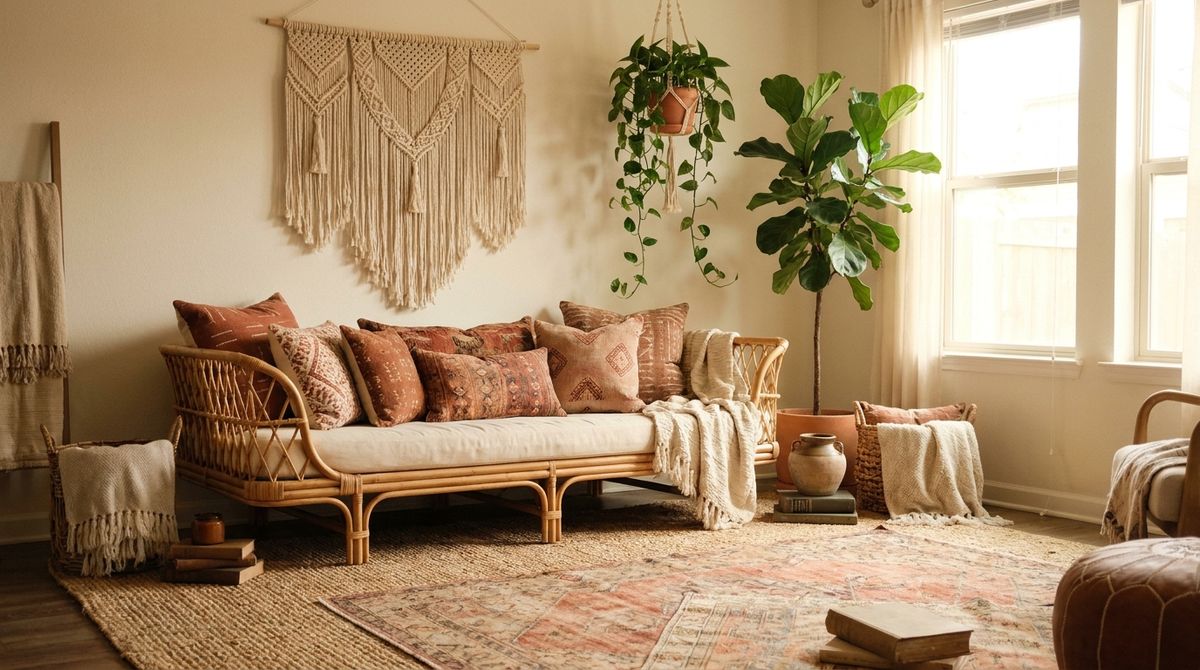
The most reliable boho macrame placement in any living room. Hang a 36–48-inch wide piece centered above the sofa, with the bottom hem landing 8–10 inches above the top cushion. At this height it reads as intentional art, not a floating textile. Keep the sofa wall clear of competing frames — the macrame alone is the art. This works best against a solid-color or very lightly textured wall (warm white, terracotta, dusty sage). Pair with one or two simple framed prints on the adjacent wall to build visual flow without crowding the anchor wall.
Recommended size: 36–48″W x 36–48″L
Cord weight: 3–5mm natural cotton
Setup 2: Console Table — Macrame + Plant Trio
This setup works for entryways or living room console tables against a longer wall. Hang a medium macrame piece (18–24 inches wide) centered above the console, then cluster three plants at varying heights on the tabletop — one trailing, one upright, one low-profile. The macrame provides vertical rhythm; the plants give organic grounding. Keep the console surface otherwise minimal: a tray, one candle, nothing else competing for attention.
Recommended size: 18–24″W x 24–36″L
Cord weight: 3mm cotton for finer knotwork detail
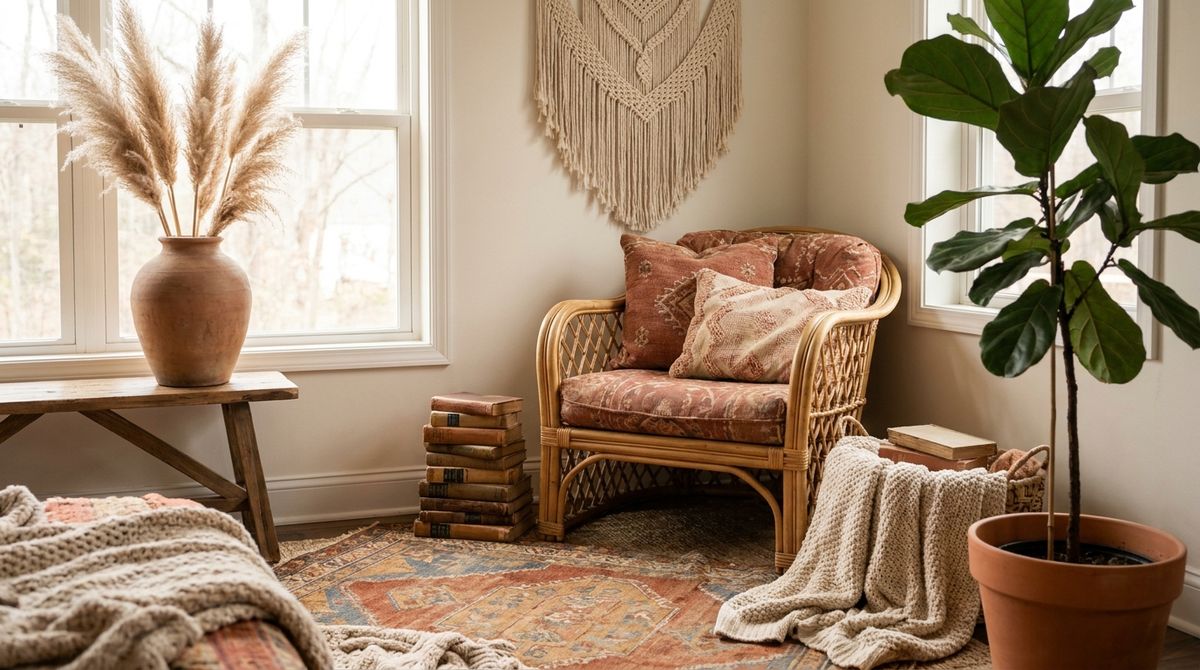
Setup 3: Hanging Room Divider Behind Reading Chair
For open-plan spaces, a long macrame curtain panel (or two narrower panels side by side) hung from a ceiling-mounted dowel creates a soft partition behind a reading chair without blocking light or airflow. This doubles as a boho backdrop and a functional space-definer. Choose a loose, open-weave pattern so the divider feels airy rather than heavy. Minimum panel height: floor to 12 inches below ceiling. Leave 8–12 inches of floor clearance so the piece floats.
Recommended size: Two 18–24″W panels, full ceiling height
Cord weight: 5mm for structural drape
Setup 4: Gallery Wall — Macrame as 1 of 5 Pieces
A macrame piece works inside a gallery wall when it occupies no more than one slot and is framed (visually, not literally) by hard-edge pieces on both sides. Position it off-center — second from the left or third from the top in a 5-piece arrangement. Keep the macrame piece small (12–18 inches wide) so it doesn’t visually overpower the prints around it. The fiber texture creates the tactile contrast that makes a gallery wall feel layered rather than flat.
Recommended size: 12–18″W x 18–24″L
Cord weight: 3mm for fine detail that holds at smaller scale
Bedroom
Setup 5: Headboard Alternative Macrame Anchor
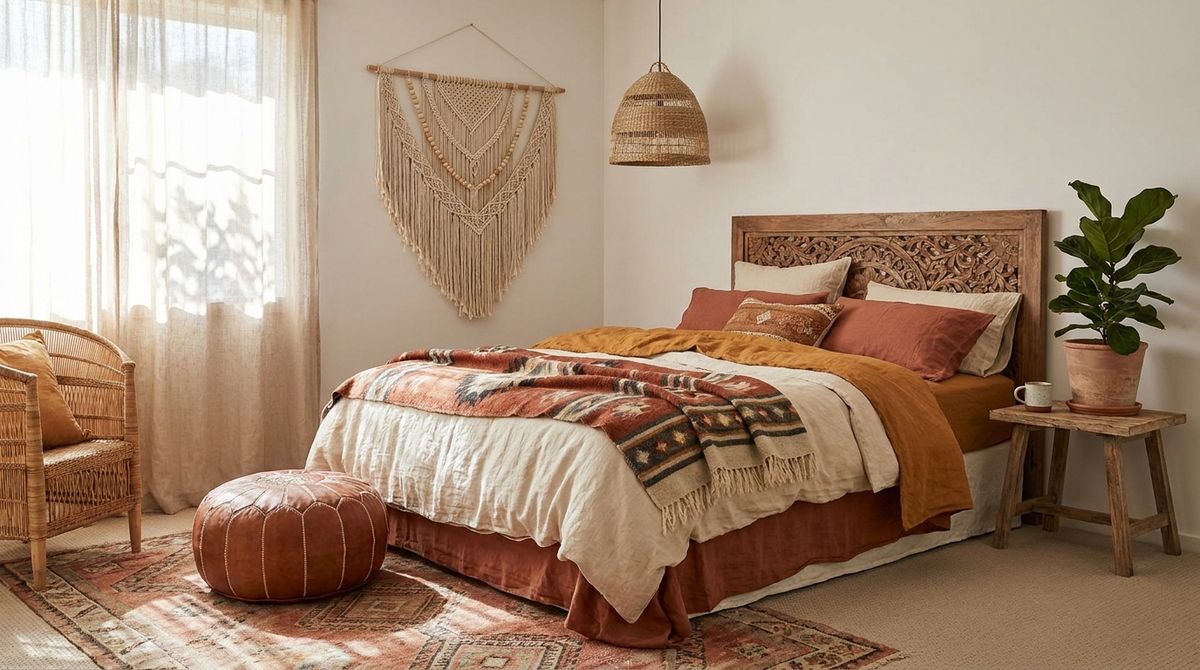
If your bed has no headboard — or a minimal one — a large-scale macrame piece centered above the bed functions as both a headboard replacement and the room’s primary art piece. Hang it so the bottom hem clears the pillow line by 6–8 inches. Go wide: ideally 60–70% of the mattress width. A king bed can take a 48–54-inch macrame piece. A queen, 42–48 inches. This setup defines the entire bedroom’s mood — commit to it and keep the side walls minimal.
Recommended size: 42–54″W x 48–60″L (scale to bed width)
Cord weight: 5mm for the visual weight a headboard needs
Setup 6: Plant Hanger Above Nightstand
A single macrame plant hanger suspended from a ceiling hook above one nightstand is a small-scale boho detail that punches above its size. Use a trailing plant (pothos, string of hearts, or ivy) so the foliage spills downward and softens the vertical line. Keep the hanger 12–18 inches above nightstand height so it doesn’t block the lamp light or create a cramped corner. Asymmetry is fine — you don’t need matching hangers on both sides of the bed.
Recommended size: Standard 6–8″ pot hanger
Cord weight: 3mm braided cotton
Setup 7: Bohemian Dreamcatcher Accent Corner
Choose the corner diagonally across from the bedroom doorway — the corner your eye lands on last when entering. A macrame dreamcatcher or fringe wall piece in this position creates a focal detail that rewards attention without competing with the bed wall. Size it modestly (18–24 inches) so it reads as an accent, not a second anchor. Pair with a floor plant in the same corner for a grounded, layered feel.
Recommended size: 18–24″ diameter or width
Cord weight: 3mm fine cotton or jute blend
Setup 8: Wall-Mounted Macrame Hangers Above Floor Cushion
A floor cushion reading nook works best when the wall above it has visual warmth at low height. Two small macrame hangers (6–8 inches each) at seated eye level — roughly 36–42 inches from the floor — create a cozy surround without requiring ceiling hardware. You can stagger them slightly: one at 36 inches, one at 44 inches. Fill one with a trailing plant; leave the other as pure textile texture.
Recommended size: Two 6–8″ plant hangers or mini wall pieces
Cord weight: 3mm cotton
Office / Study
Setup 9: Behind Desk — Single Macrame Anchor
A Zoom-friendly boho setup: one 24–30-inch macrame piece centered behind the desk chair, hung so the bottom clears the top of the monitor by at least 6 inches. Keep it simple — a clean rectangular or chevron pattern in natural cotton reads as intentional background texture rather than visual chaos on video calls. No plants in this frame if you want a clean camera background; add the plants off to the sides instead.
Recommended size: 24–30″W x 30–36″L
Cord weight: 3–5mm cotton, natural or warm ivory
Setup 10: Plant Hanger Near Window for Natural Light
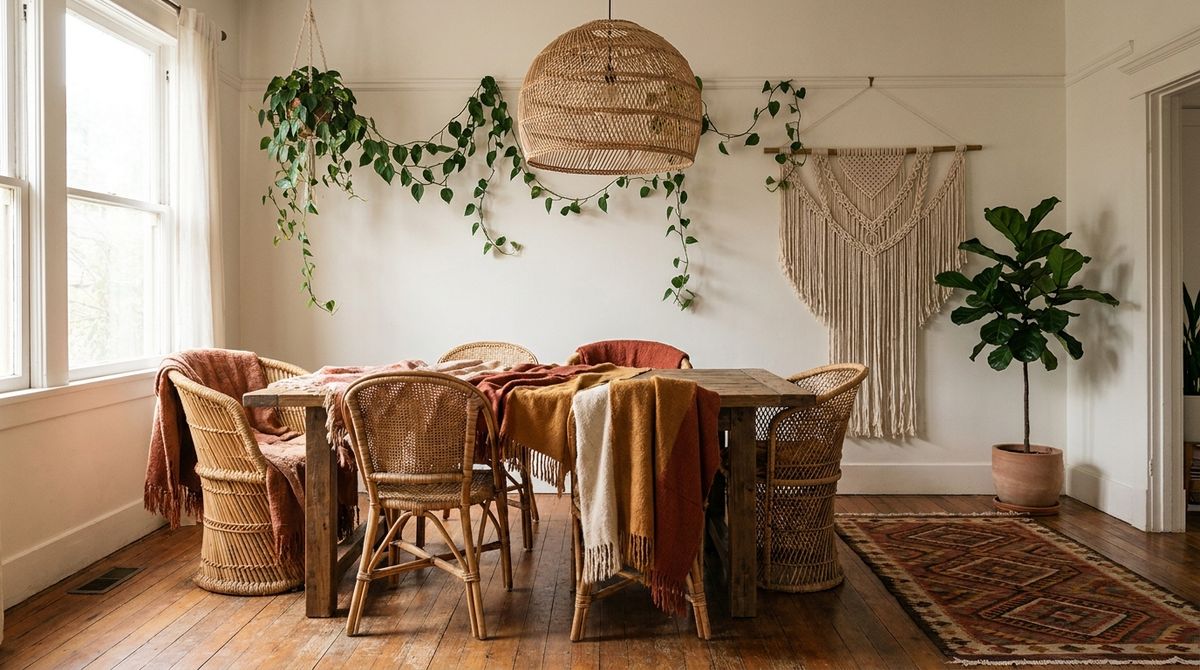
Office plants live longer near the window, and a macrame hanger is the most space-efficient way to position one without losing desk surface. Ceiling-mount a single hanger 12 inches from the window frame so the plant catches indirect light. A 6-inch trailing pothos works perfectly. The natural light creates a soft shadow pattern through the macrame knots that adds ambient warmth to the room — a secondary benefit that’s worth noting.
Recommended size: Standard 6–8″ pot hanger
Cord weight: 3mm cotton
Bathroom + Entryway
Setup 11: Plant Hanger in Bathroom Corner
Bathrooms have humidity that most wall decor can’t handle — but macrame in natural cotton or jute holds up well with adequate ventilation. A single plant hanger in the corner farthest from the shower gives the bathroom a spa-adjacent warmth without risking water damage. Use humidity-tolerant plants: pothos, ZZ plant, air plants. Keep the piece at standing eye level (60–66 inches from floor) to avoid awkward sightlines.
Recommended size: Standard 6–8″ pot hanger
Cord weight: Natural cotton (jute acceptable, polyester avoid — see materials section)
Setup 12: Entryway Welcome Macrame Above Bench
The entryway is a high-impact, low-furniture zone — a narrow macrame piece (12–18 inches wide) centered above an entryway bench makes an immediate impression without requiring much wall space. Keep the style simple: clean tassels, minimal knotwork. The entryway already has coat hooks, shoes, and bags competing for visual space — a fussy macrame piece adds noise rather than warmth. Natural cotton in warm ivory or oatmeal tones works across all boho palettes.
Recommended size: 12–18″W x 24–30″L
Cord weight: 3mm cotton for a refined look
Macrame Sizing Guide
The most common boho macrame mistake isn’t style — it’s scale. Here’s the math we use.
The 1/3 to 1/2 wall-width rule. The macrame piece should be between one-third and one-half the width of the wall it anchors. A 10-foot-wide living room wall reads best with a macrame piece between 40 and 60 inches wide. Go narrower and it floats awkwardly in too much empty space. Go wider and it starts competing with the wall’s architectural edges.
Length cap for 8-foot ceilings. At standard 8-foot ceiling height, keep macrame length (including fringe) to 6 feet maximum. Longer pieces in low-ceilinged rooms create a visually compressed feeling — the eye reads the vertical span as almost floor-to-ceiling, which closes in the room. In rooms with 9-foot or higher ceilings, you can push to 7 feet without issue.
Small rooms and oversized macrame. The instinct to fill a small room’s blank wall with a large macrame piece often backfires. A 36-inch-wide macrame piece in an 8×10 bedroom feels like it’s consuming the wall. In small rooms, go two sizes down from what seems right — a 20-inch piece will feel appropriately proportioned once the room is furnished.
Vertical vs. horizontal orientation. Most macrame hangs vertically by default, but some wider woven pieces can be oriented horizontally. Horizontal macrame works above low furniture (a long dresser, a console table, a headboard) where the furniture line sets a strong horizontal anchor. Vertical pieces work better on tall, narrow walls and above seating.
Macrame Materials + Sourcing
Not all macrame cord is equal, and the material difference shows in the finished piece — both visually and over time.
Cotton cord (best for wall pieces). Natural cotton is the standard for good reason: it knots cleanly, has a warm matte finish, and softens slightly over time in a way that improves with age. It’s also the easiest to clean (spot clean with a damp cloth, occasional air-out). Cotton macrame available in 3mm (fine detail, lighter pieces), 5mm (standard wall hangings), and 7mm+ (thick weaves, room dividers). For wall decor, 5mm is the most versatile.
Jute (rustic but rough). Jute has a more textured, earthy look that leans into the natural-material aesthetic. The downside: it’s coarser to the touch, less uniform in knotwork, and can shed over time. Works well for plant hangers and outdoor-adjacent boho spaces (covered patios, sunrooms). Not ideal for bedroom pieces near pillows or seating where skin contact is likely.
What most guides miss: jute sheds fine fibers heavily for the first few weeks and keeps shedding lightly for months, so keep it well away from bedding and dark upholstery where lint shows. Cotton barely sheds at all, which is why we default to it for anything near a bed or sofa. On cost, a DIY 18-inch cotton piece runs about $14 in materials versus $45 to $120 for a comparable handmade one, so the savings are real, but only if you count the 2 to 3 hours of knotting as time well spent.
Polyester macrame (avoid). Mass-market polyester macrame looks flat, plasticky, and lacks the depth of natural fiber. It doesn’t age well and often has a synthetic sheen that reads wrong under warm lighting. If you’re buying online and the price seems extremely low, check the material description.
Etsy artisan vs. Amazon mass-market. For a primary anchor piece — something above a sofa or bed — invest in a handmade piece from an Etsy maker. Shops like WildKnotCo, BohoWallCo, and MacrameByNature typically price wall hangings at $45–$120 depending on size, with significantly better knot consistency and cord quality than Amazon alternatives. For secondary pieces (plant hangers, small accents), Amazon Basics Macrame Wall Hanging ($18–$28) or similar budget options are perfectly adequate.
DIY Macrame for Beginners
An 18-inch macrame wall hanging is one of the most approachable first fiber projects, completeable in 2–3 hours with no prior experience. Here’s what you need and the four foundational knots.
Material list (under $20):
- 3mm natural cotton macrame cord, 100-yard spool (~$10)
- 18-inch wooden dowel rod (~$4)
- Scissors
- A wall hook or clothes hanger to work from
The four knots you need:
-
Lark’s Head Knot — how you attach cord to the dowel. Fold a cord in half, loop the fold over the dowel, pull both ends through the loop. Every macrame project starts here.
-
Square Knot — the workhorse of macrame. Take four cords (two active, two passive center cords). Cross left over center, right over left, pull through the right loop. Then reverse: right over center, left over right, pull through. One square knot complete. Rows of square knots create the honeycomb pattern seen in most basic wall hangings.
-
Half-Square Knot / Spiral — one half of the square knot, repeated on the same side. Creates the spiral twist pattern common in plant hangers. Easier than it sounds once the square knot clicks.
-
Gathering Knot — wraps multiple cords together into a bundle. Used to create tassels and fringe ends. Take one cord, wrap it tightly around a group of others, thread the end through the top of the wrapping, pull tight.
Beginner project: Cut 20 cords at 48 inches each. Fold in half, attach 20 lark’s head knots to an 18-inch dowel (40 working strands total). Tie 4 rows of alternating square knots across all strands. Finish with gathering knots at the bottom and trim the fringe to an even or V-shape. Total cord used: approximately 80 feet. Pin this for later — it’s genuinely doable on a weekend afternoon.
3 Macrame Mistakes to Skip
Mistake 1: Hanging too high. The most common macrame installation error. Eye level for macrame wall art should be treated like any other art: center the piece at roughly 57–60 inches from the floor for standalone pieces, or 8–10 inches above furniture when hung above a sofa or bed. Pieces hung at 70+ inches feel disconnected from the room and break the cozy, grounded quality that makes boho decor work.
Mistake 2: Too many pieces in one room. Two pieces of macrame in a 12×14 living room is the maximum before the texture starts to feel overwhelming. Three or more and the room reads as a fiber arts studio, not a curated boho space. When in doubt, remove one piece and see how the room reads — you’ll almost always prefer it.
Mistake 3: Wrong cord weight for wall scale. A 5-foot wall hanging made in 3mm cord looks thin and underwhelming at distance. A small 12-inch piece made in 7mm cord looks clunky and heavy. Match cord weight to piece size: 3mm for anything under 20 inches wide, 5mm for standard wall hangings (20–48 inches), and 7mm+ for room dividers and large-scale statement pieces. The cord weight determines whether the knotwork reads as delicate or structural — and each scale has its appropriate range.
FAQ
Can macrame work in modern boho instead of traditional boho?
Yes, and it often looks better. Modern boho strips back the layered excess and lets a single, clean-lined macrame piece breathe against a more neutral backdrop. Opt for geometric knotwork patterns over heavy fringe, natural cotton in warm white or ivory rather than dyed colors, and pair with clean-lined furniture rather than rattan-heavy mixed styles. The result is boho texture without the maximalist density.
How do you clean a macrame wall hanging?
For routine maintenance, a hand-held clothing steamer on low heat from 6 inches away removes dust and relaxes any cord distortion. For spot cleaning, dampen a white cloth with cool water and gentle soap, blot (don’t rub) the affected area, then air dry completely before rehanging. Avoid machine washing — the knotwork tangles and the cord can felt or warp. Full submersion cleaning is only worth attempting if a piece is heavily soiled.
Does macrame shed or collect a lot of dust?
Cotton macrame barely sheds and mostly needs a light monthly dusting: run a hairdryer on cool or a vacuum brush attachment gently over the knots to lift settled dust. Jute sheds far more, especially in its first few weeks, so it collects lint faster and suits low-contact spots like plant hangers rather than a wall right above your pillows.
Is it cheaper to make macrame or buy it?
Making it wins on materials: a beginner 18-inch cotton wall hanging costs about $14 in cord and a dowel versus $45 to $120 for a comparable handmade Etsy piece. The catch is time, budget 2 to 3 hours for a first project. For large statement pieces above a sofa or bed, buying handmade usually gives cleaner knot consistency than a first attempt would.
What hardware do you need to hang macrame on a plaster wall?
For pieces under 5 lbs (most cotton wall hangings up to 36 inches), a standard picture-hanging hook rated for 10 lbs is sufficient in drywall. For plaster walls or heavier large-scale pieces, locate a wall stud and use a 1.5-inch wood screw with a small hook end. A magnetic stud finder is worth the $10 investment if your walls are plaster. Ceiling-mounted plant hangers need a ceiling joist anchor or a toggle bolt rated for the plant’s weight plus the hanger.
Where can we find quality macrame for $20–30?
Amazon’s Mkono and TIMEYARD labels consistently produce solid cotton macrame in the $18–35 range — read reviews specifically mentioning cord quality and knot tightness. HomeGoods and TJMaxx often carry handmade-adjacent macrame pieces at 40–60% below boutique retail, though stock is unpredictable. For the $20–30 range on Etsy, search for “macrame wall hanging cotton” filtered to under $35 — newer shops often price competitively to build reviews. Avoid anything with “boho wall hanging decor” at under $12 on Amazon — it’s almost always polyester.
Conclusion
Macrame earns its place in boho decor when it’s treated as a focal element, not a filler material. One well-placed, correctly sized cotton piece anchors a room and adds the organic texture that no print or paint can replicate. The 12 setups above cover every room where macrame genuinely improves the space — and the placement rules give you a framework to evaluate any new wall before committing to a nail.
For more on layering boho wall elements, see our Boho Wall Art guide — we built the setup above as a companion to this one. And if you’re still building out your overall room vision, start with the Boho Style Decor Guide for the full framework.
Related reading: