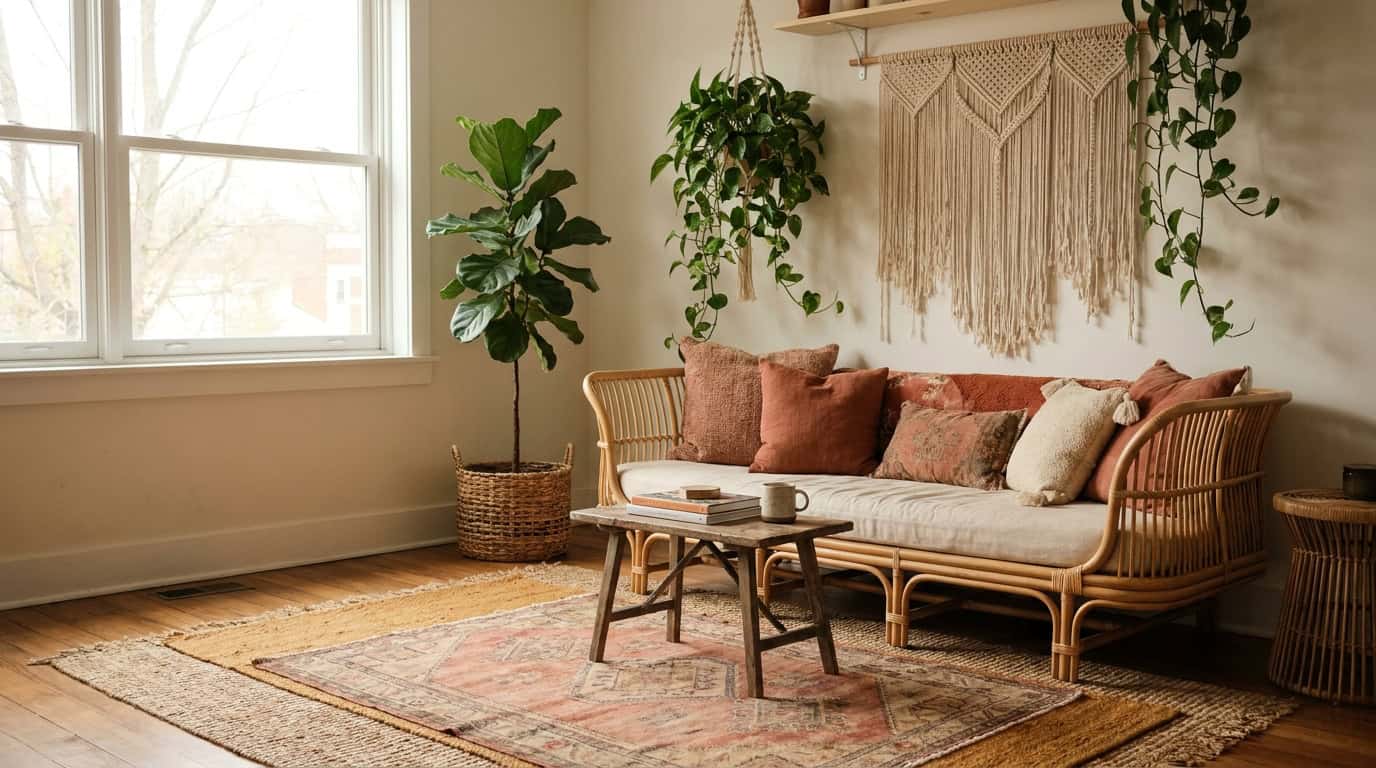
Boho layering works when you spread textures and patterns across three vertical zones, pair one dominant pattern with two smaller-scale supporters, and tie every piece together with a single shared color. Boho layering looks effortless in photos. In real rooms, it often ends up looking cluttered, busy, or just plain random. The difference between styled and chaotic comes down to a few specific techniques most guides skip entirely.
We’ve pinned thousands of boho rooms and noticed a consistent pattern: the best ones follow structural rules, even when those rules are invisible. Here’s the system our team uses to get that “collected over time” look without the visual noise.
Key Takeaways
- Apply the rule of thirds to distribute visual weight across your room
- Layer vertically: floor anchor, mid-height layer, above-eye-level detail
- Use one dominant pattern at large scale + two supporting patterns at smaller scales
- Pair at least three texture types: matte, woven, and one with sheen
- Run a 5-point layering audit before calling a room finished
The Rule of Thirds Applied to Boho Rooms
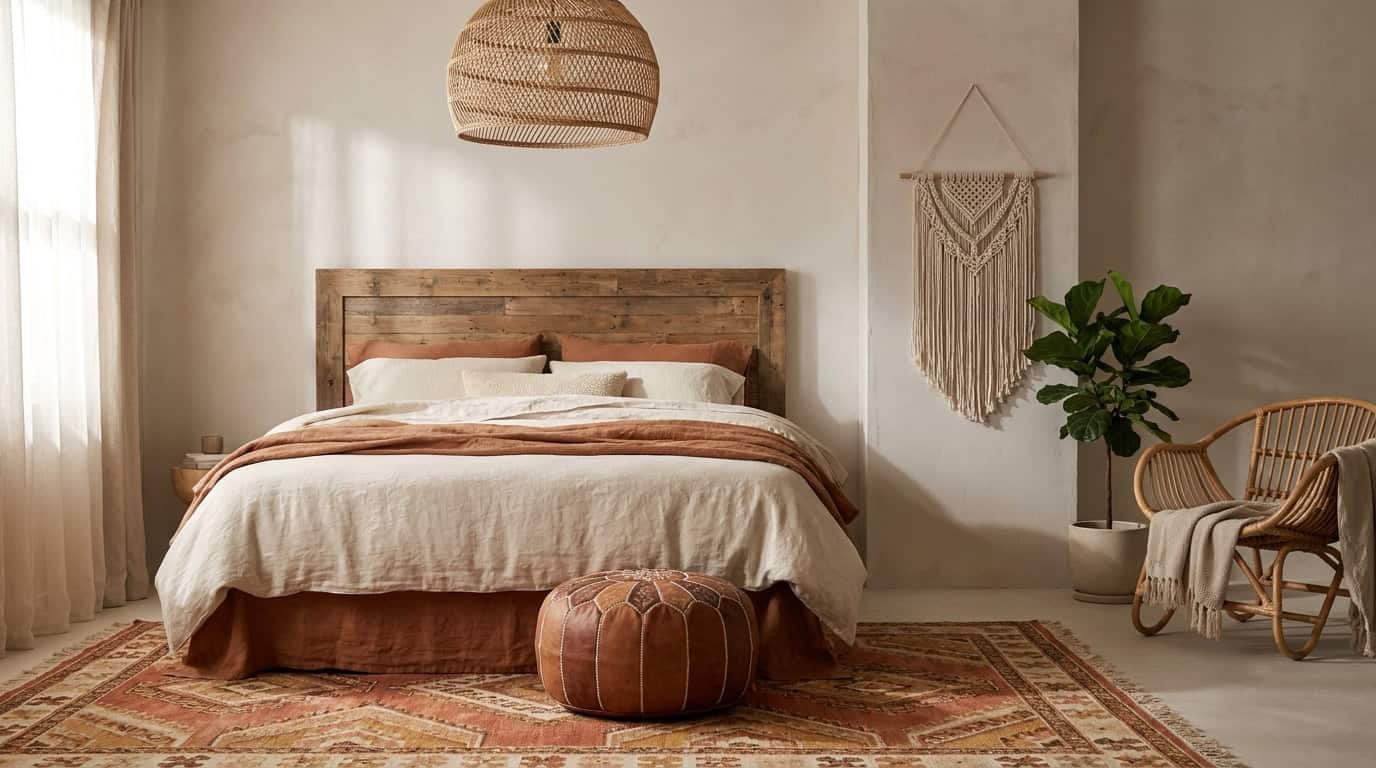
Interior designers borrow this from photography: divide your room into thirds horizontally and vertically, then place key layering elements at the intersection points. According to Apartment Therapy’s guide to bohemian style, rooms that photograph best aren’t random collections but have deliberate visual balance.
In practice: your largest textile (usually a rug) anchors the bottom third. Throw pillows, side tables, and plants occupy the middle third. Wall art, hanging plants, or macrame fill the upper third. When something feels “off,” it’s usually because all the texture is piled in one zone.
Quick test: stand at your doorway and mentally divide the room into nine squares. If six are bare and three are overloaded, that’s your problem.
Vertical Distribution: Floor, Mid-Height, Eye-Level and Above
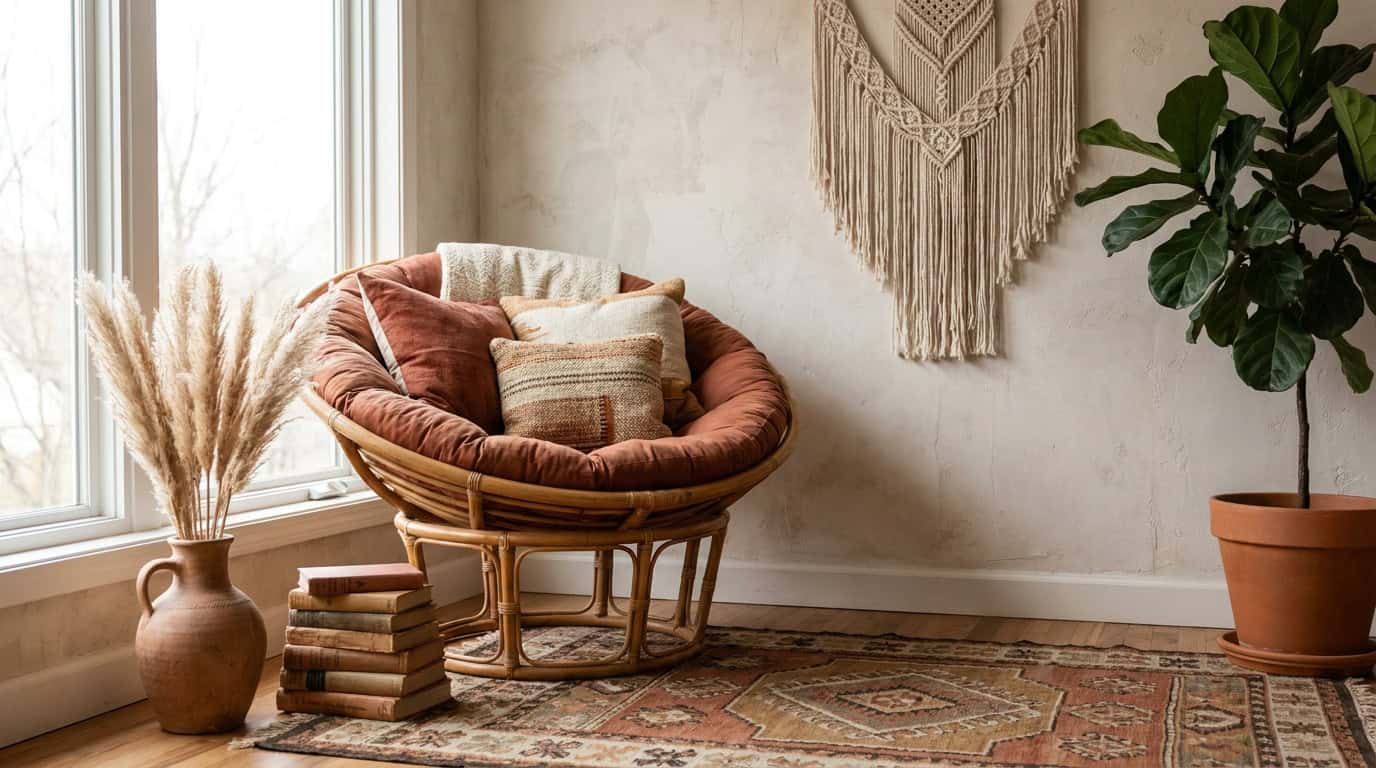
This is the technique that separates styled boho rooms from staged ones. Think of your room in three horizontal bands:
Floor layer (ground to 18 inches): This is where your largest textile lives. A layered rug setup (one large flatweave under a smaller woven accent) anchors everything above it. A jute or sisal area rug, 8×10, runs $110-$180 at Target or Wayfair. Layer a smaller Moroccan-style accent rug, 3×5, on top for around $45-$90 at World Market or Amazon. Floor cushions and poufs also live here.
Mid-height layer (18 inches to eye level, roughly 5 feet): Sofas, chairs, side tables, and shelving units. This is where most of your pattern mixing happens through throw pillows, folded blankets, and plant pots. Keep this zone busy but organized with the pattern rules we cover below.
Above-eye-level layer (above 5 feet): Wall hangings, floating shelves, hanging planters, tall floor lamps with woven shades. This layer is often empty in non-boho rooms, which is why boho spaces feel so distinctly rich. A macrame wall hanging, around $35-$75 at Urban Outfitters Home or Target Threshold, does the heavy lifting here without requiring holes in multiple places.
When we tested this vertical method in a 12×14 living room, adding just two above-eye-level elements (a hanging planter and a woven wall panel) made the whole room feel intentionally styled rather than randomly filled.
Free · 60 seconds
Not sure which style is actually yours?
Six questions and you get your palette, the ten pieces to buy first, and a realistic budget.
Scale Variation: The Large-Medium-Small Rule
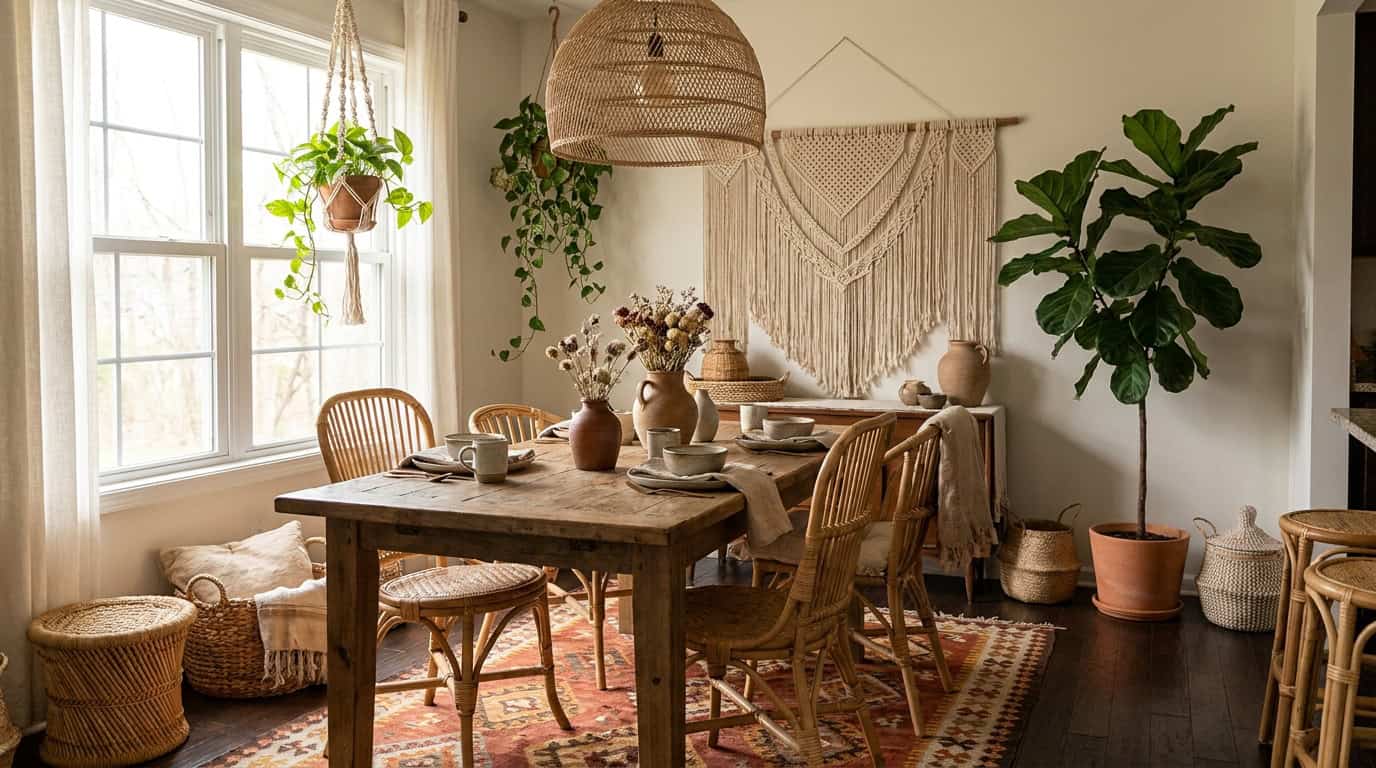
Every layer needs a scale relationship. This is where most boho rooms fall apart: too many items at the same size create visual monotony or compete for attention.
The formula is straightforward:
- Large anchor (scale 1): One statement piece per zone. A rug, a large throw draped over a sofa back, a big wall hanging.
- Medium layer (scale 2): Two or three mid-sized items. Throw pillows (18×18 or 20×20), a ceramic vase, a woven basket.
- Small accent (scale 3): Multiple small items that add density without weight. Tiny pots, taper candles, small beaded objects, stacked books.
The ratio to aim for: 1 large to 2-3 medium to 4-6 small. If your small accents outnumber your large anchors by more than 6:1, the room starts reading as cluttered rather than layered.
Ruggable’s style team (per their boho style guide) recommends choosing your rug first because it sets the dominant scale all other pieces respond to. A 5×7 rug forces smaller furniture choices; an 8×10 gives you room for larger throws and pillows.
Pattern Mixing Rules: One Dominant, Two Supporting
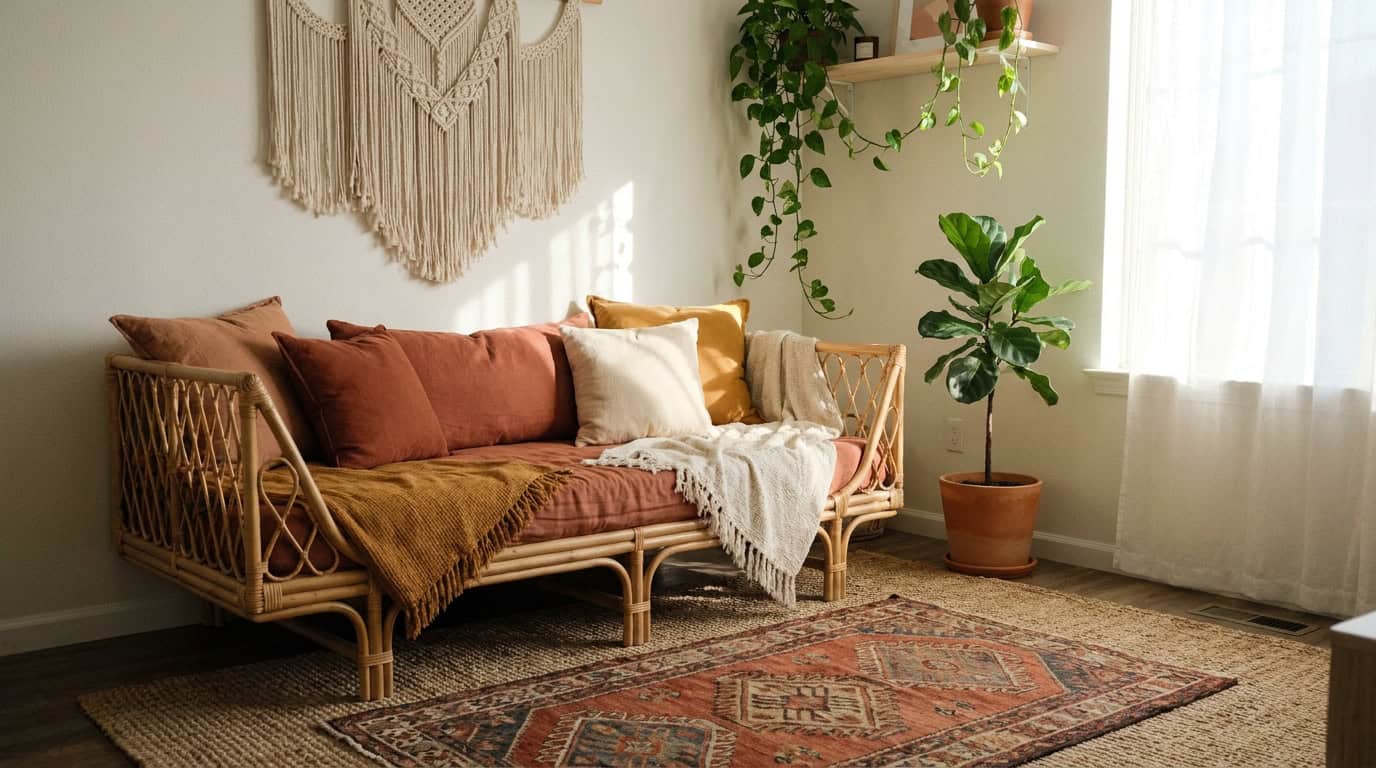
According to The Spruce’s bohemian decorating guide, successful pattern mixing follows a 1+2 structure, and it’s the rule most boho guides skip entirely.
Dominant pattern (large scale): Your rug, duvet, or largest upholstered piece. It can be bold: geometric, large floral, tribal stripe. This covers the most surface area.
Supporting pattern 1 (medium scale): A different pattern type at half the scale of your dominant. Geometric dominant pairs with a medium floral or leaf print on throw pillows.
Supporting pattern 2 (small scale): A near-solid or tight repeat: tiny stripe, subtle texture weave, tone-on-tone print. Reads almost as a solid from across the room.
Vary both pattern type AND scale simultaneously. Two large-scale geometric patterns fight each other. One large geometric with one medium floral and one small stripe creates rhythm. Color ties them: each pattern should share at least one color with the others. Our boho color palette guide covers the 12 combinations that work with these pattern types.
What most guides miss: scale does more work than color when you mix patterns. Two prints can share the exact same palette and still clash if both sit at large scale. Set your three patterns at clearly different sizes, large, medium, and near-solid, so the eye reads a hierarchy instead of a competition.
Texture Pairing: The Matte-Woven-Sheen Minimum
Texture without contrast is just sameness. After styling dozens of boho setups, our team settled on a three-texture minimum for any cohesive room.
Matte textures: Linen, cotton canvas, raw wood, unglazed ceramics. These absorb light and create depth. A linen throw pillow cover set (2-pack) runs $18-$32 at IKEA or Amazon Basics. Matte is your most common texture.
Woven textures: Jute, rattan, macrame, chunky knit, seagrass. These catch light from the side and create shadow patterns. A rattan side table at World Market runs $85-$140; a seagrass basket set at Target runs $25-$45.
Sheen textures: Hammered brass, glass, glazed ceramics, velvet. One or two pieces stops the room from looking flat. A brass candleholder set at Walmart Better Homes or Target Threshold runs $15-$28.
Target ratio: 60% matte, 30% woven, 10% sheen. No sheen = beautiful but dull in photos. Sheen over 20% = glam, not boho.
What most guides miss: the three-texture minimum still tips into chaos without a common color anchor. Pull one hue from your dominant pattern and repeat that same color across a matte piece, a woven piece, and a sheen piece. Shared color is the thread that turns three competing textures into one cohesive layer.
Common Chaos Triggers (and How to Fix Them)
Pinterest data supports what we see practically: according to Pinterest’s 2025 Predicts report, searches for “layered boho” rose 38% year-over-year, with “boho room chaos” and related problem-solving searches rising alongside it. People want the look but can’t nail the execution.
Here are the five most common problems and their fixes:
Too many colors at full saturation. Choose three colors from your dominant pattern and use only those throughout. Every other piece should share at least one.
All textiles at the same height. Apply the vertical distribution principle: add a floor pouf and one above-eye-level element to break the sofa-height plateau.
Too many patterns at the same scale. Remove all but your largest pattern, then add back one medium and one small scale.
No negative space. Empty shelf space and a bare wall stretch make layered areas pop. Boho doesn’t mean every surface covered.
Anchors that don’t anchor. A rug that’s too small floats under the furniture. Per BHG’s bohemian decorating guidance, your rug should extend at least 18 inches beyond your sofa on each side.
For room-by-room application of these fixes, our boho style decor guide covers how each fix plays out differently in living rooms versus bedrooms.
The Boho Layering Audit Checklist
Run through this before photographing or finalizing any boho room. It takes two minutes and catches 90% of the issues.
Floor layer check:
- [ ] Is there a large rug defining the main zone?
- [ ] Does the rug extend under or beyond the furniture (not floating in the middle)?
- [ ] Is there a secondary floor element (pouf, floor cushion, second rug layer)?
Mid-height check:
- [ ] Do throw pillows follow the 1+2 pattern rule (one dominant pattern + two supporting)?
- [ ] Are there at least two scale sizes among the pillows?
- [ ] Is there at least one woven texture in this zone?
Above-eye-level check:
- [ ] Is there at least one element above 5 feet (wall art, hanging plant, tall lamp)?
- [ ] Does the above-eye-level element share a color with something at floor level?
Texture check:
- [ ] Can you identify matte, woven, AND sheen in the room?
- [ ] Does any single texture type dominate more than 65% of the visual field?
Pattern check:
- [ ] Can you name the dominant pattern, supporting pattern 1, and supporting pattern 2?
- [ ] Do all three share at least one color?
Negative space check:
- [ ] Is there at least one surface or wall section that’s intentionally empty?
If you’re working on your boho bedroom, our bedroom versus living room style variations guide covers how this checklist adjusts by room type. And if you’re starting from scratch, our 7-step boho decorating walkthrough covers the full sequencing before you get to layering.
Frequently Asked Questions
How many patterns can you mix in a boho room?
Three is the practical maximum for most rooms: one dominant large-scale pattern plus two supporting patterns at smaller scales. More than three patterns at similar scales creates visual competition rather than rhythm. The key variable is scale, not quantity.
Does boho layering work in small spaces?
Yes, but the scale rule matters more. In a small apartment, your dominant pattern should be no larger than medium scale, and your rug should be the largest possible for the floor space. Our small apartment decorating guide covers boho layering specifically for constrained square footage.
What’s the easiest way to start layering boho style?
Start with the rug, then throw pillows in two complementary patterns, then one woven texture item, then one above-eye-level element. Build layers in order of visual impact.
How do you know when a boho room is over-layered?
Stand at the doorway and see if your eye has one natural resting point. If it bounces around without settling, there are too many competing elements at the same visual weight. Remove pieces until your eye lands on the largest anchor first.
What’s the difference between boho layering and just clutter?
Shared color, shared scale logic, and intentional negative space. Clutter has no color relationship between items and no breathing room. Boho layering uses restraint in some areas so the layered zones feel intentional. The boho style decor guide covers the underlying principles.
Can you do boho layering in a rental without damaging walls?
Yes. Focus on horizontal surfaces and use Command strip-compatible lightweight wall hangings. A tall floor lamp with a woven shade plus a leaning art piece create above-eye-level interest without hardware. See our rental-friendly decorating guide for product picks.
What budget do you have to start boho layering?
The core layer set (rug, two throw pillows in different patterns, one woven basket, one wall hanging) runs $120-$250 at Target, World Market, and Amazon. Building gradually also works better for layering since you can assess each addition before adding the next.
How many textures should you mix in a boho room?
Three texture families are the working minimum: matte, woven, and one with sheen. Aim for roughly 60% matte, 30% woven, and 10% sheen. Fewer than three reads flat in photos. More works only when every texture shares one common color anchor pulled from your dominant pattern.
Start With One Layer, Build From There
Boho layering isn’t about filling every surface. It’s about placing the right textures at the right scales in all three vertical zones, letting patterns relate through shared color, and leaving enough negative space that the layered areas feel intentional.
Pick one zone in your room and apply the audit checklist. Add the missing vertical layer. Fix the pattern scales. Swap in the missing texture type. The full approach is in our complete boho style decor guide. For living room-specific applications with 35 visual examples, our boho living room ideas gallery shows the layering technique across different room sizes and budgets. If you’re working on a cozy reading corner or media room, the same principles apply in our cozy living room guide.