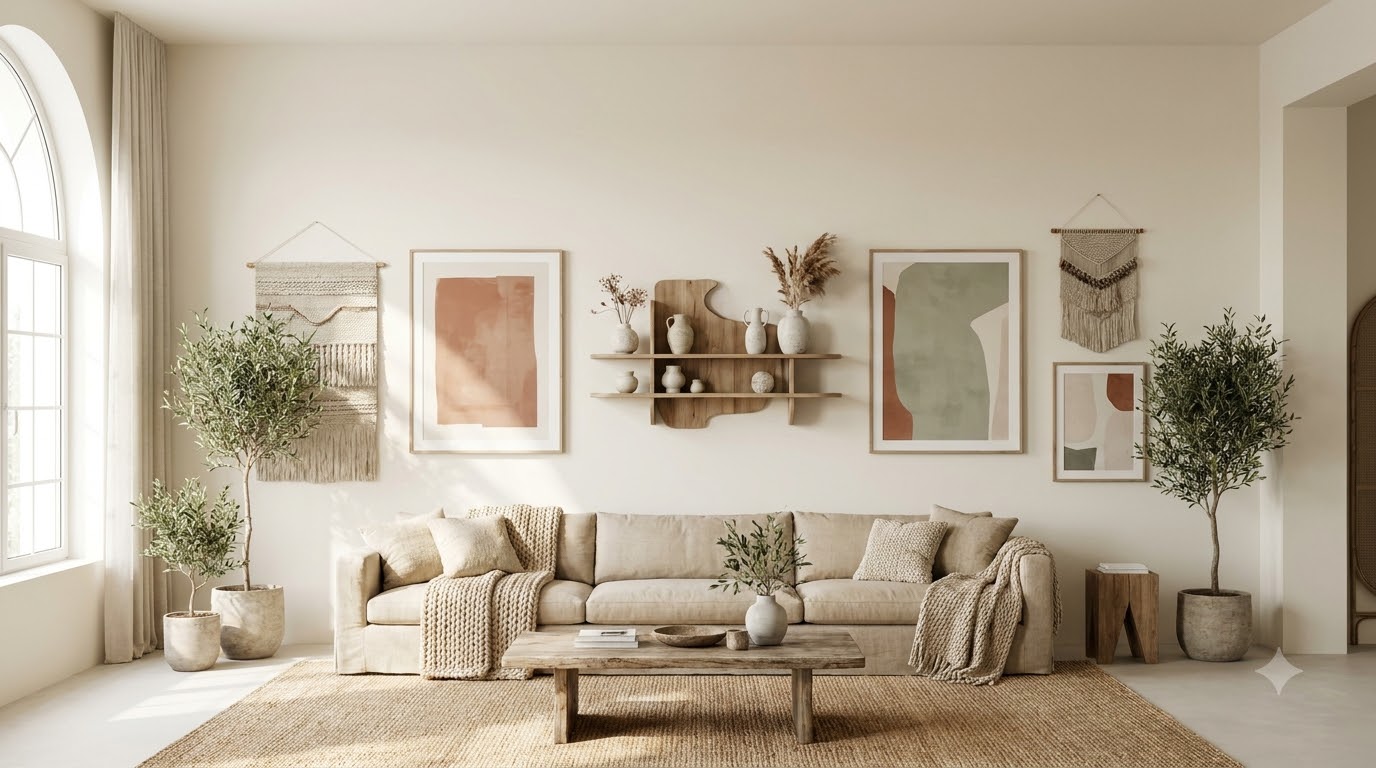
The fastest fix for a big empty wall is one piece scaled correctly, not a scatter of small frames. A single artwork should span two-thirds to three-quarters of the furniture below it, and its center should sit 57 to 60 inches from the floor (Chicago’s gallery height, the museum standard). Get those two numbers right and almost anything reads intentional. After styling dozens of rentals, here’s what to hang on that wall, sorted by budget, with the exact sizes so you don’t guess.
Key Takeaways
- Scale is the whole game: art should be 2/3–3/4 the width of the sofa or bed beneath it; anything smaller floats and looks lost
- Hang art at 57–60″ to center, or 6–10″ above a sofa back — the most common mistake is hanging too high
- One large piece beats six small frames on a big wall, and usually costs less
- Under $30: an oversized print, a large mirror, or a woven textile fills a wall fast
- Renters: Command strips rated for 10+ lbs hold most framed prints and canvases without a single nail
- Empty wall by room: behind the sofa, above the bed, and stairwell walls each want a different fix (covered below)
1. First, Measure: The Two Numbers That Decide Everything
Before buying anything, get these two measurements. They matter more than the piece you choose.
- Width target: measure the furniture below the wall, multiply by 0.67. A 72″ sofa wants art (or a grouping) about 48″ wide.
- Height to center: aim for 57–60″ from the floor to the middle of the piece. Above a sofa, leave 6–10″ between the frame bottom and the sofa back.
Wall size → art size (quick reference)
| Furniture / wall width | Single-piece art width | Or gallery cluster spans |
|---|---|---|
| 54″ loveseat | 36–40″ | 40″ wide |
| 72″ sofa | 48–54″ | 50″ wide |
| 84–96″ sofa | 56–70″ | 64″ wide |
| Bed (queen headboard 60″) | 40–50″ | 50″ wide |
| Blank wall, no furniture | 3/4 of the wall’s visual width | — |
What most guides miss: when there’s no furniture to measure against, scale to the wall itself, not the room. Measure the clear span between door or window trim and multiply by 0.55 to 0.75. A 10-foot (120″) open wall wants a piece or grouping roughly 66 to 90 inches wide. Most people undershoot by half and wonder why a “big” print still looks lonely.
2. Under $30: Fill It Fast and Cheap
These fill a wall today without draining the budget.
- One oversized engineering print ($8–20): upload a photo to a print shop, order it at 24×36″. The cheapest way to cover a big wall.
- A large round or arched mirror ($25–60 at IKEA, Target): mirrors add light and depth, and read as “decor” not “gap-filler.”
- A woven textile or flatweave rug hung as art ($20–45): texture fills space that flat prints can’t.
- A single dried palm or pampas stem in a tall wall-mounted vase ($12–18): sparse, but intentional on a narrow empty wall.
3. Gallery Wall (When One Piece Isn’t Enough)
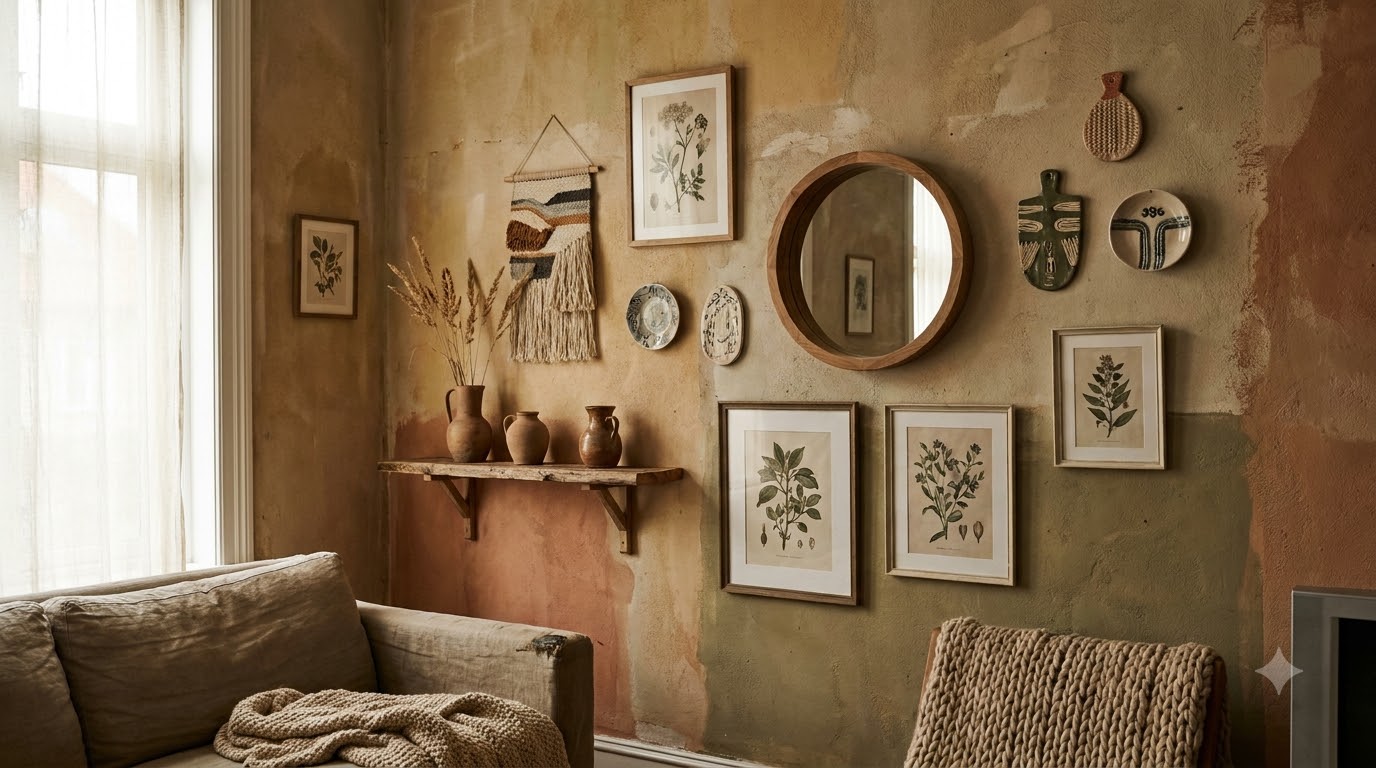
A gallery wall works when the empty wall is very wide or awkwardly shaped. The rule that keeps it from looking messy: treat the whole cluster as one rectangle, and keep 2–3″ gaps between frames. We walk through exact arrangements in the gallery wall layout templates, and the step-by-step in how to plan a gallery wall.
- Lay it out on the floor first, or trace frames onto kraft paper and tape them up
- Anchor with the largest piece slightly left of center, build outward
- Mix orientations (portrait + landscape) but keep frame color consistent
4. Empty Wall Behind the Sofa
The most-asked empty wall. Options in order of impact:
- One large landscape piece (48–54″ for a standard sofa) centered 6–10″ above the back
- A pair of matching prints side by side for symmetry
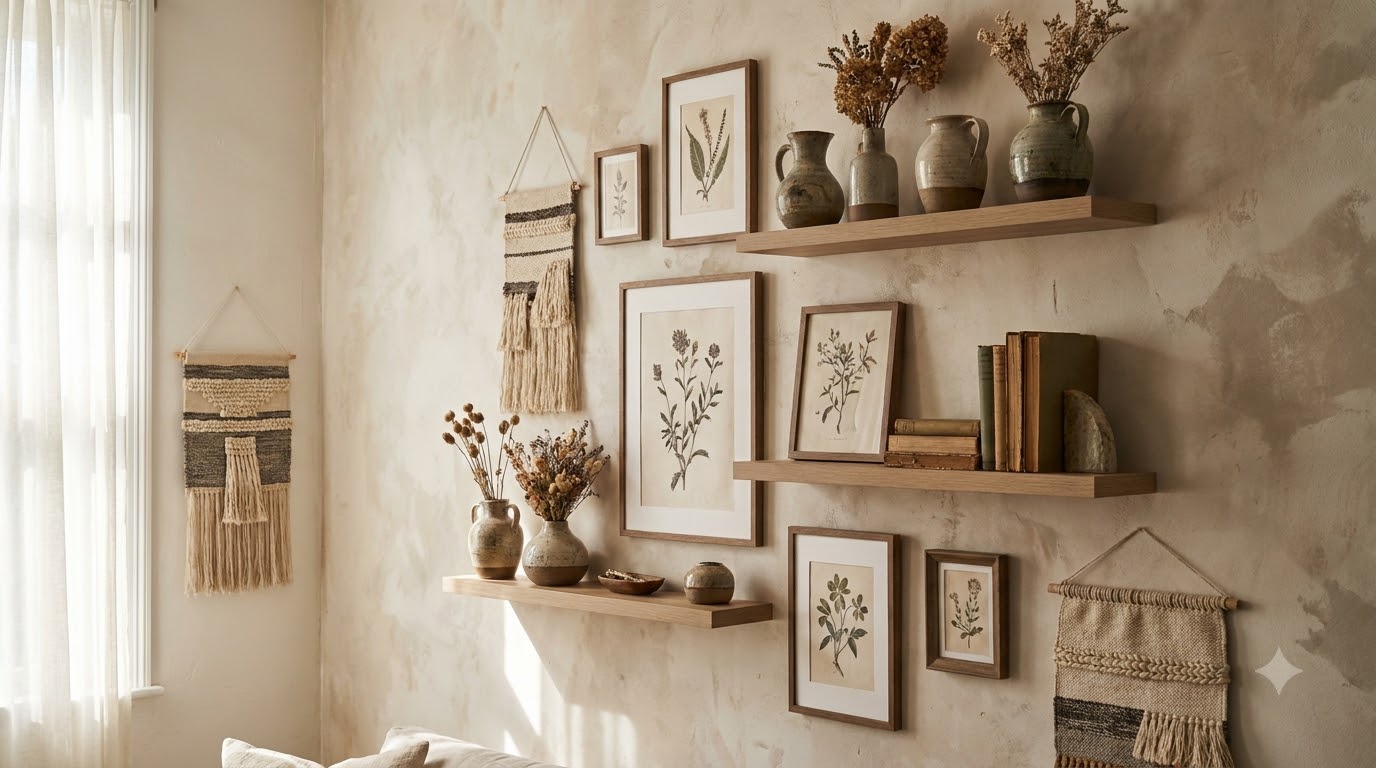
- A long horizontal shelf with leaning art + a plant (see floating shelf styling)
For the full breakdown of what to hang here, see above the couch decor.
5. Empty Wall Above the Bed
A bed wants calm, not busy. Keep it to one soft piece or a low-contrast pair, hung 6–8″ above the headboard. Full options in above the bed wall decor and no-paint texture ideas in bedroom accent wall ideas.
6. Big Blank Wall With No Furniture
The hardest empty wall, because there’s no anchor. Give it one:
- Oversized single artwork at 3/4 of the wall’s width (see large wall decor ideas)
- A grid of 6–9 identical frames for a graphic, budget look
- A tall plant + leaning floor mirror to build a corner vignette instead of a flat hang
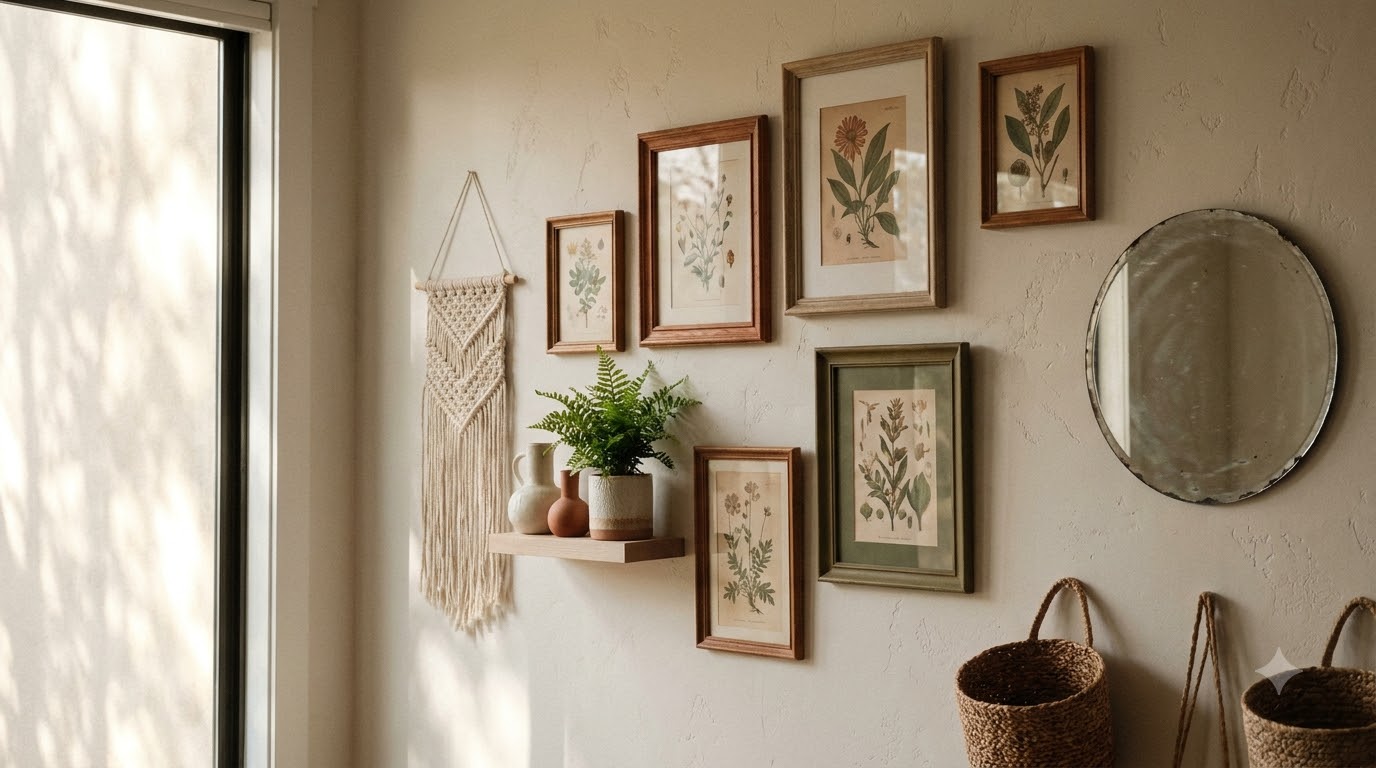
7. Renter-Friendly, No-Nail Options
- Command strips rated 10+ lbs hold framed prints up to 18×24″ with zero damage
- Picture ledges mounted with adhesive let you lean and swap art anytime
- Adhesive hooks for lightweight woven or macramé pieces
- A full budget plan for renters is in wall decor on a budget, and DIY options in cheap DIY wall art.
What most guides miss: Command strips are rated by the pair, not per strip, so weight is where renters go wrong. A “large” pair holds about 4 lbs, and a 16×20″ framed print runs 5–7 lbs with glass. Use 2–3 pairs spread across the top edge, or swap the glass for acrylic to cut weight roughly 40% and stay under the limit.
8. Get the Height and Spacing Right
Even the right piece looks wrong hung badly. The exact heights and gaps are in how to hang wall art, but the essentials:
- Center of a single piece: 57–60″ from the floor
- Above a sofa: 6–10″ above the back
- Gallery frame gaps: 2–3″, consistent
Frequently Asked Questions
What can I put on a large empty wall cheaply?
An oversized engineering print (24×36″ for $8–20), a large mirror ($25–60), or a woven textile hung as art ($20–45). One large item on a big wall almost always looks better and costs less than a set of small frames.
How high should I hang art on an empty wall?
Center the piece 57–60 inches from the floor, the standard gallery height. If it hangs above a sofa or console, leave 6–10 inches between the bottom of the frame and the furniture instead.
What size art for a big wall?
Aim for two-thirds to three-quarters of the width of the furniture below it, or three-quarters of the wall’s visual width if there’s no furniture. A 72-inch sofa wants art around 48–54 inches wide.
How do I fill a big empty wall without a gallery wall?
Use one oversized statement piece, a large mirror, a tall plant paired with a leaning floor mirror, or a long picture ledge with leaning art. A single well-scaled object reads more intentional than many small ones.
Can I decorate an empty wall without nails?
Yes. Command strips rated for 10+ pounds hold most framed prints and canvases, adhesive picture ledges let you lean and swap art, and adhesive hooks handle lightweight woven pieces, all without damage.
How much does it cost to fill a big empty wall?
Budget by solution: an oversized engineering print runs $8–20, a large round mirror $25–60, a woven textile $20–45, and a 6-frame grid roughly $40–70 with prints. Most empty walls look finished for under $60 when you pick one large anchor instead of many small pieces.