
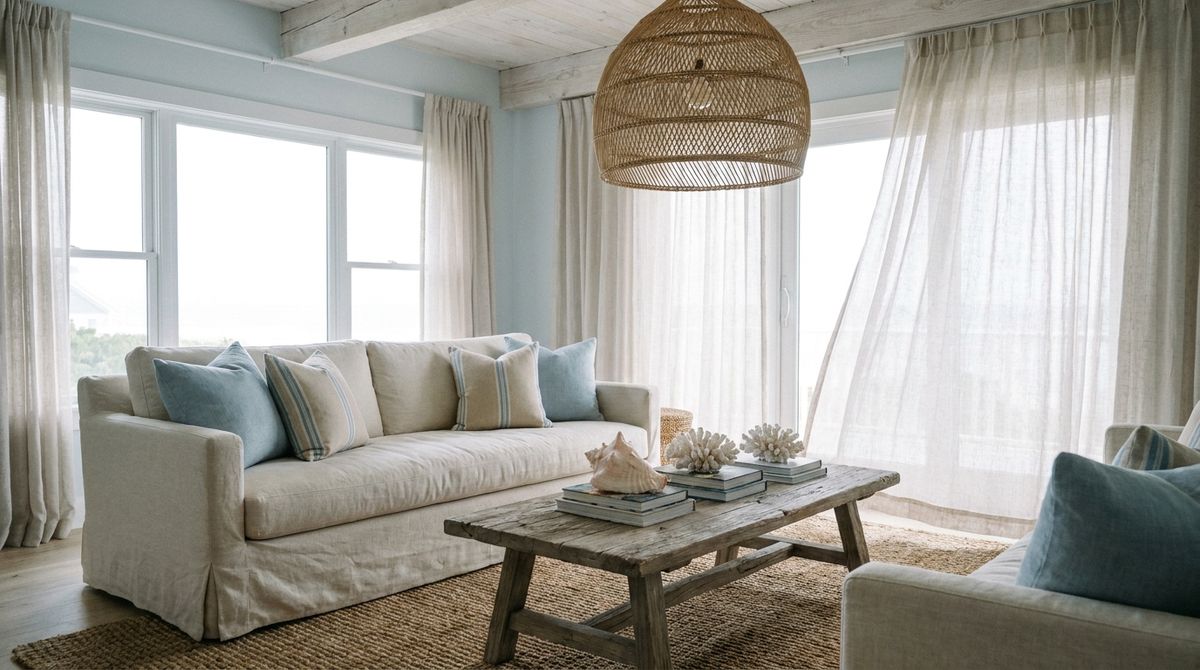
The quick distinction: coastal grandmother is aged and quiet (worn linen, inherited ceramics), classic coastal is fresh and crisp (white plus navy, rope accents), and nautical is literal and thematic (stripes, anchors, brass). “Coastal” covers at least three distinct aesthetics that look and feel quite different in practice. Coastal grandmother is quiet and sophisticated, think Nancy Meyers film sets, aged linen, and inherited ceramics. Classic coastal is the postcard version: white and navy with rope accents and shells. Nautical is the most literal, striped fabric, anchor motifs, brass hardware. Understanding the difference saves expensive mistakes and produces a more coherent result. This guide breaks down each subtype with a practical self-quiz and specific product examples.
Key Takeaways
- Coastal grandmother is the most livable subtype for most homes, because it is built on worn textures rather than new, matching pieces.
- Classic coastal works in any light condition; coastal grandmother relies on patina and texture rather than brightness.
- Nautical is best kept to single accent rooms or spaces with a genuine sailing connection, not used whole-home.
- All three subtypes work for renters, but coastal grandmother requires zero structural changes, only textiles and accessories.
What Is Coastal Grandmother Decor?
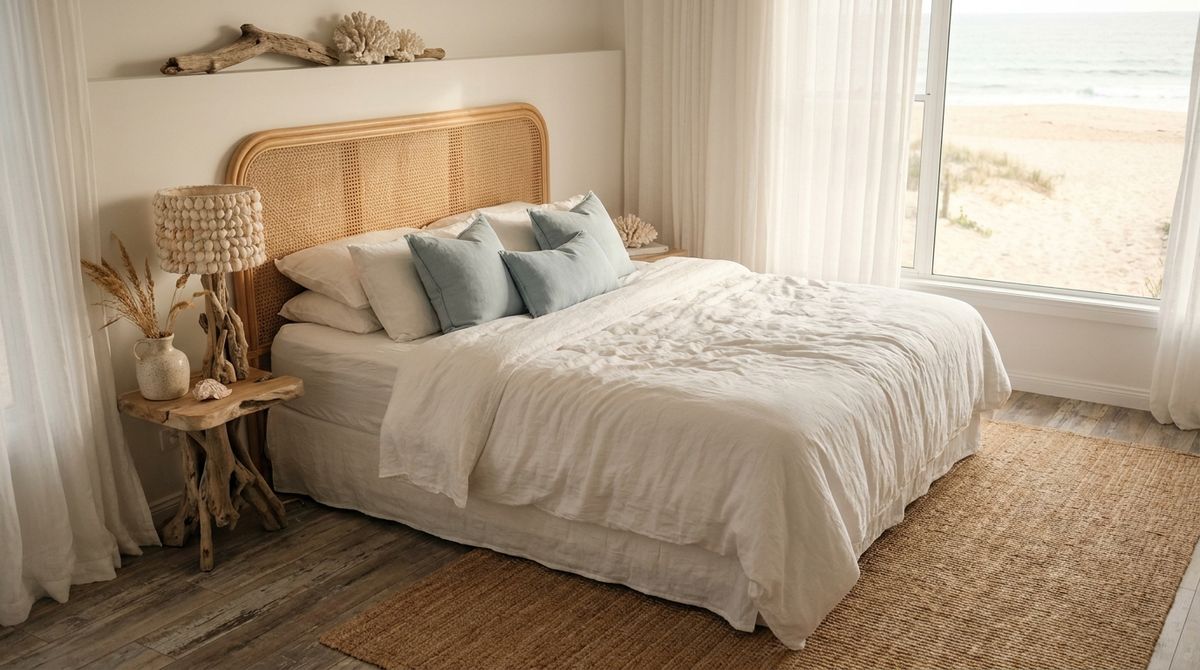
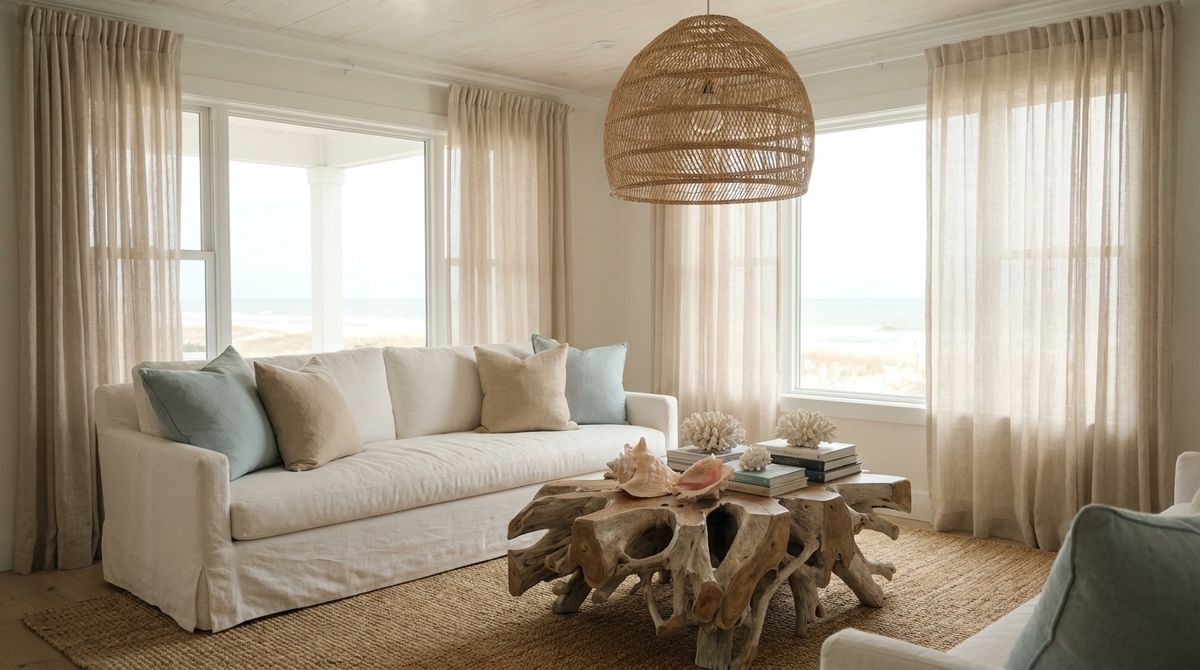
Coastal grandmother is the most livable and currently searched coastal subtype. It draws on the visual language of an older woman’s summer home: inherited ceramics, faded linen, wicker furniture worn soft by years of use, sea glass collected over decades. It’s coastal filtered through time.
No new-looking pieces, no bright colors, no graphic nautical motifs. The aesthetic is entirely built on patina and restraint. A brand-new item sitting in a coastal grandmother room looks wrong immediately. The styling trick is to choose pieces that look like they’ve been there for 20 years, whether they actually have or not.
Coastal grandmother decor is defined by aged linen, wicker furniture with visible wear, sea glass accents, and a muted palette of cream, dusty sage, and faded blue-grey.
Coastal Grandmother: Key Characteristics
Palette: Aged cream, warm white, dusty sage, faded blue-grey. Nothing crisp or bright. If it looks freshly painted, it’s wrong.
Fabrics: Heavy linen in oat or undyed tones, cotton velvet in dusty hues, a wool throw with natural variation. Avoid polyester blends entirely.
Furniture: Older wicker or rattan with some visible wear, dark-washed wood, thrifted pieces with genuine patina. New-looking pieces in matching sets are the opposite of this style.
Accents: Sea glass in a ceramic bowl, vintage coastal watercolors (not mass-produced prints), botanical field guides stacked on a side table, a single pottery piece with visible handwork marks.
What to avoid: Anything that looks brand-new, bright or saturated blue, matching furniture sets, chrome hardware, graphic patterns of any kind.
Product examples (mid-range): Aged linen pillow covers from Etsy ($18-$25), vintage-look wicker side table($55-$80), antique-finish ceramic table lamp ($45-$65), undyed linen throw ($35-$55).
What Is Classic Coastal Decor?
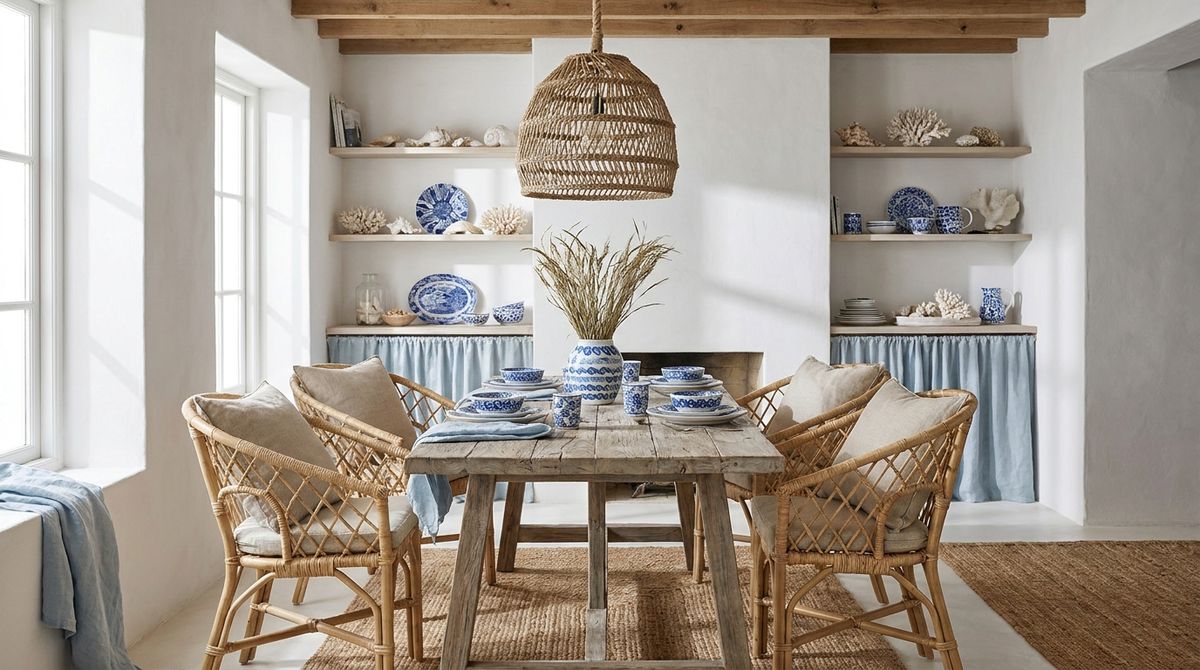
Classic coastal is the most recognized subtype and the one most people picture when they say “beach house.” A 2024 Sherwin-Williams color forecast found that blue-white interior palettes drove 28% of all paint consultation requests nationally, with buyers citing “lighter, airier feeling” as the primary goal. Done with restraint and quality materials, classic coastal reads timeless. Done poorly (too much navy, excess shell prints, plastic rope accents), it reads like a vacation rental from 2008.
The distinguishing feature is crispness. Where coastal grandmother is aged and soft, classic coastal is fresh and bright. White-painted wood, navy blue accents, rope and jute textures, and a few curated marine objects like shells or driftwood define the look. The palette has higher contrast than coastal grandmother and requires actual natural light to perform well.
Classic coastal decor relies on a crisp white plus navy palette. Key materials include whitewashed wood, cotton canvas, and navy upholstery. Unlike coastal grandmother, this subtype is defined by freshness rather than patina.
What most guides miss: the fastest way to separate coastal grandmother from classic coastal isn’t color, since both lean on cream and soft blue-grey. It’s finish and age. Coastal grandmother uses matte, worn, low-sheen surfaces; classic coastal uses crisp, clean, often semi-gloss white. Same palette, opposite finish. If you can only change one thing, change the sheen, not the hue.
Classic Coastal: Key Characteristics
Palette: Crisp white plus navy plus natural wood plus sand. Higher contrast than coastal grandmother. Nothing aged or muted.
Fabrics: Cotton, canvas, thin stripe patterns in navy and white. Light-weight linen in white or oat. Nothing heavy or velvet.
Furniture: Whitewashed or white-painted wood, navy upholstery on one anchor piece (a sofa or armchair), light rattan for accent seating.
Accents: One curated shell display (not scattered everywhere), one piece of driftwood, one or two rope-wrapped objects per room. Restraint is the difference between timeless and touristy.
What to avoid: Too much navy in a single room, literal lighthouse or anchor motifs, plastic or fake nautical items, anything that looks like a souvenir shop.
Product examples (mid-range): Whitewash finish rattan tray($20-$28), navy linen pillow covers ($16-$22), white wood frame mirror ($35-$55), cotton stripe throw in navy and white ($28-$45).
Free · 60 seconds
Not sure which style is actually yours?
Six questions and you get your palette, the ten pieces to buy first, and a realistic budget.
What Is Nautical Decor?
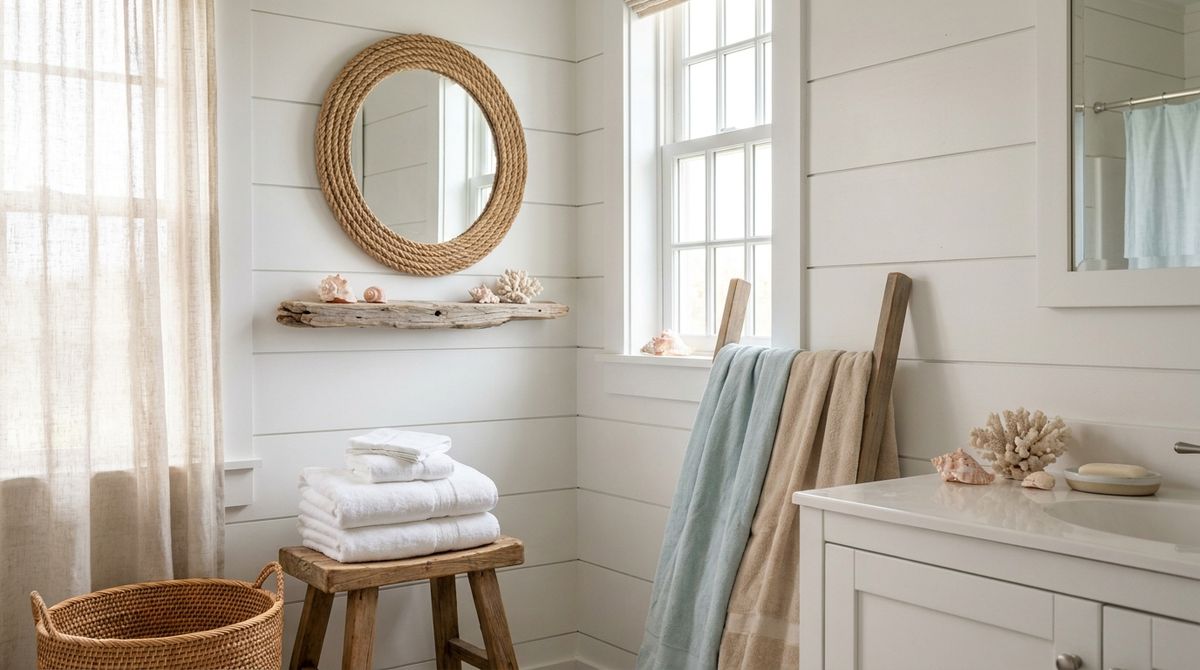
Nautical is the most thematic coastal subtype, built on direct maritime references: stripes, anchors, rope, brass hardware, compass roses, and ship’s wheel details. It’s the least in style in 2026, with coastal grandmother dominating search trends. But it works well in specific contexts. According to Apartment Therapy’s 2024 Style Survey, nautical decor ranked highest in satisfaction scores among homeowners who reported a personal connection to sailing or boating, suggesting it performs best when it’s personal rather than decorative.
The risk with nautical is commitment. When it works, it’s bold and cohesive. When it’s applied without intention, it reads as a theme park room. The safest approach is to limit nautical to one or two accent rooms rather than using it whole-home.
What most guides miss: stripe width, not stripe color, is the real dividing line between nautical and classic coastal. As a rule of thumb, stripes wider than roughly 1.5 inches read distinctly nautical, while pinstripes under half an inch read as restrained classic coastal. The navy-and-white can be identical in both; the scale of the stripe decides which style the eye lands on.
Nautical: Key Characteristics
Palette: Navy plus red plus white (the classic combination) or navy plus white plus brass. More saturated than either coastal subtype.
Fabrics: Bold horizontal stripe, canvas, sailcloth weight. Stripe scale matters: thick stripes read more boldly nautical, thinner stripes read closer to classic coastal.
Accents: Anchor motifs, rope details, compass roses, ship’s wheel. These are the elements that distinguish nautical from classic coastal. Use two or three, not all of them at once.
Best contexts: Single accent rooms, kids’ rooms, entryways, or homes with a genuine sailing and boating history. Not recommended as a whole-home aesthetic in 2026.
What to avoid: Applying full nautical theming to every room, mixing nautical motifs with coastal grandmother (the age-and-patina vs. bright-graphic contrast doesn’t resolve), using cheap rope or plastic anchor decor.
Product examples (mid-range): Canvas stripe pillow in navy and white ($14-$22), rope-wrapped table lamp ($38-$55), brass anchor wall hook set ($24-$35).
The Style Self-Quiz: 3 Questions
Not sure which subtype fits your space? Work through these three questions. They’re designed to point to one clear answer based on how you actually live, not just what you save on Pinterest.
Q1: What feeling do you want the room to produce?
- Sophisticated, calm, and timeless, like a room that’s been loved for decades. Choose Coastal Grandmother.
- Relaxed, vacation-mode, and light. Choose Classic Coastal.
- Bold, thematic, and high-commitment. Choose Nautical.
Q2: What’s your furniture starting point?
- Older, thrifted, or worn pieces with visible use. Coastal Grandmother works perfectly with these.
- New white or light wood furniture. Classic Coastal is the optimal base for this.
- Bold, mixed, or dark existing furniture. Nautical’s stripe fabric can unify contrasting pieces.
Q3: How do you feel about pattern?
- No pattern at all, only texture. Coastal Grandmother uses no graphic pattern.
- One or two subtle stripes. Classic Coastal is built around this restraint level.
- Bold stripe, anchor print, graphic maritime. Nautical is the right home for these.
The single most useful question when sorting your style is not palette preference but furniture age. If you already own vintage or secondhand pieces, coastal grandmother is usually the natural fit, regardless of your stated aesthetic preference. The existing furniture pulls the style more than the inspiration image does.
Can You Mix the Three Subtypes?
Yes, with clear rules. Some combinations are compatible; others actively fight each other.
Hybrid coastal rooms follow a clear compatibility hierarchy: coastal grandmother plus classic coastal blends well, classic coastal with a single nautical accent works, and coastal grandmother plus full nautical tends to clash.
Coastal Grandmother plus Classic Coastal: Highest compatibility. They share the same underlying palette (muted naturals and soft blue-grey) and the same material language (linen, rattan, ceramic). The difference is just the age of the pieces. Use classic coastal’s white-painted furniture as the structure and layer coastal grandmother accessories over it.
Classic Coastal with a nautical touch: Works at low doses. One striped throw or one rope basket reads as a coastal accent rather than a nautical commitment. Keep it to one item per room.
Coastal Grandmother plus full Nautical: Avoid this combination. The aged, quiet patina of coastal grandmother and the bright, graphic boldness of nautical produce visual conflict that reads as two separate decorating attempts. They don’t resolve.
Which Subtype Works Best for Renters?
All three work in rental spaces, but they’re not equally easy. Coastal grandmother is the most renter-friendly by a clear margin. The entire aesthetic runs on accessories and textiles: linen pillow covers, a ceramic lamp, a wicker side table, sea glass in a bowl. No paint, no wallpaper, no structural change required. A full coastal grandmother refresh of a living room costs roughly $120-$220 in accessories alone.
Classic coastal may require whitewashed furniture, which is easy to swap in and out on a rental timeline. The palette’s reliance on crisp white walls also means it performs better in rentals with standard white paint than coastal grandmother does.
Nautical is the least renter-friendly of the three. Bold stripe wallpaper or navy accent walls are difficult to undo, and the heavy theming looks incomplete if you can only execute it partially. In a rental, keep nautical to the entryway or a single accent wall with removable peel-and-stick panels.
Frequently Asked Questions
What is coastal grandmother aesthetic?
Coastal grandmother is an interior style defined by the visual language of a well-worn summer home: aged linen, sea glass, wicker furniture with visible use, vintage ceramics, and a muted palette of cream, dusty sage, and faded blue-grey. It’s the quietest and most sophisticated of the three main coastal subtypes, with zero graphic pattern and a heavy reliance on texture and patina.
Is coastal grandmother the same as grandmillennial style?
No. Grandmillennial style (sometimes called “granny chic”) is more maximalist and leans on traditional pattern: chintz, toile, needlepoint, and ornate furniture. Coastal grandmother is quieter and specifically coastal in its material choices. Both reference older aesthetics, but coastal grandmother edits down while grandmillennial layers up. They can share a ceramic piece or a rattan chair, but the overall rooms feel quite different.
How do I make my home look coastal grandmother?
Start with the fabrics. Swap any polyester or bright-white pillow covers for heavy undyed linen in oat or cream. Add one wicker or rattan piece with visible wear (thrift stores are the best source). Replace any shiny or chrome hardware with antique brass or matte ceramic. Collect sea glass or smooth river stones in a ceramic bowl. Keep every surface calm and avoid anything that looks mass-produced or brand-new. Budget: $80-$180 for a full accessory refresh.
What’s the difference between coastal and nautical decor?
Coastal decor is a broad category covering three subtypes (coastal grandmother, classic coastal, and nautical). Nautical is the most literal and thematic subtype within coastal, built on direct maritime references: anchor motifs, bold stripe, rope, and brass hardware in a saturated navy-red-white palette. Classic coastal is more restrained, using the ocean as a feeling rather than a theme. Coastal grandmother removes marine objects almost entirely and focuses on the age and texture of a home near the sea.
What’s the difference between coastal grandmother and classic coastal?
They share nearly the same palette of cream and soft blue-grey, so color alone won’t tell them apart. The real difference is finish and furniture age. Coastal grandmother uses matte, worn, low-sheen surfaces and thrifted pieces with visible patina. Classic coastal uses crisp, semi-gloss white and fresh, newer furniture. Coastal grandmother reads aged and quiet; classic coastal reads bright and airy, and needs genuine natural light to perform.
Does coastal grandmother work in a low-light apartment?
Yes, better than classic coastal does. Coastal grandmother relies on patina and texture rather than brightness, so a dim room actually flatters its muted, layered palette. Classic coastal’s crisp white-and-navy contrast needs real natural light to avoid looking flat or grey. In a north-facing or basement rental, lean coastal grandmother and add warm-toned lamps ($45-$65 each) for layered light.
The Bottom Line
The clearest way to separate the three: coastal grandmother is for people who want quiet sophistication and already own (or want to source) worn, vintage pieces. Classic coastal is for people who want a light, vacation-easy room with fresh white furniture and a restrained navy accent. Nautical is for people with a genuine connection to sailing or a single accent room that can carry bold theming.
Start with the furniture you already own. Worn, thrifted pieces point to coastal grandmother. New white or light wood points to classic coastal. And if you’re decorating a kids’ room or an entryway and want high visual impact with a clear theme, nautical delivers that in a contained space without requiring a whole-home commitment.
Ready to go deeper? Our coastal decor guide covers the full spectrum of coastal interiors, and our coastal color palette guide walks through which specific paint shades and textile tones work room by room.
coastal decor guide
coastal color palette
how to get the coastal look