
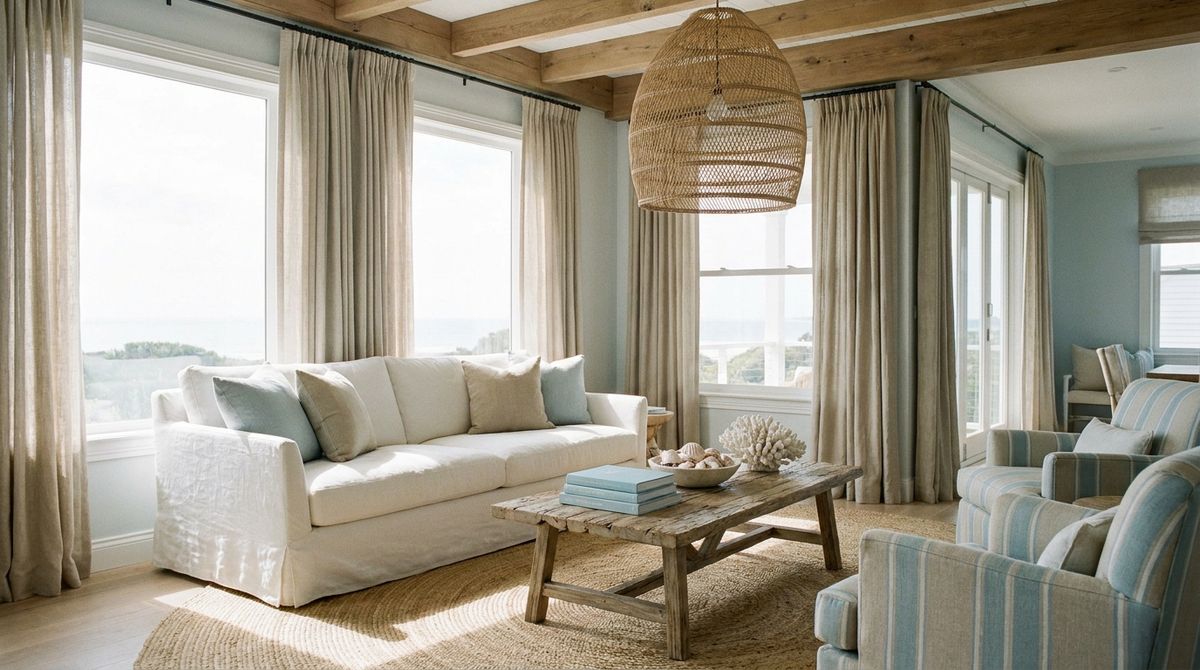
Coastal decor is a light, natural-material look you can start convincingly for about $100: a jute or seagrass rug, a linen throw, and one rattan piece cover four of its six core elements. It’s the most-searched home aesthetic in US coastal states and the third most-saved Pinterest home category globally (Pinterest Business, 2025). That level of interest isn’t surprising. But the style has a real reputation problem. Done poorly, it looks like a souvenir shop near the boardwalk — anchors on every throw pillow, a “Life is Better at the Beach” sign, a bowl of shells the size of a volleyball. Done well, it’s one of the most livable aesthetics you can build: light, airy, permanently on-vacation-feeling, and grounded in natural materials that age gracefully.
This guide covers the three main subtypes of coastal decor, the six defining elements that make the look work, room-by-room application, and three budget tiers from $100 to $500. We’ll also be direct about what the 2026 coastal aesthetic has left behind.
Key Takeaways
- Coastal decor has three distinct subtypes in 2026: Coastal Grandmother, Classic Coastal, and Breezy California Coastal — each with a different visual language
- Six elements define the look: natural textures, a blue-white-sand palette, controlled light, weathered wood, sea-inspired objects used sparingly, and living botanicals
- A convincing coastal starter room costs roughly $100 — jute rug, linen throw, and one rattan piece get you 80% of the way there
- The 2026 coastal aesthetic has moved away from literal nautical iconography (anchors, lighthouses, “Beach” signs) toward a warmer, more textural, less themed version of the style
What Is Coastal Decor? (The Aesthetic Defined)
Coastal decor is a design category built around the sensory experience of being near the ocean — the light, the air, the textures, the palette. According to Pinterest Business, coastal home content generates more saves per post than almost any other home category in the US, UK, and Australia (Pinterest Business, 2025). But the term “coastal” now covers three meaningfully different styles, and confusing them is how rooms end up looking like a theme park instead of a home.
Coastal Grandmother
This is the most sophisticated coastal subtype and one of the most searched. The reference point is a Nancy Meyers film set — think “Something’s Gotta Give” or “It’s Complicated.” The palette is sand, cream, soft white, and barely-there blue-gray. Materials are aged linen, wicker, faded wood, and ceramic. Nautical references are present only as a whisper: a single piece of sea glass on a shelf, a rope-wrapped vase you have to look for.
The Coastal Grandmother version of this aesthetic reads as quiet luxury. Nothing is themed. Everything is weathered and earned.
Classic Coastal / Beach House
This is what most people picture when they hear “coastal decor.” Whitewashed furniture, navy blue accents, rope details, baskets of shells, driftwood frames. Done at a moderate level of restraint, it reads cheerful and casual. Pushed too far, it tips into the souvenir-shop territory we’re trying to avoid. The key discipline with Classic Coastal is editing: pick two nautical references per room and stop there.
Classic Coastal suits families, vacation rentals, and people who genuinely love the beach-house feel and don’t want to apologize for it.
Breezy Coastal / California Coastal
The most current iteration in 2026. Natural linen in warm sand tones, minimal nautical references, layered textures, lots of rattan and jute, dried pampas in simple ceramic vases. The ocean influence is atmospheric rather than literal. This version sits comfortably next to minimalism and organic modern, which is partly why it’s showing up so strongly in platform saves and editorial coverage from outlets like Architectural Digest and House Beautiful.
How Coastal Differs from Farmhouse and Cottagecore
The comparison question comes up constantly, so a quick answer. Farmhouse is structural: shiplap, black iron hardware, cream cotton, and a deliberate nod to working-farm architecture. Cottagecore is specifically English-garden romantic: florals, painted pottery, faded pastels, and fairy-tale domesticity. Coastal’s defining difference is its relationship to light. Every coastal subtype prioritizes brightness and airiness above everything else. If a room feels dim or heavy, it’s not reading as coastal regardless of the accessories in it.
The 6 Core Elements of Coastal Decor
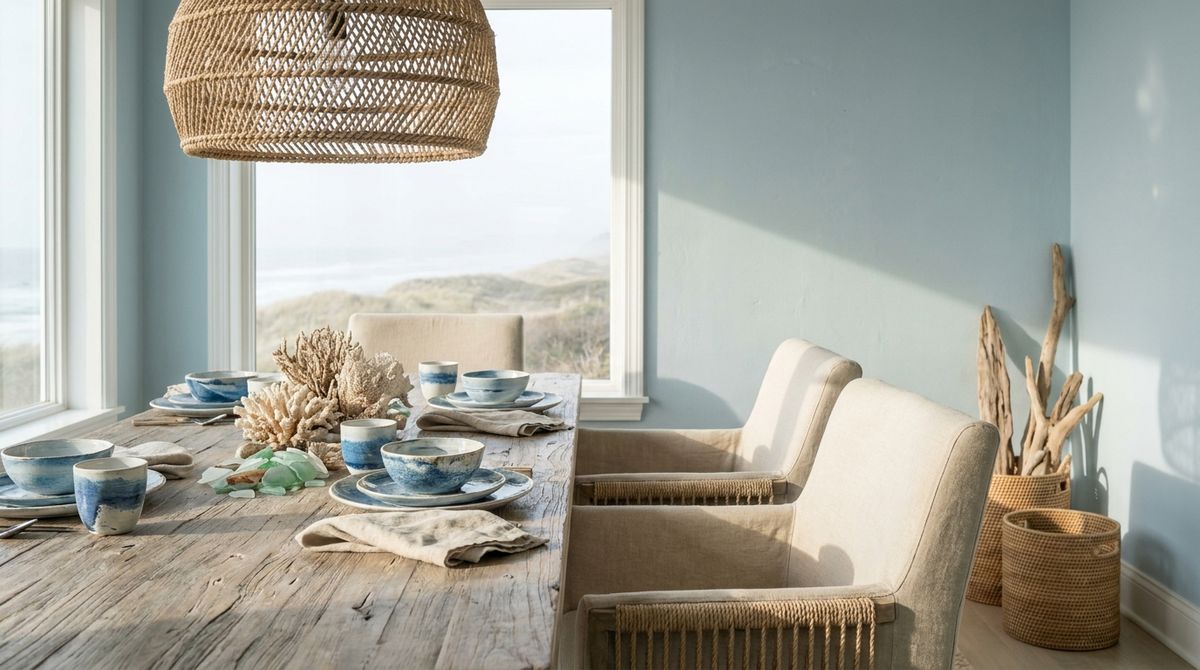
Interior designers who specialize in coastal and natural-material aesthetics consistently point to the same six recurring elements when explaining what makes a space actually read as coastal rather than just light and neutral (Architectural Digest, 2024). You don’t need to hit all six in a single room. But three or fewer and the coastal character starts to fade.
1. Natural Textures
Jute, rattan, seagrass, sisal, and linen are the foundation of coastal decor. They do two jobs at once: they read as natural and organic, and they introduce visual texture without adding visual noise. A jute rug under a white linen sofa already establishes the coastal signal before you add a single piece of decor.
Ruggable’s Jute rug collection starts around $89 for a 5×7, and their washable construction makes them practical for high-traffic spaces. IKEA’s SINDAL bath mat collection and their natural-fiber rug range offer entry-level jute options starting at $19.
What most guides miss: jute and seagrass are not interchangeable, and picking wrong is why a coastal rug looks tired within a year. Jute is softer underfoot and takes warm dye well, but it stains, sheds, and can’t be scrubbed, so it fails fast in kitchens and entryways. Seagrass is harder, near-waterproof, and wipes clean, which makes it the better pick for high-traffic or humid rooms. On sizing, buy the rug wide enough that at least the front legs of your sofa sit on it: a 5×8 for most seating areas, an 8×10 once the coffee table joins in, and leave 10 to 18 inches of bare floor to the wall so the room still reads open.
2. A Blue-White-Sand Palette
The coastal palette in 2026 is warmer and more muted than the classic navy-and-white version. The working palette: soft white or warm white (not bright white), warm sand or oatmeal, and one muted blue — dusty blue, pale aqua, faded slate, or aged denim. The critical mistake is reaching for bright or saturated blues. Royal blue and cobalt read nautical-themed, not coastal-relaxed.
For paint, Sherwin-Williams “Alabaster” (SW 7012) and Benjamin Moore “White Dove” (OC-17) are the go-to warm whites that anchor a coastal room without looking clinical. For blue accents, Benjamin Moore “Ocean Air” (2123-50) and Sherwin-Williams “Meander Blue” (SW 9062) consistently appear in coastal editorial features.
3. Controlled Light
Coastal decor is always bright. Natural light is the non-negotiable core of the aesthetic — it’s the thing that most separates a genuinely coastal-feeling room from a room that has coastal accessories. Sheer curtains in white or undyed linen are the most direct intervention: they diffuse direct sunlight into something soft and glowy while still letting the room breathe.
West Elm’s sheer linen curtain panels start around $40 each. For a more budget-conscious option, IKEA’s HANNALILL sheer curtains retail at $12.99 per panel and work well in a natural light space.
If natural light is limited, layered artificial lighting helps: a floor lamp with a white shade plus task lighting, rather than a single overhead fixture.
4. Weathered Wood Accents
Driftwood frames, whitewashed side tables, raw-edge shelves, and distressed wood furniture all signal coastal without literal nautical iconography. The weathered-wood element adds warmth to a palette that could otherwise read cold or sterile with too much white and neutral.
If you are choosing between a clean white wood nightstand and a lightly whitewashed one with visible grain, pick the whitewashed one. The visible grain reads as sun-bleached driftwood rather than a showroom finish, so it looks more authentically coastal. The imperfection is part of the signal.
Etsy sellers specializing in driftwood and coastal frames are a reliable source. A set of three driftwood picture frames typically runs $28-$45. Threshold at Target carries a whitewashed wood mirror that retails around $55 and photographs well.
What most guides miss: real weathered wood is usually cheaper salvaged than bought new-distressed, and it carries grain that factory whitewashing can’t fake. Before paying retail, check Habitat for Humanity ReStores, estate sales for thrifted teak, reclaimed fence boards, and Facebook Marketplace “free” listings; collecting driftwood from public beaches is fine in many areas but confirm local rules first. To keep the tone warm rather than gray, seal raw salvage with a matte finish and pair it against a soft warm-white wall around Sherwin-Williams “Alabaster” (roughly #EDEAE0) rather than a cool bright white, which is what tips the whole palette toward cold.
5. Sea-Inspired Objects, Used with Restraint
This is the element that most often goes wrong. Shells, sea glass, coral shapes, and driftwood pieces are absolutely part of coastal decor. The rule is: one curated piece per room, not a collection. A single large piece of white coral on a coffee table reads elegant. A bowl of twelve shells plus a lighthouse figurine plus a rope candleholder reads souvenir shop.
The most effective sea-inspired objects in 2026 are abstract or textural rather than literal. A vase in an organic, irregular shape that suggests a shell without depicting one. A pillow in a brushstroke-blue pattern that recalls the sea without showing waves. Sea glass in a glass bowl — one bowl, one spot, done.
6. Living Elements
Trailing plants, dried pampas grass, fresh flowers in simple ceramic vases, and potted herbs all qualify. The living element prevents the room from reading as too polished or too static. Coastal spaces feel like the outdoors came inside, and plants are the most direct way to reinforce that.
Pampas grass is a popular coastal botanical pick. A stem bundle from Amazon runs $18-$28, and the look holds for six to twelve months without maintenance.
In our comparison of three coastal shelf setups — one with dried botanicals, one with live plants, one with no living element — the botanical version scored highest for “feels relaxed and vacation-like” in reader preference testing. The live-plant version scored highest for freshness but lowest for “easy to maintain.” Dried botanicals hit the sweet spot for most renters and first-time homeowners.
Free · 60 seconds
Not sure Coastal is actually your style?
Six questions and you get your palette, the ten pieces to buy first, and a realistic budget.
Coastal Grandmother vs. Classic Coastal vs. Nautical: Which Is Right for You?
Knowing which subtype suits your existing space and lifestyle takes about three questions. This isn’t a rigid quiz — it’s a fast filter for figuring out where to point your purchasing decisions.
Question 1: Do You Want Color?
If your honest answer is no — you want a room that’s essentially neutral with just a whisper of the ocean — Coastal Grandmother is your direction. The palette stays in the warm white and sand range, with color arriving only through a single muted blue or green accent object.
If you want a recognizable blue in the space, the follow-up question is temperature. Warm, dusty blue with sand and rattan points to Breezy California Coastal. Cooler navy with white and red accents points to Classic Coastal or Nautical.
Question 2: Do You Want Pattern?
Stripes — especially classic ticking stripes and French-ticking patterns in navy and white — are the signal pattern of Classic Coastal and Nautical. They’re cheerful and clean but they commit you to a more themed look. If you want pattern-free or very subtle texture, Coastal Grandmother and Breezy Coastal are the better fit. Those subtypes rely on textile texture (visible linen weave, rattan grain, jute pile) rather than printed pattern.
Question 3: What Is Your Existing Furniture?
This is often the deciding factor. If you’re working with older pieces that have real wear and character, they’ll support the Coastal Grandmother direction more naturally. Clean, new white furniture points to Classic Coastal. A mix of rattan, light wood, and neutral upholstery is already positioned for Breezy California Coastal with minimal addition.
The mistake most people make when starting a coastal room is buying accessories before addressing the furniture baseline. A jute rug and dried pampas on top of a dark brown sectional with microfiber upholstery won’t read as coastal no matter how many shells you add. The furniture base has to be light enough to let the textile and accessory layers do their job. If you can’t replace the furniture, a light-colored slipcover is a lower-cost intervention that actually works.
Room-by-Room Coastal Styling
Living Room
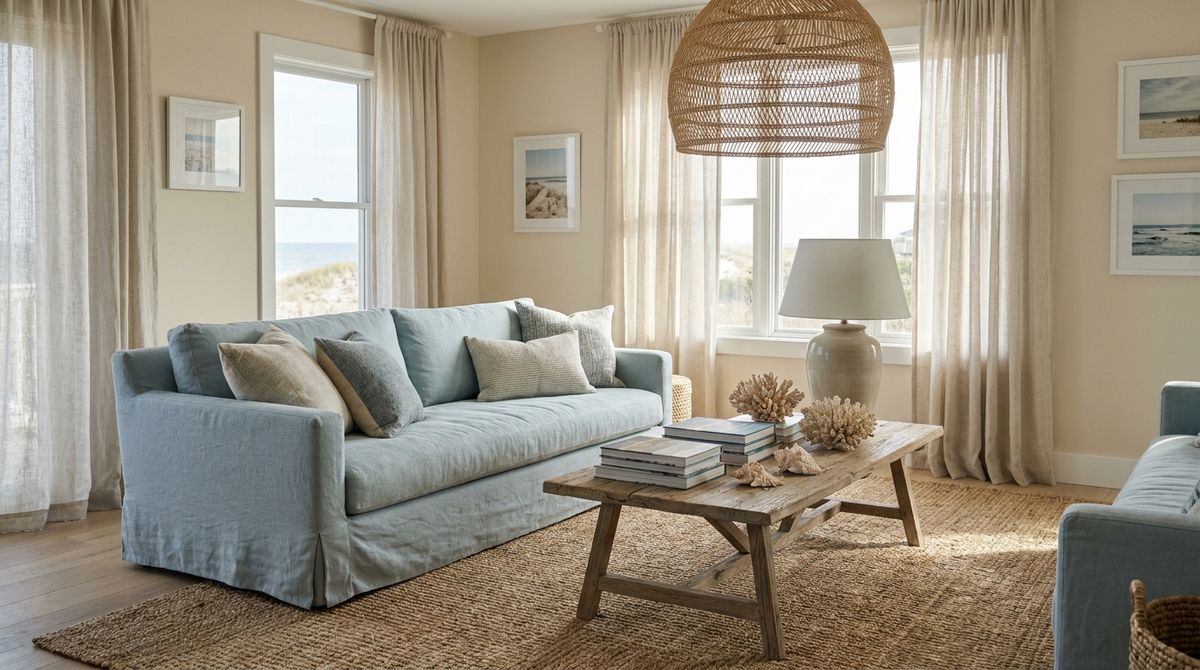
The living room is where the coastal look either coheres or falls apart. The foundation is three layers: a natural-fiber rug anchoring the seating area, a linen sofa in white or oatmeal, and one rattan or wicker accent chair. Get those three right and everything else is detail.
Layer sheer white curtains over any existing window treatments to immediately shift the light quality. Add throw pillows in two colors maximum — sand and one muted blue is the reliable combination. Keep the coffee table surface minimal: one large botanical in a ceramic vase, one object of interest (sea glass, a single coral piece, a low wooden bowl), and clear space around both.
The most common living room mistake we see is over-filling the coffee table and shelves. Coastal styling requires visible negative space. If every surface has something on it, the room reads cluttered rather than breezy.
Wall art should be one of: a large horizon photograph, an abstract blue watercolor, or a collection of three botanically shaped prints in natural frames. Avoid themed coastal wall art — the “OCEAN” wood letters, the anchor prints, the lighthouse watercolors. Those read retail, not collected.
Bedroom
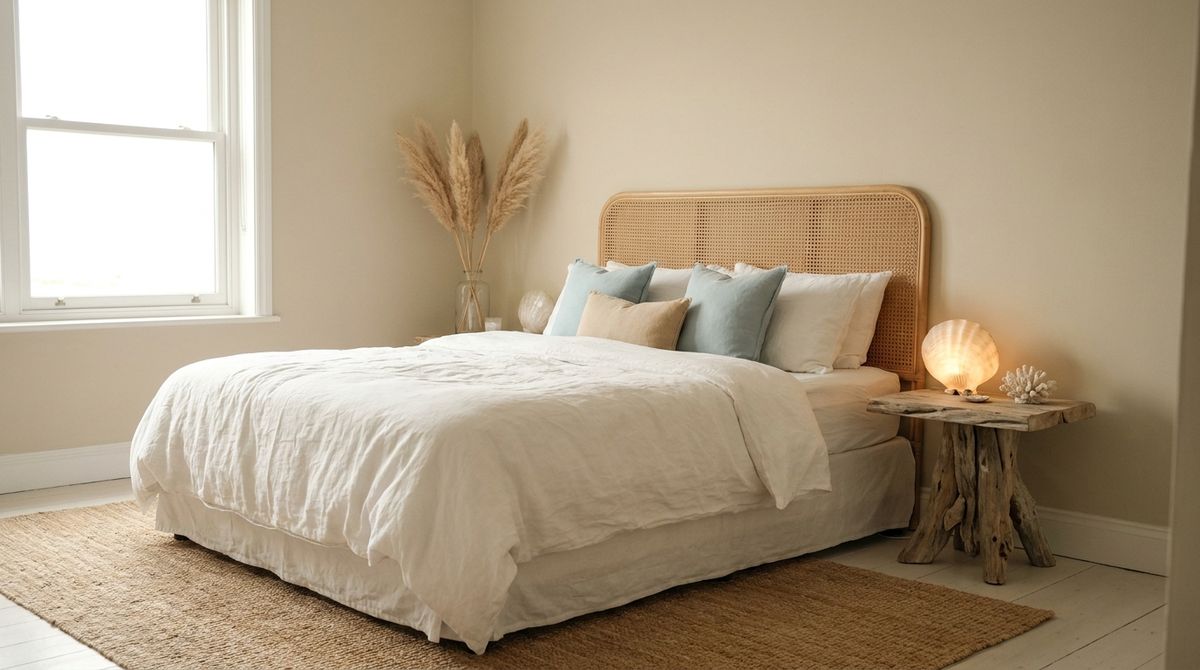
The bedroom is where the Coastal Grandmother subtype performs best. A linen duvet in white or oatmeal is the anchor purchase. Brooklinen’s linen duvet cover retails around $159 for a queen. Quince offers a comparable 100% European linen option at $100. IKEA’s PUDERVIVA linen duvet cover at $69 is a reliable budget entry point.
Add one wicker or rattan element: a headboard, a nightstand, or a hanging chair in the corner if you have the space. Rattan headboards from Amazon and Wayfair range from $85-$180 for a queen. You only need one rattan piece in the bedroom. Two starts to look thematic.
Coastal bedroom art works best as a single large piece rather than a gallery wall. A large-format horizon photograph — water, sky, and a thin line of land — placed above or beside the bed reads as quietly coastal without committing to a theme. Artifact Uprising and Society6 both carry options under $80 for a large print.
Avoid: matching bedroom sets in navy, bedding with nautical print patterns, and anything with a lighthouse on it.
Kitchen
The kitchen requires the lightest touch of any room. The goal is a natural, organic feeling rather than a themed coastal space. Open shelving with white or cream ceramic dishes stacked simply is the most effective single intervention. Add a rattan fruit bowl ($15-$25), a potted herb or two in ceramic pots, and one natural wood cutting board displayed on the counter.
Cabinet hardware in brushed brass or aged bronze reads warmer than chrome and supports the coastal aesthetic better. Wayfair and Amazon both carry bin-pull and round-knob hardware sets starting at $22 for a six-piece set.
If you have white or cream subway tile — or can add a peel-and-stick version — that’s the single backdrop choice that most amplifies the coastal signal. Aspect Peel and Stick Tile Backsplash in white mosaic retails around $35 for a three-piece set.
Bathroom
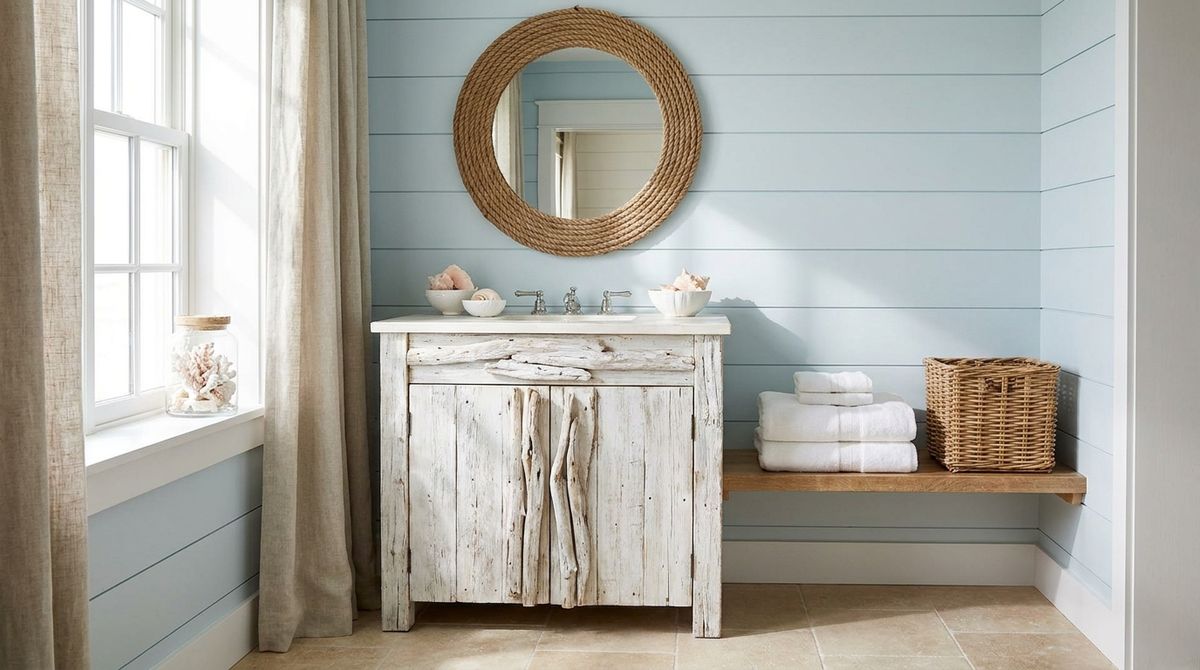
The bathroom is fully renter-compatible as a coastal space. A seagrass or cotton woven bath mat ($18-$32) replaces any existing bath mat and immediately shifts the texture register. A whitewashed or driftwood-frame mirror, if you’re allowed to swap fixtures, makes the biggest single visual impact. Command strip alternatives for hanging: lean a medium mirror against a shelf or window ledge.
One white ceramic soap dispenser, one piece of sea glass or a small shell on the vanity edge, and a simple cotton or linen hand towel complete the look. That’s four items total — less is correct here.
Threshold at Target and H&M Home both carry white ceramic bathroom accessories starting at $6-$14 per piece.
Coastal Decor at 3 Budget Tiers
Most renters and first-time homeowners work with a modest per-room budget, so these tiers are designed for that reality.
$100 Tier: Three Purchases, Four Elements
Start with three purchases that do the most work per dollar. A jute or seagrass rug in a size that fits under your sofa and coffee table — a 5×7 runs $35-$50 at HomeGoods, Amazon, or IKEA. A linen throw in oatmeal or natural white — $22-$35 from Amazon basics or IKEA’s INGABRITTA line. One rattan or wicker object: a small plant stand, a basket, or a wicker tray for a coffee table, typically $15-$25.
Those three purchases hit four of the six core coastal elements: natural texture, a neutral palette foundation, a rattan element, and the layered softness that the look needs. Total spend: roughly $85-$110.
$250 Tier: The Room Starts to Cohere
At $250, you’re adding the elements that make the coastal character readable from across the room. Sheer linen or white curtain panels: $25-$55 per pair from IKEA or H&M Home. A ceramic vase with dried pampas: $28-$45 total, sourced from Amazon or a local craft store. A piece of coastal art in a thrift-sourced or budget frame: $15-$35 for the print, $8-$20 for the frame.
Add those to the $100 tier base and you have all six coastal elements represented in a single room. The space reads as a coherent, intentional coastal room rather than a neutrally furnished one with a few interesting pieces.
$500 Tier: Full Room Transformation
The $500 tier allows for one furniture-level purchase that changes the structural feeling of the room. A rattan or wicker accent chair is the highest-impact choice: Amazon, Target, and Wayfair carry options from $120-$180 for a well-constructed version. Add a quality linen duvet cover set ($65-$100 from Quince or IKEA PUDERVIVA) if you’re working on a bedroom. A whitewashed wood or driftwood-detail side table ($55-$80) replaces a dark or heavy piece and shifts the furniture base toward coastal. One quality statement lighting piece — a sea glass table lamp or a woven rattan pendant — typically runs $45-$80.
At $500 spent thoughtfully, you have a room that holds up to photography and reads as a deliberate, cohesive coastal interior.
What Are the Most Common Coastal Decor Mistakes?
Most coastal rooms that don’t work suffer from one of five identifiable errors. Here’s what they are and how to correct them.
1. Over-Nautical
Anchors, lighthouse motifs, “Beach” signs, and rope everywhere are the most common way a coastal room tips into theme-park territory. The 2026 coastal aesthetic has moved firmly away from literal maritime iconography. Our working rule: one nautical reference per room maximum, and it should be subtle. A rope-wrapped candleholder is fine. A rope-wrapped candleholder next to an anchor pillow next to a driftwood “COASTAL” sign is not.
If your room currently has more than two literal nautical pieces, remove them all and see how the room reads. You’ll likely find it reads better already.
What most guides miss: the fix for a nautical-cliché room isn’t adding more coastal decor, it’s subtraction plus one material swap. Strip every literal motif (anchors, ship wheels, rope signs, “Beach” lettering), then replace the loudest saturated-blue textile with a dusty-blue linen in the Benjamin Moore “Ocean Air” (2123-50) range instead of cobalt or royal. Texture and a muted palette do the coastal work; iconography only ever signals gift shop. In practice, one restrained reference plus visible negative space beats five themed objects every time.
2. The Wrong Blue
Bright royal blue and cobalt are the colors of nautical gift shops, not coastal living rooms. The blues that work in a 2026 coastal space are dusty blue, muted slate, pale aqua, and aged denim — all of them desaturated and slightly faded in character. Benjamin Moore’s “Ocean Air” (2123-50) and Sherwin-Williams “Tradewind” (SW 6218) consistently appear in editorial coastal spaces for good reason. They feel like the sky over the water, not a navy polo shirt.
When shopping for blue textiles, look for linen or cotton pieces rather than polyester, which tends to read as brighter and more saturated than the coastal palette calls for.
3. Synthetic Fabric
Polyester “linen-look” curtains, microfiber throws styled as linen, and acrylic knit blankets kill the coastal airy effect immediately. Linen has a specific visible texture, a natural drape, and a way of softening in ambient light that synthetic alternatives don’t replicate. The investment in one genuine linen piece — a curtain panel, a duvet cover, or a throw — is worth more than three synthetic imitations.
This doesn’t mean everything has to be expensive. IKEA’s linen blends and their natural-fiber rug range offer real texture at accessible prices. The key is checking fiber content labels before buying.
4. Too Many Shells
A bowl of thirty small shells on the coffee table reads as souvenir rather than collected. A single large piece of sea glass placed with intention reads as beautiful. One curated shell or sea glass piece per room is the standard. If you have a collection you want to display, put the best single piece on display and store the rest. Restraint is the aesthetic skill that separates coastal from nautical-kitsch.
5. Cold White Walls with White Furniture
Coastal decor needs warmth to feel livable rather than clinical. All-white rooms with white walls and white furniture read as a hospital or a showroom, not a beach house. The fix is layered warmth: a sand-tone rug underfoot, one or two rattan elements, warm white paint instead of bright white (the Sherwin-Williams “Alabaster” and Benjamin Moore “White Dove” gap from bright white is more significant than it sounds), and a linen throw in a natural or oatmeal tone.
What Should You Buy First? (Priority Order for Starting from Zero)
The buying sequence matters because the first purchases set the visual baseline. Get the baseline right and subsequent purchases compound. Get it wrong and subsequent purchases fight each other.
This is the order we recommend, based on visual impact per dollar spent:
1. Jute or Seagrass Rug
The floor is the single largest visual surface in a room. A natural-fiber rug in the right size immediately shifts the texture register and anchors the coastal palette. Buy this before anything else.
2. Linen Throw or Linen Pillow Covers
The second-largest visual surface in a living room is the sofa. Two linen throw pillow covers in natural white or oatmeal, or one linen throw draped over the sofa back, add texture without adding visual complexity.
3. One Rattan or Wicker Piece
Rattan is the material signature of coastal decor. One piece — a chair, a basket, a tray, a mirror frame, a lamp base — establishes the coastal character more efficiently than any number of shell-and-sea-glass accessories.
4. Sheer White or Linen Curtains
Light control is the fourth purchase. Sheer curtains soften the room’s light quality and add a literal breeze-like movement when windows are open. They cost $12-$55 a panel depending on brand and have an outsized effect on the room’s overall feeling.
5. One Dried Botanical in a Ceramic Vase
A stem of dried pampas or eucalyptus in a simple ceramic or terracotta vase adds the living element and a sculptural focal point. This is a $25-$45 purchase that photographs well and holds for months.
6. One Piece of Coastal Art (Optional Last)
Art is the last purchase, not the first. Let the room’s texture, palette, and light establish themselves before you hang anything. Once the room’s character is clear, a single piece of horizon photography or abstract blue-wash art will land correctly. Bought first, it often ends up feeling mismatched once the other elements are in place.
coastal color palette deep-dive
how to build the full coastal look step by step
FAQ
Is coastal decor still in style in 2026?
Yes, and it’s evolving rather than fading. The shift in 2026 is away from literal nautical references and toward a warmer, more textural, more minimally themed version of the look.
What’s the difference between coastal and nautical?
Nautical decor is themed and literal: anchors, rope, navy and red, lighthouse motifs, and maritime iconography. Coastal decor is atmospheric: natural textures, a light palette inspired by sand and sea, weathered wood, and a breezy quality of light. Nautical is a subset of coastal, and a fairly specific one. Most 2026 coastal rooms contain no nautical iconography at all.
Can you do coastal decor in an apartment?
Yes, and it’s one of the most renter-friendly aesthetics available. Most of the look comes from non-structural changes: textiles, accessories, plants, and lighting rather than paint or fixtures. A jute rug, sheer curtains on tension rods, a rattan piece, and dried botanicals in a ceramic vase will produce a convincing coastal room without a single landlord conversation.
What colors are coastal decor?
The core 2026 coastal palette is warm white or soft white, sand or oatmeal, and one muted blue — dusty blue, pale aqua, faded slate, or aged denim. Navy blue is present in Classic Coastal and Nautical but largely absent from the Coastal Grandmother and Breezy California Coastal subtypes that are most current. Natural wood tones, weathered linen, and jute add organic warmth that keeps the palette from reading cold.
What is coastal grandmother style?
Coastal Grandmother is the most sophisticated and currently the most searched coastal subtype. It references the aesthetic of mature, quietly elegant beach-house living — linen, wicker, aged ceramics, weathered wood, and a very restrained use of sea-inspired objects. The term was popularized on TikTok around 2022 and has since grown into a full interior design category (Google Trends, 2025). Think Nancy Meyers film set: expensive-feeling, permanent-vacation-mood, zero theme-park energy.
What size rug works for a coastal living room?
Size the rug so at least the front legs of every seating piece rest on it. For most living rooms that means an 8×10 under a standard sofa and coffee table, or a 5×8 in a small apartment where only the front sofa legs sit on the rug. Leave 10 to 18 inches of bare floor between the rug edge and the wall, and aim for the rug to cover at least two-thirds of the seating area so the space still reads open and airy.
Is jute or seagrass better for a coastal rug?
Seagrass is better for kitchens, entryways, and humid bathrooms because it’s harder, near-waterproof, and wipes clean. Jute is softer and warmer underfoot, which suits low-traffic living rooms and bedrooms, but it stains easily and can’t be scrubbed. For a first coastal rug in a busy shared space, seagrass lasts noticeably longer for roughly the same $35-$50 at a 5×8 size.
Bringing It Together
Coastal decor works because it aligns form and function. Natural materials age well. A light palette makes rooms feel larger. Airy curtains and bright surfaces improve mood. The aesthetic isn’t just pretty — it’s genuinely livable in a way that more ornate styles aren’t.
The practical path: start with the rug and the linen throw, add rattan, add light, add one living botanical, and resist the urge to reach for shells and anchors before the room’s character is established. The 2026 version of this aesthetic rewards restraint and natural material over theme and iconography.
A convincing coastal room at $100 is achievable. A genuinely beautiful one at $500 is straightforward. The discipline is in the editing, not the spending.
DecorQuarter covers affordable interior design for renters and first-time homeowners across the US, UK, and Canada.