
9 Scandinavian Decor Mistakes That Make It Look Cold Instead of Calm
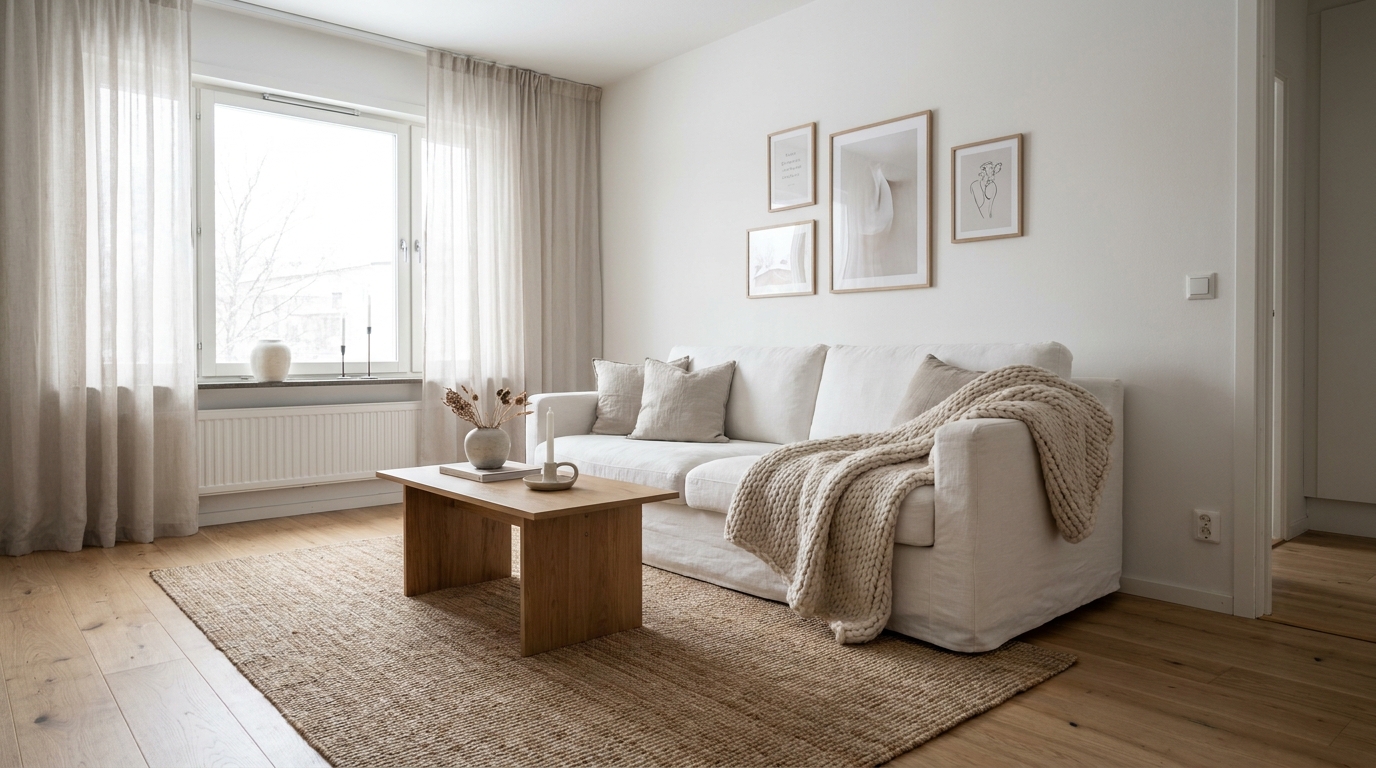
You followed every Scandi rule you’ve seen online. White walls. Bare surfaces. Minimal furniture. Clean lines. And yet the room feels like a hospital waiting area, not the serene Nordic haven you pictured. Sound familiar?
The problem isn’t Scandinavian design itself. It’s a handful of misread principles that strip warmth right out of the space. Real hygge-inspired interiors are layered, soft, and deeply intentional. Here’s what’s going wrong — and exactly how to fix it.
For the full foundation on what makes Nordic design actually work, start with our complete guide to Scandinavian and Nordic decor.
Key Takeaways
- Cool-white bulbs (4000K+) are the single fastest way to make any room feel clinical — swap to 2700K warm-white LEDs ($8–$15 each) immediately.
- Authentic Scandinavian interiors layer at least three textures: wool, linen, and sheepskin. A single blanket doesn’t cut it.
- Meik Wiking’s The Little Book of Hygge (Happiness Research Institute, 2016) identifies candlelight and natural materials as the core of Danish coziness.
- “Lagom” means balance, not emptiness. Bare shelves and scrubbed surfaces misread the philosophy entirely.
Are Your White Walls Actually Too White?
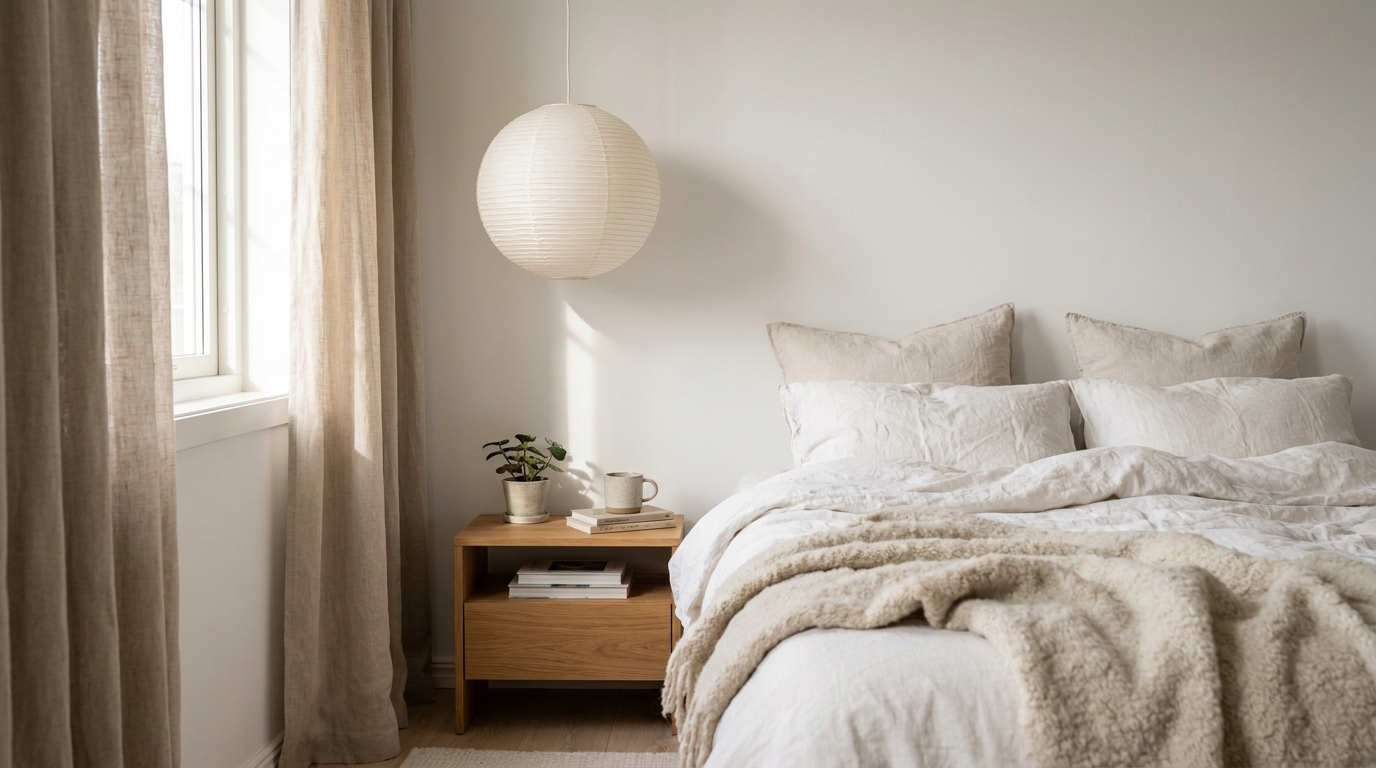
Most people paint Scandi rooms brilliant white — and that’s the wrong white. Brilliant whites with a Light Reflectance Value above 92 reflect cool blue undertones under artificial light, making rooms feel stark instead of serene. Ida Engholm’s Scandinavian Design: A History (2009) notes that Nordic interiors historically favored warm, matte wall surfaces over high-sheen, high-reflectance finishes. The right white changes everything.
Mistake 1: Using Cool Brilliant White Instead of Warm White
Cool whites like pure titanium paint (LRV 93–98) amplify shadows and read grey or blue under cloudy northern light. Warm whites in the LRV 83–90 range — think Benjamin Moore White Dove OC-17 or Farrow & Ball Wimborne White — absorb and re-emit a gentle amber tone. That single swap changes the entire mood of a room without touching a single piece of furniture.
Fix it: Repaint with a warm-white paint in the LRV 83–90 range. Budget $30–$70 per gallon for quality options like Benjamin Moore White Dove OC-17, Farrow & Ball Wimborne White, or BEHR Swiss Coffee. Always sample on a 12×12 board viewed under evening lighting before committing.
Mistake 2: Stripping Every Surface Bare
“Lagom” is one of the most misquoted words in interior design. It means just the right amount — not nothing at all. Bare shelves, empty mantels, and scrubbed countertops signal neglect, not restraint. Authentic Nordic homes display a small curated cluster: a ceramic bowl, a wooden tray, two or three candles at varying heights. The rule is edit, not erase.
Fix it: Anchor each surface with a wooden tray ($15–$50 at Target or H&M Home) and group three objects of varying heights on it. Matte ceramics ($15–$60 from West Elm or CB2) work perfectly here — they add visual weight without visual noise.
What most guides miss: an all-white room stays cold no matter how warm the paint is, because a flat white surface with zero texture has nothing to catch and soften the light. The real fix isn’t a different white. It’s a matte, tactile layer, a nubby linen cushion, a jute rug, a raw-wood tray, so the surface absorbs light instead of bouncing it back flat and clinical.
Citation Capsule: Ida Engholm’s 2009 survey of Scandinavian interior history confirms that Nordic design traditions relied on warm, matte surfaces rather than high-reflectance brilliant whites. Brilliant whites above LRV 92 introduce blue-grey undertones under standard artificial lighting — the exact opposite of the calm, enveloping atmosphere authentic Scandi interiors are built to deliver.
Actionable takeaway: Sample at least three warm-white paints on large boards and view them at 7pm under your actual room lighting before choosing.
Is Your Lighting Making the Room Feel Like a Lab?
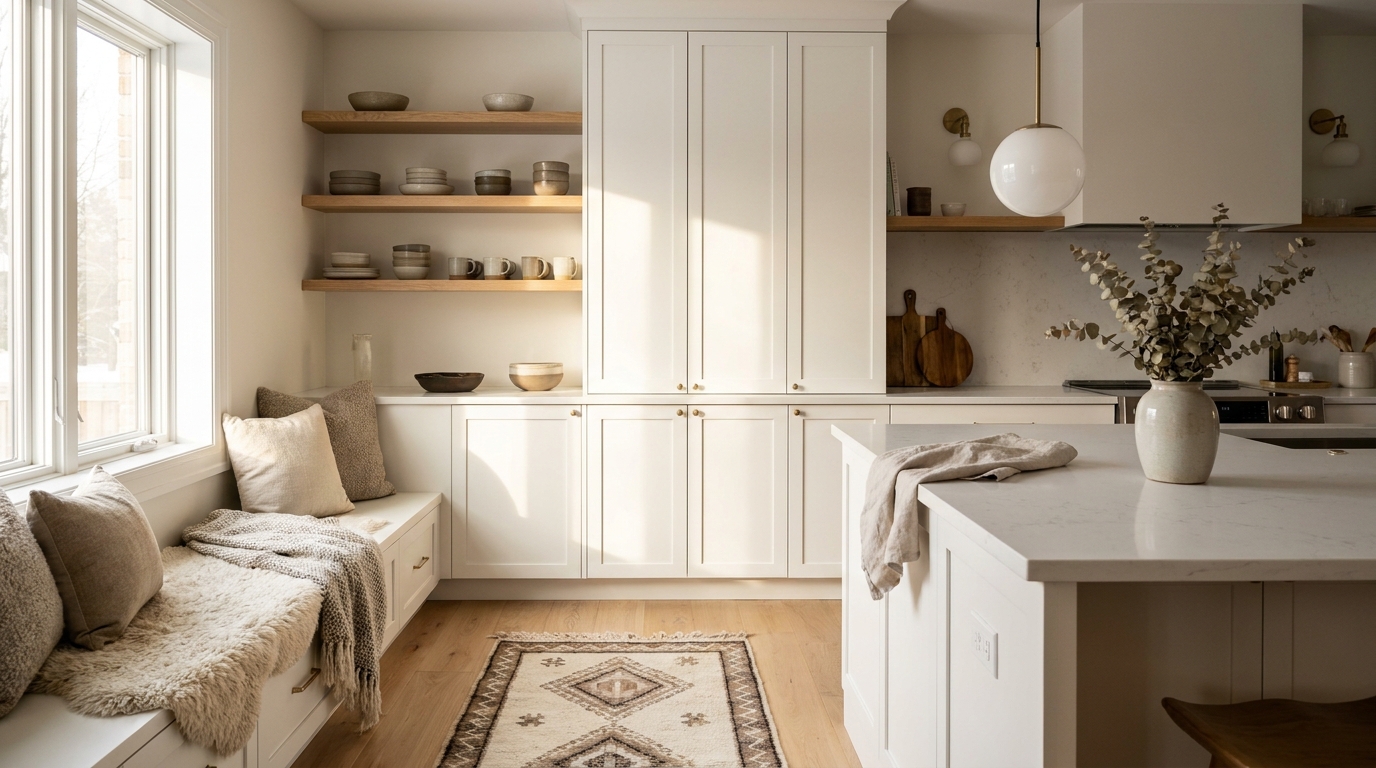
Lighting temperature is the most overlooked of all scandinavian decor mistakes, and it accounts for more “cold room” complaints than any paint color choice. Philips Human Centric Lighting research establishes that bulbs in the 4000K–6500K range increase perceived alertness and reduce relaxation — the biological opposite of what a Scandi living room is supposed to do. Warm-white bulbs at 2700K–3000K produce an amber glow that the human brain associates with fire, sunset, and rest.
Mistake 3: Using Cool-White Bulbs and a Single Overhead Source
A lone 5000K recessed ceiling fixture is as far from Nordic lighting design as you can get. Scandi interiors layer multiple low-level light sources: floor lamps, table lamps, candles, and warm pendants at different heights. The goal is overlapping pools of soft light, not uniform top-down brightness. Isn’t it strange that the cheapest fix — a different bulb — is the one most people skip?
Fix it: Replace every bulb in your living spaces with 2700K warm-white LEDs. IKEA LEDARE and Philips Warm Glow bulbs run $8–$15 each. Add at least one floor lamp and one table lamp per room. Replace chrome lamp bases with brushed-brass or matte-black alternatives ($40–$150) to reinforce the warmth.
Citation Capsule: Philips Human Centric Lighting research distinguishes bulb ranges by their physiological effect on occupants. Bulbs at 2700K–3000K produce amber-toned light associated with evening rest and relaxation. Bulbs at 4000K and above stimulate cognitive alertness — a useful quality in offices, but directly counterproductive in a living space designed around Nordic principles of calm and hygge.
Actionable takeaway: Walk through every room tonight with all lights on. Any fixture that reads white or blue-white gets a 2700K replacement before the week is out.
Free · 60 seconds
Not sure which style is actually yours?
Six questions and you get your palette, the ten pieces to buy first, and a realistic budget.
Are You Under-Layering Your Textiles?
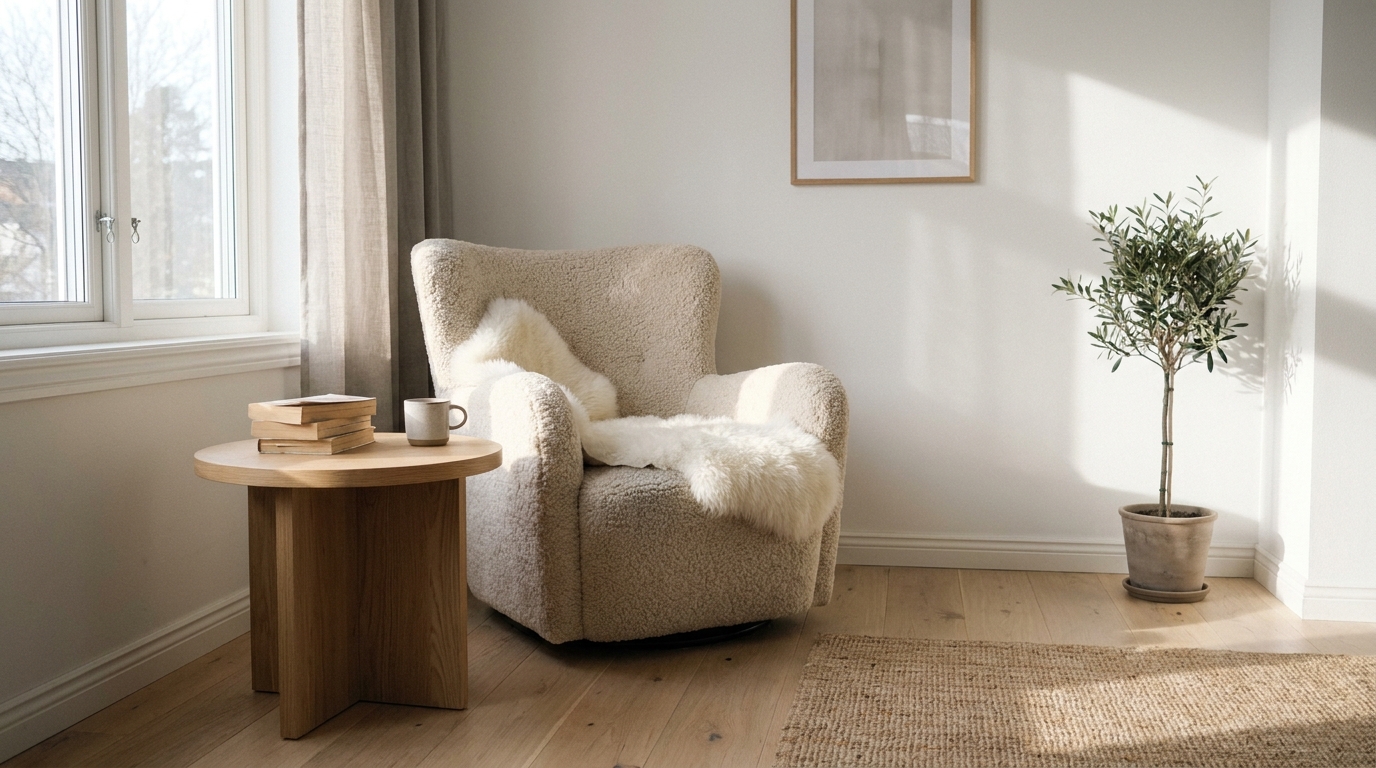
Over-minimalism might be the most widespread of all scandinavian decor mistakes, and it usually shows up in the textiles. Meik Wiking of the Happiness Research Institute (The Little Book of Hygge, 2016) identifies tactile comfort — soft throws, layered cushions, natural-fiber rugs — as a primary driver of hygge. One blanket draped over one arm of one sofa isn’t layering. It’s a placeholder.
Mistake 4: Removing All Personality in the Name of Minimalism
Scandi minimalism removes visual noise, not warmth. A room can have clean lines and still hold a chunky knit blanket. It can have bare walls and still have a jute rug grounding the furniture. The question isn’t “how little can I include?” It’s “does everything here earn its place and contribute something?” Those are completely different questions with completely different answers.
Fix it: A jute or wool area rug ($80–$350 depending on size) is the highest warmth-per-square-foot addition you can make. It defines zones, adds texture underfoot, and softens acoustics in rooms with hard flooring — all simultaneously.
Mistake 5: One Isolated Textile Instead of Three Layered Textures
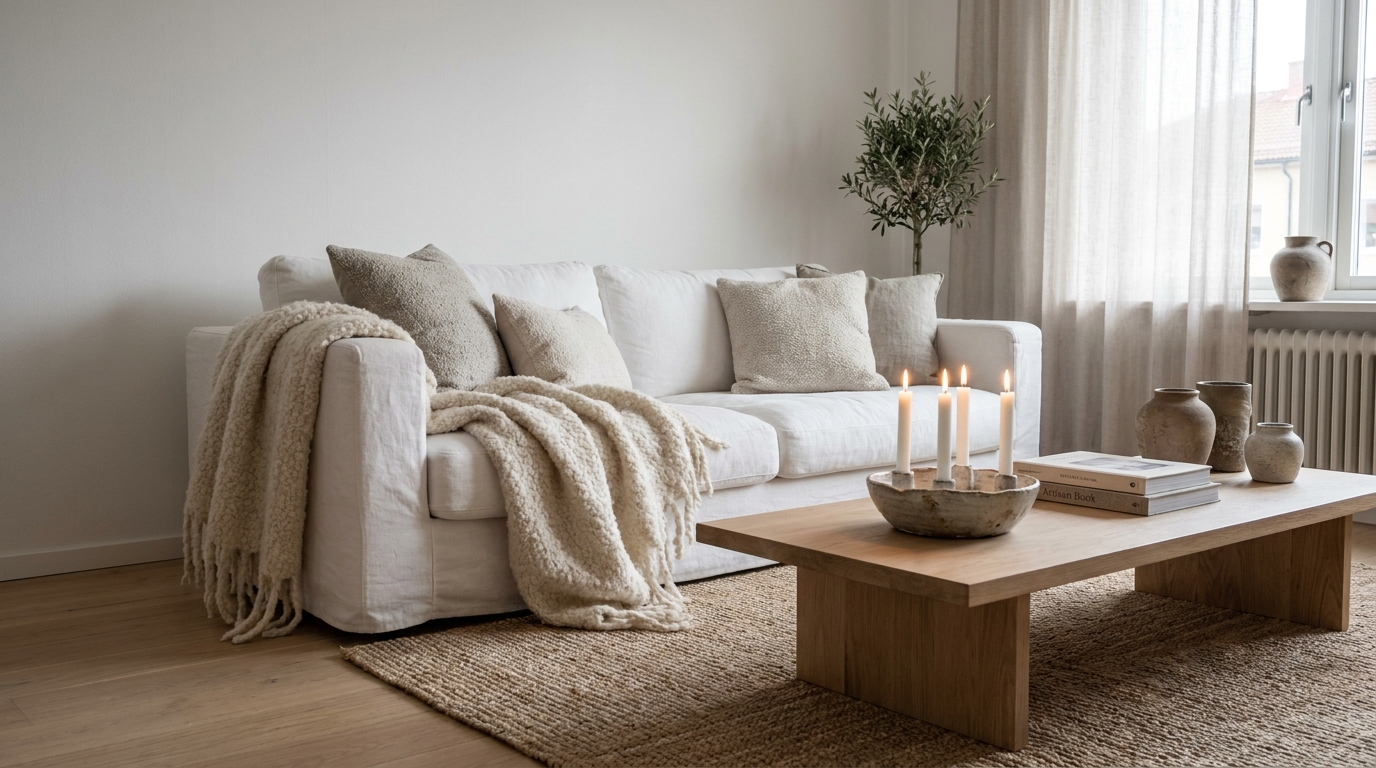
In rooms we’ve helped restyle at DecorQuarter, the before-and-after rarely involves replacing furniture. It involves adding a second and third textile layer. A sofa looks bare with one linen cushion. Add a chunky-knit wool throw draped at one end and a sheepskin over the armrest, and the whole composition reads as deliberately warm. The textures create contrast; the contrast creates perceived depth.
Fix it: Build your trio: linen cushion covers ($20–$45 per pair), a chunky-knit wool blanket ($35–$90), and a sheepskin throw ($45–$120 from IKEA, H&M Home, or Target). Stack them in one zone rather than scattering them across the room.
What most guides miss: layering is the single fix that undoes the #1 cold-room mistake fastest, because texture, not paint or furniture, is what converts warm light into a soft glow. In the rooms we restyle, adding a three-texture zone (linen, wool, sheepskin) shifts the whole space from clinical to calm in an afternoon, for well under $200 and without moving a single large piece.
For a deeper breakdown of exactly which pieces to stack and how, our guide to layering warmth with sheepskins, candles, and textiles covers the full method.
Citation Capsule: Meik Wiking’s The Little Book of Hygge (Happiness Research Institute, 2016) identifies tactile comfort as one of the ten core dimensions of hygge. Specifically, natural-fiber textiles — wool, sheepskin, linen — contribute to a sense of physical and psychological warmth that purely visual elements cannot replicate. The distinction between one textile and three layered textures is material, not decorative.
Actionable takeaway: Count the distinct textures in your main living space right now. If you have fewer than three, add the missing layers before changing anything else in the room.
Are Your Materials Working Against You?
Material and finish choices are the quieter category of scandinavian decor mistakes — subtler than lighting or color, but equally damaging over time. Scandi interiors rely on natural mid-tone woods, matte finishes, and organic textures. Ida Engholm’s design history research (2009) explicitly contrasts the Nordic preference for matte, tactile surfaces with the high-gloss aesthetic common in other European traditions. Gloss repels the eye; matte invites it to rest.
Mistake 6: Choosing the Wrong Wood Tones
Dark espresso-stained wood absorbs light and reads as formal and heavy — wrong associations for a style built on lightness. Bleached or grey-washed wood goes too cool, adding to the clinical problem rather than solving it. The right tone is natural mid-range birch, pine, or ash: pale honey or light caramel that reflects warm light without dominating the room. Think IKEA STOCKHOLM, Muuto Fiber chairs, or HAY’s natural beech products.
Fix it: IKEA’s BJÖRKSNÄS and LISABO lines use solid birch and ash respectively, priced at $79–$349 depending on the piece. These are worth prioritizing over trending grey-washed alternatives that read as cool and trendy rather than timeless.
What most guides miss: wood tone does roughly half the warming work of your lighting. A honey-toned birch or ash surface under a 2700K bulb re-emits a soft amber cast across the whole room, while the same warm bulb hitting grey-washed or espresso wood reads flat and dull. Match warm mid-tone wood to warm 2700K light and the two compound, that pairing is why authentic Scandi rooms glow rather than gleam.
Mistake 7: Too Many Glossy or Reflective Surfaces
Chrome hardware, high-gloss lacquered furniture, and polished accessories bounce cool overhead light back into the room at full intensity. Scandi interiors use brushed metals, raw wood, and matte ceramics to diffuse light rather than amplify it. A single brushed-brass pendant lamp is elegant. Every surface gleaming simultaneously is visually exhausting.
Fix it: Swap chrome fixtures for brushed-brass or matte-black alternatives ($40–$150). Replace high-gloss decorative objects with matte ceramics from West Elm or CB2 ($15–$60). A brush-finished metal or raw linen surface reads softer and more considered.
See our realistic Scandi decor budget breakdown for a full cost comparison of genuine Nordic pieces versus their fast-furniture lookalikes.
Citation Capsule: Ida Engholm’s Scandinavian Design: A History (2009) documents the Nordic tradition of prioritizing matte, tactile finishes as a deliberate aesthetic and cultural choice rooted in craft. High-gloss surfaces create what Engholm terms “visual noise” — light bouncing unpredictably from multiple points — which is directly at odds with the visual quiet and psychological calm that define the Scandinavian interior ideal.
Actionable takeaway: Do a shine audit. Walk your room and identify the three most reflective objects. Each one is a candidate for replacement or softening with a natural-textured alternative.
Are You Missing the Ritual Layer That Makes Scandi Rooms Feel Lived In?
Hygge isn’t a decorating technique — it’s a practice. And skipping it is why so many carefully styled Scandi rooms still feel cold. Meik Wiking (Happiness Research Institute, 2016) describes hygge as an atmosphere created through intentional rituals: candlelight at eye level or below, natural materials within reach, warm drinks available, light dimmed by evening. Without this layer, even a well-furnished Scandi room is just furniture.
Mistake 8: Skipping Hygge Rituals Entirely
Here’s a test: does your room look good in photos but feel stiff to actually sit in? That’s the hygge gap. Real hygge means candles burning in clusters of three or five, a blanket within arm’s reach from wherever you sit, and no overhead lights after 7pm. These aren’t decoration choices. They’re mood choices — and they’re the difference between a room that photographs well and a room you don’t want to leave.
Fix it: Start with beeswax or soy pillar candles ($8–$30 each) grouped on a wooden tray ($15–$50) in clusters of odd numbers. IKEA SNÖVIK and RUNNEN tealight holders cost $3–$15 and anchor the cluster practically. Total investment under $60; impact is disproportionate.
See the best Scandinavian decor pieces of 2026 for our curated list of woolen throws, minimalist lamps, and storage finds that reinforce hygge without visual clutter.
Mistake 9: Buying Cheap Fast-Furniture Substitutes
There’s a real tension between Scandi style’s association with affordability (IKEA exists, after all) and its core philosophy of dugelighet — functional quality. Nordic design was never about buying many things cheaply. It was about buying fewer things well. Rooms full of bowing particle-board shelves and hollow-core side tables feel restless, not restrained. The proportions are slightly off. The materials feel thin. It shows.
Fix it: Replace one low-quality piece per month with a solid-wood upgrade. Shop secondhand HAY, Muuto, or Ferm Living on Facebook Marketplace and Chairish ($30–$300 for real pieces). For new, IKEA’s solid-wood BJÖRKSNÄS and LISABO lines ($79–$349) hold up and improve with age in a way laminate substitutes never do.
Want to see what real restraint looks like in practice? Our before-and-after Nordic room makeovers show exactly how these changes land in real spaces.
Citation Capsule: Meik Wiking’s The Little Book of Hygge (Happiness Research Institute, 2016) frames hygge as an active practice rather than a passive aesthetic. Candlelight at low level, natural materials, and gathered warmth are its primary vehicles. A room decorated in Scandi style without hygge rituals remains, by Wiking’s own framing, a room that looks Scandinavian but doesn’t feel it — and that feeling is the entire point.
Actionable takeaway: Introduce one hygge ritual this week — candle clusters at table level, a dimmer switch installed, or a dedicated textile zone. Build from there, one ritual at a time.
Frequently Asked Questions
What is the single biggest Scandinavian decor mistake to avoid?
Using cool-white bulbs (4000K or above) is the most damaging single error you can make. Philips Human Centric Lighting research shows these bulbs increase alertness and reduce perceived warmth — the opposite of what a calm Nordic interior needs. Swapping to 2700K warm-white LEDs like IKEA LEDARE ($8–$15 each) changes a room’s entire atmosphere faster than any furniture or paint change.
How do I make a white Scandi room feel warm instead of cold?
Choose warm whites in the LRV 83–90 range — Benjamin Moore White Dove OC-17 or Farrow & Ball Wimborne White ($30–$70 per gallon) are reliable choices. Pair the wall color with 2700K bulbs and at least three layered textile textures: wool blanket, linen cushion covers, and a sheepskin throw. That combination shifts a room from clinical to calm more reliably than any other set of changes.
Does Scandinavian decor have to be minimalist?
Not in the emptiness sense. Lagom means “just the right amount” — a curated balance, not a blank slate. Authentic Nordic rooms hold clustered candles, natural objects, layered textiles, and quality wood. The goal is visual quiet, not visual absence. Removing everything misreads the philosophy, and the result is a room that feels unfinished rather than intentional.
How many candles do I actually need for hygge lighting?
More than you’d expect. Meik Wiking (Happiness Research Institute, 2016) describes candles grouped in odd numbers at table height or lower as central to hygge practice. A cluster of three to five pillar candles creates a warm focal point with enough ambient light to read by. Beeswax or soy pillar candles run $8–$30 each; IKEA SNÖVIK tealight holders start at $3 and work just as well in clusters.
Why does my all-white room still feel cold even with warm bulbs?
Because a white surface with no texture bounces light back flat, and flat light reads cold no matter the bulb temperature. Warm 2700K bulbs help, but the missing ingredient is tactile contrast: a jute rug, a chunky-knit throw, or a raw-wood tray. Matte, light-absorbing textures are what convert warm light into a soft, enveloping glow rather than a bright, clinical wash.
The Calm Room Is Closer Than You Think
Most cold Scandi rooms share the same core problems: the wrong light temperature, too few textile layers, and materials that throw light back at you instead of absorbing it. None of these require a full redesign or a large budget. Replacing bulbs, building a three-texture textile grouping, and auditing your shiniest surfaces will shift the room’s feeling within a single weekend.
Start with the lighting. It’s the fastest win with the widest impact. Add the textile layers next. Then move through the material choices. Work in order of impact, not cost.
For everything else — furniture selection, color palettes, seasonal styling, and the full Scandi philosophy — the complete Scandinavian and Nordic decor guide covers it all in depth.
DecorQuarter Editorial Team researches and writes practical interior design content for real homes at real budgets.