
There’s a telling moment when you place two sofas side by side — one genuinely mid-century modern, one merely MCM-inspired — and realize the gap between them isn’t about color or silhouette. It’s about the legs. The wood. The two small brass pulls on the credenza drawer. The mid century modern furniture details that most overview articles gloss over are precisely the ones that determine whether a room reads as authentic or theme-park pastiche.
This guide cuts past the “clean lines and organic forms” summaries you’ve already read on every other MCM post. We’re going deep on physical construction details — taper angles, grain patterns, joinery methods, and hardware profiles — so you can buy smarter, style with confidence, and spot quality from across the room.
For a broader foundation, our complete mid-century modern decor guide covers color, layout, and room-by-room strategy. This article zooms into the furniture details specifically.
Key Takeaways
- A true MCM tapered leg angles between 5° and 15° and is made from solid walnut, beech, or teak — never hollow MDF wrapped in veneer film.
- Black walnut has a Janka hardness of 1,010 lbf and shifts from rich chocolate to warm honey-amber as it ages with light exposure.
- Swapping hardware is the highest-ROI single change available: solid brass and ceramic pulls run $4–$25 each and instantly authenticate any MCM piece.
- Exposed joinery — mortise-and-tenon, visible dowels — isn’t a construction flaw in MCM furniture. It’s the design.
The Tapered Leg: Why It’s Non-Negotiable in MCM Furniture Details
The tapered leg is the single most copied — and most often botched — of all mid century modern furniture details. When executed correctly, it gives a sofa or credenza that signature “floating” quality. When done wrong, it turns the whole piece into a costume.
Authentic MCM legs taper at an angle between 5° and 15°, measured from the vertical. Subtle tapers (5°–8°) read as Danish Modern — restrained, precise. Steeper tapers (10°–15°) lean more California or atomic-era American. That angle isn’t arbitrary; it shifts the perceived weight of the piece, making a 200-pound sofa look like it’s barely touching the floor.
What most guides miss: taper and splay are two different angles, and copies almost always drop the second one. The taper is the leg narrowing along its length. The splay is how far the whole leg kicks outward from the frame, usually 5° to 10° on genuine MCM seating and case goods. A leg can taper beautifully yet sit dead vertical, which reads flat and heavy. That outward splay is what creates the light, lifted stance, so check the leg from both the front and the side, not just head-on.
Material matters as much as geometry. The three canonical leg materials are:
- Solid black walnut — warmest tone, most sought-after, highest price point
- Solid beech — pale honey color, widely used in Scandinavian pieces, takes stain beautifully
- Solid teak — oily grain, extremely durable, closely associated with Danish cabinetwork
Notice “solid” appears three times. That’s deliberate. Hollow legs with a veneer skin flex under load and chip at the ferrule joint. You can test a piece on the spot by pressing your thumb firmly against the thin end of the leg. Hollow legs give a faint drum-like resonance. Solid wood is silent and unyielding.
Brass ferrules — the small metal caps at the base — serve two purposes: they protect the wood end-grain from splitting and signal material quality to anyone who looks closely. Budget replicas use plastic ferrules or skip them entirely. Replacement legs in solid walnut or beech run $8–$40 per leg depending on height and profile, making leg replacement one of the most cost-effective MCM upgrades you can make.
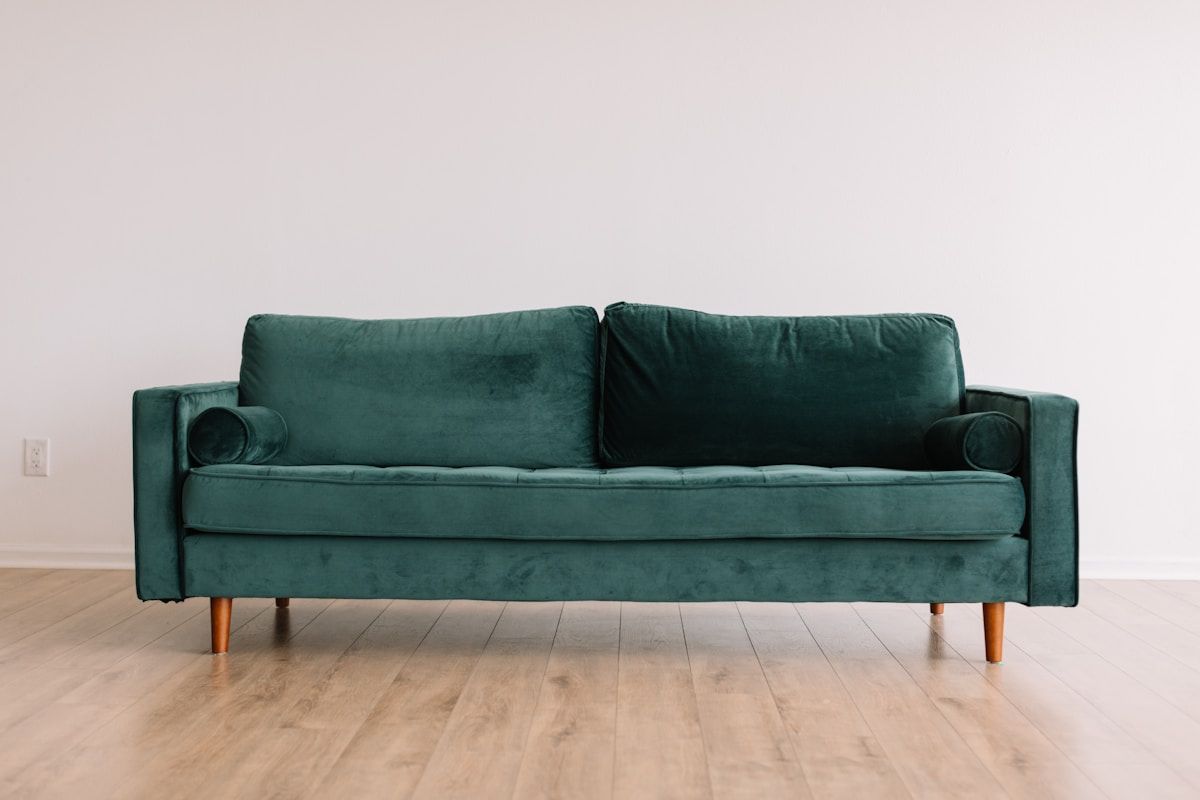
Actionable takeaway: When evaluating any MCM piece, flip it over. Count the legs, check the material, and look for a ferrule. Four properly tapered solid-wood legs with brass caps tell you more about a piece’s authenticity than any label or listing description.
Walnut Wood: Grain, Color, and How to Spot the Real Thing
Black walnut (Juglans nigra) became the defining wood of the MCM era for practical as well as aesthetic reasons. Its Janka hardness of 1,010 lbf (Wood Database) made it durable enough for daily-use furniture while remaining workable enough for the sculptural forms designers demanded. Nothing about that combination was accidental.
Understanding walnut grain separates confident buyers from frustrated ones:
- Straight grain runs in parallel lines along the board. It’s the most common cut and the most dimensionally stable — you’ll see it on tabletops and drawer fronts throughout the MCM era.
- Crotch grain comes from the junction where a trunk splits into branches. The figure is wild, almost feather-like, and commands a premium. MCM designers used crotch walnut as a focal panel on credenza doors for exactly that visual drama.
Color range and aging: Fresh walnut is a deep chocolate-brown, sometimes with purple or gray undertones. Exposed to light over decades, it oxidizes to a warm honey-amber. That aged golden tone is part of the appeal of original 1950s and 1960s pieces. If a piece claiming to be a vintage original still reads almost black, it was either stored in the dark or refinished recently — both worth asking about.
Solid vs. veneer vs. laminate — the field test:
-
Look at the end grain on any exposed edge. Solid walnut shows visible growth rings. Veneer over plywood shows thin parallel layers with a different core material. Laminate shows a printed pattern that terminates cleanly and flatly at the edge.
-
Run a fingernail lightly across the surface at a low angle. Solid walnut feels slightly warm and has very faint give. Laminate is harder, colder, and plastic-feeling under a fingernail edge.
-
Open the drawers. Quality MCM pieces used secondary woods — usually maple or poplar — inside drawer boxes. Particleboard or MDF interiors signal lower-quality construction throughout the entire piece, not just in that drawer.
Walnut-look laminates have improved considerably, and there’s nothing wrong with using them deliberately in a budget build. But don’t pay solid-walnut prices for them — and don’t let a seller charge you for authenticity a piece doesn’t have.
Actionable takeaway: Tilt any wood surface toward a window at a low angle. Real wood grain catches and shifts with raking light. Laminate flattens out completely. This one test takes three seconds and works every time.
Free · 60 seconds
Not sure which style is actually yours?
Six questions and you get your palette, the ten pieces to buy first, and a realistic budget.
Joinery & Construction Details That Separate Originals from Imposters
In almost every other furniture style, joinery is hidden. In mid-century modern, particularly under Scandinavian influence, it’s frequently featured. The mortise-and-tenon joint — a tongue of wood inserted into a matching slot — creates a mechanical connection that gets stronger as the glue cures and the wood settles. A 70-year-old Hans Wegner chair held together with mortise-and-tenon will outlast a brand-new piece assembled with cam locks and dowel screws from a flatpack box.
What to look for when buying:
| Joint Type | What It Signals | Where You’ll See It |
|---|---|---|
| Mortise-and-tenon | Highest durability, traditional craft | Chair legs to seat rail, table aprons |
| Wooden dowels | Quality production-era construction | Case goods, drawer framing |
| Exposed through-tenon | Deliberate design feature | Wegner-style chairs, Nakashima tables |
| Metal cam locks | Budget flatpack assembly | Avoid in pieces claiming MCM authenticity |
The Scandinavian influence on MCM joinery ran deep. Danish designers like Wegner and Børge Mogensen treated structural connections as opportunities for visual honesty. A through-tenon — where the tenon passes completely through the mortise and remains visible on the outside surface — was a design statement: we have nothing to hide.
What most guides miss: pull a drawer all the way out and study the corner joints. Genuine mid-century case goods use dovetails, interlocking wedge-shaped pins cut into the drawer sides, never staples or a glued butt joint. While you’re there, check any veneered panel at the edge. Real wood veneer wraps the grain continuously around the corner, so the figure flows unbroken. Printed laminate breaks the pattern at the seam and often repeats the exact same grain figure on two panels, a tell no real tree ever produces.
When shopping vintage, press gently on joints with your palm. A slight flex isn’t disqualifying in a 60-year-old piece; the original hide glue dries out and can be re-glued by any competent woodworker. A joint that moves significantly or shows daylight between parts signals a structural problem that needs professional attention before daily use.
Actionable takeaway: Don’t be put off by visible joinery — be put off by concealed joinery that’s poorly executed. A piece that shows its construction clearly is almost always more solidly built than one that hides everything behind trim panels.
Hardware: The Underrated MCM Detail With the Highest ROI
Swap the hardware, transform the piece. No single change in the MCM detail playbook delivers more visual impact per dollar than replacing builder-grade or wrong-era pulls with period-correct hardware. It’s also the most reversible change you can make, which matters when you’re not yet sure how committed you are to a piece.
The canonical MCM hardware profiles:
- Teardrop pulls — a loop of solid brass with a tapered drop; the most recognizable MCM drawer form
- Bowtie pulls — flat, horizontally elongated, pinched at center; strongly Danish in character
- Cone pulls — conical brass or ceramic form; reads well on sideboards and wide dressers
- Ceramic pulls — glazed in matte white, black, or earth tones; adds tactile interest without competing with wood grain
Material hierarchy for authenticity:
-
Solid brass — warm tone, ages beautifully, develops natural patina; $10–$25 per pull
-
Brushed brass — more matte, slightly more restrained feel; $8–$20 per pull
-
Solid ceramic — handmade examples are excellent period companions; $4–$15 per pull
-
Avoid: polished chrome, brushed nickel, or anything labeled “antique bronze” — these read as transitional, industrial, or Arts & Crafts, not MCM
Actionable takeaway: Budget $60–$150 total for a hardware refresh on a 6-drawer dresser at $8–$15 per pull. Source from Etsy vintage hardware sellers, Rejuvenation, or House of Antique Hardware. This is the single fastest, cheapest, most visually transformative move in the MCM detail toolkit.
How to Apply MCM Details Room by Room: A 5-Step Audit
Knowing the details is one thing; applying them systematically is another. Here’s how to audit any existing room and move it closer to authentic MCM without rebuilding from scratch. If you want to see complete transformations with real numbers attached, the before-and-after MCM room makeovers on this site walk through budget breakdowns for every change made.
Step 1: Audit the legs.
Walk the room and note every piece of seating and case furniture. Do the legs taper? Are they solid wood or hollow-sounding? Are ferrules present? This inventory tells you what stays, what gets upgraded with $8–$40 replacement legs, and what gets replaced entirely because the bones aren’t worth saving.
Step 2: Check the wood surfaces.
Apply the raking-light test to every wood surface in the room. Tilt pieces toward a window at a low angle and watch how the grain responds. Real wood catches and shifts. Laminate goes flat. Note which pieces are the real thing — they stay. Determine whether the laminates are worth keeping or replacing.
Step 3: Swap the hardware first.
This is your first action item after the audit. Pull every drawer pull and cabinet knob in the room. Replace anything chrome, nickel, or plastic with solid brass teardrop or bowtie pulls. Do this before spending money on anything else. The visual shift is immediate and dramatic.
Step 4: Layer period-appropriate textiles.
MCM upholstery ran to wool, boucle, and tight-weave tweed in mustard, rust, olive, and charcoal. Swapping a throw pillow from a busy geometric print to a flat-weave wool in one of those tones does more for MCM authenticity than buying a new side table. It’s not glamorous advice, but it works.
Step 5: Remove the anachronisms.
Ornate gilded picture frames, fussy table lamps with fringe shades, glass-front china cabinets with carved molding details — these compete directly with MCM’s deliberate restraint. For the full list of what not to keep in an MCM room, our guide on common MCM decorating mistakes covers the most frequent and most damaging offenders.
Budget breakdown by tier:
| Tier | Primary Focus | Estimated Investment |
|---|---|---|
| Low ($50–$200) | Hardware swap + textile refresh | $50–$200 |
| Mid ($200–$800) | Add replacement legs + 1 key accent piece | $200–$800 |
| High ($800–$2,500) | Replace non-MCM anchor furniture with verified pieces | $800–$2,500 |
For guidance on exactly which pieces justify the higher spend, the MCM splurge vs. save breakdown gets specific about where quality actually shows in the finished room — and where budget alternatives hold up perfectly fine.
Actionable takeaway: Always execute Step 3 before anything else. Hardware is the fastest change to complete, the lowest in cost, and the most immediately visible from across the room. If you stop after Step 3 and do nothing else, the room will still look meaningfully more MCM than it did before.
Frequently Asked Questions
What angle should MCM furniture tapered legs be?
Authentic mid-century modern tapered legs angle between 5° and 15° from vertical. Danish-influenced pieces sit at the low end of that range (5°–8°) for a restrained, architectural quality. Bolder American MCM designs use 10°–15°. Anything steeper starts reading as country or Arts and Crafts rather than MCM, regardless of the wood species used.
How do I tell solid walnut from walnut veneer on MCM furniture?
Check the end grain on any exposed edge: solid walnut shows visible growth rings; veneer over plywood shows thin parallel layers with a different core material beneath. Raking light also helps — real wood grain has depth and figure that shifts with angle. Veneer film and printed laminate both flatten and lose their character under that same raking light test.
Are walnut veneers on MCM furniture a red flag or historically acceptable?
Historically acceptable — and actually correct. Many original MCM pieces used walnut veneer over a plywood substrate deliberately, because plywood was a structural innovation at the time that reduced warping and allowed larger flat panels. The red flag is walnut-look laminate (a printed film with no actual wood content), which has no period precedent and degrades faster. Veneer on quality plywood is fine. Laminate pretending to be wood is not.
What hardware pulls are most period-correct for MCM furniture?
Teardrop pulls and bowtie pulls in solid or brushed brass are the most historically accurate options across the MCM era. Ceramic pulls in matte white or earth tones also read as period-correct and add tactile variety. Avoid polished chrome and brushed nickel — both finishes were less common in the original MCM period and read as contemporary transitional or industrial rather than 1950s–60s.
Where can I find replacement tapered legs for MCM furniture?
Etsy sellers specializing in mid-century restoration carry solid walnut and beech tapered legs from $8 to $40 per leg in a range of heights and profiles. Prettypegs (a Swedish company) and Osborne Wood Products are reliable sources for new production legs. For vintage originals salvaged from damaged donor pieces, eBay and local estate sale platforms are worth checking regularly — leg sets from authentic pieces occasionally surface at low prices.
How can you spot printed laminate pretending to be real walnut?
Look for repeated grain. Printed laminate is manufactured in sheets, so the identical knot or figure often appears on two or more panels of the same piece; real walnut never repeats itself. Check the corners too: genuine veneer wraps its grain continuously around an edge, while laminate breaks the pattern at a hard seam. Under a fingernail the laminate feels colder, harder, and faintly plasticky compared with warm solid wood.
Pulling It All Together
The furniture pieces that make a room feel genuinely mid-century modern share one trait: they were designed from the inside out. Every joint, every grain selection, every hardware pull was a deliberate decision rather than a default. Getting those details right — or right enough — is what separates a room that photographs well from one that actually lives well in the MCM tradition.
Start with the legs and the hardware. Those two details are visible from across the room and correctable on almost any budget. Once those are sorted, move deeper into wood quality and joinery as your knowledge and budget grow. The mid century modern furniture details discussed here aren’t niche concerns for collectors only — they’re the practical vocabulary anyone needs to shop smarter and style with more confidence.
For the full picture of how these details fit into a cohesive MCM room, the mid-century modern decor guide covers everything from palette to furniture arrangement. When you’re ready for specific product picks, the 2026 MCM furniture and decor roundup has vetted accent chairs, sideboards, and lamps across every major price tier.
Sources: Wood Database, “Black Walnut” species profile (Janka hardness data), retrieved 2026-05-26, https://www.wood-database.com/black-walnut/. DecorQuarter market survey of major US hardware retailers including Rejuvenation, House of Antique Hardware, and Etsy vintage hardware sellers, May 2026.