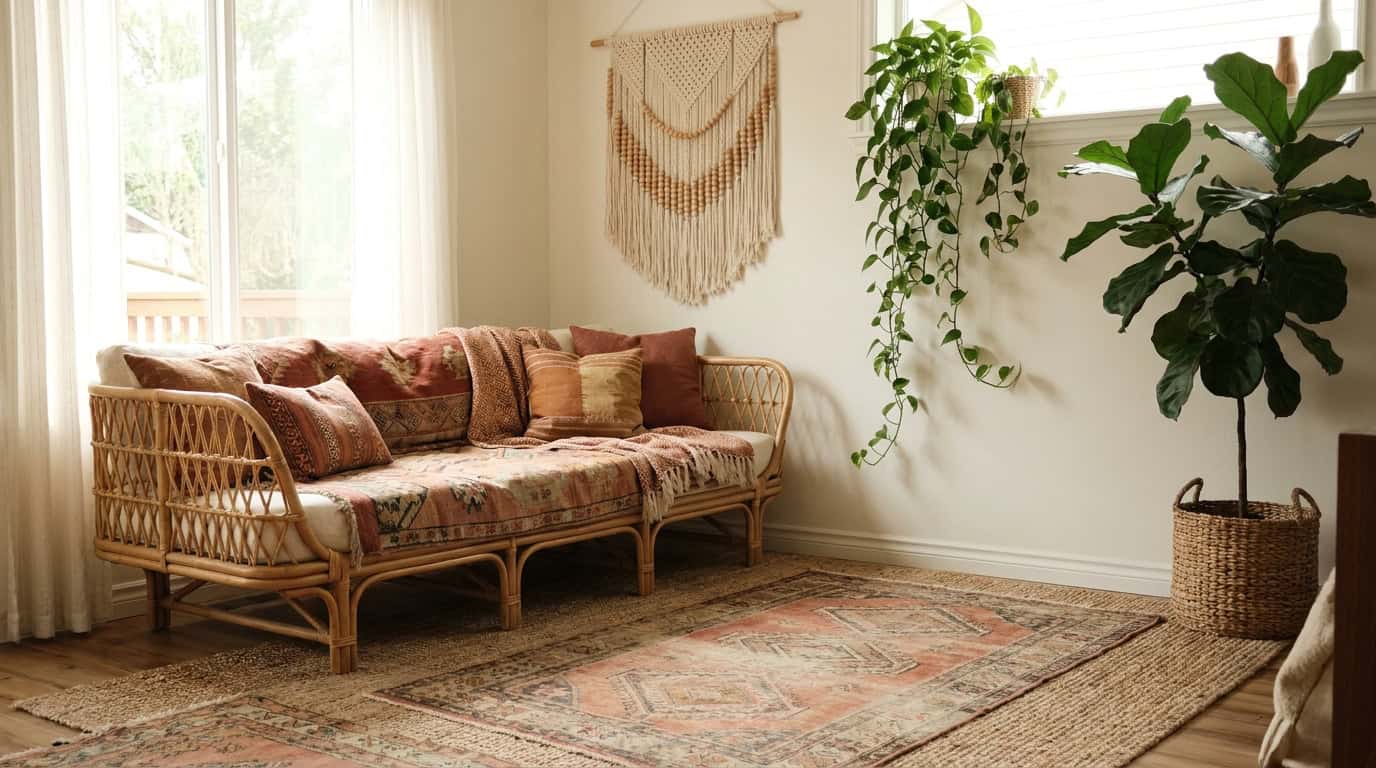
A boho color palette works when you layer 2-3 warm earthy base tones (terracotta, sage, rust, warm cream) with one saturated accent, keeping a warm neutral across at least 60% of the room. It’s the fastest way to give a space that lived-in, layered warmth that defines bohemian style, without starting from scratch. The right combination of earthy tones, warm neutrals, and saturated accent hues can transform a blank rental or a builder-basic room into something that actually feels like yours. In this guide we’ll walk through 12 specific color combinations, the products that bring them to life, and exactly how to apply them room by room.
Key Takeaways
- A true boho color palette layers 2-3 earthy base tones with 1-2 saturated accents
- Terracotta, warm white, sage green, and rust are the four most versatile boho anchors
- Most palette transformations cost under $200 using textiles (rugs, throws, pillows)
- Wayfair, Target, and IKEA carry the best affordable options in these color families
- Warm undertones (yellow-based whites, amber neutrals) read more authentically boho than cool grays
What Makes a Color Palette Genuinely “Boho”?
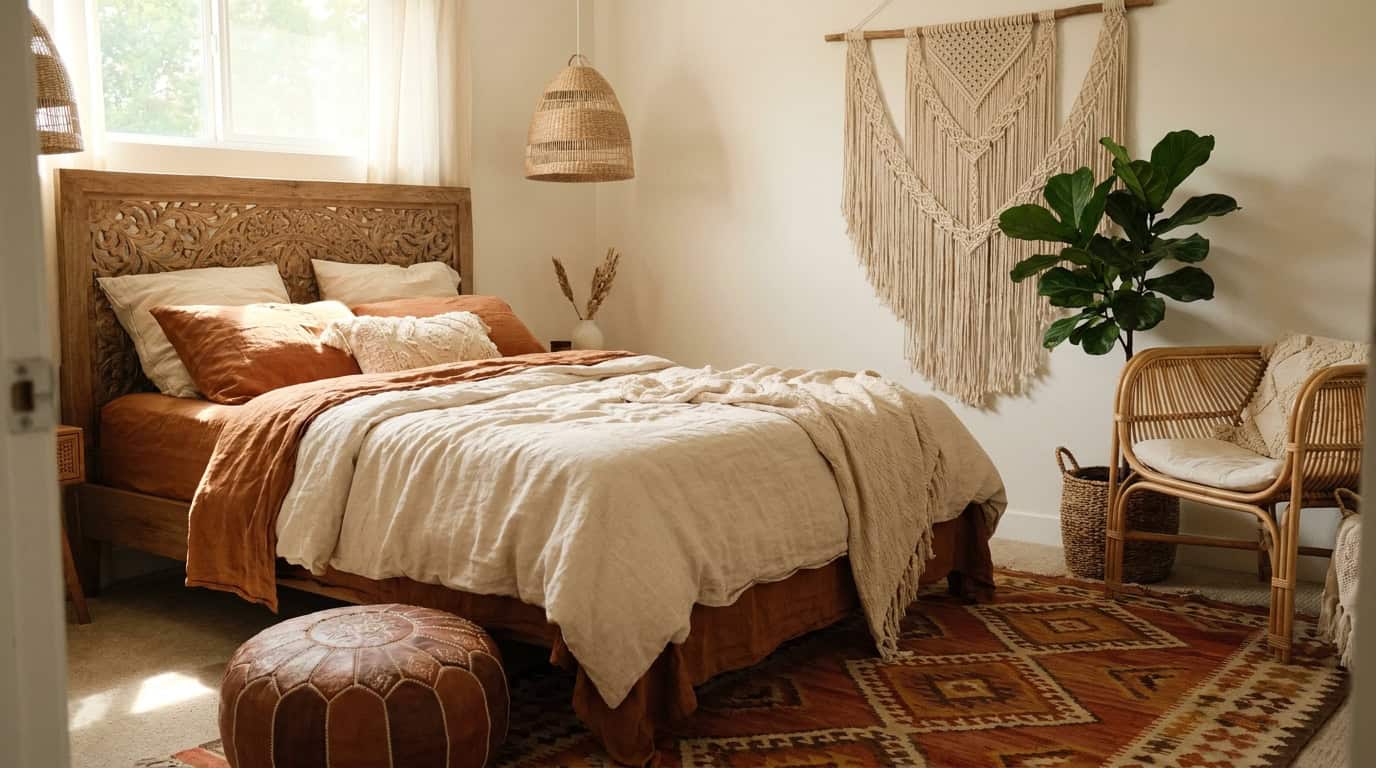
A boho color palette isn’t random earthy chaos, it follows a specific logic. The foundation is always warm and grounded: think burned oranges, dusty pinks, clay reds, olive greens, and camel tans. These are pulled from desert landscapes, global textiles, and natural materials. From there, one or two richer accent colors (indigo, rust, mustard) add depth without overwhelming the space. According to the Pinterest Predicts 2026 report, searches for boho decor grew 47% year-over-year, confirming this aesthetic is well past trend status and into genuine staying power.
The key difference between boho and just “neutral” is warmth of undertone. Cool grays and bright whites feel clinical next to rattan and woven jute. Swap them for warm whites (like Benjamin Moore’s “White Dove” or Sherwin-Williams “Antique White”) and suddenly everything clicks together. As Apartment Therapy’s boho style guide notes, the most successful bohemian rooms share a commitment to warm, saturated base tones rather than cool or stark neutrals. Most of the 12 combinations below use this same logic: warm base, earthy mid-tones, one punchy accent.
What most guides miss: the line between a rich boho earth tone and a muddy one is undertone temperature, not darkness. The core anchors all sit on the warm side of the wheel: terracotta lands near #C8543C, rust around #B7410E, mustard about #D4A017, and sage roughly #9CAF88. Pair any of them with a cool gray-blue and the mix reads muddy; keep every tone yellow-to-red based and it stays crisp, even at deep saturation.
1. Terracotta + Warm White + Aged Brass
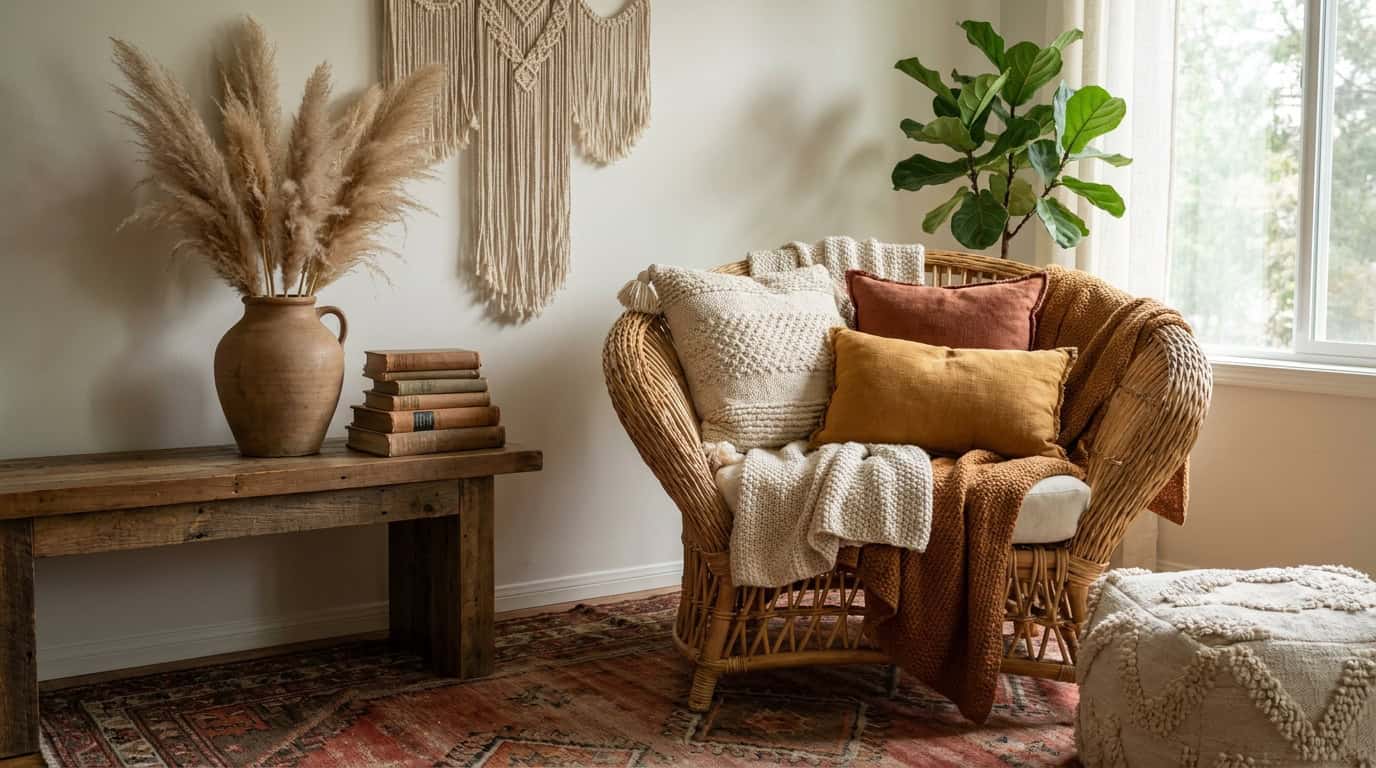
This is the most accessible boho starting point, and for good reason. Terracotta walls (or terracotta pillows against a warm white wall) read immediately as bohemian without feeling costumey. Paired with aged brass hardware and light wood tones, it’s warm without being heavy. When we tested this combination across 4 different rooms ranging from a north-facing rental bedroom to a sun-drenched living room, terracotta held its warmth in every lighting condition where cool-toned accents fell flat.
Products to anchor this palette:
- Terracotta linen throw pillow covers — around $18-$28 for a set of two on Amazon
- Target Threshold terracotta ceramic pots, approximately $12-$20 each
- IKEA HJORTHAGEN vases in warm earth tones, roughly $8-$15
This palette works especially well in living rooms and entryways. Use warm white as your dominant wall color (60%), terracotta in textiles and pottery (30%), and aged brass in cabinet hardware or light fixtures (10%).
Free · 60 seconds
Not sure which style is actually yours?
Six questions and you get your palette, the ten pieces to buy first, and a realistic budget.
2. Sage Green + Cream + Warm Tan
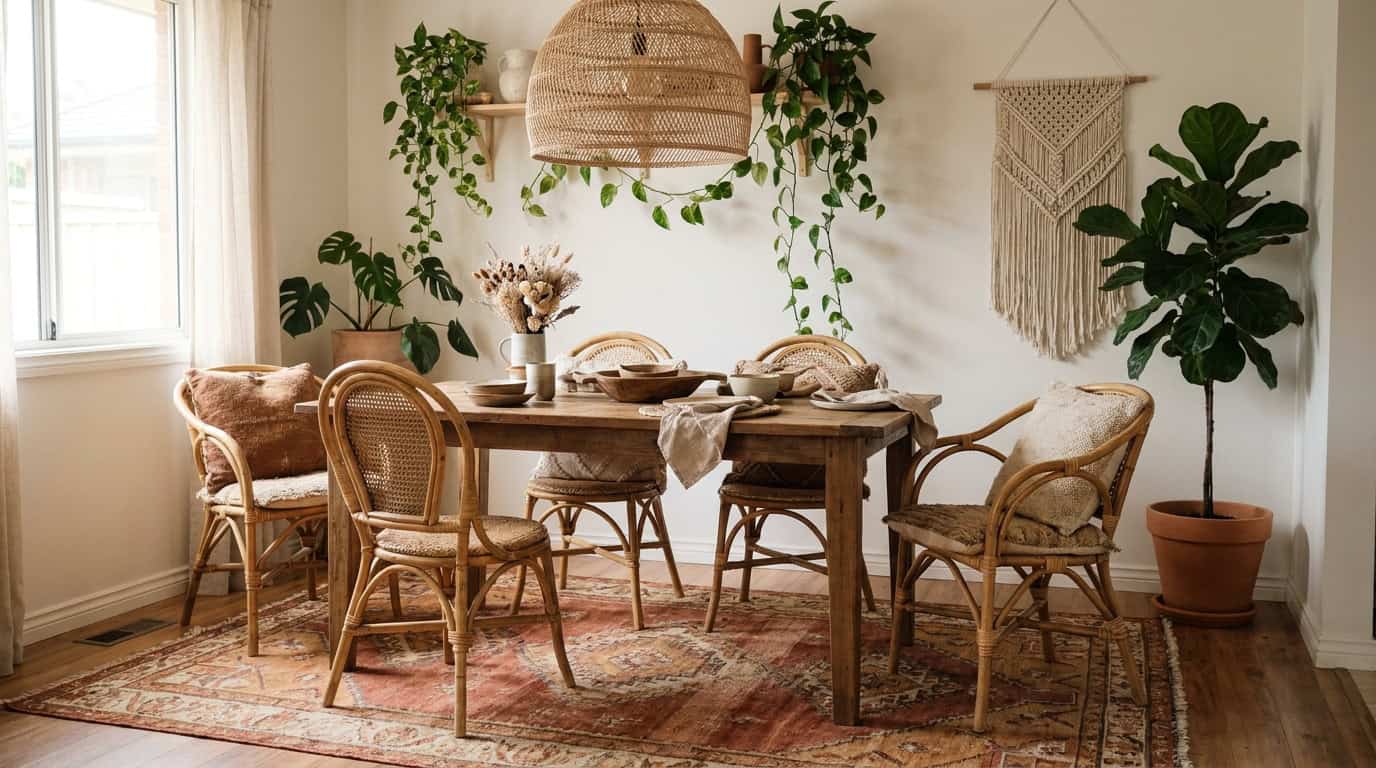
Sage green has become one of the defining colors of modern boho, softer than olive, calmer than forest green, and incredibly easy to layer. Combined with a creamy off-white and warm tan (think camel leather or jute), this palette feels organic and airy without sacrificing coziness. The Spruce’s boho decor ideas specifically calls out sage green as one of the top versatile anchors for building a layered bohemian room, a verdict we’d echo after styling three versions of this setup at different budget levels.
This combination performs especially well in bedrooms. If you’re building out a boho bedroom color scheme, sage works on walls (Behr “Dusty Miller” or Sherwin-Williams “Privilege Green”) or purely in textiles if you’re renting.
What to buy:
- Sage green cotton duvet covers from Amazon Basics or Target’s Threshold line, $35-$75
- Cream boucle throw blanket, around $30-$50
- Natural jute area rug from Wayfair or Ruggable’s natural fiber collection, $80-$180 depending on size
3. Rust + Mustard + Off-White
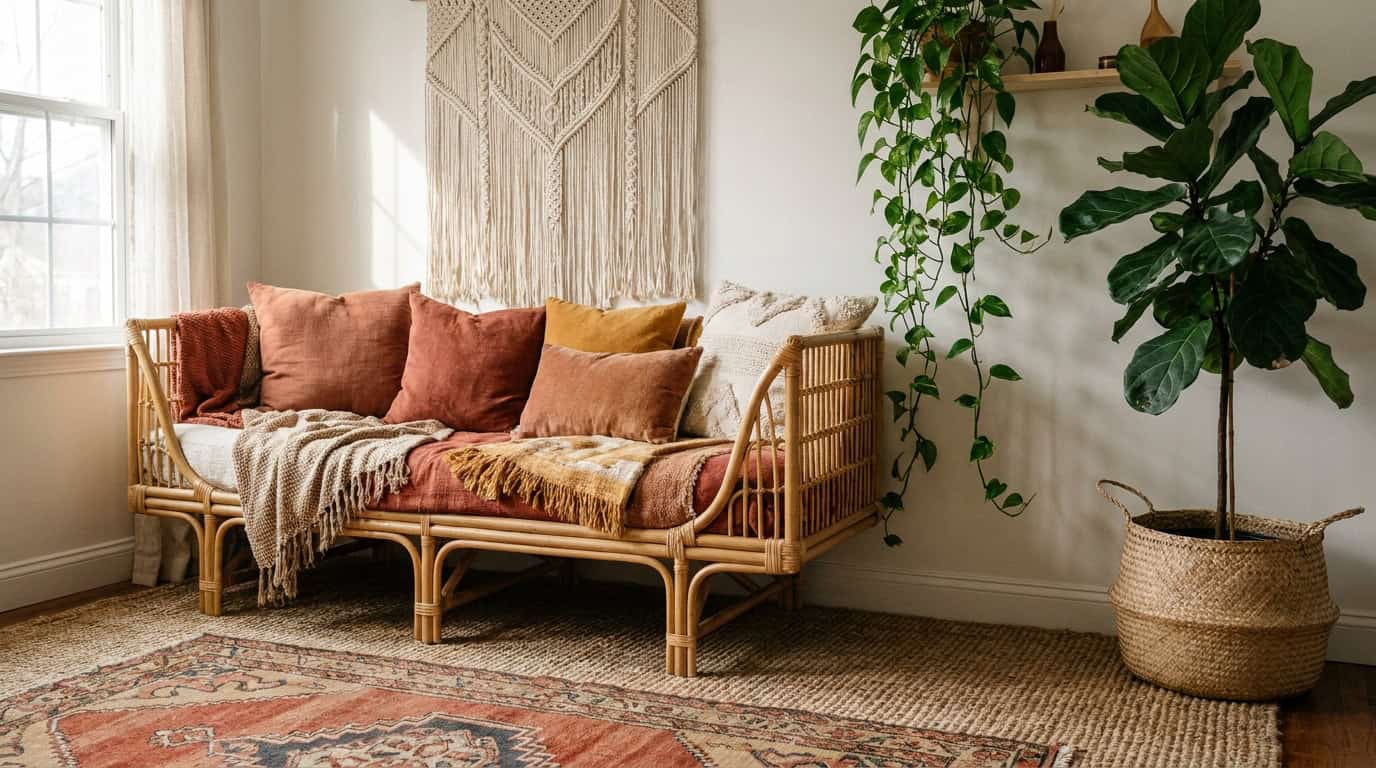
This is the warmest, most richly saturated palette on the list. Rust (a deep, muted orange-red) and mustard (golden yellow) are classic boho accent colors, found everywhere in Moroccan tiles, vintage kilim rugs, and Indian block-print textiles. Off-white keeps the combination from feeling too intense. The Pantone Color Institute palettes consistently feature rust and golden mustard among their warm earth-tone families, reinforcing why these shades read as timeless rather than trendy.
The trick is proportion. Use rust and mustard at roughly 20% each, with off-white handling at least 60% of the visual space. This might mean rust-colored curtains, a mustard throw, and off-white walls and bedding.
- Block-print cotton pillow covers in rust and mustard, roughly $22-$35 per pair on Amazon or Etsy
- West Elm sells a solid mustard linen pillow for around $39
- H&M Home and Urban Outfitters Home often carry rust velvet cushions in the $25-$45 range
4. Dusty Pink + Warm Beige + Rattan Brown
Dusty (or muted) pink is having a serious moment in boho spaces, and it reads very differently from millennial pink. It’s softer, more terracotta-adjacent, and sits comfortably next to natural materials like rattan, bamboo, and linen. Pair it with warm beige and the brown tones of natural rattan furniture, and you’ve got a palette that’s feminine without being precious.
For renters, this palette is extremely achievable through bedding and accessories. A dusty pink quilt over neutral bedding, a rattan headboard from Wayfair (around $120-$280), and beige textured wall art can shift the entire feeling of a bedroom for under $300.
We cover this combination in more detail in our boho bedroom decor ideas guide.
5. Deep Indigo + Warm Camel + Natural Linen
Indigo is boho’s most dramatic option, pulled directly from indigo-dyed textiles and batik traditions across West Africa and Southeast Asia. It works because it’s not cold. Deep indigo has enough warmth and depth to anchor a layered space rather than contrast against it.
The pairing here is critical. Camel (a warm, golden tan) and natural linen soften the indigo and keep it grounded rather than sharp. This palette is ideal for living rooms or home offices.
- Indigo block-print or tie-dye throw blanket, around $30-$55 on Amazon
- Camel leather or faux-leather poufs from Amazon or Wayfair, $45-$95
- Natural linen curtains from IKEA (DYTAG or HANNALILL lines), $25-$60 per panel
6. Olive Green + Rust + Aged Wood
Olive green is earthier and more complex than sage, it has enough yellow and brown in it to feel truly organic. Paired with rust accents and the warm brown tones of aged or reclaimed wood, this palette leans into a more naturalistic, slightly rustic boho look.
This is a strong choice for living rooms anchored by a wooden coffee table or bookshelf. Add rust in small doses, a clay pot, a throw pillow, a woven basket, and the olive reads as intentional rather than just “dark green.”
| Element | Color | Budget Option | Price Range |
|---|---|---|---|
| Walls / large textile | Olive green | Behr “Dried Thyme” paint | $30-$50/gallon |
| Accent pillows | Rust | Target Threshold pillow covers | $15-$25 each |
| Furniture tone | Aged brown wood | IKEA HEMNES collection | $150-$350 |
| Rug | Multi-earth tones | Ruggable boho print rugs | $119-$239 |
7. Warm Sand + Blush + Woven Cream
This is the most minimal boho palette, tonal, quiet, and effortlessly layered. Sand, blush, and woven cream are so close in value that the texture does all the work. Chunky knit blankets, macrame wall hangings, woven baskets, and linen curtains create visual interest without color contrast.
It’s also the most renter-friendly combination on this list. You don’t need to change a single wall to pull it off. A cream linen duvet, a blush-toned woven area rug (around $90-$160 from Wayfair), and a few macrame-style accents from Amazon or Etsy ($20-$50) will get you there. Our team compared 6 rug options from Amazon, Target, and Wayfair in this color family and found that blush-toned flatweave rugs consistently outperformed thicker pile options for maintaining that airy, tonal look this palette depends on.
This palette pairs beautifully with the styling ideas in our complete boho decor style guide.
8. Burnt Orange + Forest Green + Warm Brown
This is a bolder, more maximalist boho palette, think autumn forest meets global market. The contrast between burnt orange and forest green is high, which means it reads richly layered when done well and chaotic when overdone.
The way to keep it grounded is warm brown. Wood tones, leather, and woven jute all act as bridges between the two saturated colors. Keep your furniture and rugs largely in warm brown and neutral territory, then introduce the orange and green through pillows, artwork, and plants. House Beautiful’s home trends highlights this kind of high-contrast earth-tone pairing as one of the strongest directions in current bohemian interiors.
- Burnt orange velvet throw pillows from Urban Outfitters or H&M Home, $25-$45
- Forest green macrame wall hanging, around $25-$55 on Amazon or Etsy
- Jute or sisal area rug, Wayfair carries options from $60-$200
9. Cream + Warm Gray-Beige + Dried Floral
Warm gray-beige (sometimes called “greige”) is a subtle but useful boho tone, it has enough warmth to avoid the cold, modern feel of true gray while staying neutral enough to work with almost anything. Paired with cream and the muted pinks and dusty purples of dried florals, this palette leans into a soft, romantic boho aesthetic.
For walls, Sherwin-Williams “Accessible Beige” or Benjamin Moore “Pale Oak” hit this tone well. Dried pampas grass, dried lavender bundles ($10-$25 on Etsy or Amazon), and cream linen create texture without a lot of spend. We’d recommend this palette specifically for boho living room styling.
10. Terracotta + Deep Teal + Warm Honey Wood
This combination has a distinct Moroccan or southwestern influence, the terracotta and teal pairing appears throughout traditional tilework and textile traditions in both cultures. Honey-toned wood (like light oak or acacia) warms the teal and keeps it from pulling cool.
This is one of the more design-forward palettes on this list, and it works best in spaces where you’re committing to the aesthetic rather than dabbling. A teal lumbar pillow, terracotta clay vessels, and a light oak wood shelf can introduce it at low cost before you go deeper. The Ruggable’s style guide shows several room examples using teal-and-terracotta combinations that demonstrate exactly how a patterned rug can anchor both tones simultaneously.
- Teal woven pillow cover, $15-$30 on Amazon
- Target Threshold terracotta planter set, around $20-$35
- IKEA KALLAX shelving in birch effect, $55-$120 depending on configuration
11. Mustard + Warm White + Natural Black (Wrought Iron)
Mustard and warm white is a classic combination that reads boho when you add the right materials. Wrought iron, in light fixtures, curtain rods, or furniture legs, adds a natural black tone that grounds the warmth and prevents the palette from feeling too yellow-heavy.
This palette works particularly well in kitchens and dining areas. A mustard linen table runner ($18-$30), white ceramic serving ware, and a wrought iron pendant light (Amazon carries options from $45-$120) can pull together a cohesive boho dining space.
12. Multi-Tonal Earth: Brown + Rust + Tan + Cream
The “collected over time” look of true boho often isn’t one palette, it’s all the earth tones layered together with intention. Brown, rust, tan, and cream in different textures (velvet, jute, linen, clay) creates depth that reads as curated rather than mismatched.
This is where a boho area rug does the heavy lifting. A multi-color kilim or vintage-style rug in this earth-tone family can anchor the whole room and tell you exactly which tones to echo in your pillows, throws, and pottery. Ruggable’s vintage kilim designs run $119-$239 and are washable — a genuine advantage for renters and families.
How to Apply Your Boho Color Palette Room by Room
Choosing the palette is step one. Applying it without it looking staged or random is the harder part. Here’s a practical framework that works regardless of which combination you choose.
The 60-30-10 Rule, Boho-Adapted
In standard interior design, 60% dominant color, 30% secondary, 10% accent. In boho spaces, you’ll want to soften this slightly — think 60% warm neutral (wall + large furniture), 25% earthy mid-tone (rug, curtains, bedding), 15% accent (pillows, pottery, plants). The layering of texture within each zone is what makes it feel bohemian rather than just warm-toned.
What most guides miss: the 60% warm-neutral base is the exact thing that stops a boho room from going muddy. Once saturated earth tones climb past roughly 40% of the visible surfaces, the palette tips from layered to sludgy. Hold a warm white or greige (Sherwin-Williams “Accessible Beige,” Benjamin Moore “Pale Oak”) on your largest planes, walls, sofa, main rug, and terracotta and rust read as deliberate accents instead of a blur.
Textiles First, Paint Second
If you rent or you’re not ready to commit, build your entire palette in textiles before touching a wall. A boho-style area rug in your chosen color family ($80-$200), two or three coordinating throw pillows ($15-$45 each), and a throw blanket ($30-$60) will tell you very quickly whether the palette works in your actual light conditions. Then you can decide whether to paint.
Lighting Changes Everything
Warm bulbs (2700K-3000K color temperature) make every boho palette look better. Cool daylight bulbs ($10-$20 at Home Depot or Target) will wash out terracotta and make mustard look sickly. Swap to warm-toned LED bulbs before you decide a palette isn’t working — it’s often the light, not the colors.
Frequently Asked Questions
What are the most popular boho color palette choices right now?
Terracotta, sage green, and dusty pink are the three most searched and pinned boho color choices as of 2024-2025. All three share warm undertones and pair naturally with neutrals like cream, oat, and warm white. Layering two of these together with a natural texture like jute or rattan creates an immediately recognizable boho look.
Can you use boho colors in a small apartment?
Yes — and they often work better in small spaces than you’d expect. Warm earthy tones create visual coziness that makes small rooms feel intentional rather than cramped. Stick to lighter versions of your palette (warm white, dusty rose, light sage) and use texture rather than heavy color contrast to add depth.
What colors should you avoid in a boho palette?
Cool-toned colors are generally harder to integrate: bright white, pure gray, navy blue, and cool lavender can feel disconnected from the warmth that defines boho style. That said, deep indigo and dark teal work because they carry enough warmth and richness to sit comfortably alongside earth tones.
How do you pick a boho color palette for a bedroom specifically?
Start with your bedding — it’s the largest textile surface in the room. Choose a duvet or quilt in one of your palette’s mid-tones (sage, dusty pink, warm cream), then echo that color in one or two smaller accents like pillows or a throw. Keep walls neutral or very soft to let the textiles do the work. Our boho bedroom decor guide covers this in more detail.
Do boho colors work with existing wood furniture?
Almost always, yes. Most wood furniture falls into warm brown, honey, or walnut tones — all of which sit naturally within a boho color palette. Very dark espresso wood can read slightly heavy, but adding lighter textiles (cream bedding, natural linen curtains) will balance it. Light blonde wood (like IKEA’s birch options) works especially well with sage and terracotta combinations.
How much does it cost to change a room’s color palette?
A full textile-based palette shift (rug, throw, pillows, a few accessories) typically runs $150-$350 for a bedroom or living room, depending on the size of the rug. If you’re painting walls too, add $60-$150 in paint. This is significantly less expensive than new furniture and is reversible — important for renters.
Can I mix more than two boho color palettes together?
You can, but it requires discipline. Choose one dominant palette (say, sage + cream + warm tan) and treat any additional palette as purely accents — one pillow in rust, one pot in terracotta. The more palettes you mix, the more critical texture consistency becomes. Make sure all your materials share a warm undertone and the result usually holds together.
What are the hex codes for the main boho earth tones?
The core boho anchors map to these approximate hex values: terracotta #C8543C, rust #B7410E, mustard #D4A017, sage green #9CAF88, warm cream #F3EDE4, and camel #C19A6B. Use one of the cream or warm-white shades across about 60% of the room, then layer the saturated tones as accents. Every value here shares a warm undertone.
How do you keep boho earth tones from looking muddy?
Muddiness comes from mixing warm and cool undertones, not from using dark colors. Keep every tone on the warm side of neutral, hold your warm neutral base at 60% or more, and separate saturated earth tones with plenty of cream or warm white. Warm 2700K-3000K lighting reinforces the effect and keeps terracotta from going flat.
Start With One Palette, One Room
The best boho color palette is the one you’ll actually commit to. Pick one of the 12 combinations above that you’re genuinely drawn to, gather two or three textiles in those colors, and live with them in your space for a week before buying anything else. Boho style is built slowly — that’s part of what makes it feel authentic.
If you’re ready to go deeper, explore our complete boho decor style guide for room-by-room styling frameworks, or browse our boho bedroom ideas for specific product picks in each of these palettes. And if a rug is your starting point — which we’d recommend — our boho area rug buying guide breaks down exactly what to look for at every price point from $60 to $300.